Business As Usual is Dead

dzerzhinsk-factories.jpg

Even if nations increased their energy and resource-use efficiency four-fold, there isn’t enough natural capital left intact to continue business as usual says says Eugene Rosa, a professor of natural resources and environmental policy at Washington State University.

(Natural capital are the resources — metals, oil — and services — air, water, etc — that nature provides.)

Improvements in technology and modernisation won’t rescue our planet from the depletion of the Earth’s natural capital, says Rosa.

For more on this topic please see this three-part series from 2007 on natural capital and how future global prosperity and equity CAN be achieved through the preservation of ecosystems:

See Part One: Like Enron, Earth Inc. Sliding Into Bankruptcy

Part Two: Global Warming is Real But I didn’t Do It

Part three: How to Kick-Start the 21st Century Eco-Economy
Ending The Oil Addiction: Galápagos Islands

img_0501.jpg

By Stephen Leahy*

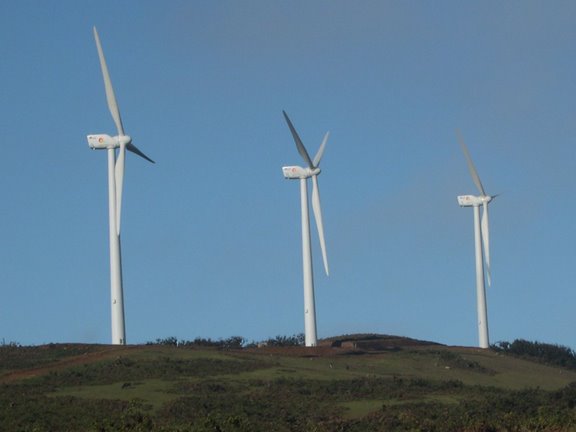
TORONTO, Feb 29 (Tierramérica) – Ecuador has taken the first step towards ending the oil dependence of its Galápagos Islands, in the eastern Pacific Ocean, with the official opening of a 10.8 million dollar wind energy facility on the island of San Cristóbal.

Ecuador’s President Rafael Correa toured the facility as part of a celebration of the 500th anniversary of the discovery of the Galápagos, and proposed to declare the islands fossil fuel free by 2015.

Located 1,000 kilometres off the coast of Ecuador, the archipelago comprises 17 small and 13 large islands that are home to 30,000 people and visited by more than 120,000 tourists each year.

Nearly everything is imported from the mainland, including vast quantities of diesel fuel for energy and transport. In 2001, a tanker ship struck a reef off the coast of San Cristóbal, one of the main islands, spilling 150,000 gallons of fuel into the ocean. Continue reading

Free, authoritative and online: 1.8 million species

carolina-anole-lizard-sml-john-sullivan-aol.jpgBy Stephen Leahy

Feb 27 (IPS) – Free, authoritative and online: 1.8 million species.

That is the ultimate goal of the Encyclopedia of Life project, which put its first 30,000 species on the Internet this week. This ambitious global project will provide the details of every known species — habitat, range, lifecycle, pictures and more — and archive everything online so anyone can access this important information about life on Earth.

From sharks to mushrooms to bacteria, the Encyclopedia of Life will provide scientifically verified information that will satisfy both a grade school child’s american-burying-beetle-doug-backlund-aol.jpegcuriosity or enable a university researcher — or amateur naturalist — to make a scientific breakthrough, says James Edward, new executive director of the Encyclopedia of Life (EOL) project headquartered in Washington at the Smithsonian Institution. Continue reading

CARBON FORESTS: Can the Free Market Slow Deforestation?

Sumatra burning forest courtesy of Kim Worm Sorensen sml

By Stephen Leahy

IPS 28/10/2006

Tropical forests’ ability to store carbon dioxide and mitigate climate change makes them more valuable than alternative uses like pasture or lumber, and rich countries ought to pay tropical countries to preserve their forests, the World Bank says.

However, some environmentalists caution that while reducing deforestation is vital, a so-called carbon trading system is the wrong approach and too complicated to implement.

The world’s tropical forests have been shrinking at a rate of five percent per decade since the 1950s. In the past five years, more than 50 million hectares of tropical forest have been lost — an area nearly the size of France. Aside from the loss of biodiversity, destruction of ecosystems and other negative impacts, deforestation is a major source of human-made emissions of climate-altering greenhouse gases (GHGs).

In fact, deforestation contributes almost twice as much GHGs as does all road transport around the world.

“The trees are worth more alive, storing carbon, than they would be worth if burned and transformed to unproductive fields,” said Kenneth Chomitz, lead author of the World Bank report released Monday. Continue reading