Billions Needed to Climate-Proof Africa

By Stephen Leahy

BROOKLIN, Canada, Nov 6 (IPS) – Climate change will devastate Africa without substantial help from the world community, according to a new report released at the opening of a major U.N. climate change conference in Nairobi, Kenya Monday.

“Africa is the least responsible for climate change but will be hit the hardest,” said Nick Nuttall, spokesperson for the United Nations Environment Programme (UNEP).

New scientific data shows that Africa is more vulnerable to the impacts than previously thought, Nuttall told IPS from Nairobi.

Seventy million people and 30 percent of Africa’s coastal infrastructure face the risk of coastal flooding by 2080 linked to rising sea levels, the report found. More than one-third of the habitats that support African wildlife could be lost. Crop yields will fall due to warmer temperatures and more intense droughts.

By 2025, some 480 million people in Africa could be living in water-scarce or water-stressed areas.

“If Africa’s weather gets any more fickle, then they are in very deep trouble,” said Steve Sawyer of Greenpeace International. Sawyer is one of 6,000 people in Nairobi attending the United Nations Climate Change Conference.

Full story here

ENERGY REVOLUTION NEEDED NOW

Answer to Energy Crisis? Waste Not, Want Not

By Stephen Leahy*

BROOKLIN, Canada, Oct 23 (IPS/IFEJ) – Soaring worldwide demand for energy is driving climate-altering greenhouse gas emissions dangerously higher, and even as investments grow in new “clean” energy sources, existing technologies to reduce energy use are being neglected.

Energy remains crucial to economic development in a world where over 1.6 billion people have no access to electricity. While the media and government focus has been on greener and cleaner ways to generate power through renewable sources like biofuels, wind, solar and hydrogen, experts say that major improvements in energy efficiency could dramatically reduce emissions of greenhouse gases, save money and provide the breathing space needed to improve and develop new energy sources.

Scientists estimate that to avoid dangerous climate change (generally viewed as a two-degree rise in global temperatures), world greenhouse gas emissions need to be reduced by about 60 percent from today’s levels by 2050.

At the same time, world energy demand is projected to increase by over 50 percent between now and 2030, and that will raise energy-related carbon dioxide emissions 52 percent higher than they are today, reported the International Energy Agency (IEA) in its 2005 World Energy Outlook, considered the definitive report on global energy.

That energy path is unsustainable, warns the IEA, which is calling for major changes.

“The need to dramatically reduce greenhouse gas emissions means a drastic overhaul of how we produce energy,” said Christopher Flavin, president of the Worldwatch Institute, a U.S. environmental group.

“We are facing the biggest economic transformation since the Industrial Revolution,” Flavin told IPS.

FULL STORY

CARBON FORESTS: Can the Free Market Slow Deforestation?

Sumatra burning forest courtesy of Kim Worm Sorensen sml

By Stephen Leahy

IPS 28/10/2006

Tropical forests’ ability to store carbon dioxide and mitigate climate change makes them more valuable than alternative uses like pasture or lumber, and rich countries ought to pay tropical countries to preserve their forests, the World Bank says.

However, some environmentalists caution that while reducing deforestation is vital, a so-called carbon trading system is the wrong approach and too complicated to implement.

The world’s tropical forests have been shrinking at a rate of five percent per decade since the 1950s. In the past five years, more than 50 million hectares of tropical forest have been lost — an area nearly the size of France. Aside from the loss of biodiversity, destruction of ecosystems and other negative impacts, deforestation is a major source of human-made emissions of climate-altering greenhouse gases (GHGs).

In fact, deforestation contributes almost twice as much GHGs as does all road transport around the world.

“The trees are worth more alive, storing carbon, than they would be worth if burned and transformed to unproductive fields,” said Kenneth Chomitz, lead author of the World Bank report released Monday. Continue reading

CANADA BAD: New Environment Policy Ignores Science

Critics Say New Environment Policy Ignores Science

By Stephen Leahy

Canada has officially turned its back on the Kyoto Protocol and climate change in its new “green plan” introduced Thursday, environmentalists say.

The new Conservative government’s environmental legislation called the Clean Air Act does not offer specific reduction targets other than a goal of cutting emissions of greenhouse gases 45-65 percent below 2003 levels by 2050.

“It’s a green scam, a delaying tactic that involves three more years of consultations,” said Claire Stockwell of the Canadian Youth Climate Coalition.

“We have already had six years of consultations and under existing legislation we could regulate emissions of greenhouse gases tomorrow,” Stockwell told IPS.

About 40 youth groups formed the non-partisan coalition this past September because of the realisation that the Conservative government will not comply with Canada’s commitments under the Kyoto Protocol, she said.

The coalition organised mock “funerals for the future” in 14 Canadian cities last week to protest the lack of urgent action on “the most pressing issue of our time”.

IPS News – published October 20 2006

How To Exit Gridlock? Don’t Build Roads, Lessons from Brazil

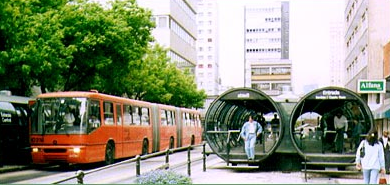
Stuck in a traffic jam? Choking on car fumes? Then take the next exit and head south past the equator to the city of Curitiba, Brazil, where you can board a bus to a public transit utopia.

By Stephen Leahy

[This 2002 magazine article offers a positive example of urban transport while cities continue to grow exponentially often without creating sustainable ways for people to move around.]

By the year 2025, two-thirds of the planet’s population will live in cities, according to the United Nations. And almost all of this growth – a staggering 90 percent – will take place in countries of the developing world.

Third World cities usually conjure up images of traffic and pollution, poverty and shantytowns. But the remarkable city of Curitiba in southern Brazil is trying to paint a different picture. This mid-sized city of just over one-and-a-half million has become a Mecca for urban planners, transit officials and environmentalists the world over.

Cities as far flung as Cape Town, Santiago, Lagos, New York, Toronto, Montreal, Amsterdam and Bogota have come to learn how Curitiba fought the car congestion and pollution nightmares that haunt many, if not most, of the world’s cities.

What’s even more remarkable is that by most standards, Curitiba is a poor city. Its annual per capita annual income is under $3,000 (all figures in U.S. dollars). Yet polls show that residents of Curitiba love their city and wouldn’t want to live anywhere else. Visitors call it one of the most liveable cities anywhere.

The story of Curitiba’s transformation into a self-styled ‘Capital of Ecology’ begins in the late 1960s when the city of then 360,000 faced a population growth boom, like other cities in Latin America.

Curitiba was industrializing rapidly, levelling the old to make way for the modern. And like most cities, it was suffocating on its own traffic.

The solution, of course, was to build more roads.

So in a scene repeated hundreds of times the world over, the narrow, main street, and many of its magnificent turn-of-the-century buildings, were to be obliterated by a modern expressway. But in 1971, a young architect and newly-minted mayor by the name of Jaime Lerner thought the unthinkable.

He wanted to stop the construction and instead create Brazil’s first pedestrian mall. However, not even the shopkeepers on the old street were in favour; how would people shop if they couldn’t drive their cars?

Lerner, who had trained in Paris, believed that once people experienced a pedestrian mall they’d love it. Over one weekend Lerner pushed the public works department to rip up the pavement and put in cobblestones and flowerbeds.

By Monday afternoon the shopkeepers wanted the mall extended.

–full story

New Data Erases Doubt on Storms and Warming

Stephen Leahy

BROOKLIN, Canada, Sep 11 (IPS) – There is little doubt now that climate change is making hurricanes and cyclones much more powerful and more frequent, top scientists announced Monday.

Sea surface temperatures are rising due to global warming and more than a dozen studies since Hurricane Katrina hit the United States last August show this has resulted in the dramatic increase in the strength of hurricanes in recent years.

“There is no doubt at all that hurricane intensity has increased,” said Kerry Emanuel, a climatologist at the Massachusetts Institute of Technology.

“I was startled to see the power of hurricanes and cyclones increase by 50 to 100 percent since the 1970s,” said Emanuel, one of 19 climate scientists who published a major study Monday in the Proceedings of the National Academy of Sciences (PNAS).

–full story

Another Piece of Alaska Goes on Sale

Stephen Leahy

BROOKLIN, Canada, Sep 8 (IPS) – While the George W. Bush administration has so far failed in its bid to open up the Arctic National Wildlife Refuge to oil and gas drilling, eight million acres of pristine Alaskan wilderness goes on sale to oil and gas companies Sep. 27.

Located west of the Prudhoe Bay’s oil fields, the eight million acres include Teshekpuk Lake and the surrounding wetlands, considered important habitat for caribou and water birds.

“This is the most important bird area in the entire circumpolar Arctic,” said Stan Senner, executive director of Audubon Alaska, an environmental group.

“We’re not opposed to oil and gas development, but it needs to stay out of critical areas like this,” Senner told IPS from Juneau, Alaska.

“The lands near Teshekpuk Lake are one of the most important ecological areas on the entire North Slope,” agreed Nicole Whittington-Evans, assistant regional director in Alaska of the Wilderness Society.

— Inter Press news Service