Food Supply In Deep Trouble – Agriculture Most Vulnerable to Climate Change

veg food basketBy Stephen Leahy

UXBRIDGE, Canada, Oct 2 (IPS)

Rocketing food prices and hundreds of millions more starving people will be part of humanity’s grim future without concerted action on climate change and new investments in agriculture, experts reported this week.

The current devastating drought in East Africa, where millions of people are on the brink of starvation, is a window on our future, suggests a new study looking at the impacts of climate change.

“Twenty-five million more children will be malnourished in 2050 due to effects of climate change,” such as decreased crop yields, crop failures and higher food prices, concluded the International Food Policy Research Institute (IFPRI) study.

“Of all human economic activities, agriculture is by far the most vulnerable to climate change,” warned the report’s author, Gerald Nelson, an agricultural economist with IFPRI, a Washington-based group focused on global hunger and poverty issues.

The report, “Quantifying the Costs of Agricultural Adaptation to Climate Change“, may be the “most comprehensive assessment of the impact of climate change on agriculture to date”, as IFPRI claims, but researchers concede that there is no current way to quantify all of the future repercussions of changing weather patterns on the food supply.

A critical component of agriculture is knowing the best time to plant seeds, for example. Farmers rely on their past experience and weather records. But one of the most robust science findings is that climate change has and will produce significant increases in weather variability.

This means extremes like droughts or floods will happen more often or last longer, and extreme temperature shifts are more likely. The past is no longer a reliable guide for farmers because the fundamental conditions in the atmosphere have been altered – far more heat is being trapped in the atmosphere today because of carbon dioxide and other greenhouse gases than at any time since the dawn of agriculture.

Nelson told IPS that the IFPRI report is a “conservative estimate” of the potential impacts and does not include impacts of pests and disease, loss of farmland due to rising sea levels or loss of water from melting glaciers. Continue reading
Snow Cover Turning to Lakes in the Himalayas

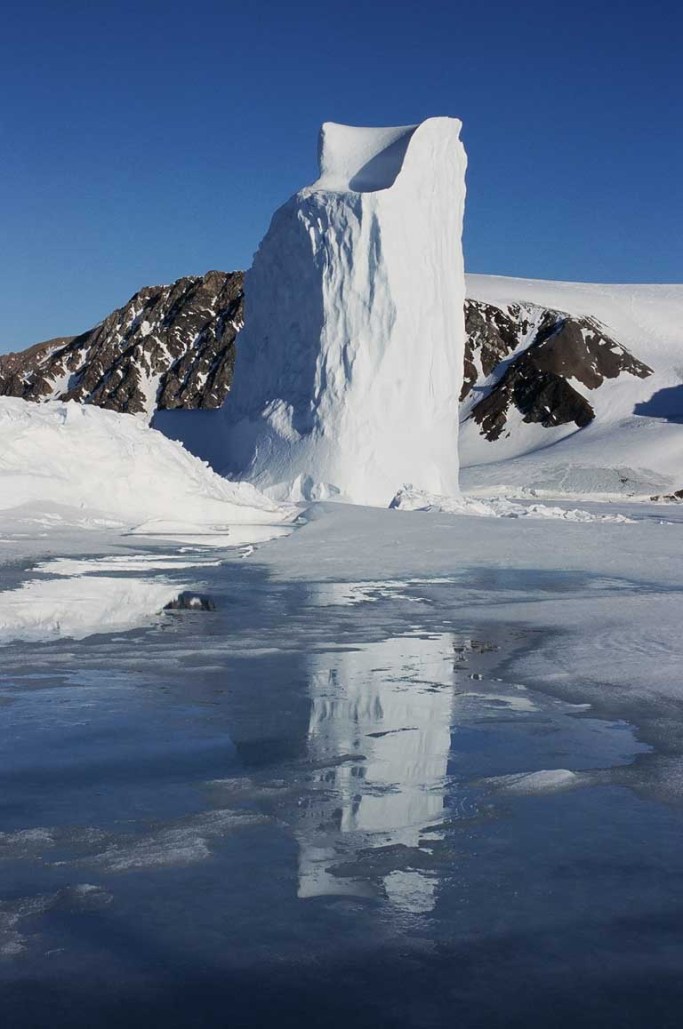
Iceberg in Glacier Strait, Nunavut, Canada, Image credit- Sandy Briggs.By Stephen Leahy

UXBRIDGE, Canada, May 7 (IPS) – As climate change takes hold, even the mighty Himalayas and Hindu Kush mountain ranges are now losing their snow and ice.

These are the world’s greatest repositories of snow and ice outside of the polar regions, and yet they may melt away in just 20 to 30 years, leaving more than a billion people desperately short of water, experts concluded in San Diego this week.

“There’s been a super-rapid decline in the glaciers of the region,” said Charles Kennel, senior strategist at the University of California San Diego Sustainability Solutions Institute and former director of Scripps Institution of Oceanography.

Kennel told IPS that nearly all of the 20,000 glaciers in the Himalaya-Hindu Kush mountain ranges are in retreat and the meltwater from some has created enormous lakes held back by rockslides that will inevitably burst, endangering anyone living in the valleys below. The World Wildlife Fund calculates there are 2,000 glacial lakes forming in Nepal and around 20 are in danger of bursting. Several have already flooded valleys in the past two decades in Nepal and Tibet.

“We are trying to make it known that the Himalayas are to the issue of the world’s water supply problem what the Amazon rain forest is to the issue of deforestation,” he said in reference to the “Ice, Snow, and Water” workshop convened at UC San Diego this week that included scientists from India, Nepal, Singapore and China. Continue reading

North American Trees Dying Twice as Fast

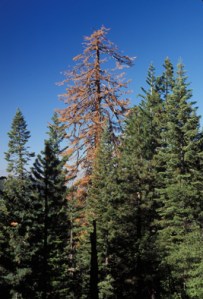
sugar-pine-dying-from-bark-beetle-attack-in-yosemite-national-parkimage-courtesy-of-jerry-franklinBy Stephen Leahy

UXBRIDGE, Canada, Jan 22 (IPS)

Our trees are dying. Throughout the western United States, cherished and protected forests are dying twice as fast as they did 20 years ago because of climate change, researchers reported Thursday in the journal Science.

Fire did not kill these trees, nor did some massive insect outbreak. The trees in this wide-ranging study were “undisturbed stands of old growth forests”, said Jerry Franklin, a professor of forest resources at the University of Washington and one of 11 co-authors of the report.

“The data in this study is from our most stable, resilient stands of trees,” Franklin told IPS.

What this means is that the United States’ best forests are getting thinner.

It is like a town where the birth rate is stable but the mortality rate for all ages doubled over the past two decades. “If that was happening in your hometown you’d become very concerned,” said Nate Stephenson, an ecologist with the U.S. Geological Survey (USGS).

This dramatic increase of in tree mortality applies to all kinds, sizes, ages and locations of trees. In the Pacific Northwest and southern British Columbia, the rate of tree death in older coniferous forests doubled in 17 years. In California, doubling mortality rates took a little longer at 25 years. For interior states it took 29 years. Continue reading

Record Glacier Melt Down Leads to Drought

By Stephen Leahywinter-melt-gatineau.jpg

Mar 17 (IPS) – Glaciers, the world’s freshwater towers, continue their record-breaking meltdown, a new U.N. report shows.

The average rate of thinning and melting more than doubled between 2004 and 2006, reports the World Glacier Monitoring Service (WGMS), a centre based at the University of Zurich in Switzerland.

“The latest figures are part of what appears to be an accelerating trend with no apparent end in sight,” said Wilfried Haeberli, director of the WGMS.

The accelerated glacier meltdown is a clear indicator that climate change has taken hold and millions if not billions will be affected, warned Achim Steiner, executive director of the U.N. Environment Programme (UNEP).

Glaciers feed the rivers that people are completely dependent on — 360 million on the Ganges in India and 388 million on the Yangtze in China alone. Reduced water or irregular water flows will make it more difficult to grow crops in these regions and other parts of the world. Rapidly melting glaciers also produce floods and raise sea levels. On average, there is one metre water of fresh water in every 1.1 metres of glacier ice. Continue reading