Venezuelan Smuggling Opens Door to Blood Diamond Trade

blooddiamond-movie-poster-sml.jpg“Crooks are taking Venezuelan diamonds out of the country and selling them to other crooks.

In November, the Venezuelan government will report to an intergovernmental entity about the controls used to regulate diamond mining.

By Stephen Leahy

Oct 22 (Tierramérica).- Venezuela will have to explain its policies on mining and exporting diamonds at the next annual session of the Kimberley Process, an intergovernmental initiative to halt the use of the diamond industry to finance conflicts and civil wars.

The Venezuelan government has recognized that it is not easy to monitor its vast border, but assures that it intends to comply with the Kimberley Process, of which it is one of the three South American members, along with Brazil and Guyana.

Venezuela is not involved in the smuggling of the so-called conflict diamonds, or “blood diamonds”, uncut stones that in the past two decades were mined and trafficked to finance civil wars and illegal armed groups in countries like Angola, Cote d’Ivoire, Democratic Republic of Congo and Sierra Leone. Continue reading

Organic Provides 3X More Food Per Acre in Poor Countries – podcast

Organic farming can yield up to three times as much food on individual farms in developing countries, as low-intensive methods on the same land—according to new findings by researchers from the University of Michigan.

This refutes the long-standing claim that organic farming methods cannot produce enough food to feed the global population.

Listen to U of Michigan Podcast and Podcast En Español

Related articles/posts:
Food Additives Make Kids Hyperactive – Organic Better?
Overweight? Hungry? Blame “Hollow Food”
Organic Agriculture Reduces Climate Change, Poverty and Hunger
The Real Cost of US Strawberries

Lifespans: Americans 80 years and rising; Africans 40 and falling

esc-cover.pngMedical Research Hits Cultural Roadblocks
By Stephen Leahy

The lifespan of a U.S. citizen is 80 and rising while an African’s is 40 and falling.
“That is the mother of all ethical challenges for the world to grapple with,” said Peter Singer of McLaughlin-Rotman Centre for Global Health in Toronto.

Sep 11 (IPS) – Many new medical technologies to improve the lives of people in the global South fail to be adopted not because of the costs but because of ethical, social and cultural issues, a new study reveals.

These issues include community and public engagement, cultural acceptability and gender, according to the comprehensive study featuring interviews with leading health experts in developing countries and published Monday in the U.S. peer-reviewed online journal PLoS Medicine.

Improper consultation with affected communities resulted in public pressure to end to medical trials of tenofovir, an antiviral medication used to treat HIV, in Cambodia, Cameroon, and Nigeria. In that instance, the community was commercial sex workers who weren’t properly consulted and would not benefit from the trials. Continue reading

Wildlife Vanishing from African Game Parks

AFRICA: Game Parks Offering Protection in Name Only?
By Stephen Leahy

“If the international community increased funding by 10 times then there is hope. But I don’t think that’s realistic,” said Paul Scholte of the Institute of Environmental Science at Leiden University

kob-antelope.png

Sep 8 (IPS) – The sharp decline of Africa’s abundant wildlife is now happening inside the continent’s protected areas, a new analysis indicates. Africa’s world renowned parks are destined to become isolated pockets of wilderness with few large animals left, as is the case in Europe, conclude the authors of an article in the current edition of the ‘African Journal of Ecology’.

“It is not a pleasant conclusion,” said Paul Scholte, co-author of the article, and a researcher at the Institute of Environmental Science at Leiden University in the Netherlands.

“Where we have good data, there are dramatic declines in wildlife inside parks and protected areas,” he told IPS. “It was a shock. The declines are far worse than we expected.” Continue reading

US Generals Say Warming Poses Major Security Threat

US Military Panel Calls Warming a Major Threat
By Stephen Leahy


May 15 (IPS) – Senior retired military officers in the United States are urging immediate action on climate change to avoid a massive upsurge in regional and global instability that could threaten their country’s security.

Climate change is a “threat multiplier”, said 11 retired three- and four-star U.S. generals and admirals who make up a military advisory board put together by the non-profit CNA Corporation. They warned Monday that many Asian, African and Middle Eastern nations could fail, opening the door for terrorists and drawing the U.S. into a variety of new conflicts.
Continue reading

Abrupt Environmental Change Sparks Violent Conflicts

Thirstier World Likely to See More Violence
By Stephen Leahy

Mar 16 (IPS) – A strong link between droughts and violent civil conflicts in the developing world bodes ill for an increasingly thirsty world, say scientists, who warn that drought-related conflicts are expected to multiply with advancing climate change.

“Severe, prolonged droughts are the strongest indicator of high-intensity conflicts,” said Marc Levy of the Centre for International Earth Science Information Network at Columbia University’s Earth Institute in New York.

Continue reading

Strict Quarantines Possible for African Outbreak of Deadly New Infectious TB Strain (XDR-TB)

Deadly New Strain of TB May Require QuarantinesCopyright 2004 Renate Leahy

Stephen Leahy

Jan 22 (IPS) – Enforced quarantines may be needed in South Africa and elsewhere to bring a deadly, contagious and drug-resistant strain of tuberculosis under control, health experts say.

An outbreak of extensively drug-resistant tuberculosis (XDR-TB) in South Africa’s KwaZulu-Natal province gained the attention of the World Health Organisation last year. Hundreds have been infected and the fatality rate is extremely high.

“The problem is a lot bigger than we know,” said Jerome Amir Singh, an HIV/AIDS expert at the Nelson R. Mandela School of Medicine, University of KwaZulu-Natal in Durban.
Continue reading

World’s Poor Depend on Livestock But Little Aid for Vet Services

Saving Farmers’ Four-Legged Bank Accounts Fish and Meat for sale
Stephen Leahy

Jan 19 (IPS) – Most of the world’s poor depend on livestock to survive, but international poverty reduction efforts devote little attention to the health of these animals, experts say.

Animal diseases not only decimate herds and flocks in Africa and Asia, they prevent the sale of animals into the growing markets for meat, milk, eggs and other animal products at home and abroad, according to a policy paper published Friday in the journal Science.
Continue reading

Blood Diamonds and Prosecuting Child Soldiers for War Crimes

The first person they have to kill is someone in their own family — or be killed themselves,” says Susan McKay of the University of Wyoming who has interviewed boy and girl child soliders throughout central Africa.

blooddiamond-movie-poster-sml.jpgMost girls are forcibly abducted and given roles as cooks, porters, spies, “wives” and in combat, McKay said.

[FYI: I’m an independent journalist who supports his family and the public interest writing articles about important social/environmental issues. ]

In spite of this fact legal experts believe child soldiers should be held accountable for war crimes otherwise they may be more likely to be chosen by warlords to perform the worst atrocities.

See story Prosecuting Child Soldiers For Their Own Safety

Do you like this article? It is funded by contributions from readers like you. Please click here to make a donation.

See also my other articles:

Venezuelan Smuggling Opens Door to Blood Diamond Trade
Sierra Leone’s Blood Diamonds and the Kimberley Process,

For a good introduction to the issue  watch the excellent movie Blood Diamond.

**UPDATE JAN 2010**

Blood diamond problem has largely been solved but now there may be “Blood Coltan” in your phone, ipod, and other electronic devices…read the shocking story here World’s “Grotesque Indifference” to Congo “Rape Mines”

what you can do:

Electronic Gadgets Fuel Congo “Rape Mines”

Organic Agriculture Reduces Climate Change, Poverty and Hunger

An Organic Recipe for Development

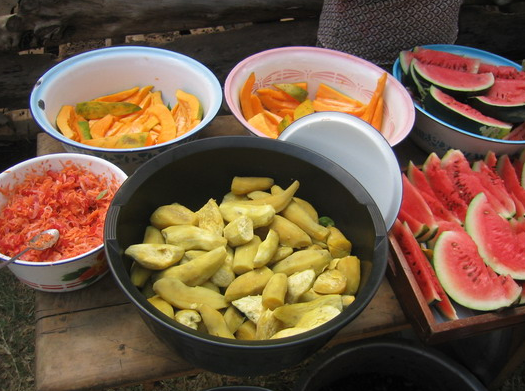
Organic food from Kenya

Stephen Leahy

Dec 18 (IPS/IFEJ) – Organic agriculture is a potent tool to reduce emissions of greenhouse gases, but also to alleviate poverty and improve food security in developing countries, many experts now believe.

Organic agriculture’s use of compost and crop diversity means it will also be able to better withstand the higher temperatures and more variable rainfall expected with global warming.

“Organic agriculture is about optimising yields under all conditions,” says Louise Luttikholt, strategic relations manager at the International Federation of Organic Agriculture (IFOAM) in Bonn, Germany. IFOAM is the international umbrella organisation of organic agriculture movements around the world.

For example, a village in the Tigray region of northern Ethiopia that had converted to organic agriculture continued to harvest crops even during a severe drought, while neighbouring villages using conventional chemical fertilisers had nothing, Luttikholt told IPS.

Because compost is used rather than chemical fertilisers, organic soils contain much more humus and organic carbon — which in turn retains much more water.

“They can also absorb more water faster which means they are less likely to flood,” she said.

It took more work to make the conversion to organic but it paid off when the drought stuck in the third year, according to Tewolde Berhan Gebre Egziabher, director general of the Environmental Protection Authority of Ethiopia.

Full story on how organic can reduce climate change, poverty and hunger.

Part of a series on sustainable development for IPS and IFEJ (International Federation of Environmental Journalists)

Related Stories:
Overweight? Hungry? Blame “Hollow Food”
Organic Provides 3X More Food Per Acre in Poor Countries – podcast
Food Additives Make Kids Hyperactive – Organic Better?
New Studies Back Benefits of Organic Diet

Contact: writersteve AT gmail . com (no spaces)