Content Control: Patents Threaten Traditional Knowledge of Indigenous People

Quechua in Cusco region

“To have potatoes, there must be land, people to work it, a culture to support the people, Mother Earth and the mountain gods…”

By Stephen Leahy*

VIENNA, Jul 6 (Tierramérica)

Indigenous peoples risk losing control over their traditional knowledge if the World Intellectual Property Organisation (WIPO) insists on strict standards for managing access to information.

Patents and other forms of restricting access to knowledge are very worrisome in a time of climate change, says a new report by the London-based International Institute for Environment and Development (IIED).

The study was presented at meetings of the WIPO – a United Nations agency – held Jun. 23-Jul. 3 in Geneva.

Intellectual property standards restrict use of genetic resources when we need flexibility and adaptability to cope with climate change,” said Michel Pimbert, director of IIED’s Sustainable Agriculture, Biodiversity and Livelihoods Programme.

WIPO aims to develop rules for protecting rights over traditional knowledge, such as indigenous knowledge about medicinal plants, which conventional intellectual property laws do not cover.

However, according to IIED’s Krystyna Swiderska, who coordinated the research in Africa, Asia and Latin America, “WIPO’s call for consistency with existing intellectual property standards is a flawed approach as these have been created on Western commercial lines to limit access to inventions such as drugs developed by private companies.”

Intellectual property is about restricting access, creating monopolies and eliminating competition, and it is being pushed by transnational pharmaceutical and seed companies, said Pimbert. Continue reading
Call for Climate-safe Living

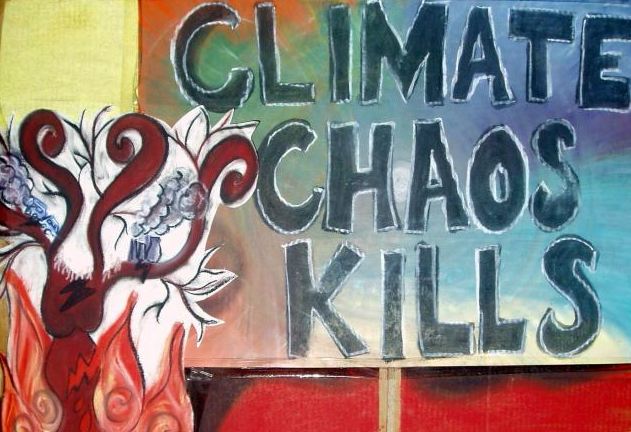
climate-chaos-kills-art-not-oil.jpg

“Our fingers are glued to the global climate thermostat. And in a feverish delirium where the present has been severed from the future, we dial it higher and higher.Foolishly and dangerously.”Coming soon on IPS, a new four-part article series that looks at the psychological and behavioural changes needed to dial down the temperature on our global greenhouse.Includes: Three Basic Principles for Climate-safe Living

Reduce. Eliminate. Demand. R.E.D.

Extinction Tourism — See It Now Before Its Gone

isfjorden-ved-jakobshavn-ilulissat-greenland-sml.jpg

By Stephen Leahy*

TORONTO, Jan 18 (Tierramérica) – Hurry! Hurry! See the polar bears, penguins, Arctic glaciers, small pacific islands before they disappear forever due to global warming.

Tourism companies are now using climate change as a marketing tool: Visit the pacific island paradise of Tuvalu before rising sea levels swallow it in the next 30 to 50 years. See the Arctic while there is still ice and polar bears.

“Some companies are using climate change as a marketing pitch, a ‘see it now before it’s gone’ kind of thing,” says Ayako Ezaki, communications director for the International Ecotourism Society, based in Washington DC.

This independent environmental journalism depends on public support. Click here learn more.

emperor penguins

Continue reading

Human Cloning Likely Legal and Popular

“Chances are clones will soon be sharing the planet with us.” — Brendan Tobin, Irish Centre for Human Rights, National University of Ireland

jamie-clone.jpg

Photo: “Jamie Clone” © 2007 citymorningblue. Used with kind permission.

By Stephen Leahy

Nov 13 (IPS) – As scientists master the technology to clone primates, some legal experts worry that human clones are no longer in the realm of science fiction, and wonder what legal rights they would have in the absence of an international ban on the practice.

More than a dozen animal species have been cloned in the last decade, including sheep, cows, dogs and pigs. Just last summer, a U.S. research team reported the first-ever cloning of a primate. A rhesus monkey embryo was cloned from adult cells and then grown to generate stem cells.

“Human clones are absolutely inevitable,” says Brendan Tobin, a barrister with the Irish Centre for Human Rights, National University of Ireland, who researched a United Nations University (UNU) report on the issue.

Continue reading

Make Climate Change Art, Not War

franke-suzuki-sml.jpg“Unlike the scientist, we artists have the freedom to weave facts, opinions, thoughts, emotion and color all together. We can instill passion and motivate change. That is our palette.” — Visual artist Franke James

Toronto artist Franke James is doing great work both in expressing her concern and understanding in her colourful and insightful visual essays about climate change but also as a teacher of others in workshops for young artists — Six Tools to Make Climate Change Art.

Artists are desperately needed to help us understand the impacts of climate change at an emotional level and to inspire action. Information and knowledge are not nearly enough. As Franke wisely notes:

“Think of this: If any one of us stands up and tells a group an idea we have, it may spread — or it may disappear into the ether. A far more effective way to make an idea spread is to give it ‘tangible form’.” Continue reading

How to Lay the Foundations for a New World

EARTH DAY: Happiness Is a Smaller Eco-Footprint

blue marble

… more children knew the characters of the video game Pokemon than could recognise an oak tree or an otter…”

By Stephen Leahy

Apr 21 (IPS) – Today’s children will live in a new world of climate change and greatly diminished natural resources, which may give way to a nightmarish reality, or it could give birth to a happier and lighter way of living on the Earth, say environmentalists.

The scientific evidence for environmental troubles — from rising sea levels to species extinction to desertification — sends a clear signal that we are running into the limits of spaceship Earth to support us as it has for millennia.

“This world is ending; we need to lay the foundations for a new world,” says Alice Klein, a magazine editor and documentary filmmaker in Toronto. “We have a great opportunity to make a better world,” she told IPS.

Klein’s film “Call of the Hummingbird“, to premiere on Earth Day — Apr. 22 — at Toronto’s Hot Docs film festival, tracks the 13 days when some 1,000 teachers, eco-activists, farmers, Mayans, Rastafarians, holistic health-workers, non-governmental organisation executives, student leaders from all over Latin America and a few from Europe and North America camped out together in central Brazil in 2005.

Continue reading

Pacific Islanders Preyed on by Bio-Pirates

By Stephen LeahyCopyright 2004 Renate Leahy

Mar 20 (IPS) – The Pacific region has long been a favourite target of gene hunters, unethical bio-researchers and “patent bottom trawlers” looking to profit from its unique flora, fauna — and human beings.

Pacific Islanders have had their genes patented against their will. T-cells from the Hagahai tribe in Papua New Guinea can be purchased today on the internet for 216 dollars.
Continue reading

Shopping Our Way To Disaster – Connecting the Dots

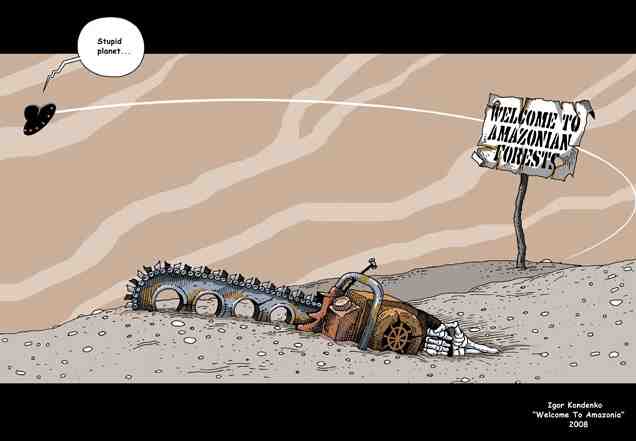
amazon-desert-chainsawBy Stephen Leahy

It’s well past time that people began to connect the dots between what they buy and the resulting environmental impacts such as global warming. In other words, consumption has consequences: big, nasty environmental consequences that inflict suffering mainly on the world’s poor experts say.

(IPS) (Originally published Jan 15 2007)

A Chinese-made $50 computer desk is likely the result of illegal clear-cutting in Indonesian rainforests. Buying such items fuels crime syndicates and emits huge amounts of global warming gases.

That North Americans, and to a lesser extent Europeans, are profligate consumers is well known. If everyone consumed like North Americans we’d need five planets to support us — only three planets are necessary if we all lived like Europeans, according to the World Wildlife Fund’s Living Planet Report.

The world collectively overshot the Earth’s capacity to support us in 1984, the report notes. In the 22 years since reaching that crucial tipping point, rates of consumption of resources have accelerated. Not just in North America and Europe but China and India, not to mention other parts of Asia and Latin America.

While this ever-accelerating consumption of resources the sign of a healthy global economy according to economists, it has also resulted in climate change, amongst many other environmental and social ills.

People don’t appreciate that their purchases have real environmental impacts,” said Monique Tilford, acting executive director of the Centre for a New American Dream (CNAD), a Maryland group promoting environmentally and socially responsible consumption. Continue reading

How Museums and Art Galleries Can Create a Sustainable Culture

Greening Stewardship: How Museums Can Help Create a Sustainable Culturegreening-stewardship-e-bk-cover.png

The challenge of creating a sustainable culture is a major opportunity for museums, art galleries and other cultural institutions. This six-page article examines how some of North America’s leading museums and galleries including Chicago’s Shedd Aquarium, Ottawa’s Canadian War Museum, New Jersey’s Liberty Science Center and many others are meeting this challenge.

“All cultural institutions ought to be leaders and intelligent commentators on social and environmental issues.” — Former CEO of the Glenbow Museum.

— includes examples from large and small institutions about programming, community outreach, green buildings and LEED standards .

— Written by Stephen Leahy and originally published in 2003 by muse magazine. Reprints are available as an E-Book: Greening Stewardship: How Museums Can Help Create a Sustainable Culture

Questions, story ideas, potential assignments, speaking engagements contact: writersteve AT gmail . com (no spaces)