Paris Climate Talks – Science Behind Need for 1.5C

dai drought 2060-2069 wOceanLabels.jpg

No climate scientist thinks two degrees C will be “safe”. Many countries, especially least-developed countries and small island states, have been calling for global target to be less than 1.5C of heating in 2009 at COP 15 in Copenhagen. Before that some countries launched  ‘1.5 to stay alive’ campaign at the UN in September 2009.

Humans have enjoyed 10,000 years of climate stability, in which the global average temperature varied less than one degree C – even during the Little Ice Age.

This heating will be wildly uneven with the Arctic warming 2-3 times faster. In 1.5C world much of the far north will be 4.0C. Canada is already 1.6 to 1.8 C warmer today.

Large parts of Africa including the African Sahel, including the Horn of Africa, are very vulnerable to any increase in temperatures. Even with 1.5C large portions of the Arctic and Antarctic will continue to melt raising sea levels, albeit at a slower rate threatening the very existence of some small islands states.

Delay in making the shift to non-fossil fuel energy sources will be very costly. Waiting until 2020 to curb global emissions will cost twice as much compared with peaking emissions by 2015 various analysis have shown.

At least 65% of Existing Coal Plants Must be Shuttered by 2030
Serious action to reduce greenhouse gas emissions means 65 percent of current coal power plants will have to be shut down in the next decade or two, a 2012 study concludes.

There are enormous benefits if global emissions decline before 2020. Failure to do so will mean we will need to use more nuclear, massive amounts of bioenergy, large-scale carbon capture and storage

  • Joeri Rogelj, a climate scientist at Switzerland’s Institute for Atmospheric and Climate Science

Paris Climate Talks: Illegal March Sat – Start of “Red Line” Global Protests

Screen Shot 2015-12-09 at 11.09.25 AM.jpg
Illegal March Planned for Sat Dec 12 in Paris Credit: 350.org

Breaking:  Climate March Planned for Paris this Saturday, at noon <

According to 350.org “thousands of people will gather in the streets of Paris carrying red flowers to honour past and future victims of climate change”.

Marches are illegal in Paris under current security measures. Where people will gather and march is being kept a secret.Details will be posted here

Oganizers say they plan to unfurl over 100 meters of red fabric to form a giant red line down a major boulevard. The flowers will include more than 5,000 red tulips that will be laid down along the line.

This  “Red Lines” action is the launch of a new wave of what some activists call “climate disobedience,” civil disobedience actions that challenge the fossil fuel industry, often at major infrastructure projects like coal mines or pipelines.

On Thursday, campaigners at COP21 will announce a major mobilization planned for May 2016 called “Break Free,” when people around the world will take on some of the worst fossil fuel projects in their region.

Protests Escalate in Paris: Beginning of “Red Lines” Protests

10 Arrested at Louvre Wednesday

Sit down protest inside COP 21 ongoing

Police remove protestors at “Solutions 21” event in Paris

Screen Shot 2015-12-09 at 11.32.18 AM.jpg

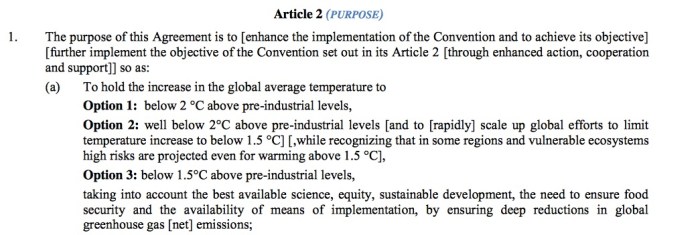
Paris Climate Talks – Breaking: Options for Global Target 1.5C

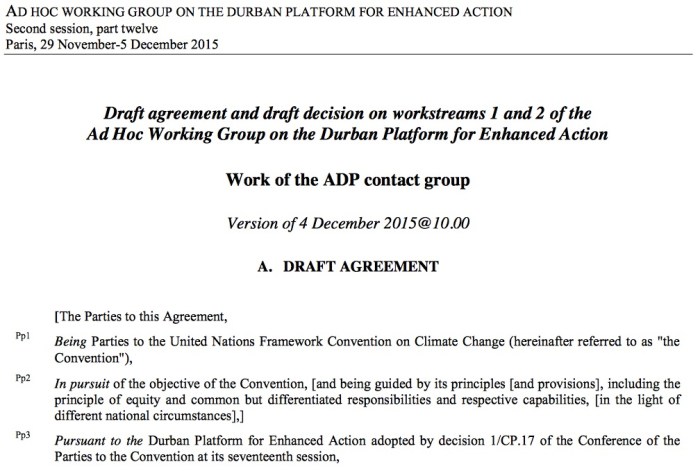
Final President’s Draft  Just Released

At 3pm CET Dec 9 the President’s draft was released. It’s much shorter at 29 pages. A quick glance reveals perhaps two dozen brackets down from 800 a few days ago.

Parties will review this new next and reconvene the plenary at 8 pm CET to figure out how to resolve the remaining contested issues.


 On the Contentious Issue of 1.5 vs 2.0C

— 3 options still to debate — see below

Screen Shot 2015-12-09 at 9.47.40 AM.jpg

Paris Climate Talks – Final Draft Deadline Wednesday 1 pm CET

cop21 logo smlParis Accord Final Draft Due Wednesday
COP21 President Fabius sets deadline for a clean text by 1 pm Wed in Comité de Paris plenary this evening.Clean text means removing most (90%?) of the 600 to 800 brackets currently in the draft. (Read it here)

Fabius still believes that the Accord can be finalized and voted on by Friday  6 pm.

Loss and Damage Impasse?
Late Tuesday in the second Comité de Paris plenary a facilitator reported the loss and damage mechanism – called the “Warsaw Mechanism” — could not be resolved.Loss and Damage is the third pillar of the Paris Accord and pertains to current and ongoing climate impacts. Those impacts result in both economic and non-economic losses, including the growing issue of climate refugees, people who are forced to move because their homelands can no longer support them.

The US and other countries are very concerned this may open the door to liability claims.

This is just one of handful of issues. No one will get much sleep in Paris tonight.

Paris Climate Talks – Fossil Fuel Subsidies Called “Absurd”


Screen Shot 2015-12-08 at 9.26.47 AM

“A price on carbon and fossil fuel subsidies are two opposing forces.”  — Fatih Birol, Executive Director, International Energy Agency  Credit: IISD

At the “Fossil Fuel Subsidies and Climate Change” side event last evening a range of energy experts said continuing to pour  hundreds of billions of dollars of public money into subsidizing fossil fuels was “absurd”, “incoherent”, “unacceptable” and more.

Only 3% of Fossil Fuel Subsidies reaches the poorest 20% of households, said Felipe Calderón, Chair, Global Commission on Economy and Climate.  As often claimed these subsidies do not help poor families nor improve energy access he said.

A few more comments and some startling facts:

The carbon price in Europe is approximately US$10, yet incentives for fossil fuel use, equate to a global average of US$110 per tonne of carbon…an “absurd situation” …

— Fatih Birol, Executive Director, International Energy Association (IEA)

Each hour, US$8 million is spent on Fossil Fuel Subsidies

–Scott Vaughan, President, IISD

 Fossil Fuel Subsidies amount to five times the global annual climate finance commitment of US$100 billion.

— Børge Brende, Minister of Foreign Affairs, Norway

…partial phase out of Fossil Fuel Subsidies would generate 12 percent of the global abatement needed by 2020 to achieve a 2ºC pathway.

— Doris Leuthard, Head, Federal Department of Environment, Transport, Energy and Communications, Switzerland

First published on the Climate News Mosaic Paris Climate Talks Live Blog available here:

Paris Climate Talks – Peak CO2 Already?

Screen Shot 2015-12-07 at 3.32.09 PM
Have We Reached the Crucial Peak in Global CO2 Emissions?
New report released today says CO2 emissions will likely decline this year for the first time after growing 2-3% per year for last 15 years.

“Whether a slower growth in global emissions will be sustained depends on the use of coal in China and elsewhere, and where new energy will come from. In 2014, more than half of new energy needs in China were met from renewable sources such as hydro, nuclear, wind, and solar power.” — Corinne Le Quéré, Director of the Tyndall Centre

  • cop21 logo sml

Paris Climate Talks – Final Draft Agreement Released

Screen Shot 2015-12-04 at 8.46.23 AM

UPDATE!!  New Dec 5 Text Sent to Ministers

This means technical negotiations officially closed.

French presidency now assumes the leadership of the 21st Conference of Parties which will get underway today.

First published on the Climate News Mosaic Paris Climate Talks Live Blog available here:

Paris Climate Talks – Halfway Done but Long, Uphill Road Ahead

earthatnight sml
Halfway through the ‘historic’ Paris climate talks and things are going far too slow leaving major issues for last day, late night bargaining by country leaders. This is despite six years of previous negotiations since Copenhagen in 2009. 

There are now two alternative draft texts — each less than 50 pages long but still containing 200 to 300 brackets (disputed text) each.
Some of this weeks ‘hot’ issues:
cop21 logo sml
Science says 1.5C; Oil Rich Countries say 2.0C 
Countries continue to block agreement based on their short term self interest – looking at you oil-producing Arab countries blocked 1.5C as a new global target. Recent scientific studies show 1.5C provides better protection for all nations – 2.0C condemns some to drown, many to starve.


No Human Rights?
Norway and some Arab states don’t want any reference to human rights in the new climate deal. This has been in the text for nearly a year.
Where’s the Money?
Finance or funding to help developing nations survive climate impacts remains at an impasse as it has for a long time. Countries were promised this funding in 2009 and it was to ramp up to $100 billion a year by 2020. That has not happened. 

“I’m out of words, it’s just not right,” said Juan Hoffmeister, a Bolivian negotiator.


Transparency and Verification of Commitments
Although technical, another outstanding issue is “transparency”. What’s the proof countries are actually cutting emissions as promised? Rules and expert review formulas for verification are hotly contested. China and India wanting lax rules and no independent review while US insisting on strict ones.
Will We Get a Paris Climate Accord?
In the end there will be an agreement of sorts – the “Paris Climate Accord”?  What-ever the final title, it will not set the world on a path to 2.0C. Far deeper CO2 emissions cuts and more investment will be needed. 

First published on the Paris Climate Talks Live Blog available here:

Paris Climate Talks: Cities are 70% of C02 Emissions – Fighting to be Climate Leaders

By Stephen Leahy

National Governments Should Be Helping Green Cities

Cities are responsible for 70 per cent of global CO2 emissions but they can save the planet by greening one community at a time said Vancouver’s David Cadman at the close of the ICLEI World Congress 2015, the triennial sustainability summit of local governments in Seoul, South Korea.

cop21 logo sml“We can do it. We must do it,” Cadman, the retiring president of Local Governments for Sustainability, told some 1,500 delegates from nearly 1,000 cities and local governments in 96 countries on April 11.

The majority of climate actions and most plans to reduce CO2 emissions are happening at the city level, Cadman told DeSmog Canada in Seoul.

Vancouver and 50 other cities have committed to 100 per cent renewable energy and 500 more are part of ICLEI’s Cities Climate Registry that documents verifiable CO2 emission reduction actions and commitments that amounted to 2.8 billion tons a year in 2014.

Cadman, a former City of Vancouver councillor, has been president of ICLEI since 2006. It’s an international organization headquartered in Bonn, Germany, with 280 staff and 23 other offices scattered around the globe. ICLEI, which stands for International Council for Local Environmental Initiatives, started 25 years ago in Toronto to help cities become more sustainable. It now goes by the more manageable name of “Local Governments for Sustainability,” but still uses the original acronym.

Canada’s federal and provincial governments were very strong supporters in the early days but the past decade has been very different.

Canada Chained to Fossil Fuel Sector

“We seem to be chained to the fossil energy industry in Canada and it’s pulling us down. Cities and organizations can hardly dare to speak out about this now,” he said.

Germany was only too happy to bring ICLEI to Bonn eight years ago and has been generous with its support, along with the European Union. Now the organization is experiencing what is being called an “Asian pivot,” with the mayor of Seoul, Park Won Soon, as the new president.

Park has helped Seoul to become one of the world’s leaders on sustainable development. With 11 million people and growing fast, Seoul will reduce its energy use and increase renewable generation including rolling out 40,000 solar panels to households by 2018 and 15,000 electric vehicles. By 2030, CO2 emissions will be cut 40 per cent.

“Action on climate will be by local governments no matter what national governments decide,” Park Won Soon told DeSmog Canada.

“We need to act quickly, we need to act energetically,” the mayor said.

China’s megacities are also joining ICLEI. At the congress, Hailong Li, deputy secretary general of the China Eco-city Council said the country will have 100 low-carbon eco-cities by 2017. That will drive down the costs of energy efficiency and renewable energy, Li said.

China also intends to become an expert on eco-construction and to market its expertise to the rest of the developing world.

By 2030 another 3.5 billion people will be living in cities so it is absolutely critical that the infrastructure be sustainable said Cadman who will continue to be active as special representative to the new ICLEI President.

Canadian cities could also do more and sooner if they had the support of provincial and federal governments, he said. That may be changing at the provincial level with growing support for various forms of carbon taxes that will help generate funds and financial incentives to reduce emissions.

“The provinces are doing the heavy-lifting on climate while the Harper government sits on the sidelines.”

Fossil fuels are in decline — divestment is taking off and investments are shifting to renewable energy. There’ll be no pipelines to the West Coast and no new investments in the oilsands, Cadman said.

Even in B.C., the hoped-for markets for LNG may not exist with China building gas pipelines to tap reserves in Iran and Russia, he said.

“Canada needs to move away from selling raw resources, but is any political party ready to go there?”

First published April 2015

Paris Climate Talks: Three Major Issues

The main issue in Copenhagen in 2009 was determining each country’s fair share of CO2 emission reductions cuts and by when. If a flag could be attached to every CO2 molecule humanity has put into the atmosphere over the last 150 years, about 70 percent would be the flags of wealthy countries: the U.S., United Kingdom, Germany and so on.

Those rich nations agreed to make some CO2 cuts by 2020 but they were mostly small and voluntary. In exchange poor countries were promised $100 billion a year by 2020.

How much has changed at COP 21?cop21 logo sml

#1 Most countries have filed their plans for emissions reductions but they aren’t big enough to keep temperatures below 2C, never mind 1.5C. There is agreement more cuts are needed but the big issue is when. Europe and small countries want to see another round of cuts every 5 years starting as soon as 2020. Other countries like India want longer time frames.

 #2 Money has always been issue. In Copenhagen rich countries promised $100 billion a year by 2020 to help poor countries cope with climate impacts and  to green their economies. The money was supposed to ramp up from about $10 billion a year in 2010. Instead it’s been a fight to get any funds. Now developing countries want  guaranteed amounts from 2015 to 2020.

#3 Legally binding agreement. For the first time the US is saying it will agree to this for parts of an eventual Paris Climate Agreement. The US will not sign a legal-binding emission reduction target, Todd Stern, the chief negotiator said today.

First posted on Climate News Mosaic Live Blog available at Inter Press Service  news