Russia Leads the Most Poisonous Places on Earth

dzerzhinsk-factories[I have added more of the story in this post but the full article remains for subscribers only, sorry.]

By Stephen Leahy

Russia tops the list of the 10 most polluted places on the planet, while more investigation into Latin American and African pollution sites is needed, according to a U.S. environmental group.

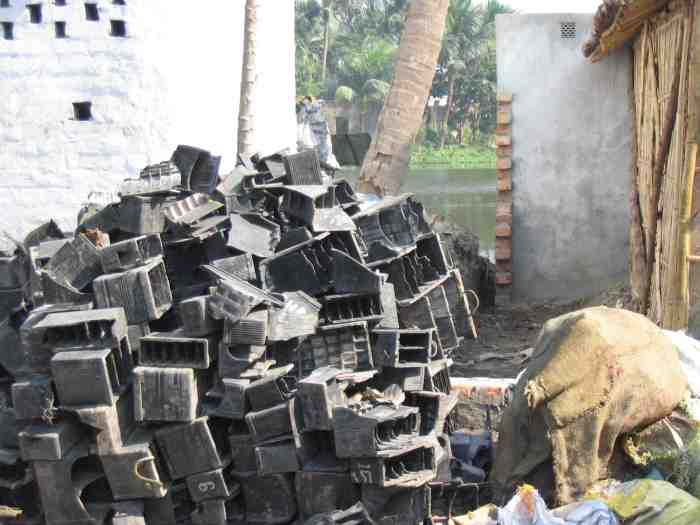
Lead and other heavy metals, along with buried chemical weapons and radiation hazards from sites like Chernobyl in Ukraine, are the main sources of pollution affecting the health of 10 million people in different locations around the world.

empty-car-battery-casings-india-photo-by-blacksmith-institute-sml

“These extremely toxic areas are mostly unknown even in their own countries,” said Richard Fuller, director of the New York-based Blacksmith Institute.

Continue reading

Canada Fights Ban on “Bulldozers of the Sea”

By Stephen Leahy

Oct 12 (IPS) – Canada is trying to scuttle a proposed United Nations moratorium on destructive bottom trawling of the open ocean that has received surprisingly strong support from the United States, as well as other countries.

“Canada’s attitude towards the oceans is embarrassing and archaic,” said Elliott Norse, president of the Marine Conservation Biology Institute, a scientific environmental group in Washington State.

“Canada treats the oceans as if nothing could harm them,” Norse told IPS.

The U.N. General Assembly started debate this week on an Australian-led plan for a temporary moratorium on deep-sea bottom trawling in unmanaged high seas and to impose tougher regulation of other destructive fishing practices.

Because of Canada’s good international reputation, other nations are listening and that greatly increases the risks the U.N. will not act on the proposed moratorium, Norse said.

Canada’s opposition, especially from a recently elected government, comes as a surprise.

“Canada doesn’t have any open ocean trawlers and has everything to gain from a ban,” Norse pointed out.

–FULL STORY

Related stories by Stephen Leahy

Trawling seamounts threatens ocean’s biodiversity
Hundreds of deep-sea species new to science are disappearing before they can be identified or studied, oceanographers are warning. The organisms are being pushed to extinction by trawlers targeting undersea volcanic mountains called seamounts. — New Scientist Magazine

A Plan to Torpedo the Trawlers
Environmentalist groups will soon be dragging deep-sea trawl nets the size of Boeing 747s across cities, rolling out ad campaigns featuring photos of unique creatures from the ocean’s depths, and sending out ships to dog the movements of ocean-going trawlers. — Wired News

How To Exit Gridlock? Don’t Build Roads, Lessons from Brazil

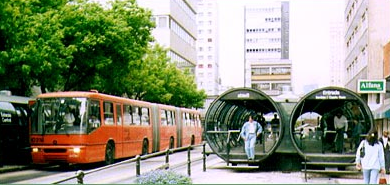
Stuck in a traffic jam? Choking on car fumes? Then take the next exit and head south past the equator to the city of Curitiba, Brazil, where you can board a bus to a public transit utopia.

By Stephen Leahy

[This 2002 magazine article offers a positive example of urban transport while cities continue to grow exponentially often without creating sustainable ways for people to move around.]

By the year 2025, two-thirds of the planet’s population will live in cities, according to the United Nations. And almost all of this growth – a staggering 90 percent – will take place in countries of the developing world.

Third World cities usually conjure up images of traffic and pollution, poverty and shantytowns. But the remarkable city of Curitiba in southern Brazil is trying to paint a different picture. This mid-sized city of just over one-and-a-half million has become a Mecca for urban planners, transit officials and environmentalists the world over.

Cities as far flung as Cape Town, Santiago, Lagos, New York, Toronto, Montreal, Amsterdam and Bogota have come to learn how Curitiba fought the car congestion and pollution nightmares that haunt many, if not most, of the world’s cities.

What’s even more remarkable is that by most standards, Curitiba is a poor city. Its annual per capita annual income is under $3,000 (all figures in U.S. dollars). Yet polls show that residents of Curitiba love their city and wouldn’t want to live anywhere else. Visitors call it one of the most liveable cities anywhere.

The story of Curitiba’s transformation into a self-styled ‘Capital of Ecology’ begins in the late 1960s when the city of then 360,000 faced a population growth boom, like other cities in Latin America.

Curitiba was industrializing rapidly, levelling the old to make way for the modern. And like most cities, it was suffocating on its own traffic.

The solution, of course, was to build more roads.

So in a scene repeated hundreds of times the world over, the narrow, main street, and many of its magnificent turn-of-the-century buildings, were to be obliterated by a modern expressway. But in 1971, a young architect and newly-minted mayor by the name of Jaime Lerner thought the unthinkable.

He wanted to stop the construction and instead create Brazil’s first pedestrian mall. However, not even the shopkeepers on the old street were in favour; how would people shop if they couldn’t drive their cars?

Lerner, who had trained in Paris, believed that once people experienced a pedestrian mall they’d love it. Over one weekend Lerner pushed the public works department to rip up the pavement and put in cobblestones and flowerbeds.

By Monday afternoon the shopkeepers wanted the mall extended.

–full story

New Data Erases Doubt on Storms and Warming

Stephen Leahy

BROOKLIN, Canada, Sep 11 (IPS) – There is little doubt now that climate change is making hurricanes and cyclones much more powerful and more frequent, top scientists announced Monday.

Sea surface temperatures are rising due to global warming and more than a dozen studies since Hurricane Katrina hit the United States last August show this has resulted in the dramatic increase in the strength of hurricanes in recent years.

“There is no doubt at all that hurricane intensity has increased,” said Kerry Emanuel, a climatologist at the Massachusetts Institute of Technology.

“I was startled to see the power of hurricanes and cyclones increase by 50 to 100 percent since the 1970s,” said Emanuel, one of 19 climate scientists who published a major study Monday in the Proceedings of the National Academy of Sciences (PNAS).

–full story

Binational Crusade to Save Wetlands

Stephen Leahy*

TORONTO, Sep 8 (Tierramérica) – With 20,000 hectares of bright green in a sea of sand in the state of Sonora, the Ciénaga de Santa Clara is one of Mexico’s richest coastal ecosystems. Faced with the imminent reopening of a desalinisation plant just across the border in the United States, a binational team is working to protect the vast wetland.

Ongoing drought conditions in the south-western United States has prompted the George W. Bush government to finance the restart of the long unused Yuma Desalting Plant (YDP) in the border state of Arizona in 2007.

“Full operation of the desalting plant would mean the ciénaga will get less water and the water would be much saltier,” said Karl Flessa, professor of geosciences at the University of Arizona in Tucson.

And “that would completely eliminate the wetland,” according to Jaqueline García-Hernández, a scientist at a food and development research centre (Centro de Investigación en Alimentación y Desarrollo) in the Mexican city of Guaymas, Sonora.

The Ciénaga de Santa Clara is home to some 225 species of birds, like the Yuma clapper rail (Rallus longirostris yumanensis) and southwest willow flycatcher (Empidonax traillii extimus), which are rare in the United States.

— Tierramerica and Inter Press News Service

Another Piece of Alaska Goes on Sale

Stephen Leahy

BROOKLIN, Canada, Sep 8 (IPS) – While the George W. Bush administration has so far failed in its bid to open up the Arctic National Wildlife Refuge to oil and gas drilling, eight million acres of pristine Alaskan wilderness goes on sale to oil and gas companies Sep. 27.

Located west of the Prudhoe Bay’s oil fields, the eight million acres include Teshekpuk Lake and the surrounding wetlands, considered important habitat for caribou and water birds.

“This is the most important bird area in the entire circumpolar Arctic,” said Stan Senner, executive director of Audubon Alaska, an environmental group.

“We’re not opposed to oil and gas development, but it needs to stay out of critical areas like this,” Senner told IPS from Juneau, Alaska.

“The lands near Teshekpuk Lake are one of the most important ecological areas on the entire North Slope,” agreed Nicole Whittington-Evans, assistant regional director in Alaska of the Wilderness Society.

— Inter Press news Service

60 Years to Restore the Ozone Layer Over Antarctica

Stephen Leahy*

TORONTO, Sep 20 (Tierramérica) – Another giant ozone hole has opened up over the Antarctic, while evidence mounts that 20 years of international efforts have finally helped the atmosphere to start to heal itself.

The “hole” over the South Pole — actually an annual thinning of the ozone layer, which protects Earth from the sun’s ultraviolet radiation — measured about 24 million square kilometres, nearly the size of North America, according to the Sep. 8 estimate by the renowned British Antarctic Survey, a scientific organisation that has been studying the region for the past six decades.

The ozone hole will continue to grow and likely be one of the larger and “deeper” ones, perhaps 28 million square kilometres, predicts Andrew Klekociuk of the Australian government’s Antarctic Division. The largest ever recorded was 30.3 million sq km in 2000, according to NASA, the U.S. space agency.

— Tierramerica and Inter Press News Service