India’s Right to Produce Low-Cost, Life Saving Drugs Challenged by Big Pharma

Patients Before Patents, Groups Urge

By Stephen Leahy

Jan 29 (IPS) – A quarter of a million people from over 150 countries don’t think a multinational drug company should seek to overturn a provision of India’s patent law that permits the manufacture of low-cost life-saving drugs for the world’s poor.

Swiss pharmaceutical giant Novartis AG went to India’s High Court Monday to challenge India’s new patent laws despite months of pressure from health organisations working in the developing world.
Continue reading

Massive Ecological Impacts Coming with New ‘Hothouse’ Climate

Endless Summer Not As Nice As It Sounds

Copyright 2004 Renate Leahy

Queensland, Australia river Copyright 2004 Renate Leahy

By Stephen Leahy

Jan 25 (IPS) – Warmer, wetter and stormier — the largest ever scientific review of climate change will say there is virtually no doubt that emissions from burning fossil fuels are causing the documented rise in global temperatures.
Continue reading

Strict Quarantines Possible for African Outbreak of Deadly New Infectious TB Strain (XDR-TB)

Deadly New Strain of TB May Require QuarantinesCopyright 2004 Renate Leahy

Stephen Leahy

Jan 22 (IPS) – Enforced quarantines may be needed in South Africa and elsewhere to bring a deadly, contagious and drug-resistant strain of tuberculosis under control, health experts say.

An outbreak of extensively drug-resistant tuberculosis (XDR-TB) in South Africa’s KwaZulu-Natal province gained the attention of the World Health Organisation last year. Hundreds have been infected and the fatality rate is extremely high.

“The problem is a lot bigger than we know,” said Jerome Amir Singh, an HIV/AIDS expert at the Nelson R. Mandela School of Medicine, University of KwaZulu-Natal in Durban.
Continue reading

Synthetic Biology on Trial at World Social Forum 2007

etc-group-synbio-cover.png

Group Seeks Ban on “Living Machines”

By Stephen Leahy

Jan 20 (IPS) – Anyone with a laptop and a mailbox could create their own bacteria or virus, for good or ill, thanks to a rapidly evolving new technology called synthetic biology, activists warn.

Companies are jumping into synthetic biology and beginning to commercialise and patent bits of constructed DNA and other molecules that can be used to create living machines in the near future, the Canadian-based ETC Group warn in their report “Extreme Genetic Engineering: An Introduction to Synthetic Biology” which will be released at the World Social Forum (WSF) in Nairobi, Kenya Saturday.
Continue reading

World’s Poor Depend on Livestock But Little Aid for Vet Services

Saving Farmers’ Four-Legged Bank Accounts Fish and Meat for sale
Stephen Leahy

Jan 19 (IPS) – Most of the world’s poor depend on livestock to survive, but international poverty reduction efforts devote little attention to the health of these animals, experts say.

Animal diseases not only decimate herds and flocks in Africa and Asia, they prevent the sale of animals into the growing markets for meat, milk, eggs and other animal products at home and abroad, according to a policy paper published Friday in the journal Science.
Continue reading

Shopping Our Way To Disaster – Connecting the Dots

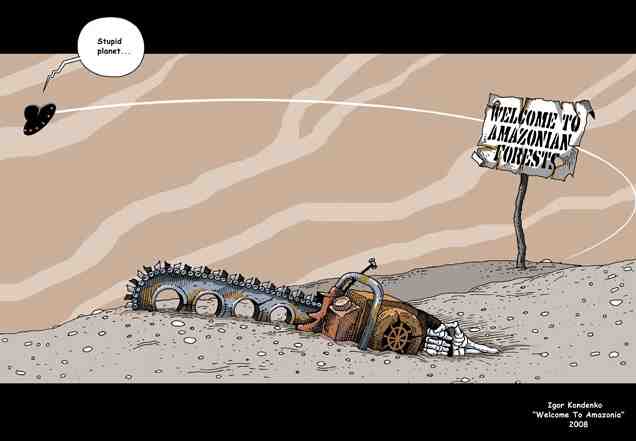
amazon-desert-chainsawBy Stephen Leahy

It’s well past time that people began to connect the dots between what they buy and the resulting environmental impacts such as global warming. In other words, consumption has consequences: big, nasty environmental consequences that inflict suffering mainly on the world’s poor experts say.

(IPS) (Originally published Jan 15 2007)

A Chinese-made $50 computer desk is likely the result of illegal clear-cutting in Indonesian rainforests. Buying such items fuels crime syndicates and emits huge amounts of global warming gases.

That North Americans, and to a lesser extent Europeans, are profligate consumers is well known. If everyone consumed like North Americans we’d need five planets to support us — only three planets are necessary if we all lived like Europeans, according to the World Wildlife Fund’s Living Planet Report.

The world collectively overshot the Earth’s capacity to support us in 1984, the report notes. In the 22 years since reaching that crucial tipping point, rates of consumption of resources have accelerated. Not just in North America and Europe but China and India, not to mention other parts of Asia and Latin America.

While this ever-accelerating consumption of resources the sign of a healthy global economy according to economists, it has also resulted in climate change, amongst many other environmental and social ills.

People don’t appreciate that their purchases have real environmental impacts,” said Monique Tilford, acting executive director of the Centre for a New American Dream (CNAD), a Maryland group promoting environmentally and socially responsible consumption. Continue reading

Top 10 Hottest Stories of 2006

Selected as one of IPS News Hot Stories of 2006:

From Mosques to Mollusks, No Haven From Rising CO2

By Stephen Leahy
drought-manaquiri-amazon-brazil-2005-greenpeacealberto-cesar-araujo.png
Three hundred and eighty parts per million.

That’s the current concentration of carbon dioxide going into your lungs with each breath. Our parents or grandparents’ first breaths at birth contained about 290 parts per million (ppm), as it was for everyone born before them.

What does it really mean when in the not so distant future our children or grandchildren will inhale 450, perhaps 500 ppm or more of carbon dioxide?

Evidently, breathing in a bit more carbon dioxide (CO2) isn’t bad for human health — oxygen at sea level is 200,000 ppm, after all — but the changing atmosphere is having profound impacts on the climate of the planet.

The changing climate has many consequences, among them the potential loss of ancient ruins in Thailand, coral reefs in Belize, 13th century mosques in the Sahara, the Cape Floral Kingdom in South Africa and other irreplaceable natural and historic sites around the world, experts reported this week.

— More at Mosques to Mollusks story published Nov 10 2006.

— See also IPS News Top Stories of 2006

Questions, story ideas, potential assignments, speaking engagements contact: writersteve AT gmail . com (no spaces)

GM Crops Creating Pest Problems Around World

GE Crops Slow to Gain Global Acceptance


By Stephen Leahy


BROOKLIN, Canada, Jan 9 (IPS) – Widespread use of genetically engineered (GE) crops remains limited worldwide, even as growing weed and pest issues are forcing farmers to use ever greater amounts of pesticides.

More than 70 percent of large-scale GE planting is still limited to the U.S. and Argentina, according to a new report released Tuesday by Friends of the Earth International (FOEI).

“No GM (GE) crop on the market today offers benefits to the consumer in terms of quality or price, and to date these crops have done nothing to alleviate hunger or poverty in Africa or elsewhere,” said Nnimmo Bassey of Friends of the Earth Africa in Nigeria.

“The great majority of GM (GE) crops cultivated today are used as high-priced animal feed to supply rich nations with meat,” Bassey said in a statement.

— See full story on how GM/GMO Crops are causing weed and insect problems.

Questions, story ideas, potential assignments, speaking engagements contact: writersteve AT gmail . com (no spaces)


Greener Cell Phones Thanks to European Laws

By Stephen Leahy


Mobile telephones in Latin America and across the developing world will contain less toxic materials, thanks to strict European standards, analysts say.

Art not Oil

TORONTO, Jan 6  2007 (Tierramérica)

Cellular telephones that contain toxic chemicals are still being sold in Latin America and other developing regions. But thanks to strict European regulations, there are progressively fewer phones being made with cadmium, lead and other dangerous materials.

The new, stricter standards adopted by the European Union in 2006, forced the world’s five leading cell phone manufacturers to eliminate toxic metals and other materials from their products.

In a year or two, the majority of the more than one billion new mobiles sold annually will meet the EU standards even if most countries don’t have those restrictions, says Zeina Alhajj, a toxics expert with the environmental watchdog Greenpeace International.

“The mobile phone is a global product with screws made in China, silicon chips made in Malaysia, and cables made in the Philippines,” Alhajj told Tierramérica from Amsterdam.

It would be too complicated to manufacture phones to meet different standards, so the big companies are making all their phones meet European regulations, which are the toughest in the world, she added. Continue reading

Blood Diamonds and Prosecuting Child Soldiers for War Crimes

The first person they have to kill is someone in their own family — or be killed themselves,” says Susan McKay of the University of Wyoming who has interviewed boy and girl child soliders throughout central Africa.

blooddiamond-movie-poster-sml.jpgMost girls are forcibly abducted and given roles as cooks, porters, spies, “wives” and in combat, McKay said.

[FYI: I’m an independent journalist who supports his family and the public interest writing articles about important social/environmental issues. ]

In spite of this fact legal experts believe child soldiers should be held accountable for war crimes otherwise they may be more likely to be chosen by warlords to perform the worst atrocities.

See story Prosecuting Child Soldiers For Their Own Safety

Do you like this article? It is funded by contributions from readers like you. Please click here to make a donation.

See also my other articles:

Venezuelan Smuggling Opens Door to Blood Diamond Trade
Sierra Leone’s Blood Diamonds and the Kimberley Process,

For a good introduction to the issue  watch the excellent movie Blood Diamond.

**UPDATE JAN 2010**

Blood diamond problem has largely been solved but now there may be “Blood Coltan” in your phone, ipod, and other electronic devices…read the shocking story here World’s “Grotesque Indifference” to Congo “Rape Mines”

what you can do:

Electronic Gadgets Fuel Congo “Rape Mines”