Carbon Capture Fraud: The $1.6 billion (and counting) Taxpayer Gift to Coal and Oil Industry

Could carbon capture and sequestration save the world?

Canadian taxpayers are putting $1.6 billion into the experiment

Desperate Times, Desperate Measures

by Stephen Leahy

Published in Nov/Dec’09 issue of Watershed Sentinel

Like a reckless gambler, the federal government’s plan to deal with our emissions of climate-altering carbon dioxide is to put most of our money on an unproven, risky and expensive long shot called “carbon capture and sequestration,” CCS for short. In a pair of October announcements, the Alberta and federal governments committed $1.6 billion to use this untested technology to reduce carbon emissions from an Alberta coal plant and a Shell Oil tar sands upgrader. Billions more are promised.

Canada puts 600 million tonnes of carbon dioxide into the atmosphere every year. That has to stop. This generation, you and me, must determine what methods and technologies offer permanent CO2 reduction at the scale we need, and do so quickly, safely and at the lowest cost. And we must act on that knowledge as if the future of children’s lives depend it because we are shaping the world they will inherit.

We cannot rely on political and business leaders to make these decisions on their own, as will become evident.

What other ways could we reduce our CO2 emissions with $1.6 billion of public money – $200 per Canadian family of four?

Replace 3.2 million older inefficient refrigerators with high-efficiency ones, thus reducing carbon emissions by 2-3 million tonnes annually. Continue reading

Earth Day Wish – The 3 Rules

Take time to be outside today.

Think about everything that nature provides – air, water, plants and animals that sustain us. Such gifts should not be taken lightly for they can vanish or be degraded. With our numbers and powerful technologies we are ‘the bull in nature’s china shop’.

We need to take great care and practice Climate-safe Living.

3 Rules to dial down the temperature on our global greenhouse:

1. Reduce.

Reduce fossil fuel consumption everywhere.

2. Eliminate.

Eliminate all non-essential activities and products that involve burning fossil fuel.

3. Demand.

Demand that business and government provide transport, activities and products that use minimize fossil fuel use.

Reduce. Eliminate. Demand. R.E.D.

May you always cherish this Earth and share in her joys.

Stephen

[I’m an independent journalist based in Canada who supports his family and the public interest writing articles about important environmental issues. This is now only possible with your support (see Collapse of Media). A small contribution ($5, $10, $20) is the ONLY way this can continue.  PayPal or Credit Card Or contact me for mailing address.]

Arctic Leaking Methane a Super-Potent Global Warming Gas — Reaching Feared Tipping Point?

By Stephen Leahy

“The way we’re going right now, I’m not optimistic that we will avoid some kind of tipping point.

— Mark Serreze, senior research scientist at the National Snow and Ice Data Centre

UXBRIDGE, Canada, Mar 5, 2010 (IPS)

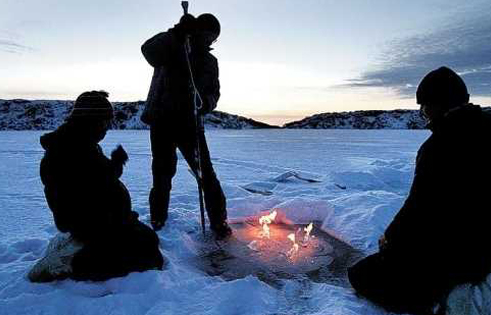
The frozen cap trapping billions of tonnes of methane under the cold waters of the Arctic Ocean is leaking and venting the powerful greenhouse gas into the atmosphere, new research shows.

It is not known if this may be one of the first indicators of a feedback loop accelerating global warming.

Researchers estimate that eight million tonnes in annual methane emissions are being released from the shallow East Siberian Arctic Shelf, which is equivalent to all the methane released from the world’s oceans, covering 71 percent of the planet.

On a global scale of methane emissions from the land-based sources – animals, rice paddies, rotting vegetation – the newly measured emissions from the Siberian seabed are less than two percent.

“That’s still very significant,” Natalia Shakhova, a researcher at the University of Alaska in Fairbanks, told IPS. “Before, it was assumed that this region had zero emissions.”

Do you like this article? It is funded by contributions from readers like you. Please click here to make a donation

Methane concentrations measured over the oceans are currently about 0.6 to 0.7 parts per million (ppm), but they are now 1.85 in the Arctic Ocean generally, and between 2.6 and 8.2 ppm in the East Siberian Arctic Shelf, an area roughly two million square kilometres in size, said Shakhova.

Shakhova, and her University of Alaska colleague Igor Semiletov, led eight international expeditions to one of the world’s most remote and desolate regions and published their results in the Mar. 5 edition of the journal Science. Continue reading

Traditional Indigenous Knowledge & Global Warming

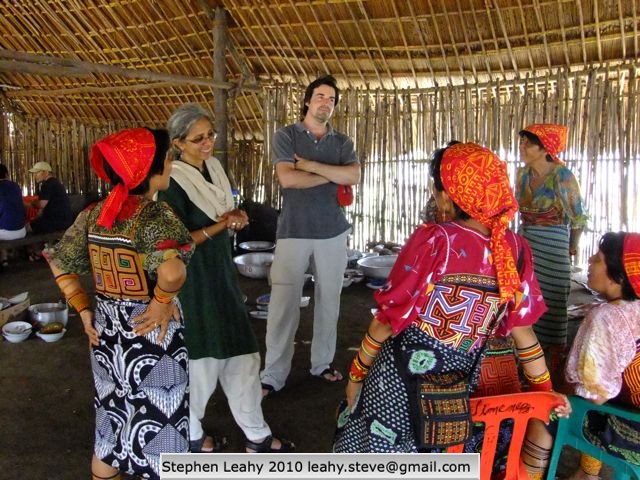
Returned from Panama a few days ago. I was offline for a week in a village in autonomus Kuna Yala territory on an island in the south Caribbean Ocean with no electricity, no roads, vehicles….just the sounds of the ocean and children playing. It was an amazing experience amongst unique group of Indigenous people still living by their traditional ways with a very strong emphasis on family, community and reciprocity.

Thanks to travel funding from an educational organization I was able to be at a unique workshop on the island where 18 indigenous people from around the world came to share their experiences in dealing with climate change. They are also documenting how their traditional knowledge is helping them adapt. What is often forgotten by those of us in the north is the lengthening of summer seasons, shortening winter, or changes in rainfall that are minor inconveniences for us often spell disaster for those who are subsistence farmers.

CONTRIBUTION UPDATE:

Special thanks to Ken of Ottawa, James from Toronto, Richard of Oshawa, Aidan who lives in Germany, Siri of London UK, Michael of Toronto, David of Salmon Arm and Catherine from Atikokan for your recent support. It is heartening to receive your encouragement and desire to help ensure I can continue to write and report on these important issues for everyone.

Thanks to these good folks the Community Supported Environmental Journalism Fund has now reached $1450.00, nearly 10 per cent of what’s needed for 2010.

There are some very important articles I’m hoping to write this year so help out if you can.

Contributions can be made via PayPal or Credit Card here:

(NOTE: For ocean lovers there is a major conference on Oceans this May –there are new prospects of international governance to hopefully end the ruthless rush to get the last fish. But will need $1000 to be able to get there)

— Greenest wishes, Steve

One Meter Sea Level Rise on the Way New Studies Show

New research from several international research groups now reveals that at least one metre sea level rise is virtually certain. Confirms other recent studies that found that IPCC predictions of less than a half a meter rise in sea levels is around 3 times too low. See the Niels Bohr Institute at the University of Copenhagen and the scientific journal, Geophysical Research Letters.

Fish Companies Push Hard to Halt Tuna Collapse

By Stephen Leahy*

VICTORIA, Seychelles, Feb 8, 2010 (IPS)

In the Seychelles’ only cannery, the din of thousands of empty tuna cans rattling on narrow metal troughs is incredible as they bustle along, soon to be filled with Skipjack tuna that only days ago were swimming freely in the inky blue Indian Ocean.

At one end of the Indian Ocean Tuna Limited processing plant – the world’s second largest – cranes offload nets full of frozen tuna from huge international fishing boats called purse seiners while at the other end of the plant, 5,000 cans of tuna roll off the line every minute.

That’s a lot of tuna – roughly 400 metric tonnes a day. Can the Indian Ocean tuna bounty, which amounts to more than 20 percent of the world’s tuna, be sustained?

That was the key question at the first-ever Seychelles Tuna Conference that ended last weekend. It brought together nearly 200 scientists, fishers, environmentalists and policy makers here in Victoria, Africa’s smallest capital city, located 1,800 km east of Somalia and practically in the middle of the Indian Ocean.

“The boats are much more efficient today and the tuna stocks are declining and there is much less tuna than before, ” said Alain Fonteneau, a scientist with the L’Institut de recherche pour le développement, in Montpellier, France, who opened the conference. Continue reading

Canada’s Idea of Working on Climate Change Means Muzzling Climate Scientists, Closing Research Stations and Cutting Funding

“This government is doing nothing on climate but they always make sure to sound like they’re doing something to fool Canadians.” — John Bennett, Sierra Club of Canada

By Stephen Leahy

UXBRIDGE, Canada, Mar 16, 2010 (IPS)

Canada’s climate researchers are being muzzled, their funding slashed, research stations closed, findings ignored and advice on the critical issue of the century unsought by Prime Minister Stephen Harper’s government, according to a 40-page report by a coalition of 60 non-governmental organisations.

“This government says they take climate change seriously but they do nothing and try to hide the truth about climate change,” said Graham Saul, representing Climate Action Network Canada (CAN), which produced the report “Troubling Evidence”.

“We want Canadians to understand what’s going on with this government,” Saul told IPS.

Climate change is not an abstract concept. It already results in the deaths of 300,000 people a year, virtually all in the world’s poorest countries. Some 325 million people are being seriously affected, with economic losses averaging 125 billion dollars a year, according to “The Anatomy of a Silent Crisis“, the first detailed look at climate change and the human impacts.

Released last fall by the Geneva-based Global Humanitarian Forum, the report notes that these deaths and losses are not just from the rise in severe weather events but mainly from the gradual environmental degradation due to climate change.

Is this article of interest? It exists thanks to contributions from readers. Please click here to learn more about Community Supported Journalism.

“People everywhere deserve to have leaders who find the courage to achieve a solution to this crisis,” writes Kofi Annan, former U.N. secretary-general and president of the Forum, in the report.

Canadians are unlikely to know any of this. Continue reading

Doubt Is Our Product: Media and Global Warming

Why do media run nonsensical “scandals” about climate science?

Why does the public put up with it?

Those are some of the questions posed on Alex Smith’s fine syndicated weekly Radio Ecoshock Show has three expert viewpoints in his one hour show OUR PRODUCT IS DOUBT

Clive Hamilton on “Requiem for a Species, Why We Resist the Truth About Climate Change.” The madness of masses & media.

Stanford’s Prof. Stephen Schneider on death threats, & threats from Senators (calling climate scientists “criminals”).

Naomi Oreskes on “Merchants of Doubt”.

1 hour CD Quality 56 MB or Lo-Fi 14 MB

See also Alex’s detailed notes and links to far more on his blog: DOUBT IS OUR PRODUCT – the blog

[full disclosure: I supplied my interview with climatologist Stephen Schneider – Violent Backlash Against Climate Scientists

]

Scientists Face Death Threats, Democracy at Risk

[A personal note from Stephen]

There’s something strange in the air when a highly-respected US scientist says he or a colleague will likely be killed for saying climate change is happening.
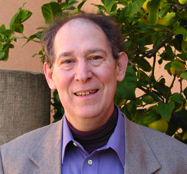
That’s what Stanford’s Stephen Schneider told me last week. He’s not an alarmist, he’s a pro with 40 years under his belt. These days climate scientists receive all kinds of hate mail and even death threats. I even get hate mail. Bizarre times.

At the same time traditional media are complicit, giving ‘face time’ to those who smear scientists with no evidence, just nonsensical conspiracy allegations. Schneider says simply:

I’m pretty damn angry that media companies are putting profits ahead of truth. The media are deeply broken… That’s a real threat to democracy.”

I couldn’t agree more. We’re in a dangerous trap. Schneider, Victoria Tauli-Corpuz, Chair, UN Permanent Forum on Indigenous Issues, and many other experts have recently told me: ‘we need people like you to write about these issues’.

I could do far more but my time is largely gobbled up trying to figure out how to put bread on the table. Last year writing about these issues put my family $10,000 in the red despite about $4000 in donations which mostly went towards travel costs. (And we have a pretty modest lifestyle, living in my in-law’s basement apt)

Put plainly, writing honestly about important issues is not rewarded in our current economic system, even though it’s in our best interests. Writing junk mail to sell crap that people don’t need is rewarded 100X more. (I know, I used to do it)

Community Supported Journalism

Community Supported Journalism is the only way forward that I can see. That means reciprocity: You help support the investigation, research, writing about what’s important for all of us to know so we can make informed decisions. In an earlier age I would have come to your village, taught your children and told you useful stories about what I’d learned from wise elders in other villages. Today I send out those stories to you and many others in our global village and rely more and more on you to provide the financial equivalent of a place to sleep and a meal to eat.

Reciprocity, co-operation and community are some of the key values we need to escape the trap we are in.

On a practical level supporting or funding individual story ideas isn’t working mainly because it takes too much time to put together and generate support. It’s not nimble enough to respond to breaking news, but it could work for larger, long term projects. Instead what’s needed is ‘bread and butter’ funding — contributions that help cover the everyday costs of living and doing environmental journalism.

A “Bread and Butter Environmental Journalism Support Fund” if you will. That fund will need about $15,000 in 2010 for the work to continue.

It has taken me three days to find the words to ask because it is a lot of money. Please consider $50, $100 or more — less than cost of a newspaper or cable TV subscription — for coverage of important issues that shape our world and our future.

Contributions can be made safely and easily via PayPal or Credit Card. Or  contact me at writersteve [AT] gmail [DOT] com (no spaces) to send a cheque.

Please also pass this along to interested family, friends and organizations. My continued appreciation to those who have contributed in the past.

Thanks and best wishes, Steve