Europeans stopped Canada’s Slaughter of Baby Seals – Can They Stop Canada’s Tar Sands?

On July 17th Berliners and other Europeans will take to the streets to stop the worst environmental disaster on the planet:

Canada’s “Dirty Oil” Tar Sands

[UPDATE: See pix and story on the Stop Tar Sands “demo-fest”]

“The tar sands of Canada constitute one of our planet’s greatest threats” — James Hansen, Director of NASA’s Goddard Institute for Space Studies

“Extracting oil from Alberta’s tar sands jeopardizes the survival of our species” — Al Gore

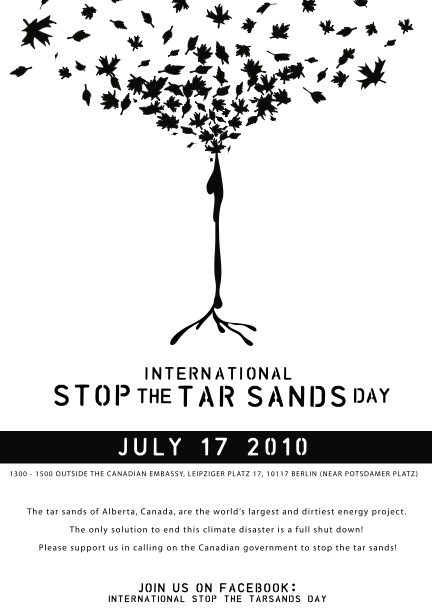
Warning of the global environmental disaster represented by Canada’s production of oil from its western tar sands, protesters will gather in front of the Canadian Embassies in Berlin, London and Copenhagen on Saturday, July 17 to mark International Stop the Tar Sands Day.

[Download poster international tar sands day A3]

The goal of International Stop the Tar Sands Day is to raise awareness in Europe that oil made from Canada’s tar sands has “two-to-three times the global warming pollution of conventional oil,” according to eminent scientist James Hansen, Director of NASA’s Goddard Institute for Space Studies. “But the process also diminishes one of the best carbon-reduction tools on the planet: Canada’s Boreal Forest.”

Similar protests are planned at Canadian embassies in London, Paris and Vienna.

“Ultimately only Canadian people can stop the expansion of the tar sands. Through our demonstrations we want to show Canadians there is international support for a moratorium,” says first-time organizer Derek Leahy, a Canadian living in Berlin.

“We believe Canadians will make the right decision,” Leahy said

“Although European companies and banks are profiting from Canada’s tar sands few Europeans have heard about the tar sands. We intend to change that ,” he said

[Full disclosure: this is copied from a press release and Derek is my son — Steve] Continue reading

‘Tourists Please Don’t Go To Home of Canada’s Dirty Oil Sands’ Ad Campaign

Beautiful Alberta, Canada??

US enviro group is putting up billboards in four U.S. cities urging Americans to exclude Alberta from their travel plans, saying it is “one of the world’s dirtiest destinations”.

Let’s be clear here: I am not a supporter of this use of  a big “economic” club to hit govt over the head to get their attention. It will hurt many Albertans who are in the tourist biz where many likely support a moratorium on new tar sands development. Indeed most Albertans have said they want a “time out” in the tar sands. But big oil says no way and are pushing for faster approvals of new projects with “streamlined environmental reviews” of course.

In their  Re-Think Alberta Campaign enviro groups say they are trying to counter Alberta and Canadian government propaganda. Canada is lobbying the US  to prevent any cleaner-fuel regulations because the tar sands has the world’s highest CO2 levels and is the most destructive form of oil production. Yes worse, than off shore drilling – see here for more

And they are also down here lobbying for infrastructure, new pipelines, refineries, which would keep us addicted to high-carbon oil for another 50 years.” Corporate Ethics International Executive Director Michael Marx told Reuters.

1.3 million barrels of dirty oil is shipped  from tar sands region  to the US every day

Corporate Ethics also has a powerful video about the ongoing environmental mess that can easily be seen from space it is so big.

See also International Stop the Tar Sands Day commencing July 17 (more on this later).

You can learn more on enviro impacts of the tar sands in my short ebook:

Oil Stains in the Boreal Forest: The Environmental Cost of Canada’s Oil Sands

And from my recent articles:

Canada’s “Mordor” Ensures Climate Treaty Failure in Copenhagen

Tar Sands, Riot Police & Hope in Copenhagen

— Green wishes, Steve

Burning Oil, Gasoline, Coal Causes Heart Attacks – American Heart Association

Researchers have long proven emissions from cars, trucks, coal plants reduce air quality and affect our health. Yet another study documents the serious health impacts on all of us, specifically our heart and arteries.

Reuters take:

The evidence is stronger than ever that pollution from industry, traffic and power generation causes strokes and heart attacks, and people should avoid breathing in smog, the American Heart Association said on Monday. Continue reading

2020 Climate Deadline Is the Crucial “Litmus Test”

Chile—The fury of Chaitén volcano - nat geo

The atmosphere and the climate is a public good, a commons, and can’t be protected by the private sector.”

— Marianne Haug, Oxford Institute for Energy

By Stephen Leahy

VIENNA, Jun 29 2009 (IPS)

“So who here thinks there will be a meaningful deal in Copenhagen?”

Few of the more than 600 energy ministers, officials and experts from 80 countries attending the Vienna Energy Conference raised their hands in response to the conference moderator’s question about the final round of climate negotiations this December in Copenhagen.

“I don’t think there will be agreement on an emissions cap,” said Andre Amado, Brazil’s vice-minister for energy, science and technology.

Greenhouse gas emissions from the burning of fossil fuels must peak between 2015 and 2020 and then decline to prevent dangerous, irreversible climate change, scientists have warned. A strong international agreement on emissions targets for both the industrialised and developing world is widely believed to be the only way to ensure emissions peak and then decline.

“There will be agreement on technology transfer and reducing barriers for technology transfers,” to assist developing countries in cutting their emissions and adapting to the changing climate, Amado told participants last week in Austria’s capital city.

Continue reading

New $Billion Cash Hand Out To Fossil Fuel Companies Under ‘Green’ Economic Stimulus Plans

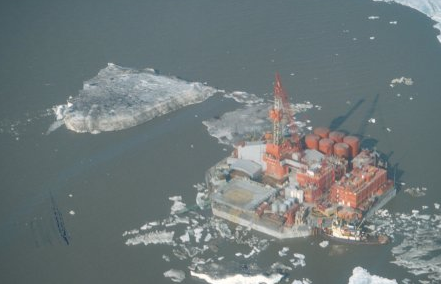
Shell in Curacao, Netherlands - Humane Care Fondation, Curacao[Updated: Monday Sept 28/09

Last Friday at the G20 countries agreed to phase out subsidies for oil and other carbon dioxide-spewing fossil fuels in the “medium term” as part of efforts to combat global warming. This article documents NEW taxpayer subsidies to some of the world’s richest corporations]


By Stephen Leahy

UXBRIDGE, Canada, May 29 2009 (IPS)

Despite the economic slow down, growing numbers of world leaders are calling for urgent action on climate change while many governments used their economic stimulus packages to increase subsidies to the fossil fuel industry.

Consider Europe, with the strongest public commitment to reduce carbon emissions that are causing climate change.

In the past five years, 8 billion U.S. dollars of public money went to Europe’s fossil fuel companies mainly to the natural gas sector. And in May the European Parliament approved an additional 3.35 billion dollars in subsides as part of Europe’s 225 billion dollars economic recovery plan, according to a new research report by Friends of the Earth Europe.

“We Europeans are supposedly leading the world on the path to a new green economy but we’re putting billions of euros into fossil fuel sector that’s taking us in the opposite direction,” Darek Urbaniak of Friends of the Earth Europe.

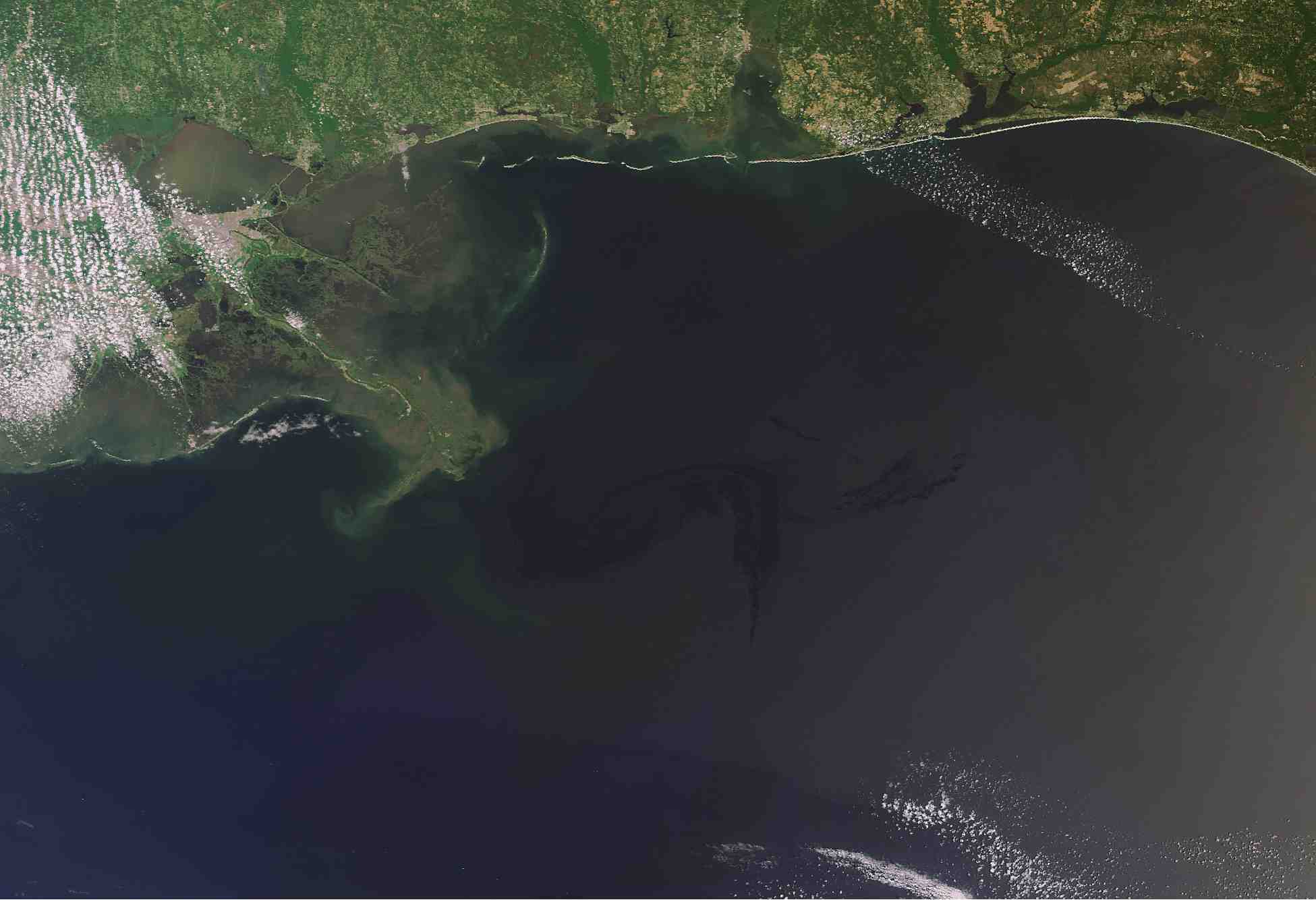
gulf spill nears coast Apr 30 2010 - ESA

Its complete hypocrisy,” Urbaniak told IPS from Brussels.

Perhaps recognising this fact, global business leaders at the World Business Summit on Climate Change that concluded May 26 called on governments to “strive to end the current perverse subsidies that favour high-emissions transport and energy”.
Continue reading

‘Bailout’ for Oil Companies $20-40 Billion (and maybe more) every year


By Stephen Leahy

UXBRIDGE, Canada, Sep 30 ’08 (IPS)

Why do U.S. oil companies — some of the most profitable corporations on the planet — receive 20 to 40 billion dollars a year in subsidies from the U.S. government?

And, in a time of skyrocketing oil prices and profits, why did the George W. Bush administration in 2005 authorise an additional 32.9 billion dollars in new subsidies over a five-year period?

“Those are very good questions,” said Doug Koplow of Earth Track, Inc., an independent energy information research organisation in Boston, Massachusetts.

“I don’t have a good answer other than to say we’ve been subsidising American oil companies since 1918,” Koplow told IPS.

Koplow’s 2007 report to the Organisation for Economic Cooperation and Development puts the annual U.S. subsidy at an average of 39 billion dollars a year, when the costs of guarding oil lanes in the Persian/Arab Gulf, and the Alaska Pipeline are included. This does not include any costs from the Iraq war.

Official U.S. government statistics from the Energy Information Administration (EIA) offer a different picture, stating that the oil and gas industry only received 2.15 billion dollars in 2007.

“The EIA has a very narrow definition of what constitutes a subsidy,” said Koplow.econ-v-envir-franke1

Like many industrialised countries, the U.S. subsidises oil production, not oil consumption. Consumption subsidies reduce the cost of buying fuel to the public while production subsidies reduce the cost of finding and producing oil for oil companies.

Experts agree that both forms of subsidies encourage consumption and thus increase the price of oil.

Estimating U.S. oil and gas subsidies is very challenging. Subsidies rarely involve cash payments. Instead scores of U.S. government agencies and departments create hundreds of programmes to support the U.S. energy sector. And there is no requirement for the federal government to keep track of all this.

Among the most common subsidies are construction bonds and research-and-development programmes at low interest rates or tax-free, assuming the legal risks of exploration and development in a company’s stead and income tax breaks. Despite record high prices at the pump, the federal sales tax on petroleum products is lower than average sales tax rates for other goods. And on it goes.

Originally these production subsidies were intended to help the nascent industry meet a growing nation’s energy needs. Despite record-high prices, that rationale remains firmly in place. In 2007, U.S. oil giant Exxon corporation made history with 40.7 billion dollars in profits, the most any U.S. company has ever achieved in a single year.

And subsidy programmes from 1918 are still in place.

“I’m not aware of any oil and gas subsidy that has ever been phased out,” said Koplow, the leading expert on U.S. energy subsidies.

Energy subsidies are often simply hidden from public scrutiny. It’s only recently been revealed that 40 companies granted leases between 1996 and 2000 for drilling in the Gulf of Mexico do not have to pay royalties for the publicly-owned resource. This is worth nearly a billion dollars a year in lost revenue to the federal government, according to a 2008 study by Friends of the Earth (FOE), a U.S. environmental NGO, and may ultimately total 50 billion dollars.

That study also revealed that the Energy Policy Act of 2005 would generate an additional 32.9 billion dollars in new subsidies in the form of tax breaks, reduced royalty payments, and accounting gimmicks over a five-year period.

“The report only includes the explicit subsidies we could find,” said Erich Pica, an energy analyst at FOE.

For complete article see US: Great Place for the Oil Business

It gets better — June 09: New Story: New Way to Give Money to Oil Companies – Economic Stimulus Packages

Arctic Oil and Gas Rush Alarms Scientists

By Stephen Leahy

[See also more recent story: Arctic Ice Gone in 5 Years – First Time in One Million Years; see also other Arctic and oil stories below. US and Canada to start offshore drilling in the Arctic summer 2010 – your support is needed to investigate and report on this. ]

UXBRIDGE, Canada, Sep 8 2008 (IPS)

As greenhouse gas pollution destroys Arctic ecosystems, countries like Canada are spending millions not to halt the destruction but to exploit it.

Late last August, Canada announced a 93.7-million-dollar prospecting programme to map the energy and mineral resources of the region. There are “countless other precious resources buried under the sea ice and tundra,” Prime Minister Stephen Harper said during the announcement. The government’s mapping effort is expected to trigger 469 million dollars in private sector resource exploration and development.

“It is estimated that a quarter of the world’s undiscovered oil and gas lies under the Arctic,” Harper said.

This scramble to exploit some of the most environmentally delicate regions of Earth has alarmed international experts who are meeting this week in Iceland to make recommendations to the United Nations and world governments on how to protect the polar regions.

“Many experts believe this new rush to the polar regions is not manageable within existing international law,” says A.H. Zakri, director of the United Nations University’s Yokohama-based Institute of Advanced Studies (UNU-IAS), co-organisers of the conference with Iceland’s University of Akureyri. Continue reading

Oil vs Polar Bears in Alaska: Big Oil Sues Govt for Protecting Polar Bear Habitat

[Update Mar 3 2011: An Alaska oil industry trade group representing 15 oil & gas companies sued the US federal government because it banned drilling in 187,157 square miles as polar bear critical habitat. They claim plenty of polar bears without offering any evidence. And it’s not like Alaskan oil interests haven’t run the state for years. My article below documents how 30 million acres of polar bear habitat were auctioned off in a big hurry in 2008. It really is all about oil/gas $ VS survival of polar bears. — Stephen]

[Update: May 1 2010 – Alaska’s polar bears are now official listed as threatened. In April 2010, the Obama administration tried but failed to get the world’s 20-25,000 remaining polar bears listed as endangered species. What a difference a new administration makes .–Stephen]

By Stephen Leahy

BROOKLIN, Canada, Mar 11, 2008 (IPS)

A coalition of environmental groups sued the George W. Bush administration Monday for delaying a decision to protect polar bears threatened with extinction due to the melting ice in its Arctic habitat. Polar bears could be the first species officially threatened by climate change.

The huge loss of summer sea ice in 2007 has caused many scientists to project that the Arctic could be ice-free in summer by as soon as 2012. Although excellent swimmers, polar bears are not very good at catching seals in the water. Seals comprise the main diet for these giant bears, which are far larger than their grizzly bear cousins.

While legally required to make a decision Jan. 9, US Fish and Wildlife (U.S. FWS) officials have been silent. Meanwhile on Feb. 6, 2.6 billion dollars in oil and gas leases were auctioned off to energy companies on nearly 30 million acres of prime polar bear habitat in the Alaska’s Chukchi Sea.

This independent environmental journalism depends on public support. Click here learn more.

Coincidence? I doubt it, but I don’t have the smoking gun to prove it,” said Kassie Siegel of the Centre for Biological Diversity (CBD), an environmental non-governmental organisation based in Joshua Tree, California.

The CBD, along with Greenpeace and the Natural Resources Defence Council, filed the suit for missing the legal deadline for issuing a final decision on whether to list the polar bear under the Endangered Species Act due to global warming.

“There was absolutely no urgency to hold that lease sale and plenty of public opposition to it as well,” Siegel told IPS. Continue reading

Ending The Oil Addiction: Galápagos Islands

img_0501.jpg

By Stephen Leahy*

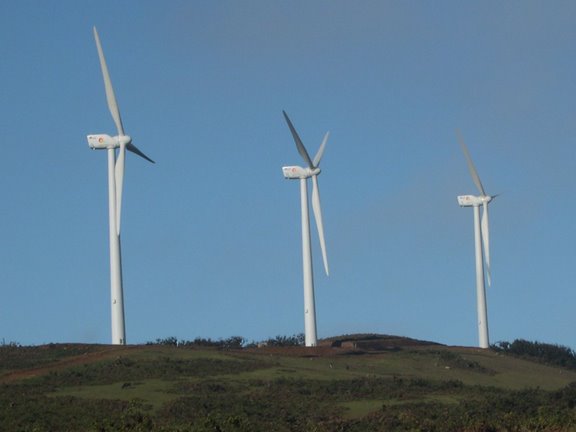
TORONTO, Feb 29 (Tierramérica) – Ecuador has taken the first step towards ending the oil dependence of its Galápagos Islands, in the eastern Pacific Ocean, with the official opening of a 10.8 million dollar wind energy facility on the island of San Cristóbal.

Ecuador’s President Rafael Correa toured the facility as part of a celebration of the 500th anniversary of the discovery of the Galápagos, and proposed to declare the islands fossil fuel free by 2015.

Located 1,000 kilometres off the coast of Ecuador, the archipelago comprises 17 small and 13 large islands that are home to 30,000 people and visited by more than 120,000 tourists each year.

Nearly everything is imported from the mainland, including vast quantities of diesel fuel for energy and transport. In 2001, a tanker ship struck a reef off the coast of San Cristóbal, one of the main islands, spilling 150,000 gallons of fuel into the ocean. Continue reading