
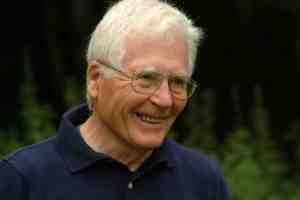
Stephen Leahy interviews JAMES LOVELOCK the scientist who first proposed the Gaia Hypothesis
TORONTO, June 5 2009 (Tierramérica)
“When the first great climate disaster strikes, I hope we will all pull together just as if our nation were being invaded,” says British scientist James Lovelock in this exclusive Tierramérica interview.
Please throw something in the tip jar before reading on.
This is how I make my living.
As the world marksInternational Environment Day Friday, Lovelock argues that as the climate warms and the carbon content of the atmosphere soars, humanity is facing a far grimmer future that will be upon us sooner than any of the projections made by the Intergovernmental Panel Climate Change (IPCC).
A chemist, physician and biophysicist, Lovelock is one of the world’s foremost environmental scientists and founder of the Gaia Hypothesis, which describes the planet as a living organism, a complex system in which the components of the biosphere and atmosphere interact to regulate and sustain life.
Although his ideas often feed controversy, Lovelock has wide-ranging scientific credentials. As an inventor, he holds more than 50 patents, including the first devices for detecting the presence of ozone-depleting CFCs (chlorofluorocarbons) and pesticide residues in the environment.
He is also the author of many books. The most recent, “The Vanishing Face of Gaia: A Final Warning”, was published in April. Lovelock spoke with Tierramérica’s Stephen Leahy in Toronto.
TIERRAMÉRICA: Why are you critical of the IPCC?
JAMES LOVELOCK: There are many excellent scientists working with the IPCC but their computer climate models cannot model the biosphere’s response to increasing temperatures from global warming. The models do not include forest or ocean response to rising carbon dioxide levels. They cannot model a self-regulating Earth as yet. That is why the IPCC projections are so far off the mark.
Observational evidence shows sea level rise has been much higher and the melting of the Arctic is happening far more quickly than IPCC predictions. Climate change is happening much faster than most realise.
TIERRAMÉRICA: Has the Earth already passed a climate tipping point?
JL: Yes, I think it has. The Earth is already moving towards a hotter state in response to the changes we’ve made in transforming much of the surface of the planet and adding CO2 into the atmosphere.
Let’s not forget that the Earth was once nearly entirely forested and those forests were a major part of a living planet’s regulatory system.
Based on Gaia theory at some point in the future there will be a sudden shift to a new global climate that may be 5 or 6 degrees Celsius warmer on average than today. I have no idea when that shift might happen but my guess is that we may have 20 years to prepare.
TIERRAMÉRICA: What will this new climate be like?
JL: The tropical and subtropical zones of the Earth will be too hot and dry to grow food or support human life. People will be forced to migrate towards the poles to places like Canada. There will be less than one billion people by the end of the century. My hope is that we will stay civilised and those in the North will give refuge to the unimaginably large numbers of climate refugees.
TIERRAMÉRICA: You paint a grim view of the future. Is there no hope?
JL: My main point is that we humans need to adapt and survive on this new hotter planet. Humans survived the last interglacial age, when ice covered much of North America and Europe and sea levels were 120 metres higher than today. The first step is to stop thinking blindly that all we have to do is reduce our carbon footprint, and begin preparations to adapt to what is coming.
For complete interview Q&A: “I Hope We Are Civilised When Climate Disaster Hits”
 Stephen Leahy, International Environmental Journalist
> The first step is to stop thinking blindly that all we have to do is reduce our carbon footprint…
Nobody who is reasonably informed is “thinking blindly”. Reduction of carbon pollution is by far the most important issue today – we must mitigate climate change and limit the damage as much as possible.
I think Lovelock’s spiel about ‘Gaia’ and his cheerful predictions of billions dying are dangerous nonsense that is being eagerly embraced by the deniers and delayers. Why should they act when most of us are doomed anyway?
> My hope is that we will stay civilised and those in the North will give refuge to the unimaginably large numbers of climate refugees.
This is a clear demonstration of ignorance and naiveté at work. Look at the turmoil created by New Orleans. There’s no way millions of refugees can be accommodated.
Hopefully very few people will pay attention to Lovelock and instead look to professional climate scientists for their climate science and the actions we need to take to avert catastrophic climate change.
P.S. I’ve no idea where he got his sea level of +120m. for the last interglacial – it was more like +6m.
Lovelock is definitely an outsider on this — and he acknowledges he doesn’t have the data to back up his contentions. That said his points that the current state of climate science likely underestimates the speed and extent of CC are correct as many in the field acknowledge.
Good catch on the interglacial sea level — 6+ meters is correct…will check the transcripts
Absolutely, the IPCC predictions are out of date – some were out of date or lacking (e.g. glacier melt was not factored in to sea level rise) when they were published. Also, consider that the papers used for the FAR synthesis are at least ~4, possibly 5-years old now. A *lot* has happened in that time – not least of which is another 100+ billion tons of carbon released.
And agreed that speed and extent have often been underestimated (e.g. http://www.guardian.co.uk/environment/2009/jul/08/arctic-ice-ocean), but climate scientists are still the best source for climate science, not maverick scientists with books to sell.
The underestimates by the scientific community simply increase the urgency with which we must act to reduce and stop carbon pollution.
I’ve read / watched a number of Lovelock’s interviews recently and I think his cheerful nihilism damages the cause. This one was more of the same. I guess I’ve made clear that I’m not a fan. 😉
He’s a very interesting person and difficult to dislike. However I did not like his book for many, many reasons. And agree he is not the best source on climate science.
At first his nihilism bothered me a great deal as well but doesn’t now for some reason.
[…] Stephen Leahy Simon Leufstedt Simon Leufstedt is the founder and editor of Green Blog – an environment blog […]
A guy who can advocate nuclear power obviously can’t have much of a care for the future in any case.
[…] also my 2009 interview with Lovelock "I Hope We Are Civilised When Climate Disaster Hits” […]
Western science has lost track in many fields so far, climate change being the most crucial one. Lovelock has always been a real open mind since half a century ago giving always a wider perspective to what is going to happen. The fact he makes negative predictions providing at the same time reasonable time margins (20 years, 100 years) has ever been faced by many as a SEP (Someone Else’s Problem). And yes – nuclear power is the ONLY short-term effective solution – willing or not.
Global Climate Change Crisis & Sustainability Panorama http://www.frogboiled.org – Metis Global Awareness Network Accredited Observer to the UNFCCC.
Dr Lovelock has NOT backtracked on AGW or climate change, he still believes in it for sure but in the MSNBC non story which was planted news story PR hype by his publsiher for pre-order sales of 2013 book, to test the waters of public opinion, Dr L merely said that he was reframing his time line, that things won’t get bad in 2100 like he said earlier but much later, maybe 2200 or 2400 or 3500, he did not say time this time, but he still believes, don’t let the MSNBC non story spin fool you. Lovelock is for real. He is my teacher and i am…”James lovelock’s accidental student’ google it and see my take on MSNBC faux story here:
http://www.jewishboston.com/danbloom/blogs/3488-how-msnbc-s-ian-johnston-mis-reported-the-james-lovelock-non-story-that-went-viral
dear Dan
This ie your blog about Lovelock fake interview news story PR hype is just utter nonsense.
Do You offer a single piece of evidence that Lovelock was misquoted by MSNBC? Not that I can see. Has Lovelock walked back his comments in the past few days? I can’t find that online either.
So your entire thesis is garbage. Famous people give interviews all the time. That’s what Lovelock did. He spouted nonsense before and he is continuing to spout nonsense.
You really lost a lot of credibility with me on this.
You might consider retracting your nonsensical story since you have offered no evidence whatsoever for your charges against me or Dave Roberts.
Joseph Romm
Senior Fellow
Center for American Progress.
Editor, ClimateProgress.org
Dear Mr. Bloom: Thank you very much for sending me your take on the Lovelock story. I am curious – are you arguing that Lovelock has not changed his opinion about the seriousness of man-made global warming? If he has, then that would seem to be newsworthy.
Best,
Ron Bailey
Science editor, REASON mag
You see Ron Bailey and David Roberts and Joe Romm and Marc Morano, if there really was a news value to this Lovelock story, then there would have been a press con in UK with ten top reporters there, OR Lovelock would have given his “get” to Andy Revkin at the New York Times or Seth Borenstein at AP in DC, but who cares Ian Johnston at msnbcm who is NOT even a reporter. this was an inside job, inside PR job, a savvy Pr drill to create pre-marketint bonanza for the 2013 book. Lovelock did not ask for this. His publishers sat it up and someone at his PR team knew Ian in NYc, Ian is Brit too, and that is how this non story evented……WHY AM I the only internet sleuth to figure this out. you all been had. had good!
Aha, Lovelock’s PR people at his publisher in London, or New
York, most likely know
Ian and in anticipation of Lovelock’s new book coming out in 2013, the
PR people asked Ian if he would
like to interview James Lovelock by telephone person to person in the
UK? Of course, Ian took the bait and ran with it. Great story too.
Interesting. But why NOW? It seems that the PR people wanted to create
a pre-publication BUZZ a good 9 months before publication in order to
create a waiting readership for the new book. A great PR move. Ian
fell for it. Ian did not report why or how the interview came about
and that is both unethical and unprofessional. But the PR team is
happy. And Ian got his scoop. And Dr Lovelock doesn’t mind, because he
is a great man and he’s always good for good quotse. Ian’s story
rocked. But
there’s a back story to the MSNBC story we need to know. Now you know it.
It was a PR stunt, a marketing set up, a news gimmick. And MSNBC fell for it.
Worse, the entire known blogosphere fell of it. Rightwing and leftwing. Marc Morano and David Roberts. Joe Romm and Ronald Bailey. But I did not. I know a faux story when I read one.
It’s called “reading between the lines.”
Still, the news IS interesting and good on Ian for telling it. Just
wish he had been more forthcoming about the genesis of the alleged
“story.” In fact, there was no story here. When the book comes out in
2013, yes, there
is a legit story then. NOT NOW. Now the entire story was pre-marketing
pre-publication bullshit to set the the stage for book sales later on.
How the MSNBC Ian Johnston take-down article on James Lovelock
happened and why now? This week, this month. When in fact, there was no news event going on to report. I got the inside scoop here, if you care to know how MSNBC missed the boat on this one and threw a lopsided inside sinker that went nowhere and reported nothing but marketing hype for Lovelock’s 2013 book.
Since when did MSNBC get into the PR and marketing business?
Climate denialists are in Seventh Heaven this month, starting with Marc
Morano’s CLIMATE DEPOT, where news of MSNBC’s sorry and insipid take down of
global warming guru Lovelock by MSNBC editor Ian Johnston has gone gliral —
that’s global and viral mixed together for new portmanteau word. But
in fact, this was not a normal news story and that day was not a normal
news day.
Facts: Ian Johnston is not a reporter for MSNBC. He is an editor. On
his Twitter page, he admits as such. He writes: “I am an editor for
MSNBC.com, and I like to cover stories about [lists topics he likes,
one
of which is environment].” He appears to be a British man. He might even have an inside link to Dr Lovelock via school or family or PR trainging. We’ll know more when he tells the truth on how this non-story transpired. So far, he’s not talking, and he’s not answering my emails. Stonewalling again?
Two: he interviewed Dr Lovelock by telephone at his home in Cornwall,
England, from his news desk in New York. And there was no press conference.
Three: why did this telephone interview take place on that day when in fact
there was NO NEWS about
LOVELOCK or climate change that would warrant such a big news story?
Steve, re “James Lovelock is in news because he is apparently backtracking on his climate doom views. If true, a remarkable turnabout – but based on no real evidence. I interviewed him some time ago saying climate change was happening much faster than any expected. Puzzling to say the least — …”
URGENT: Lovelock was in the news due to an MSNBC editor’s BS PR hype marketing team “faux interview” by telephone merely to hype new book sales for 2013. There was no news event, and tehre was NO REASOn for Brit reporter Ian Johnston with a T to call Lovelock for interview , from NYC to UK, unless some PR plant was involved. SEE? Lovelock did not backtrack anything about global warming being man made or climate chagne being REAL. he just said well, maybe my earlier time line was too ecentric, i said by end of century the end would come, nowi say i don[t knpw when but I STILL BNELIEVE in GW and CC. so nothing has changed. However, due to the unprofessional anture of the MSNBNC non story, the news went viral due to Internet blogs adn wow, both the right wing MORANo and WATTS and the leftwing has gone crazy saying how sick Lovelock was…..NO, Dr L is still in top form and NOTHING has changed, just the timel;ine time frame, as you know, from our 2008 interview at IPS, I always said time is more like 2500 AD
when the eff hits the fan….not now…..so Lovelock is now following my lead. SMILE…but he reamins my teacher and i remain “JL’s Accidental Student”, danny bloom, 1949-2032……
James Lovelock is in news because he is apparently KEY WORD: APPARENTLY! IN FACT HE DID NOT BACKTRACK MAIN ISSUE ……backtracking on his climate doom views. HE STILL IS DOOMSTER and WE MUST PAY ATTENTION……If true, NOT TRUE…..a remarkable turnabout NOT A TURNABOUT – but based on no real evidence. BECAUSE MSNBC HAD NO REAL EVIDENCE THSI WAS PR PLANT BY LOVELOKC”S BOOK EDITORS……i know thsi for a fact! ./……STEVE interviewed him some time ago saying climate change was happening much faster than any expected. THAT WAS GREAT INTERVEW./…Puzzling to say the least — NOT PUIZZLE NOW YOU KNOW THE REAL STORy./….danny