3 Reasons Why Gore Should Not Have Won Nobel Prize

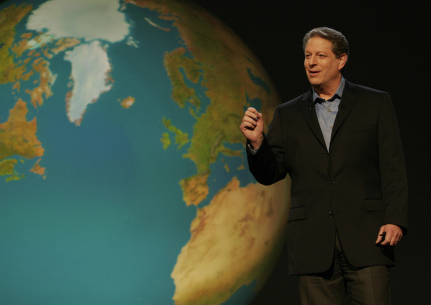
al-gore.pngThis year’s Nobel Prize for Peace went to Al Gore and the UN’s Intergovernmental Panel on Climate Change (IPCC) for their efforts to awaken the world about the risks of climate change. That’s great news but I’d have preferred to see the other candidate for the prize, Canadian Inuit Sheila Watt-Cloutier share the award with the IPCC not Gore.

Three Reasons Why Gore Should Not Have Won:

1. Watt-Cloutier has been a passionate and eloquent communicator about the fact that indigenous people of the Arctic, and indigenous peoples elsewhere, have taken the first and hardest climate change hits so far. It would be been fairer and more representative of the reality to award the prize to an indigenous person.watt-cloutier.png

2. For eight long years Al Gore was second in command of the largest greenhouse gas emitting country in the world. And yet emissions climbed and climbed even though Gore knew climate change was a real and pressing emergency. When running for President Gore barely mentioned GW and then the world had to suffer thru the other GW — George W Bush and his blind and selfish intransigence.

3. Al Gore’s GW solutions are mostly wrong. Biofuels are a bad idea and only make rich agri-corporations richer. Carbon trading markets are an equally bad idea — enshrines the rich countries’ right to pollute our common atmosphere. A moratorium on coal and a carbon tax are some of his better ideas. However, Gore fails to address the root of the problem which is an economic system based on endless growth on a tiny planet with an awful lot of people.

“People do want to do the right thing, but they just don’t realise that the Arctic is melting and they are responsible,” Watt-Cloutier told me in 2004. From Global Warming Will Decimate Arctic Peoples and also see Inuit Sue America Over Climate Change

Inuit Sue America over Climate Change

By Stephen Leahy

The Inuit people of the Arctic regions are preparing to charge the United States with human rights violations, saying that country is the leading culprit behind climate change, which threatens their way of life — and their very survival.

Originally published in Latin America Feb 15 2005 by Tierramérica

The sharp increase in temperatures in the Arctic has led to dramatic losses of sea ice and melting permafrost (the layer of ground that normally remains frozen year round), which have destroyed buildings and roads and forced relocations of entire native Inuit villages. Continue reading

Global Warming Will Decimate Arctic Peoples

By Stephen Leahy10000660_jpg.jpg

Climate change will soon make the Arctic regions of the world nearly unrecognisable, dramatically disrupting traditional Inuit and other northern native peoples’ way of life, according to a new report that has yet to be publicly released.

Originally published in September 11 2004 by the Inter Press Service

The dire predictions are just some of the findings by the Arctic Climate Impact Assessment (ACIA), an unprecedented four-year scientific investigation into the current and future impact of climate change in the region. “This assessment projects the end of the Inuit as a hunting culture,” said Sheila Watt-Cloutier, chairwoman of the group that represents about 155,000 Inuit in the Arctic regions of Canada, Russia, Greenland, and the United States.

The report predicts the depletion of summer sea ice, which will push marine mammals like polar bears, walrus and some seal species into extinction by the middle of this century, Watt-Cloutier told IPS. Continue reading

GW Dramatically Rearranging Arctic Landscape

By Stephen Leahy


Credit:micropolisnews

A lone glacier drifts in the Canadian Arctic, Aug. 14, 2007.

Oct 4 (IPS) – The hot breath of global warming has now touched some of the coldest northern regions of world, turning the frozen landscape into mush as temperatures soar 15 degrees C. above normal.

Entire hillsides, sometimes more than a kilometre long, simply let go and slid like a vast green carpet into valleys and rivers on Melville Island in Canada’s northwest Arctic region of Nunavut this summer, says Scott Lamoureux of Queens University in Canada and leader of one the of International Polar Year projects.

“The entire landscape is on the move, it was very difficult to find any slopes that were unaltered,” said Lamoureux, who led a scientific expedition to the remote and uninhabited island. Continue reading

CANADA: Losing Control of Water Through NAFTA and SPP

By Stephen Leahy

“The SPP (Security and Prosperity Partnership ) is like putting the monkeys in charge of the peanuts.”

[UPDATED Feb 12’08]

TORONTO, Sep 22 2007 (Tierramérica) – Under the North American Free Trade Agreement, Canada lost control over its energy resources. Now, with “NAFTA-plus”, it could also lose control over its freshwater resources, say experts.Canada’s water is on the trade negotiating table despite widespread public opposition and assurances by Canadian political leaders, said Adèle Hurley, director of the University of Toronto’s Programme on Water Issues at the Munk Centre for International Studies.A new report released Sep. 11 by the programme reveals that water transfers from Canada to the United States are emerging as an issue under the auspices of the Security and Prosperity Partnership (SPP). The SPP — sometimes called “NAFTA-plus” — is a forum set up in 2005 in Cancún, by the three partners, Canada, United States and Mexico.

Economic integration as envisioned by the powerful but little-known SPP is slowly changing the lives of Canadians, says Andrew Nikiforuk, author of the report “On the Table: Water Energy and North American Integration“.

The SPP is comprised of business leaders and government officials who work behind the scenes and are already responsible for changes to border security, easing of pesticide rules, harmonisation of pipeline regulations and plans to prepare for a potential avian flu outbreak, Nikiforuk writes.

“The SPP is run by corporate leaders; governments are irrelevant,” said Ralph Pentland, a water expert and acting chairman of the Canadian Water Issues Council.

UPDATE: The Canadian Water Issues Council has written a model law to protect Canadian waters. For more see: Protecting Canada’s Water from the US Continue reading

Pollute for Free – America’s Economic Model

copyright Pembina Institute

If ever there was a project where sustainable accounting is needed, Alberta tar sands oil extraction is it.” — Mindy S. Lubber

Mindy Lubber, president of Ceres, a leading coalition of investors and environmental groups working on sustainability issues notes in this article today that the current “accounting system meant that companies were long able to “externalize” natural resource costs. In other words, they could pollute for free without paying for environmental damage and cleanups. Society and taxpayers shouldered these costs instead.”

Reform of this not-grounded-in-reality accounting and economic system is essential to move towards sustainable societies.

Canada’s oil or tar sands that supply the US with much of its oil is devastating huge swaths of pristine boreal forest, ruining wild rivers and polluting the air of the north Lubber says. For more on the environmental impacts of the biggest industrial project on the planet see Destroying Canada’s Boreal Forest for America’s Oil

Who Owns the Arctic?

arctic-oil-rig-on-ice.pngWith Russia planting its flag 14,000 feet under the North Pole yesterday, oil and gas exploration and conflict over territorial rights in the vast Arctic ocean basin is just beginning.

“The Arctic is one of the last frontiers, representing about 25 percent of the last unexplored potential oil and gas reserves in the world,” says Michael Byers, Canada research chair in Global Politics and International Law at the University of British Columbia

Sovereignty Claims Revived in the Arctic
By Stephen Leahy

(Originally published in 2006)

TORONTO, Apr 22 (Tierramérica) – An expedition is under way to help Canada and Denmark prove their sovereignty over certain areas of this frozen region, and its potential sources of petroleum and natural gas.

Canada and Denmark launched a joint expedition in early April to map the floor of the Arctic Ocean and help the two countries prove their claims of sovereignty over areas potentially rich in petroleum and natural gas.

Continue reading

Destroying Canada’s Forests for America’s Oil

“Nowhere else in the world where this much money is being invested”

cover 2.0**REVISED** Oil Stains in the Boreal Forest:

The Environmental Cost of Canada’s Oil Sands

An eBook by Stephen Leahy

Oil Stains in the Boreal Forest is a 30-page eBook presenting a factual overview of the environmental impacts of pumping more than 1.1 million barrels of oil — 175 million litres (50 million gallons) — each day to thirsty US markets.

Based on a 4-part investigative journalism series, leading scientific and environmental experts along with industry officials are interviewed.

Recipe for making a make a gallon of gasoline from the oil sands:

  • burn 1500 cubic feet of natural gas
  • use up 700 litres of water
  • dig up two tonnes of earth and rock
  • dump 948 litres (250 gallons) of mine tailings

And that’s just the beginning – now the crude has to be processed.

Oil Stains in the Boreal Forest   includes pictures of the destruction of virgin boreal forest, links to access additional information, and a peek at a new economic study that shows oil company profits are subsidized by not having to pay for their pollution.

Download your copy of the updated 2009 version 2.1 today for only $3.75
Oil Stains in the Boreal Forest: The Environmental Cost of Canada’s Oil Sands 2.1

eBook -Version 2.1 (2009) – full-color, 8 1/2 x 11″,  30 pages   (14 mb pdf download) 

Learn more about the author


Canadian Government Thinks People Are Stupid

copyright Pembina Institute

Canada’s New Plan “Pretends” to Curb Emissions, Say Activists

By Stephen Leahy

Apr 26 (IPS) – Canada’s newest plan to curb greenhouse gas emissions will be much too little and too late, environmentalists said Thursday.

Its third climate action plan in less than two years, the Canadian government proposal titled “Turn the Corner”, released Thursday afternoon, proposes to reduce emissions 20 percent by 2020. However, that would be a 20 percent reduction from 2006 levels.

“That would leave Canada 11 percent above its Kyoto commitments many years after the country is legally obligated to meet them,” says John Bennett of the Climate Action Network Canada, a coalition of environmental groups.

“This government is all about pretending to reduce emissions,” Bennett told IPS.
Continue reading

Just Published: Oil Stains in the Boreal Forest

os-cover.jpg


Oil Stains in the Boreal Forest:
The Environmental Cost of Canada’s Oil Sands

A New eBook Available Here

Canada’s oil sands are the world’s largest industrial project easily visible from space. Some of the environmental impacts can also be seen from space but many more are invisible and unacknowledged in their entirety until now.

Oil Stains in the Boreal Forest offers a fast, factual overview of the environmental impacts of pumping more than 1.1 million barrels of oil — 175 million litres/50 million gallons — each day to thirsty US markets. Leading scientific and environmental experts along with industry officials are interviewed to provide the full story.

Oil Stains in the Boreal Forest includes pictures of the environmental destruction, hyperlinks for additional information, a bonus chart on The Real Cost of Tank of Oil Sands Gas and a new economic study that shows Oil Company profits are based on no-cost pollution.

Written by independent journalist Stephen Leahy who has been published in New Scientist, The London Sunday Times, Maclean’s Magazine, The Toronto Star, Wired News, Audubon, BBC Wildlife, and Canadian Geographic. Leahy is the science and environment correspondent for Inter Press Service News Agency (IPS), a wire service headquartered in Rome that covers global issues, and its Latin American affiliate,Tierramérica, located in Mexico City.

Oil Stains in the Boreal ForesteBook – full-color, 8 1/2 x 11″, 28 page pdf (1.2 mb download) Special publication price $6.00