Overcoming Climate of Despair and Apathy

a.jpeg“Climate Change, Despair and Empowerment” roadshow is coming to North America starting in Miami April 14 and on to Arkansas, Ontario, US Northeast. Author and eco-activist John Seed of Australia leads a series of ‘pay-what-you-can’ workshops designed to start, invigorate and support grassroots climate study/action groups.

The evening or day long workshops address the hopeless despair that many people feel and provide tools to transform despair into empowerment and effective action. This will be based on the Despair & Empowerment work of Joanna Macy and will:

* unveil the false and “business as usual”, solutions being touted by the major political parties such as nuclear power and so called “clean coal”.

* raise awareness and inspire political action towards the real solutions that we, the people, must insist upon. (eg. end the many billion dollars a year in subsidies to the fossil fuel industries, support energy efficiency, solar, wind etc.)

* provide resources for the many things that we can all do to turn the situation around.

* Support a network of Climate Study/Action Groups across N America.

Highly recommended — see this recent story for more about the roadshow and what it hopes to accomplish:

Passion Needed to Meet Climate Challenge

Dust Bowl Returns Permanently to US Southwest

Southwestern U.S. Becoming a Dust Bowl
Stephen Leahy

Apr 5 (IPS) – The severe seven-year drought in the Southwestern United States is just the beginning of a new and even drier climate for the region due to climate change, scientists say.

The infamous “dust bowl” conditions of the 1930s will be the norm, with the possibility that the aridity will be unlike anything in the past, according to research published Thursday in Science — one day before the release of another key report by the Inter-Governmental Panel on Climate Change, which also warns that drought-prone areas are likely to become even drier due to global warming.

According to Ming Fang Ting, a senior research scientist at Columbia University’s Lamont-Doherty Earth Observatory and co-author of the Science study, the current drought in the U.S. Southwest is not part of the natural variability in climactic conditions.
Continue reading

Overfishing Sharks Leading to Ecological Collapse

As Sharks Vanish, Chaotic New Order EmergesWhite Shark courtesy of TOPP
By Stephen Leahy

Mar 29 (IPS) – Major declines in large sharks along the U.S. coast have in turn triggered declines in shellfish and reduced water quality, proof that the ocean’s food web is collapsing, a groundbreaking new study reveals.

With the virtual elimination of large sharks along the U.S. east coast, such as black tip and tiger sharks, the species they used to eat — small sharks, rays and skates – have boomed in numbers. Cownose ray populations increased 20-fold since 1970 and as a direct consequence, shellfish like scallops that the cownose ray eats have been nearly wiped out despite major conservation efforts.

The cascade of impacts resulting from overfishing large sharks goes further still, marine scientist Ransom Myers and coauthors document in a paper published Thursday in Science. The loss of scallops has reduced water quality because scallops and other shellfish filtre sea water. And the cownose ray is now feeding voraciously on other shellfish, like oysters and clams.
Continue reading

Biofuels and Carbon Credits Behind Global Deforestation

Biofuels Boom Spurring Deforestation
By Stephen Leahy

Mar 21 (IPS/IFEJ) – Nearly 40,000 hectares of forest vanish every day, driven by the world’s growing hunger for timber, pulp and paper, and ironically, new biofuels and carbon credits designed to protect the environment.

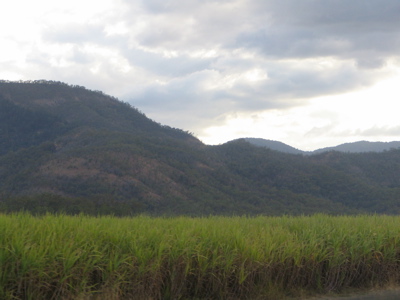
Sugarcane field Queensland Australia Copyright Renate Leahy 2004The irony here is that the growing eagerness to slow climate change by using biofuels and planting millions of trees for carbon credits has resulted in new major causes of deforestation, say activists. And that is making climate change worse because deforestation puts far more greenhouse gases into the atmosphere than the entire world’s fleet of cars, trucks, planes, trains and ships combined.

“Biofuels are rapidly becoming the main cause of deforestation in countries like Indonesia, Malaysia and Brazil,” said Simone Lovera, managing coordinator of the Global Forest Coalition, an environmental NGO based in Asunción, Paraguay. Continue reading

Environmental Changes Wiped Out 170 Amphibian Species Over Past 20 years

Frogs Fading Into Silence

By Stephen Leahy

The extinction of amphibians in Latin America has reached alarming proportions: 209 species in Colombia and 198 in Mexico alone are in danger of disappearing forever

Mar 5 (Tierramérica) – Frogs and other amphibians are rapidly becoming extinct around the world and in Latin American countries in particular. In the Caribbean as many as 80 percent of these species are endangered, while in Colombia there are 209 and in Mexico 198 amphibians may soon disappear.

Environmental degradation along with habitat loss, ultraviolet radiation, disease and climate change are all factors involved in these unprecedented losses.

Continue reading

Peak Fish: The Beginning of the End of Ocean Seafood

Ocean Fisheries Maxed OutCopyright 2004 Renate Leahy

By Stephen Leahy

Mar 5 (IPS) – Two-thirds of fish stocks in the world’s high seas are overfished, while most of those closer to shore are failing or fished to the maximum, a new U.N. report said Monday.

More and stronger regional fisheries management organisations are needed to rebuild depleted stocks and prevent the collapse of other stocks, warned the FAO’s latest “State of World Fisheries and Aquaculture” (SOFIA) report.
Continue reading

Response To Global Change Too Slow


Paraphrase of the Day:

Institutions are not responding fast enough to the industrial might and scale of change that is happening be it climate change or rapid loss of species or decline in the global fisheries. The rate are which our institutions take action is simply too slow. — Daniel Pauly, director of the Fisheries Centre at the University of British Columbia.

See complete story

Heed the Warning of the Frogs

Amphibians are rapidly going extinct around the world — 43 per cent of known species are in decline according to the Global Amphibian Assessment.

Frogs and other amphibians are warning us about environmental deterioration that threatens all species and our own well being, said Alan Pounds an ecologist at the Tropical Science Center, Monteverde Cloud Forest Preserve in Costa Rica.

“We should be listening to the message from the frogs.”

Story to be completed and published in a few days.

Melting Ice Offers Window on Polar Ecosystem

Copyright Alfred Wegener Institute for Polar and Marine Research

By Stephen Leahy

Feb 27 (IPS) – The collapse of Antarctic ice shelves due to climate change is providing the first views of marine life hidden deep under the polar ice for more than 5,000 years.

A 10-week Antarctic international expedition to probe the region’s secrets is also the first major scientific effort of the International Polar Year that was officially launched Monday in Paris and London.

Continue reading