Climate Change Driving Our Weather Crazy

flooding of jersey shore
Flooding of New Jersey shoreline

By Stephen Leahy

Helle Thorning-Schmidt came home at 3:30am one night last August to find her home flooded after heavy rains. Ironically the Danish prime minister had been attending European Commission meetings discussing climate change among other topics. As she cleaned up the soggy mess at home, she recalls thinking that “climate change truly affects us all”.

According to the Intergovernmental Panel on Climate Change (IPCC) Synthesis Report, there are now more and longer-lasting heat waves, more heavy rainfall events, bigger storm surges, larger wildfires and other extreme events than prior to 1950. Some of these “have been linked to human influences” and such events are “very likely” to get worse in future than they are today, the IPCC report concludes.

For example, Denmark has experienced extensive flooding in recent years. In 2011, one downpour resulted in 5 billion euros in damages to the city of Copenhagen alone. “We’re having lots of floods now and these are badly damaging our infrastructure,” Thorning-Schmidt told 750 attendees at the IARU Sustainability Science Congress in Copenhagen in October. “Climate change is happening now.”

“All weather events are affected by climate change because the environment in which they occur is warmer and moister than it used to be,” says Kevin Trenberth, senior scientist at the National Center for Atmospheric Research (NOAA) in Boulder, Colorado and an expert on extreme events.

Conditions in the atmosphere have fundamentally changed, he explains, thanks to hundreds of millions of tonnes of carbon dioxide emitted from burning fossil fuels. Carbon dioxide traps the sun’s heat and as a result there is far more heat energy in the climate system and warmer temperatures. This also means 4-6% more moisture in the air – “fuel” for storms that makes them more destructive, says Trenberth.

“This is the new normal,” he says. “It doesn’t make sense to rebuild in some regions – they’ll just be swept away again.”

Changing odds

This new normal is borne out by a ground-breaking series of studies of 16 extreme weather events in 2013, most of which bear the fingerprints of climate change according to a team of researchers from around the world. For the first time, thanks to new data and better computer models, scientists were able attribute the odds of actual extreme events occurring with or without climate change. They found that climate change increased the odds of nine extremes in 2013: heat waves in Australia, Europe, China, Japan and Korea, intense rain in parts of the United States and India, and severe droughts in California and New Zealand. The studies were published in the special edition of the Bulletin of the American Meteorological Society in September.

California’s devastating drought is ongoing and researchers at Stanford University determined that the warming from carbon emissions was three times more likely to create the conditions for drought than with no emissions. “There was a strong link to climate warming,” says Stanford’s Daniel Swain.

Australia’s record breaking heat wave in 2013, meanwhile, would not have happened without climate change, Swain told chinadialogue. Not all extreme events are so clearly connected to global warming, however, in large part because the complex natural variability of weather systems and a lack of data in some cases, he added.Seaside Heights, New Jersey, on October 31, 2012. (AP Photo:Mike Groll)

Forecasting where and when extreme events will occur is even more challenging. However a new mathematical method based on “big data” may help to predict extreme rainfall in the South American Andes. An international team of scientists led by Germany’s Potsdam Institute for Climate Impact Research (PIK) say they can “correctly predict 90% of extreme rainfall events in the Central Andes”.

“The data was there, but nobody joined the dots like this before,” says co-author Jürgen Kurths of PIK.

Rising costs

The insurance industry is getting increasingly worried by the strengthening evidence that climate change is increasing extreme weather since they face rapidly rising bills. In Canada, for example, property damages from extreme weather averaged US$200 to US$500 million a year over 24 consecutive years. In the last six years it shot up to US$1 billion a year and in 2013 it was US$3.4 billion.

“Extreme weather events are increasing in frequency and intensity,” explains Blair Feltmate, professor at Canada’s University of Waterloo and chair of the Climate Change Adaptation Project Canada, though not every event is caused by climate change.

“It’s like a baseball player on steroids: you can’t say every home run is because of the drug but it does increase the odds of hitting more home runs.”

He adds: “What people need to understand is this is only going to get much worse. A US$35 billion flood is coming to Canada.”

Many countries have contributed relatively little CO2 to the fossil-fuel blanket heating the planet but are, like the Philippines with Typhoon Haiyan, which killed more than 6,000 people, already experiencing significant impacts from extreme events. This reality was officially recognised at a contentious United Nations climate treaty meeting last December in Warsaw, Poland.

After 36 straight hours of intense negotiations industrialised nations finally agreed with developing nations that a new climate treaty will have what’s called a “loss and damage mechanism”, or the “Warsaw mechanism”. This recognises that the impacts of climate change will lead to both economic and non-economic losses, including the growing issue of climate refugees.
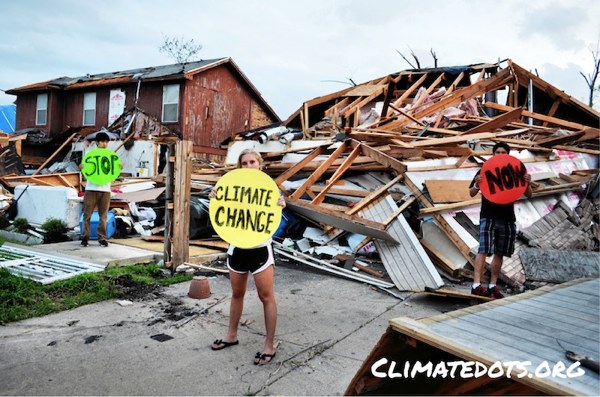
TXTornadoesDots
Aftermath of an early tornado in Lancaster, Texas. To join thousands of others connecting the dots between climate change and extreme weather, visit ClimateDots.org.

Nearly a year later there has been little progress on fleshing out how the Warsaw Mechanism will work. A leaked internal US State Department document revealed US fears that poor nations will seek “redress for climate damages from sea level rise, droughts, powerful storms and other adverse impacts”.

A new climate treaty that effectively phases out carbon emissions entirely was signed by all nations in Paris in December 2015. However difficult issues including financial assistance for adaptation and a functional Warsaw Mechanism were not resolved in Paris.

“From a science perspective there is a good case that climate change contributed substantially to the damage from Haiyan,” says NOAA’s Trenberth. How much damage is hard to determine. In addition perhaps there were too many people living in too vulnerable a region he said. “Who was responsible for that?”

Updated dec 2015. First published on China Dialogue 17.11.2014

Paris Climate Talks – Canada’s “Thrilled”

Canadian Minister of Environment and Climate Change Catherine McKenna speaks during a news conference, in Paris, France, on Nov. 29, 2015. The Climate Action Network International awarded Canada a second place "fossil of the day" award today at the COP21 climate summit, citing the reluctance of Canadian negotiators to have compensation for weather destruction in poor countries included in the final Paris agreement.THE CANADIAN PRESS/Adrian Wyld
THE CANADIAN PRESS/Adrian Wyld


I’m really thrilled Canada was able to play an active part of it.

— Catherine McKenna,  Minister of environment and climate change

Years from now, today may very well be the day our children look back to as the beginning of an ambitious global effort to finally fight climate change. I am proud of the role Canada is playing in reaching this historic and balanced agreement, and I am confident that the world will rise to the challenge of addressing climate change.

— Justin Trudeau, Prime Minister of Canada

Canada: What a difference an election can make

cop21 logo smlThe historic Paris Agreement is front page news in most of Canadian media in part because Canada’s new minister of environment and climate change Catherine McKenna was a key player in the final outcome. Moreover McKenna endorsed the 1.5C target, and lobbied to ensure human and indigenous rights were part of the agreement.
In Paris Canada might have won the “most helpful” or “biggest turn around” award if such things existed — 180 degree change from previous COPs.

For eight years under the previous Stephen Harper government, ‘won’ consecutive “Fossil of the Day” awards for being the most unhelpful country. An award Canada’s previous Minister’s of the Environment took pride in. It was a government so intent on supporting the county’s fossil fuel industry it denied the reality that climate change was already impacting the country.

“We see in Canada the impacts of climate change. We have wildfires in B.C.; we have flooding in Alberta; Prince Edward Island is shrinking; and we see in our Arctic the permafrost is melting and hunters have shorter seasons. Canadians know that we need to act, and that’s what we’re going to do,” McKenna told the Toronto Star.

“Now it’s time to do the hard work,” McKenna added. “We’re going to go home and figure out the plan. . . Every Canadian has to do their part.”

Most Canadian media focused on the details of the agreement nearly all considered it a historic shift to a low-carbon economy. Some focused on the huge challenge of doing so calling it daunting.

So far there is little analysis of the implications of the deal for Canada, the world’s fifth largest crude oil producer and the biggest supplier of oil to the US. It is also the third largest producer of natural gas and one of the top ten miners of coal.

For context here is my four part series revealing how Canada became a very wealthy, fossil-fuelled energy superpower and an international climate pariah.

First published on the Climate News Mosaic Paris Climate Talks Live Blog available here:

Why the Paris Agreement is Historic – In 60 Words

cop21 logo sml

Every country in the world just agreed to:

1. Phase out fossil fuels well before the end of the century

2. Try to keep global warming to less than 1.5C (very difficult since it’s already 1.0C)

3. Rich countries will help poor countries to green their economies, help pay for the damages from climate impacts and help them adapt to future impacts.

[The Paris Agreement is like buying life insurance. It’s for the benefit of our children and grandchildren.]

Paris Climate Talks – ‘Betrayal’ vs ‘We Can Work With This’

Screen Shot 2015-12-12 at 10.30.12 AM.jpg


Two Sets of Civil Society Reactions to Final Text of Paris Agreement

– Links to today’s official UN press conference videos –

Greenpeace, WWF, Oxfam: We can work with the Agreement’

Friends of the Earth, Third World Network, International Trade Union Confederation: ‘Agreement is a Betrayal


Paris Climate Talks – Late Breaking Update Friday

cop21 logo smlFinal Paris Agreement to be released Sat Dec 12 at 1030 am CET
Countries will then spend Saturday reviewing, commenting and, if all goes well, voting on the new climate agreement by end of day.

It is certainly possible – some say likely – that contentious revisions will be requested by a few countries and that will delay a final vote until Sunday.

Once accepted by all (or nearly all) — it is a consensus process which often leads to last-minute drama, sometimes forcing the COP President to bend the rules —  the Paris Agreement will be the climate action plan for all nations.

[Check here for the Agreement]

Paris Climate Talks – Human and Indigenous Rights Removed

Screen Shot 2015-12-11 at 2.36.06 PM.jpg

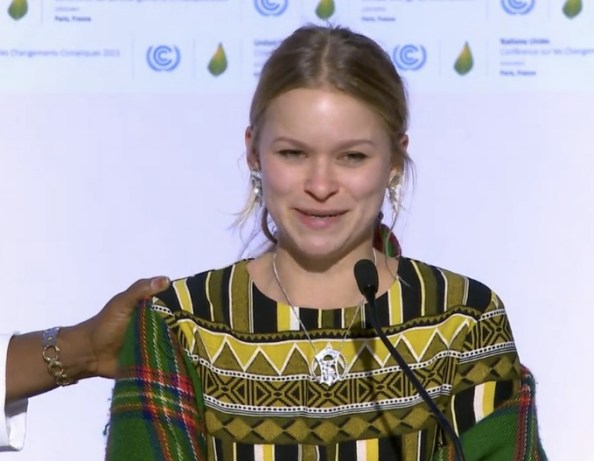
“How can our voices be silenced here?”  Jannie Staffansson – a Sami woman from Northern Europe


We are the persons who are dying. My friends, my family are the ones who go through water, they are the ones killed in avalanches. How can the purpose of this negotiation not be people? How can our voices be silenced here?

  • Jannie Staffansson – a Sami woman from Northern Europe

Two environmental activists are killed every week according to Global Witness, and disproportionate number are Indigenous people

  • Kumi Nadioo, Greenpeace International
References to human and Indigenous rights have been removed from Article 2 in the core part of the Paris Agreement draft. They remain in the preamble. More than 240 civil society groups insist the human rights language be re-inserted into Article 2.

Why is this important?

Article 2 is about the purpose of the agreement which surely is to protect people and the climate said María José Veramendi Villa, Asociacion Interamericana Para La Defensa Del Ambiente (AIDA) of Perú.

“Indigenous peoples are amongst the most impacted by climate change,” she said in a press conference today.

Article 2 also sets out how the agreement is to be implemented. This is crucial because some purported climate actions already in place such as biofuel plantations and carbon sequestration projects have already violated the rights of local people. People have been removed from their ancestral lands and protesters have been killed in Africa, Asia and Latin America.

Norway, the European Union, the US and others oppose the inclusion for reasons that are completely unclear said Veramendi.

“It doesn’t change obligations  that are already in the UN Declaration on Human Rights,” she said.

Countries like the US are only acting to protect the interests of a few powerful corporations in these negotiations, said Greenpeace’s Nadioo.

That’s why there is a global movement, a dynamic movement for real climate action that they cannot stop, he said.

Paris Climate Talks – What Does “Emissions Neutrality” Mean?

cop21 logo smlWhat Does “Emissions Neutrality” Really Mean?

Explainer:
Negotiators have deleted specific emission reduction targets for the long-term goal i.e. +2050. Thursday night in Paris a new proposal surfaced for “greenhouse gas (GHG) emissions neutrality in the second half of the century, on the basis of equity and guided by science in the context of sustainable development and poverty eradication”.

This should mean zero GHG emissions from all sectors by first reducing emissions to near zero and then using negative emissions (taking CO2 etc out of the atmosphere) to achieve net zero.

Defining it as GHG neutrality vs carbon neutrality is very important from climate science perspective. In 2012, 23% of emissions were non-CO2 greenhouse gases.

Bottom line:

There is no way to get to 1.5C or 2.0C without GHG neutrality before 2100. What’s missing in the agreement is a specific time table – “second half of the century” is pretty vague. Expect this to change at some future COP (yes there will be many more) when the science catches up with figuring out what is needed to achieve it.

Paris Climate Talks – Reactions to New Dec 10 Text

Things are moving faster than expected, debate continues overnight with hopes of a final agreement ready to be voted on late Friday. We’ll see. Remember this is a consensus process, one country can hold up the rest. 

NEW TEXT HEREcop21 logo sml

It is slightly longer with about 50 brackets – down from 150 to 200. 

Some reactions in the order they were made:

“The standard of any effective climate policy is clear: does it keep fossil fuels in the ground and accelerate a just transition to 100% renewable energy?

The commitments we are seeing in the text are a start, but they won’t get the job done, so activists are already mobilizing to close the gap between rhetoric and reality.”
— Payal Parekh, 350.org Global Managing Director

At first glance happy with new COP21 draft – target ‘well below 2C’ and ’emissions neutrality’ in 2050-2100 both ambitious but achievable
— Corinne Le Quéré (@clequere)

$100bn confirmed as rich nations’ floor in new draft Paris #COP21 text. Left – today Right – yesterday
— Simon Evans (@DrSimEvans)

#Oceans #biodiversity & “Mother Earth” out of #brackets in Preamble #update #UNFCCC #COP21
— Paris Agreement News (@ParisAgreement)

Binding part of new #climate agreement draft no longer includes #humanrights – that is going to upset a lot of people
— Megan Rowling ‏@meganrowlin

I see “people in vulnerable situations and under occupation” remains… here’s why that’s a little tricky: http://www.climatechangenews.com/2015/12/07/israel-palestine-conflict-seeps-into-paris-climate-talks-in-human-rights-row/
— Edward King

As I’ve been saying, addition of 1.5C wording is about recognizing harm to small islands and other countries #COP21 pic.twitter.com/Cw4Di5dtGz
Simon Donner (@simondonner)

3rd draft is out. No liability/compensation. Adriano Campolina of @ActionAid called it “draft deal that denies the world justice”
— Stella Paul (@stellasglobe)

By including a clause for no future claim of compensation and liability, the US has ensured people suffering from the disastrous impacts of climate change will never be able to seek the justice owed to them.

This unfair and unjust draft deal won’t face up to the realities of climate change and will only serve to widen the chasm between rich and poor.Rich countries have a responsibility to ensure a fair global deal for everyone, not just themselves, and as we move into these final hours of negotiations poorer countries must not settle for anything less.
— Adriano Campolina, ActionAid Chief Executive

New #COP21 text is remarkably streamlined. But big issues on target, differentiation (funding) & transparency still open. Important progress
— Simon Lewis (@SimonLLewis)

First published on the Climate News Mosaic Paris Climate Talks Live Blog available here:
Inter Press Service News Agency (International)
DeSmog Blog (Seattle)
Philippine EnviroNews (Philippines)
Earth Journalism (International)
Watson (Switzerland)
Skeptical Science (International)

Paris Climate Talks – New Text Now, Final On Track for Friday

Screen Shot 2015-12-10 at 3.25.06 PM
In a very brief session at 21:00 COP President Fabius says he will lead meetings of negotiators from 11.30 pm and overnight to hash out “compromises” and “landing zones”.

“I think I will be able to present final text tomorrow,” he said.

NEW TEXT HERE

It is slightly longer with about 50 brackets – down from 150 to 200.