Paris Climate Talks – Breaking: Options for Global Target 1.5C

Final President’s Draft  Just Released

At 3pm CET Dec 9 the President’s draft was released. It’s much shorter at 29 pages. A quick glance reveals perhaps two dozen brackets down from 800 a few days ago.

Parties will review this new next and reconvene the plenary at 8 pm CET to figure out how to resolve the remaining contested issues.


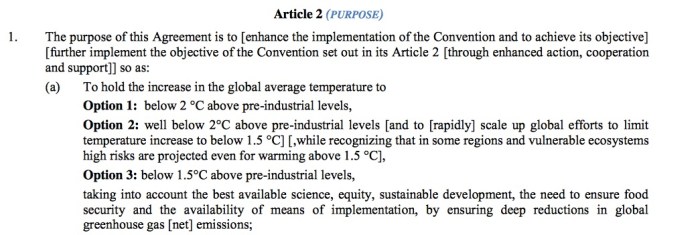
 On the Contentious Issue of 1.5 vs 2.0C

— 3 options still to debate — see below

Screen Shot 2015-12-09 at 9.47.40 AM.jpg

Paris Climate Talks – Final Draft Deadline Wednesday 1 pm CET

cop21 logo smlParis Accord Final Draft Due Wednesday
COP21 President Fabius sets deadline for a clean text by 1 pm Wed in Comité de Paris plenary this evening.Clean text means removing most (90%?) of the 600 to 800 brackets currently in the draft. (Read it here)

Fabius still believes that the Accord can be finalized and voted on by Friday  6 pm.

Loss and Damage Impasse?
Late Tuesday in the second Comité de Paris plenary a facilitator reported the loss and damage mechanism – called the “Warsaw Mechanism” — could not be resolved.Loss and Damage is the third pillar of the Paris Accord and pertains to current and ongoing climate impacts. Those impacts result in both economic and non-economic losses, including the growing issue of climate refugees, people who are forced to move because their homelands can no longer support them.

The US and other countries are very concerned this may open the door to liability claims.

This is just one of handful of issues. No one will get much sleep in Paris tonight.

Paris Climate Talks – Fossil Fuel Subsidies Called “Absurd”


Screen Shot 2015-12-08 at 9.26.47 AM

“A price on carbon and fossil fuel subsidies are two opposing forces.”  — Fatih Birol, Executive Director, International Energy Agency  Credit: IISD

At the “Fossil Fuel Subsidies and Climate Change” side event last evening a range of energy experts said continuing to pour  hundreds of billions of dollars of public money into subsidizing fossil fuels was “absurd”, “incoherent”, “unacceptable” and more.

Only 3% of Fossil Fuel Subsidies reaches the poorest 20% of households, said Felipe Calderón, Chair, Global Commission on Economy and Climate.  As often claimed these subsidies do not help poor families nor improve energy access he said.

A few more comments and some startling facts:

The carbon price in Europe is approximately US$10, yet incentives for fossil fuel use, equate to a global average of US$110 per tonne of carbon…an “absurd situation” …

— Fatih Birol, Executive Director, International Energy Association (IEA)

Each hour, US$8 million is spent on Fossil Fuel Subsidies

–Scott Vaughan, President, IISD

 Fossil Fuel Subsidies amount to five times the global annual climate finance commitment of US$100 billion.

— Børge Brende, Minister of Foreign Affairs, Norway

…partial phase out of Fossil Fuel Subsidies would generate 12 percent of the global abatement needed by 2020 to achieve a 2ºC pathway.

— Doris Leuthard, Head, Federal Department of Environment, Transport, Energy and Communications, Switzerland

First published on the Climate News Mosaic Paris Climate Talks Live Blog available here:

Paris Climate Talks – Short Cut to Success?

cop21 logo smlComité de Paris Reveals Significant Disagreements Remain
Special “Paris Committee” (Comité de Paris) created last Saturday evening to sort out the disputed parts of a potential Paris Accord at COP 21.

It is comprised of 14 ministers from various countries have split the draft accord into four key issues . Monday night facilitators reported mostly progress and good will.

However when the floor was opened some countries raised questions and concerns about both the contents of the draft agreement and the openness and transparency of the Comité de Paris process. This included requests for more detailed word by word negotiation.

However a final draft must be completed in 48 hours reminded Laurent Fabius, COP 21 President.

It is unlikely that all contested issues will be sorted by end of day Tuesday say observers.

“A line by line negotiation is not feasible” –Miguel Arias Cañete, Commissioner for Climate Action and Energy, European Commission representing the EU said late Monday evening.

Paris Climate Talks – Peak CO2 Already?

Screen Shot 2015-12-07 at 3.32.09 PM
Have We Reached the Crucial Peak in Global CO2 Emissions?
New report released today says CO2 emissions will likely decline this year for the first time after growing 2-3% per year for last 15 years.

“Whether a slower growth in global emissions will be sustained depends on the use of coal in China and elsewhere, and where new energy will come from. In 2014, more than half of new energy needs in China were met from renewable sources such as hydro, nuclear, wind, and solar power.” — Corinne Le Quéré, Director of the Tyndall Centre

  • cop21 logo sml

Paris Climate Talks – Halfway Done but Long, Uphill Road Ahead

earthatnight sml
Halfway through the ‘historic’ Paris climate talks and things are going far too slow leaving major issues for last day, late night bargaining by country leaders. This is despite six years of previous negotiations since Copenhagen in 2009. 

There are now two alternative draft texts — each less than 50 pages long but still containing 200 to 300 brackets (disputed text) each.
Some of this weeks ‘hot’ issues:
cop21 logo sml
Science says 1.5C; Oil Rich Countries say 2.0C 
Countries continue to block agreement based on their short term self interest – looking at you oil-producing Arab countries blocked 1.5C as a new global target. Recent scientific studies show 1.5C provides better protection for all nations – 2.0C condemns some to drown, many to starve.


No Human Rights?
Norway and some Arab states don’t want any reference to human rights in the new climate deal. This has been in the text for nearly a year.
Where’s the Money?
Finance or funding to help developing nations survive climate impacts remains at an impasse as it has for a long time. Countries were promised this funding in 2009 and it was to ramp up to $100 billion a year by 2020. That has not happened. 

“I’m out of words, it’s just not right,” said Juan Hoffmeister, a Bolivian negotiator.


Transparency and Verification of Commitments
Although technical, another outstanding issue is “transparency”. What’s the proof countries are actually cutting emissions as promised? Rules and expert review formulas for verification are hotly contested. China and India wanting lax rules and no independent review while US insisting on strict ones.
Will We Get a Paris Climate Accord?
In the end there will be an agreement of sorts – the “Paris Climate Accord”?  What-ever the final title, it will not set the world on a path to 2.0C. Far deeper CO2 emissions cuts and more investment will be needed. 

First published on the Paris Climate Talks Live Blog available here:

Paris Climate Talks: Cities are 70% of C02 Emissions – Fighting to be Climate Leaders

By Stephen Leahy

National Governments Should Be Helping Green Cities

Cities are responsible for 70 per cent of global CO2 emissions but they can save the planet by greening one community at a time said Vancouver’s David Cadman at the close of the ICLEI World Congress 2015, the triennial sustainability summit of local governments in Seoul, South Korea.

cop21 logo sml“We can do it. We must do it,” Cadman, the retiring president of Local Governments for Sustainability, told some 1,500 delegates from nearly 1,000 cities and local governments in 96 countries on April 11.

The majority of climate actions and most plans to reduce CO2 emissions are happening at the city level, Cadman told DeSmog Canada in Seoul.

Vancouver and 50 other cities have committed to 100 per cent renewable energy and 500 more are part of ICLEI’s Cities Climate Registry that documents verifiable CO2 emission reduction actions and commitments that amounted to 2.8 billion tons a year in 2014.

Cadman, a former City of Vancouver councillor, has been president of ICLEI since 2006. It’s an international organization headquartered in Bonn, Germany, with 280 staff and 23 other offices scattered around the globe. ICLEI, which stands for International Council for Local Environmental Initiatives, started 25 years ago in Toronto to help cities become more sustainable. It now goes by the more manageable name of “Local Governments for Sustainability,” but still uses the original acronym.

Canada’s federal and provincial governments were very strong supporters in the early days but the past decade has been very different.

Canada Chained to Fossil Fuel Sector

“We seem to be chained to the fossil energy industry in Canada and it’s pulling us down. Cities and organizations can hardly dare to speak out about this now,” he said.

Germany was only too happy to bring ICLEI to Bonn eight years ago and has been generous with its support, along with the European Union. Now the organization is experiencing what is being called an “Asian pivot,” with the mayor of Seoul, Park Won Soon, as the new president.

Park has helped Seoul to become one of the world’s leaders on sustainable development. With 11 million people and growing fast, Seoul will reduce its energy use and increase renewable generation including rolling out 40,000 solar panels to households by 2018 and 15,000 electric vehicles. By 2030, CO2 emissions will be cut 40 per cent.

“Action on climate will be by local governments no matter what national governments decide,” Park Won Soon told DeSmog Canada.

“We need to act quickly, we need to act energetically,” the mayor said.

China’s megacities are also joining ICLEI. At the congress, Hailong Li, deputy secretary general of the China Eco-city Council said the country will have 100 low-carbon eco-cities by 2017. That will drive down the costs of energy efficiency and renewable energy, Li said.

China also intends to become an expert on eco-construction and to market its expertise to the rest of the developing world.

By 2030 another 3.5 billion people will be living in cities so it is absolutely critical that the infrastructure be sustainable said Cadman who will continue to be active as special representative to the new ICLEI President.

Canadian cities could also do more and sooner if they had the support of provincial and federal governments, he said. That may be changing at the provincial level with growing support for various forms of carbon taxes that will help generate funds and financial incentives to reduce emissions.

“The provinces are doing the heavy-lifting on climate while the Harper government sits on the sidelines.”

Fossil fuels are in decline — divestment is taking off and investments are shifting to renewable energy. There’ll be no pipelines to the West Coast and no new investments in the oilsands, Cadman said.

Even in B.C., the hoped-for markets for LNG may not exist with China building gas pipelines to tap reserves in Iran and Russia, he said.

“Canada needs to move away from selling raw resources, but is any political party ready to go there?”

First published April 2015

Paris Climate Talks – Voices 4 Mother Earth Gathering

Sacred prophesies of Indigenous peoples say the gathering  of people at the Paris climate talks are turning point for humanity

From 1 to 5 December 2015 some thirty outstanding Wisdom Keepers from around the world – elders and grandmothers of Indigenous Peoples, spiritual leaders, scientists, economists, artists, youth and more – will gather in the Voices 4 Mother Earth Gathering – World Wisdom Gathering just outside Paris.

“We recognize that all people are members of the Human Family and that our life depends on our Mother Earth. We accept our obligation to our children and our children’s children to live in modest harmony with all living things.”

Paris Climate Talks: Global Warming Explained in 60 Seconds or Less

cop21 logo sml

One night in a bar a Russian journalist who I’d just met says:  “This global warming is too complicated for people to know if it’s real or not”.

“You don’t think climate change is happening?” I asked with surprise since we were both covering a big United Nations climate conference.

“No one has been able to give me a good explanation to prove it’s real,” said Yuri (not his real name).

“I can explain it to you in less than one minute,” I replied.

Yuri was sceptical but I went ahead and said:

“The moon has no atmosphere so it is scorching hot (+100C) during the day and bitterly cold (-150C) at night. The Earth has an atmosphere made up of oxygen, nitrogen, carbon dioxide (CO2) and other gases. Over 150 years ago scientists proved that CO2 traps heat from the sun. We also know without any doubt that burning fossil fuels like oil, gas and coal emits CO2.

Measurements, not computer models or theories, measurements show that there is now 42% more CO2 in the atmosphere than 150 years ago before massive use of fossil fuels. That extra CO2 is like putting another blanket on at night even though you are already nice and warm. The Earth is now 1.0 C hotter on average according to the latest measurements. Heat is a form of energy and with so much more energy in our atmosphere our weather system is becoming supercharged resulting in stronger storms, worse heat waves, major changes in when and where rain falls and more.

That’s it.

After a long silence Yuri says “I guess that makes sense…”.

I’m not sure he was convinced but the truth is that climate change is not that complicated.

One additional thing to know is that CO2 is forever. Every little CO2 molecule we add to the atmosphere will continue to trap the sun’s heat for hundreds and thousands of years.

First published Aug 2015

Paris Climate Talks – Most Countries Want 1.5C Target not 2.0C


Wrapping Day 2 of COP 21
 

Majority of Countries want 1.5 C target not 2.0C

Leaders of 30 nations began the Paris climate negotiations with a call to cut CO2 emissions dramatically to keep the global average temperature rise below 1.5C. These countries are part of Climate Vulnerable Forum (CVF) — countries highly vulnerable to impacts of climate change.

The call for a global target of 1.5C is supported by 106 of the 195 countries in Paris this week. They also call for 100 percent renewable energy and a full decarbonization of the global economy by 2050.

Important to note that 2.0C is a political target not a scientific one. Moreover climate science does support 1.5C as a safer level of climatic change than 2.0. Currently global warming is 1.0C.cop21 logo sml 

Leaders Inspired Speeches but BAU for Negotiators
Monday saw 150 leaders making speeches about the need for urgent action. However in the negotiating rooms today it was business as usual crawling along at a snail’s pace with negotiators apparently oblivious to their leaders impassioned speeches and pleas for urgent action said Saleemul Huq is the Director of the International Centre for Climate Change & Development (ICCCAD) in Bangladesh.

Renewables Everyone’s Favorite Energy Technology

Billions and billions of dollars are being promised for renewables:
U.S. President Barack Obama, French President Francois Hollande and 18 other world leaders launched Mission Innovation, a $20-billion commitment to accelerate public and private clean energy innovation worldwide.

Bill Gates and other tech billionaires unveiled the Breakthrough Energy Coalition, to bring billions of dollars to help new, clean energy technologies come to market.

India’s prime minister announced an international solar alliance of over 120 countries. 

Tuesday also featured a focus on forests


Deforestation accounts for at least 12 percent of CO2 emissions and among developing countries it’s often the largest source of emissions. Today the Lima-Paris Action Agenda “Forest Focus” launched a number of forest protection initiatives including a commitment Germany, Norway and the United Kingdom, to provide $5 billion from 2015 to 2020, if forest countries demonstrate measured, reported and verified emission reductions.

First posted on Climate News Mosaic Live Blog