State of Denial: The Real Global Warming Fantasy

What ever happened to common sense?
(based on a true story)

By Stephen Leahy

Two guys were sitting in a bar one evening. The first one says: “Climate change is a complete hoax you know. There’s lots information on the internet proving that.”

“No it’s not” the second guy replies. “I’ve talked to dozens and dozens of climate scientists around the world and read hundreds of reports and studies.”

The first guy responds saying: “All my friends agree with me. This global warming thing was just scam to make money for Al Gore.”

“But I’ve seen the vanishing glaciers, melting Arctic ice, rising temperatures and sea levels and extreme weather events with my own eyes,” says the second.

The first guy, pauses for a few seconds and says: “Well, I guess you’re entitled to your opinion. So let’s just say the jury is still out on global warming.”

The two fall silent for awhile. Finally the second asks: “Let’s say I’m driving you home and it’s foggy out. You tell me to slow down a bit because there’s a sharp curve in the road coming up. Now I’ve never been on this road before and could acknowledge you might know the road well but instead of slowing down I say: ‘you’re entitled to your opinion, but the road looks straight enough to me’ and then step on the gas.”

The first guy gets up and puts on his coat saying: “You’d have to be crazy not to slow down just in case. I don’t think we’re talking about the same thing now.”

“But we are,” says the second as the first guy walks out the door.

Even if the world’s best scientists are wrong about climate change taking action now will create new jobs, save money, clean the air and water, improve energy efficiency, boost the health of our children, reduce our dependency on big oil companies, create more sustainable communities and many more benefits to all.

So you have to wonder why people oppose this.

And should 30 years of climate research done in dozens of countries be correct, the “bonus” in taking action is keeping rising temperatures to no more than 2 degrees C hopefully ensuring our children and grandchildren have a reasonable climate system to live with.

My wish for the new decade is that common sense will come back in fashion.

Related:
Denial & Delay: Global Warming B.S. Detector Tips

Greed Stalls 21st Century Bio-Economy

Interview With One of the Last Environmental Journalists Left Standing

+4 Degrees C By 2060? Alarming But Not Alarmist

07_00_01_News_Panonoramica

By Stephen Leahy

UXBRIDGE, Canada, Oct 9, 2009 (IPS)

The prospect of a four-degree Celsius rise in global average temperatures in 50 years is alarming – but not alarmist, climate scientists now believe.

Eighteen months ago, no one dared imagine humanity pushing the climate beyond an additional two degrees C of heating, but rising carbon emissions and inability to agree on cuts has meant science must now consider the previously unthinkable.

“Two degrees C is already gone as a target,” said Chris West of the University of Oxford’s UK Climate Impacts Programme.

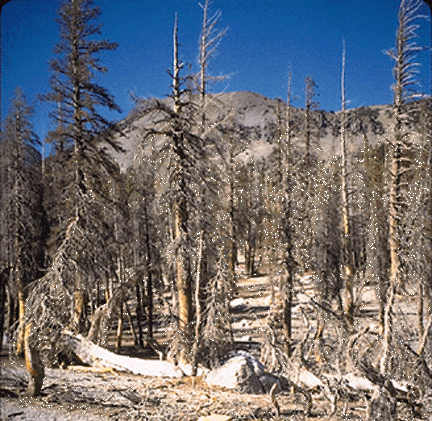
“Four degrees C is definitely possible…This is the biggest challenge in our history,” West told participants at the “4 Degrees and Beyond, International Climate Science Conference” at the University of Oxford last DeadTrees CO2 release naturalweek.

A four-degree C overall increase means a world where temperatures will be two degrees warmer in some places, 12 degrees and more in others, making them uninhabitable.

It is a world with a one- to two-metre sea level rise by 2100, leaving hundreds of millions homeless. This will head to 12 metres in the coming centuries as the Greenland and Western Antarctic ice sheets melt, according to papers presented at the conference in Oxford.

Four degrees of warming would be hotter than any time in the last 30 million years, and it could happen as soon as 2060 to 2070.

“Political reality must be grounded in physical reality or it’s completely useless,” John Schellnhuber, director of the Potsdam Institute for Climate Impact Research, told the conference.

Schellnhuber recently briefed U.S. officials from the Barack Obama administration, but he says they chided him that his findings were “not grounded in political reality” and that “the [U.S.] Senate will never agree to this”.

He had told them that the U.S. must reduce its emissions from its current 20 tonnes of carbon per person average to zero tonnes per person by 2020 to have an even chance of stabilising the climate around two degrees C.

China’s emissions must peak by 2020 and then go to zero by 2035 based on the current science, he added.

“Policymakers who agreed to a two-degree C goal at the G20 summit easily fool themselves about what emission cuts are needed,” Schellnhuber said.

Even with a two-degree rise, most of the world’s coral reefs will be lost, large portions of the ocean will become dead zones, mountain glaciers will largely vanish and many other ecosystems will be at risk, Schellnhuber warned. And there is the risk of reaching a tipping point where the warming rapidly accelerates. Continue reading

James Lovelock: “there will be a sudden shift to a new global climate … 5 or 6C warmer”

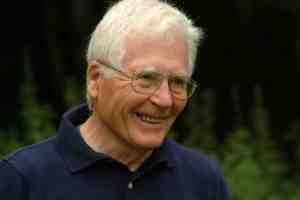
Lovelock_James credit Sandy Lovelock

Stephen Leahy interviews JAMES LOVELOCK the scientist who first proposed the Gaia Hypothesis

TORONTO, June 5 2009 (Tierramérica)

“When the first great climate disaster strikes, I hope we will all pull together just as if our nation were being invaded,” says British scientist James Lovelock in this exclusive Tierramérica interview.

Please throw something in the tip jar before reading on.
This is how I make my living.

As the world marksInternational Environment Day Friday, Lovelock argues that as the climate warms and the carbon content of the atmosphere soars, humanity is facing a far grimmer future that will be upon us sooner than any of the projections made by the Intergovernmental Panel Climate Change (IPCC).

A chemist, physician and biophysicist, Lovelock is one of the world’s foremost environmental scientists and founder of the Gaia Hypothesis, which describes the planet as a living organism, a complex system in which the components of the biosphere and atmosphere interact to regulate and sustain life.

Although his ideas often feed controversy, Lovelock has wide-ranging scientific credentials. As an inventor, he holds more than 50 patents, including the first devices for detecting the presence of ozone-depleting CFCs (chlorofluorocarbons) and pesticide residues in the environment.

He is also the author of many books. The most recent, “The Vanishing Face of Gaia: A Final Warning”, was published in April. Lovelock spoke with Tierramérica’s Stephen Leahy in Toronto.

TIERRAMÉRICA: Why are you critical of the IPCC? Continue reading

Global Warming Puts Food Supplies At Risk, New Green Revolution Needed

cattle-oz-rslBy Stephen Leahy

UXBRIDGE, Canada, Apr 2 (IPS) – Don’t forget about agriculture in the upcoming global negotiations to combat climate change, experts warn. Not only is farming most at risk in an increasingly variable and tempestuous climate, it is also a major emitter of greenhouse gases.

But with the right policies in place, agriculture could both continue to feed the world and play a crucial role in solving the climate problem.

“Agriculture has been missing in the run-up talks to Copenhagen,” says Mark Rosegrant of the International Food Policy Research Institute (IFPRI).

The nations of the world will meet in Copenhagen this December to hammer out a new climate treaty to reduce emissions of greenhouse gases (GHGs) and establish a fund to help poorer countries adapt. The complex process began in 2007 at the Bali talks, continued in Poznan, Poland in 2008 and is ongoing this week in Bonn.

Agriculture accounts for about 15 percent of human emissions of GHGs, IFPRI says, although the Intergovernmental Panel on Climate Change puts it higher at 25 percent. Much of those emissions come from developed countries that rely heavily on fossil fuels and fertilisers and raise far more methane-emitting livestock.

With climate change the world is facing reduced yields of up to 20 percent in maize and rice by the year 2050, Rosegrant told IPS. Much of that yield decline will be in the developing world, mainly because sub-tropical and tropical regions are expected to be hit hardest by significant changes in water availability and warmer temperatures.

Climate change could mean ever-rising food prices and therefore significant investments are needed in agricultural research to help countries cope with the coming changes, he says: “We’re trying to work out what the costs for adaptation in agriculture might be.” Continue reading

Climate Change: ‘Things Happen Much Faster in the Arctic’ – Summer Sea Ice Could be Gone Soon

polar-bear-leap-wwwfirstpeopleus-sml

By Stephen Leahy

We’re going to see huge changes in the Arctic ecosystem

QUEBEC CITY, Canada, Dec 13 2008 (IPS)

In just a few summers from now, the Arctic Ocean will lose its protective cover of ice for the first time in a million years, according to some experts attending the International Arctic Change conference here.

A summer ice-free Arctic wasn’t due for another 50 to 70 years under the worst-case climate change scenarios examined by the Intergovernmental Panel on Climate Change (IPCC).

“Things are happening much faster in the Arctic. I think it will be summer ice-free by 2015,” said David Barber, an Arctic climatologist at the University of Manitoba.

Such a “dramatic and serious loss of sea ice will affect everyone on the planet,” Barber told IPS. Continue reading

Reporter’s Notebook 1999: “CO2 levels in decline last five years”

CO2 levels have been in decline the last five years said Tim Ball, a retired Professor of Geography, on Nov 24, 1999, at the Riverview Center, Guelph, Ontario, Canada.

That statement was completely false then and laughable now, but Ball continues to spew similar lies and misinformation to this day. Just last week Ball was a leading speaker in New York City at last week’s climate change denial festival.

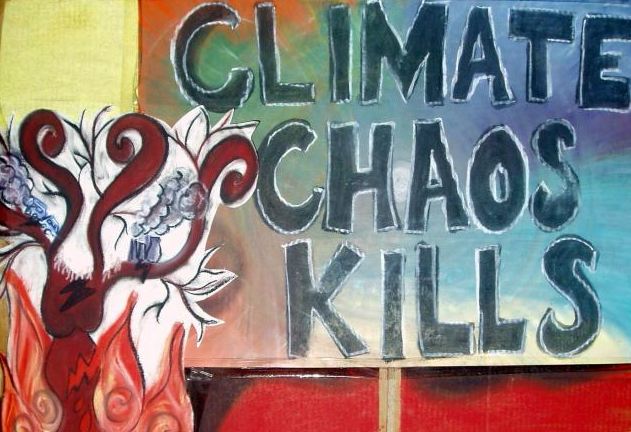
climate-chaos-kills-art-not-oil.jpg

I happened across my notes from the 1999 conference and was stunned at the outrageous comments Ball presented as “facts” to about 200 to 300 business types at a time when people knew little about carbon dioxide or global warming. No doubt many were convinced as Ball claimed (wrongly in every case) that: Continue reading

New Era of Spin in the War to Save Ourselves From Global Warming

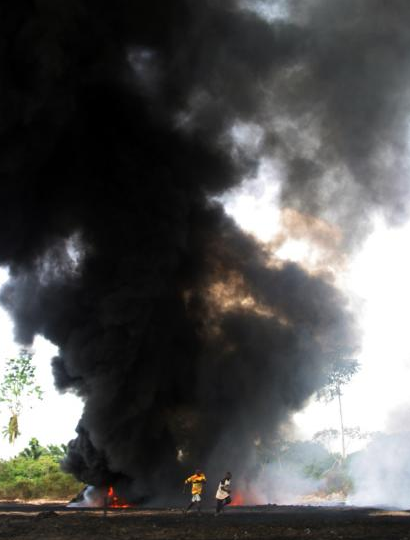
No Getting Around Emissions Caps, Experts Saynigerian oil field

By Stephen Leahy

Feb 5 (IPS) – With the stark realisation that global warming is transforming our world, there will be crazy new era of “greenwashing”, desperate “geo-engineering” schemes, “grandfathering” of newly-built coal power plants and carbon-credit “profiteering”, environmentalists warn.

Welcome to the battle to save ourselves and future generations from the worst impacts of climate change, like increased floods, droughts and storms.
Continue reading