Paris Climate Talks – Walkout Over Finance

cop21 logo smlCOP21 delegates received the updated negotiating text of a potential Paris Climate Agreement (ADP Draft Agreement) wednesday. Still too long at 50 pages and 208 brackets (disputed text/issues).

The text revealed the major perennially thorny issue of funding (finance) to help developing countries cope with climate impacts and move to low carbon energy systems. In a meeting late Wednesday  a coalition of 77 developing nations called the G77 apparently walked out saying developed countries’ were negotiating in bad faith, reinserting old text, and not engaging on #adaptation finance. (Media are not allowed in negotiating sessions or other meetings.)

The G77 chair tweeted her frustration:

“Current text is littered with “no text options” on the areas that are most relevant to empowering action by #G77 countries”
Screen Shot 2015-12-03 at 3.37.11 PM
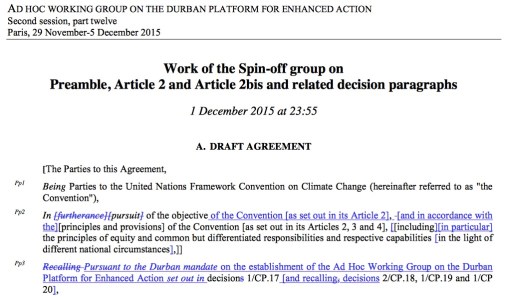
The first page of a draft global climate agreement under negotiation in Paris

That tweet could have been made at every COP since Copenhagen in 2009  The new major economies (Brazil, India) and developing countries want to see more of the billions of dollars rich countries promised in Copenhagen to help countries adapt to climate impacts and reduce their own emissions. So far only about $30 billion has been transferred from north to south since 2010.

The Green Climate Fund is a new mechanism to receive and dole out this cash but it was practically empty in 2014. One of the breakthroughs in Lima last year was a commitment by rich countries to put the bare minimum, $10 billion, into the fund for 2015. It has been an annual struggle to get the money that’s supposed to become at least $100 billion annually by 2020. It is even harder to determine if this is new and additional money — not re-directed foreign assistance — as promised.

In Paris, finance will be a major issue. It is hard to see developing countries signing a new climate agreement without clear commitments and details about how the Fund will be replenished and reach $100 billion a year.
Paris Climate Talks – Voices 4 Mother Earth Gathering

Sacred prophesies of Indigenous peoples say the gathering  of people at the Paris climate talks are turning point for humanity

From 1 to 5 December 2015 some thirty outstanding Wisdom Keepers from around the world – elders and grandmothers of Indigenous Peoples, spiritual leaders, scientists, economists, artists, youth and more – will gather in the Voices 4 Mother Earth Gathering – World Wisdom Gathering just outside Paris.

“We recognize that all people are members of the Human Family and that our life depends on our Mother Earth. We accept our obligation to our children and our children’s children to live in modest harmony with all living things.”

Paris Climate Talks: Three Major Issues

The main issue in Copenhagen in 2009 was determining each country’s fair share of CO2 emission reductions cuts and by when. If a flag could be attached to every CO2 molecule humanity has put into the atmosphere over the last 150 years, about 70 percent would be the flags of wealthy countries: the U.S., United Kingdom, Germany and so on.

Those rich nations agreed to make some CO2 cuts by 2020 but they were mostly small and voluntary. In exchange poor countries were promised $100 billion a year by 2020.

How much has changed at COP 21?cop21 logo sml

#1 Most countries have filed their plans for emissions reductions but they aren’t big enough to keep temperatures below 2C, never mind 1.5C. There is agreement more cuts are needed but the big issue is when. Europe and small countries want to see another round of cuts every 5 years starting as soon as 2020. Other countries like India want longer time frames.

 #2 Money has always been issue. In Copenhagen rich countries promised $100 billion a year by 2020 to help poor countries cope with climate impacts and  to green their economies. The money was supposed to ramp up from about $10 billion a year in 2010. Instead it’s been a fight to get any funds. Now developing countries want  guaranteed amounts from 2015 to 2020.

#3 Legally binding agreement. For the first time the US is saying it will agree to this for parts of an eventual Paris Climate Agreement. The US will not sign a legal-binding emission reduction target, Todd Stern, the chief negotiator said today.

First posted on Climate News Mosaic Live Blog available at Inter Press Service  news

Paris Climate Talks: Global Warming Explained in 60 Seconds or Less

cop21 logo sml

One night in a bar a Russian journalist who I’d just met says:  “This global warming is too complicated for people to know if it’s real or not”.

“You don’t think climate change is happening?” I asked with surprise since we were both covering a big United Nations climate conference.

“No one has been able to give me a good explanation to prove it’s real,” said Yuri (not his real name).

“I can explain it to you in less than one minute,” I replied.

Yuri was sceptical but I went ahead and said:

“The moon has no atmosphere so it is scorching hot (+100C) during the day and bitterly cold (-150C) at night. The Earth has an atmosphere made up of oxygen, nitrogen, carbon dioxide (CO2) and other gases. Over 150 years ago scientists proved that CO2 traps heat from the sun. We also know without any doubt that burning fossil fuels like oil, gas and coal emits CO2.

Measurements, not computer models or theories, measurements show that there is now 42% more CO2 in the atmosphere than 150 years ago before massive use of fossil fuels. That extra CO2 is like putting another blanket on at night even though you are already nice and warm. The Earth is now 1.0 C hotter on average according to the latest measurements. Heat is a form of energy and with so much more energy in our atmosphere our weather system is becoming supercharged resulting in stronger storms, worse heat waves, major changes in when and where rain falls and more.

That’s it.

After a long silence Yuri says “I guess that makes sense…”.

I’m not sure he was convinced but the truth is that climate change is not that complicated.

One additional thing to know is that CO2 is forever. Every little CO2 molecule we add to the atmosphere will continue to trap the sun’s heat for hundreds and thousands of years.

First published Aug 2015

Paris Climate Talks – Most Countries Want 1.5C Target not 2.0C


Wrapping Day 2 of COP 21
 

Majority of Countries want 1.5 C target not 2.0C

Leaders of 30 nations began the Paris climate negotiations with a call to cut CO2 emissions dramatically to keep the global average temperature rise below 1.5C. These countries are part of Climate Vulnerable Forum (CVF) — countries highly vulnerable to impacts of climate change.

The call for a global target of 1.5C is supported by 106 of the 195 countries in Paris this week. They also call for 100 percent renewable energy and a full decarbonization of the global economy by 2050.

Important to note that 2.0C is a political target not a scientific one. Moreover climate science does support 1.5C as a safer level of climatic change than 2.0. Currently global warming is 1.0C.cop21 logo sml 

Leaders Inspired Speeches but BAU for Negotiators
Monday saw 150 leaders making speeches about the need for urgent action. However in the negotiating rooms today it was business as usual crawling along at a snail’s pace with negotiators apparently oblivious to their leaders impassioned speeches and pleas for urgent action said Saleemul Huq is the Director of the International Centre for Climate Change & Development (ICCCAD) in Bangladesh.

Renewables Everyone’s Favorite Energy Technology

Billions and billions of dollars are being promised for renewables:
U.S. President Barack Obama, French President Francois Hollande and 18 other world leaders launched Mission Innovation, a $20-billion commitment to accelerate public and private clean energy innovation worldwide.

Bill Gates and other tech billionaires unveiled the Breakthrough Energy Coalition, to bring billions of dollars to help new, clean energy technologies come to market.

India’s prime minister announced an international solar alliance of over 120 countries. 

Tuesday also featured a focus on forests


Deforestation accounts for at least 12 percent of CO2 emissions and among developing countries it’s often the largest source of emissions. Today the Lima-Paris Action Agenda “Forest Focus” launched a number of forest protection initiatives including a commitment Germany, Norway and the United Kingdom, to provide $5 billion from 2015 to 2020, if forest countries demonstrate measured, reported and verified emission reductions.

First posted on Climate News Mosaic Live Blog

What a Difference Six Years Makes: Copenhagen to Paris

IMGP5790
Climate March 100% is Possible – Ottawa, Canada. Credit: Renee Leahy
The Paris climate talks began today following a weekend where a record-breaking 785,000 people in 175 countries marched in support of strong climate action. In addition almost 1.8 million people of faith signed a petition for compassionate climate action.With nearly 150 Heads of State on hand the COP 21 negotiations began Monday. Hopes are high there will be a strong, new global agreement to tackle climate change. Unlike six years ago in Copenhagen at COP 15, there is now broad public support for action on climate and virtually all leaders now take the issue very seriously.cop21 logo smlOne of the very first side meetings outside of the negotiations today featured the World Bank, the leaders of Germany, Mexico, Chile, Canada and others calling for a global price on carbon. [Watch it here]The world simply cannot afford to continue polluting the atmosphere with carbon said World Bank President Jim Yong Kim.
“We need to drastically cut CO2 emissions… or we will push another 100 million people into poverty” Kim said.

Global price on carbon inevitable

Putting a price on carbon is now seen as an inevitable in the creation of a low carbon economy that will eventually take the world to zero CO2 emissions he said.

“The price of solar has fallen 50 per cent since Copenhagen,” said Keya Chatterjee of the US Climate Action Network.

There has also been huge growth in the numbers of climate activists and in public support for real action on climate over the past six years Chatterjee said in a press conference.

The only question now is how much has political will grown, she said.

A great deal of political will is needed to overcome the many remaining obstacles to a comprehensive, ambitious, and universal climate agreement. These obstacles include finance, equity, legal status of the agreement and so on will become clear over the next two weeks.

For now hope is also back after a six year absence.

First posted on Climate News Mosaic Live Blog

Climate News Mosaic Live Blog of Paris Climate Talks


cop21 logo sml

A historic climate change conference is taking place in Paris, France from November 30 to December 11th. World leaders from more than 195 nations will meet to work on a new international climate deal, with the aim of keeping global warming below 2 degrees Celsius.

The award-winning Climate News Mosaic (CNM) will provide a free daily live blog to track all progress, major announcements and events, latest scientific reports, as well as happenings in and outside of the conference halls with stories, photos, videos, soundbites from experienced journalists from different countries.

The live blog will also feature climate news updates, reactions and short reports from a variety of countries for a unique mix of global and local coverage.

The Climate News Mosaic (CNM) is the award-winning collaboration of independent environmental journalists from Canada, the Philippines, Germany, Italy, Costa Rica, Brazil and many more. In 2014 CNM won the international HostWriter Prize for its collaborative coverage of the UN Climate Change Conference in Warsaw (COP 19). The live blog was hosted on nine news sites including the Inter Press News Service, Climate Home, Earth Journalism Network.

Stay up-to-date. Follow @climatemosaic on Twitter for the latest news and information in follow-up to the summit and elsewhere (hashtag: #climate2015)

Host the CNM Live Blog

Would you be interested in hosting the Climate News Mosaic COP 21 live blog  your website? A small snippet of open source code from Germany’s Sourcefabric is all that’s needed. Please contact CNM co-founder Stephen Leahy 

Best Science Book of the Year: Your Water Footprint

Celebrating the Best in Canadian Science Writing

28 September 2015Screen Shot 2015-08-31 at 11.25.29 AM

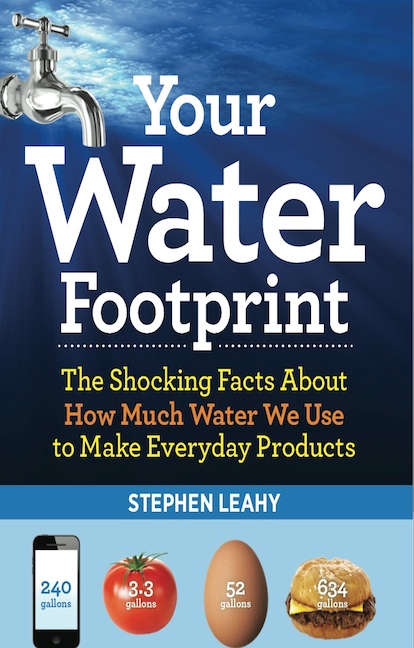
Stephen Leahy won the prestigious Lane Anderson Award for the best science writing in Canada in 2014 for his book Your Water Footprint:  The Shocking Facts About How Much Water We Use To Make Everyday Products

In Your Water Footprint (Firefly Books), Stephen Leahy introduces readers to the Virtual Water Concept and to readers’ awareness of how much water is used in our everyday activities. Leahy is an environmental journalist from Uxbridge, Ontario.

The juries based their decision on the relevance of each book’s content to the importance of science in today’s world, as well as the author’s ability to connect the topic to the interests of the general trade reader.

“The Fitzhenry Family Foundation is excited to award two pieces of work that ultimately encourage protection of the earth’s resources and animal welfare,” said Holly Doll. “It’s important to us that Canadians are encouraged to read about science and the environment at both young reader and adult levels.”

REVIEWS

front cover resized1

“…a brilliant and shocking exposé on precisely how much water we use…” — Publishers Weekly

“This book is unique in its handling of a complex topic…the content is timely, important, and fascinating” — Library Journal

…exceptionally lucid narration with arresting, full-page info graphics”  — Booklist,  starred review

“Leahy, an award-winning Ontario environmental journalist… makes it clear that the most innocent-seeming actions and products are far from water-neutral. — Toronto Star

Your Water Footprint: The Shocking Facts About How Much Water We Use To Make Everyday Products

Firefly Books, 160 Pages, 125 Unique Infographics only $19.95 Paperback (Also avail in hardcover) Order today at your local bookstore or online.

In US:  AmazonPowell’s Books; Barnes&NobleIndiebound

Canada:  Chapters-Indigo Signed copies avail at Blue Heron Books – Stephen’s home town bookstore; 

Global Warming Explained in 60 Seconds or Less

derek me cop15 sml logo
Derek and Stephen Leahy at entrance to UN climate conference COP 15 in Copenhagen

One night in a bar a Russian journalist who I’d just met says:  “This global warming is too complicated for people to know if it’s real or not”.

“You don’t think climate change is happening?” I asked with surprise since we were both covering a big United Nations climate conference.

“No one has been able to give me a good explanation to prove it’s real,” said Yuri (not his real name).

“I can explain it to you in less than one minute,” I replied.

Yuri was sceptical but I went ahead and said:

“The moon has no atmosphere so it is scorching hot (+100C) during the day and bitterly cold (-150C) at night. The Earth has an atmosphere made up of oxygen, nitrogen, carbon dioxide (CO2) and other gases. Over 150 years ago scientists proved that CO2 traps heat from the sun. We also know without any doubt that burning fossil fuels like oil, gas and coal emits CO2.

Measurements, not computer models or theories, measurements show that there is now 42% more CO2 in the atmosphere than 150 years ago before massive use of fossil fuels. That extra CO2 is like putting another blanket on at night even though you are already nice and warm. The Earth is now 1.0 C hotter on average according to the latest measurements. Heat is a form of energy and with so much more energy in our atmosphere our weather system is becoming supercharged resulting in stronger storms, worse heat waves, major changes in when and where rain falls and more.

That’s it.

After a long silence Yuri says “I guess that makes sense…”.

I’m not sure he was convinced but the truth is that climate change is not that complicated.

One additional thing to know is that CO2 is forever. Every little CO2 molecule we add to the atmosphere will continue to trap the sun’s heat for hundreds and thousands of years.

Road to Paris: Plain Talk Briefing on the UN Climate Treaty Negotiations

What:    A candid, 15 minute explanation on why the UN climate negotiations are so difficult and the likely result in Paris. Intended for a general audience.

Who:     Stephen Leahy is an independent, environmental journalist who has covered climate negotiations around the world. He is co-winner of the 2012 Prince Albert/United Nations Global Prize for reporting on Climate Change.

Where: Part of a public forum in Toronto June 2014 titled CLIMATE CHANGE EMERGENCY.

Thanks to Peter Biesterfeld for making the recording.