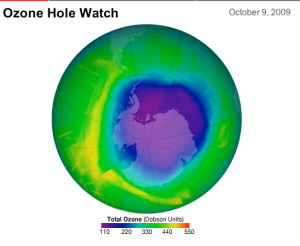
Ozone Hole 2009 – Bigger than North America – 24 million sq km

Picture 7

I’m not doing a full article on this year’s Antarctic ozone hole but you should know that the maximum size appears to have peaked at 24 million sq km, less than the 2006 record year 27 million sq km. Although some media reported this as a downward trend, it is too soon to say because ozone depletion is a complicated process and affected by local weather conditions.

Chilean Children Warned to Stay Indoors

The hole moves and shifts overhead like a unseen gigantic amoeba and on Oct 9 officials in southern Chile warned residents that the hole had extended itself over Punta Arenas and warned children to stay indoors and avoid exposure to the very hi-level UV rays.

Children hiding indoors during the day at the southern tip of Chile could have been the fate for much of the planet without the Montreal Protocol treaty 21 years ago to eliminate some of the ozone destroying chemicals used in deodorants and refrigerants.

This ought to be crucial cautionary tale for climate change.

Some of my previous articles on ozone:

Skin Would Fry in 5 Mins Without Ozone Treaty says NASA – Precautionary Lesson for Climate

Monster Ozone Hole (Again) – But your skin would fry in 3 mins without 20-yr old Ozone Treaty

*Skin Cancer Rising Despite New Ozone Deal to Cut CO2 Emissions

*Ozone Hole is Back and Bigger Than Ever

Time Running Out on Vows to Act on Climate Scientists Warn

Alleyway, RLeahy 2007

By Stephen Leahy

COLUMBUS, Ohio, Sep 24 (IPS)

Promises are easy to make.

But promises by world leaders will not halt the heat-trapping carbon emissions that are dialing-up global temperatures and altering the climate, say critics and climate researchers meeting in this U.S. Midwestern city.

As evidenced at the U.N. leader’s summit on climate change in New York Tuesday, the world’s big economies are refusing to commit to actions that will prevent this and future generations from inheriting a hostile climate no other humans have ever faced.

Do we have the social and political will to deal with a problem that we will only see partially in our lifetimes?” wonders Don McConnell, president of Battelle Energy Technology, the world’s largest non-profit research centre.

“What most don’t realise is that the biggest impact from climate change will be shifts in precipitation, not temperature increase,” McConnell told IPS at the McCormick Energy Solutions Conference at Ohio State University this week.

Continue reading

Facebookers Last Hope for Environment?

facebook header

‘The only real hope is for a global citizens’ movement unlike anything ever seen on the face of the Earth’ — Erik Assadourian, Vital Signs

By Stephen Leahy

BROOKLIN, Canada, Sep 14 2007 (IPS)

Global trends indicate a looming environmental catastrophe, and engaging high school students around the world may be the only hope say experts.

Governments, the corporate sector and media continue to champion industrial and economic growth at the cost of escalating impacts on the environment, concludes the latest report from the Washington-based Worldwatch Institute, “Vital Signs 2007-2008″.

For a number of years, the “Vital Signs” report has tracked 44 trends that are shaping the future, and they document a record level of industrial growth, says Erik Assadourian, Vital Signs project director.

“‘Vital Signs’ also documents the escalating impacts of such growth on the environment,” Assadourian told IPS in an interview from Barcelona.

The scale of the environmental crisis, in which catastrophic climate change is just one of many, is undermining the ecosystems that support life on Earth.

“Climate change and other environmental problems are symptoms of the root problem, which is the obsession with consumerism,” he said.

Vital Signs reports that in 2005, more wood was removed from forests than in any previous year. Fossil fuel usage dumped 7.6 billion tonnes of carbon emissions into the atmosphere. Meat production hit a record 276 million tonnes (43 kilogrammes per person) in 2006. Rising meat consumption is driving rising soybean demand to feed cattle, which in turn is a driver of deforestation as tropical forests are turned into soy fields.

And on it goes: global seafood consumption breaks records, steel and aluminium production too. None of this is sustainable – another three or four or five planets would be needed to maintain these levels of production and consumption. Continue reading

Solar Dreams – To Fly Around the World – Without Fuel By 2012

solar impulse3

By Stephen Leahy*

DÜBENDORF, Switzerland, Sep 16 (Tierramérica)

A solar-powered aircraft will take flight next month from Switzerland with hopes ultimately to circle the Earth in 2012, without fuel, and stopping every five days only to change pilots.

“I’m intrigued by the vision of perpetual flight,” mechanical engineer Andre Borschberg, chief executive of the 100-million-dollar Solar Impulse project, told Tierramérica.

Designed to use only energy from the sun during the day and run on sun-charged batteries at night, it could stay aloft perpetually, like a giant version of the thin-winged Arctic tern that migrates annually from the Antarctic to the Arctic, non-stop.

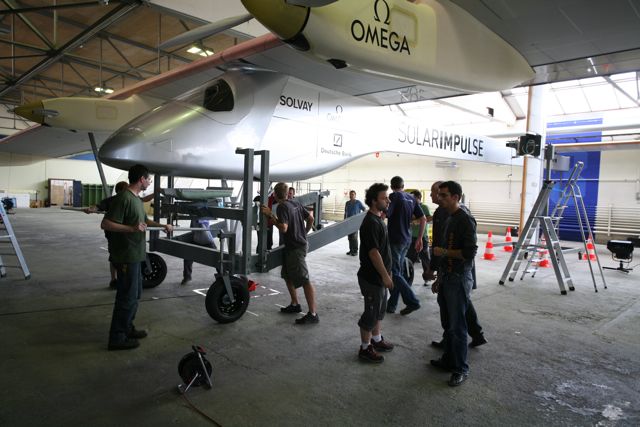
“The big lesson of the Wright brothers is that if you don’t try you never succeed,” Borschberg told Tierramérica in the Dübendorf Airfield hanger outside of Zurich, where the first prototype was being assembled for a test flight in October or November.

solar impulse2The U.S. inventors Orville and Wilber Wright are credited with the first airplane flight in 1903. “They never dreamed that a plane could cross the Atlantic Ocean, and yet less than 25 years later (in 1927) Charles Lindbergh flew from New York to Paris,” Borschberg said.

“It is our hope that the Solar Impulse will be a symbol to the world and create awareness about our own energy use,” he added.

The Solar Impulse HB-SIA prototype plane is essentially a 64-metre long thin wing with four small propellers and narrow pilot pod and tail attached underneath.

Sitting in the airport hangar, even with its inner workings exposed, it doesn’t look like much more than a big paper glider – not much for 100 million dollars. Continue reading

Climate Survival Means Anticipating and Adapting

Alberto Cesar AraujoBy Stephen Leahy

GENEVA, Sep 8 (IPS)

Imagine being able to know months in advance when and where floods or droughts may occur.

That is what over 150 countries participating in the third World Climate Conference, which concluded last Friday in Geneva, pledged to achieve through the creation of a Global Framework for Climate Services.

Today is a landmark day for making climate services available to all people,” said Michel Jarraud, secretary-general of the World Meteorological Organisation (WMO), convener of the conference, told over 2,000 climate scientists, sectoral experts and decision-makers.

“Climate services” is the long-distance cousin to weather services or weather forecasting. New technology and better climate science has opened the window to very long range forecasting of climate events like droughts weeks and months in advance.

This year, scientists were able to anticipate unprecedented flooding of the Red River Valley in the United States Midwest months in advance, enabling local communities to prepare and avoid the worst consequences, said Jane Lubchenko, a noted ecologist, administrator of the National Oceanographic and Atmospheric Administration (NOAA) and head of the U.S. delegation.

“Imagine farmers able to determine what to plant and where, based on drought forecasts three to five years in the future, or coastal communities able to plan for sea level rise and storm intensity,” Lubchenco told IPS.

The proposed Global Framework for Climate Services will “strengthen production, availability, delivery and application of science-based climate prediction and services”.

Continue reading

The Arctic — The Earth’s Freezer — Is Defrosting With Dire Results

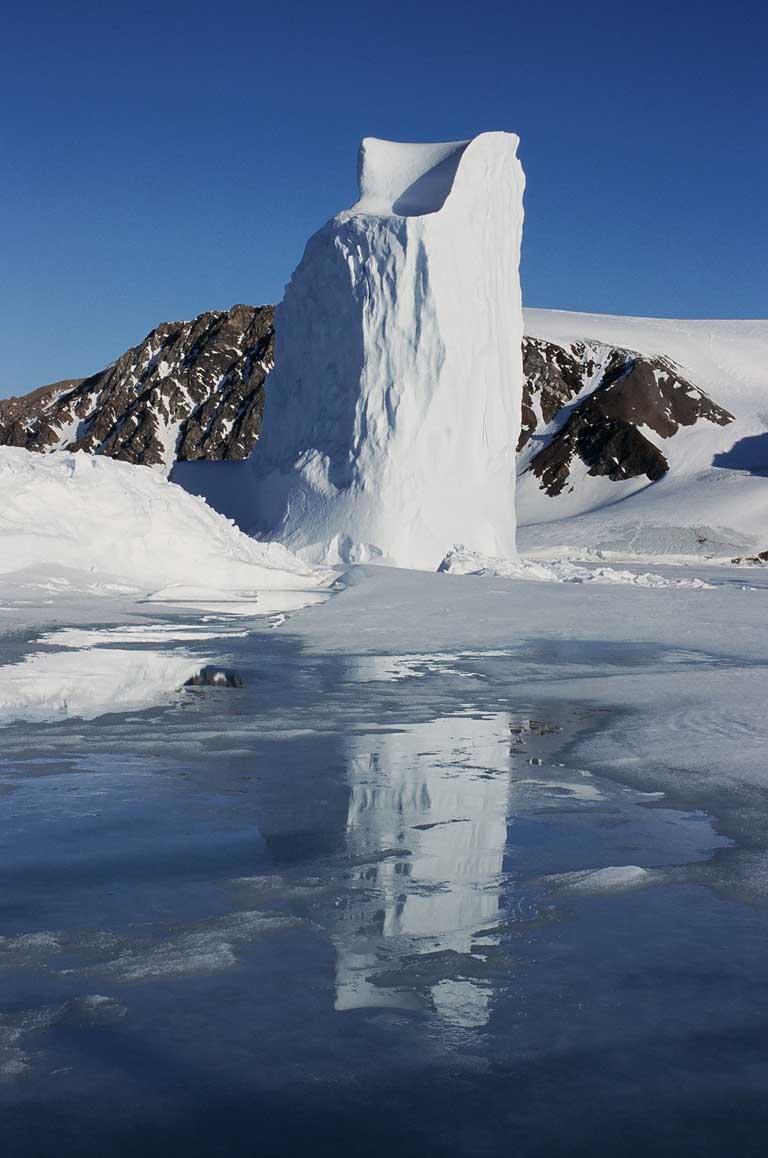
Iceberg in Glacier Strait, Nunavut, Canada, Image credit- Sandy Briggs.By Stephen Leahy

GENEVA, Sep 2 (IPS)

The rapidly warming Arctic region is destabilising Earth’s climate in ways science is just beginning to comprehend.

The entire world is being affected, and without urgent action to cut emissions, a too-warm Arctic could trigger catastrophic, irreversible climate change, top scientists say in a report released Wednesday in Geneva.

“It is crucial to know the full consequences of the Arctic warming, and this is an unprecedented review of the latest science,” said Martin Sommerkorn, an Arctic researcher and senior climate change advisor to World Wildlife Fund International.

“Simply put, if we do not keep the Arctic cold enough, people across the world will suffer the effects,” Sommerkorn told IPS.

Sea level rise of more than one metre, flooding affecting one quarter of the world’s population, and extreme global weather changes are on the way at the current pace of unchecked carbon emissions, the “Arctic Climate Feedbacks: Global Implications” report warns.

A warming Arctic has far wider and more serious consequences than previously believed based on the latest science of the past three years, including the very recent research from International Polar Year 2008-2009.

“There is a large potential that a warming Arctic will make climate change far worse,” said Sommerkorn, who acted as editor of the report written by 10 of the world’s leading climate scientists. Continue reading

Early Warning Systems for the Coming Climate Storm

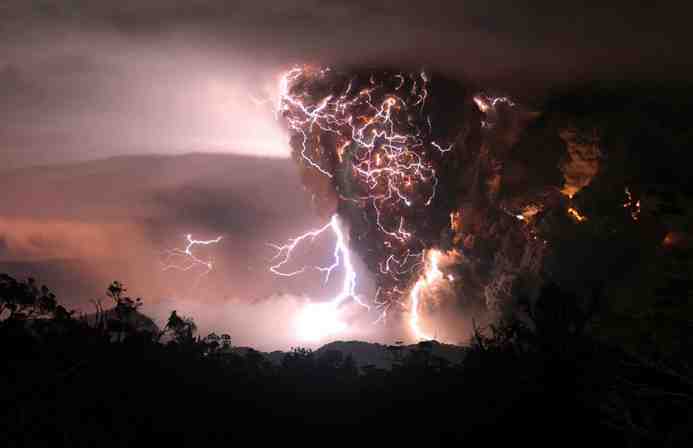
Chile—The fury of Chaitén volcano - nat geoBy Stephen Leahy

GENEVA, Aug 31 (IPS)

Climate change is here. The challenge in Geneva this week is to find ways to help the world cope with a climate that will have more and worse extremes in terms of temperatures, floods, and storms.

More than 2,500 experts and policy-makers from 150 countries are attending the Aug. 31-Sep. 4 World Climate Conference to discuss how to improve weather forecasting and long-range seasonal weather projections, especially to help poor nations in areas such as agriculture.

“Until now, the way that we deliver climate information to some sectors has been ad hoc. What we need is a formal system that all people can trust to access vital information that can save their lives and protect property and economies,” said Michel Jarraud, secretary- general of the World Meteorological Organisation (WMO), which is convening the World Climate Conference this week in Geneva.

The WMO has proposed that a global climate services system be created to boost observations and research for monitoring the climate and new information tools that will provide sector- and regional-specific products and services, Jarraud told IPS.

The first two “World Climate Conferences” in 1979 and 1990 were organised by the WMO and played the key roles in the creation of the U.N. climate secretariat, and the Intergovernmental Panel on Climate Change.

This “Global Framework” system could help reduce losses caused by extreme weather and climate events such as heat waves, sandstorms, cyclones, drought and floods which will become more frequent and more intense as the climate continues to warm, he said.

“Extreme weather events and changing climatic conditions affect all of us, frequently resulting in humanitarian disasters and heavy losses,” said Swiss President Hans-Rudolf Merz.

For full article:  CLIMATE CHANGE: Early Warning Systems for the Coming Storm.

2020 Climate Deadline Is the Crucial “Litmus Test”

Chile—The fury of Chaitén volcano - nat geo

The atmosphere and the climate is a public good, a commons, and can’t be protected by the private sector.”

— Marianne Haug, Oxford Institute for Energy

By Stephen Leahy

VIENNA, Jun 29 2009 (IPS)

“So who here thinks there will be a meaningful deal in Copenhagen?”

Few of the more than 600 energy ministers, officials and experts from 80 countries attending the Vienna Energy Conference raised their hands in response to the conference moderator’s question about the final round of climate negotiations this December in Copenhagen.

“I don’t think there will be agreement on an emissions cap,” said Andre Amado, Brazil’s vice-minister for energy, science and technology.

Greenhouse gas emissions from the burning of fossil fuels must peak between 2015 and 2020 and then decline to prevent dangerous, irreversible climate change, scientists have warned. A strong international agreement on emissions targets for both the industrialised and developing world is widely believed to be the only way to ensure emissions peak and then decline.

“There will be agreement on technology transfer and reducing barriers for technology transfers,” to assist developing countries in cutting their emissions and adapting to the changing climate, Amado told participants last week in Austria’s capital city.

Continue reading

Desperately Seeking Leadership on Climate

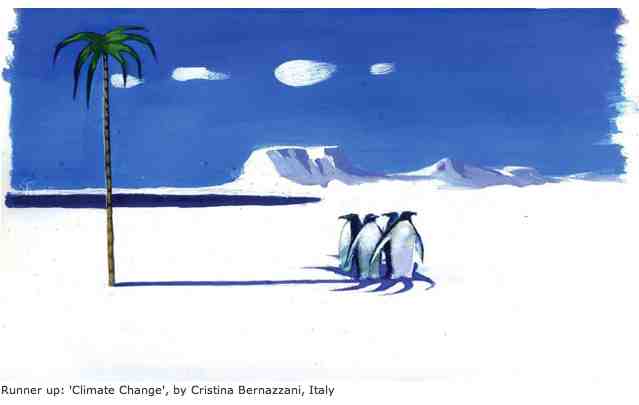
penguin palm tree

Civil society will have to provide unrelenting leadership if  global carbon emissions are to peak in less than 10 years and go ‘negative’, experts say.

By Stephen Leahy

UXBRIDGE, Canada, Jan 15 2009 (IPS)

Global emissions of carbon dioxide must reach a peak in less than 10 years and then begin a rapid decline to nearly zero by 2050 to avoid catastrophic disruption to the world’s climate, according to a new report.

Emissions of carbon dioxide will actually need to “go negative” – with more being absorbed than emitted – during the second half of this century, according to “State of the World 2009: Into a Warming World” released by the U.S.-based Worldwatch Institute this week.

“2009 is a pivotal year to deal with climate change,” said Christopher Flavin, president of well-respected Worldwatch Institute (WI), a U.S.-based environmental think tank.

“Humanity will face grave danger if we don’t move forward now,” Flavin told IPS.

Climate change is happening faster and with larger impacts than previously predicted, concludes the 26th annual “State of the World” report, devoted entirely to the challenges and opportunities of global climate change.

Even an additional warming of 2 degrees Celsius poses unacceptable risks to key natural and human systems, warned climate scientist W.L. Hare, one of the report’s 47 contributors.

SN852512 Continue reading

Content Control: Patents Threaten Traditional Knowledge of Indigenous People

Quechua in Cusco region

“To have potatoes, there must be land, people to work it, a culture to support the people, Mother Earth and the mountain gods…”

By Stephen Leahy*

VIENNA, Jul 6 (Tierramérica)

Indigenous peoples risk losing control over their traditional knowledge if the World Intellectual Property Organisation (WIPO) insists on strict standards for managing access to information.

Patents and other forms of restricting access to knowledge are very worrisome in a time of climate change, says a new report by the London-based International Institute for Environment and Development (IIED).

The study was presented at meetings of the WIPO – a United Nations agency – held Jun. 23-Jul. 3 in Geneva.

Intellectual property standards restrict use of genetic resources when we need flexibility and adaptability to cope with climate change,” said Michel Pimbert, director of IIED’s Sustainable Agriculture, Biodiversity and Livelihoods Programme.

WIPO aims to develop rules for protecting rights over traditional knowledge, such as indigenous knowledge about medicinal plants, which conventional intellectual property laws do not cover.

However, according to IIED’s Krystyna Swiderska, who coordinated the research in Africa, Asia and Latin America, “WIPO’s call for consistency with existing intellectual property standards is a flawed approach as these have been created on Western commercial lines to limit access to inventions such as drugs developed by private companies.”

Intellectual property is about restricting access, creating monopolies and eliminating competition, and it is being pushed by transnational pharmaceutical and seed companies, said Pimbert. Continue reading