GE Trees: Poor Countries Can’t Control

Courtsey of Museo d\'Arte Contemporanea, Turin, Italy

by Stephen Leahy

BONN, May 29 (IPS) – An intense North-South debate over genetically engineered trees has sidetracked delegates at a U.N. conference on biodiversity here: African nations want a global moratorium, while a few rich countries led by Canada say it should be up to individual countries to regulate.

While 168 nations that are part of the U.N. Convention on Biological Diversity (CBD) debate the issue, a new two-year U.N.-funded study warns that developing countries simply don’t have the capacity to manage or monitor biotechnology.

“Africa doesn’t have the technical and scientific capacity to fully debate let alone enforce rules around biosafety of biotechnology,” said the study’s co-author, Sam Johnston of the United Nations University Institute of Advanced Studies (UN-IAS) in Tokyo.

“Genetic contamination by GE plants is a huge issue and it’s increasing,” Johnston told IPS in Bonn.
Continue reading

Ocean Trouble and the End of Hurricane Seasons

By Stephen Leahy*

New, disconcerting science from the oceans

GIJÓN, Spain, May 26 (Tierramérica).- Climate change is altering the world’s oceans in so many ways scientists cannot keep pace, and as a result there is no comprehensive vision of its present and future impacts, say experts.

Rising sea levels, changes in hurricane intensity and seasonality, declines in fisheries and corals are among the many effects attributed to climate change.

In an attempt to put some order to their disconcerting findings, more than 450 scientists from some 60 countries gathered in the northern Spanish city of Gijón for the symposium “Effects of Climate Change on the World’s Oceans” May 19-23.

Change is evident where ever marine scientists look. Sea level rise and warmer ocean temperatures are the most obvious, but other changes include a decline in the oceans’ productivity, which means many areas are unable to support as many fish as they once did, according to Luis Valdés, a world expert on plankton and one of the symposium organizers. Continue reading

“Doctor” Nature in Danger

By Stephen Leahy*

CAPE TOWN, South Africa, May 3 (Tierramérica)

“When we harm nature, we are harming ourselves,” says Aaron Bernstein, a doctor at Harvard Medical School and one of the authors of the upcoming book “Sustaining Life: How Human Health Depends on Biodiversity“.

Few people realise that our health is directly tied to the health of the natural world,” Bernstein told Tierramérica

Bernstein and Harvard colleague Eric Chivian wrote and edited contributions from more than 100 leading scientists in their new book, published by Oxford University Press and available last May.

Written for a general audience, “Sustaining Life” draws on the latest scientific evidence to make a persuasive case that the current extinction crisis, with species vanishing every day, is a serious threat to humanity equal to, if not greater than, climate change.

Pharmaceuticals, biomedical research, the emergence and spread of infectious diseases, and the production of food, both on land and in the oceans, depend on biodiversity — the rich variety of life on our planet. Continue reading

CLIMATE CHANGE: A Game With Too Many Free Riders

By Stephen Leahy*

BROOKLIN, Canada, Apr 4 (IPS) – The evidence is piling up that climate change threatens to bring a chaotic future unlike anything ever known. Taking collective action in time to avert the worst means rewarding climate-safe behaviour, punishing climate transgressors and publicly praising those who are trying to protect the environment, a new study suggests.

The nations of the world will come together to set a target and timeframe for reducing emissions from burning fossil fuels at the end of 2009 in Copenhagen, Denmark. Scientists have repeatedly stated the 2020 target must be 25 to 40 percent emission reductions from the 1990 emission baseline. Can the global community reach this collective target through individual efforts when everyone suffers individually if the target is missed?

The short answer: No.

At least that’s the result of an elegant experiment to examine people’s ability to deal with this kind of situation. “People do not act rationally, even to protect their own interest,” observed Manfred Milinski of the Max Planck Institute of Evolutionary Biology in Plon, Germany.

[ *This story is part four of a four-part examination of the psychological and behavioural changes needed to dial down the temperature on our global greenhouse. Part one: Climate Change Reshaping Civilization Part two: Climate River in Full Flood   Part three: CLIMATE CHANGE: A Vision Worth Fighting For ]

Continue reading

Climate Change Reshaping Civilization

By Stephen Leahy*

Apr 1 (IPS) –Our fingers are glued to the global thermostat, pushing it ever higher, and climate catastrophe has already begun to reshape human civilisation.

Drought. Flood. Heat wave. Tornado and hurricane. Once sole products of natural forces, all are now amplified by the massive amounts of additional heat trapped in the atmosphere because of burning fossil fuels, scientists warn.

[ *This story is part one of a four-part examination of the psychological and behavioural changes needed to dial down the temperature on our global greenhouse. Part two: Climate River in Full Flood   Part three: CLIMATE CHANGE: A Vision Worth Fighting For  Part four: CLIMATE CHANGE: A Game With Too Many Free Riders ]

Such calamities are no longer distant in time or space. Tens of millions have already been impacted by unnaturally extreme and violent weather for at least the past two decades.

Annual emissions of heat-trapping carbon dioxide (CO2) are three times higher today than in the 1990s. Even if the impossible could be done — cease all CO2 emissions today — the average global temperature will continue to increase from the present 0.8 degrees C above normal to 1.6 – 1.8C, data shows. And that new global average temperature would remain higher than normal for the next 500 years because of the time it will take for the warming oceans to cool.

To prevent Earth from heating further than 2.0 C, a potentially catastrophic tipping point, carbon dioxide emissions would need to be completely eliminated and soon, say researchers in a new study published in March in the journal Geophysical Research Letters. Continue reading

About Canada’s Seal Hunt

molting-harp-seal-ifaw.jpg

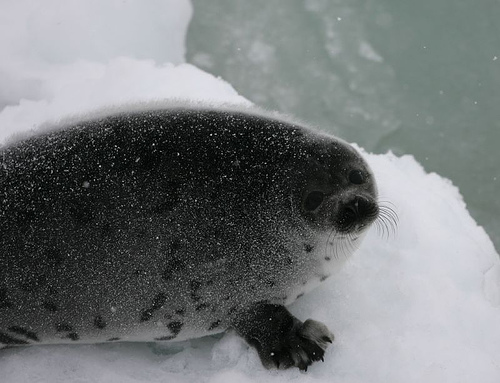
On Monday Canada announced this year’s seal hunt quota to allow the killing of 275,000 young harp seals near Newfoundland. The announcement sets off the annual round of protests mainly focused on sustainability of the seal population and animal cruelty issues. This feature article was written two years ago but would be little different if done today.

[Originally published by Mexico’s Tierramerica, Mar 29 2006 ]

By Stephen Leahy

The Canadian government increased the annual quota of harp seals (Phoca groenlandica) from 319,000 in 2005 to 325,000 this year. That’s too many seals, says Chris Cutter, an activist with the International Fund for Animal Welfare (IFAW).

An unusually warm winter has left little ice in the Gulf, Cutter told Tierramérica after a helicopter overflight last week, before the hunting season began on Mar. 25. “We hardly saw any seals,” he said.

Named for the harp-shaped pattern on the backs of the adults, the seals mainly give birth to their pups on floating ice, where they are safe from land-based predators.

Young seal pups are able to float, but are poor swimmers and often drown in rough weather. The harp seal herd is about 5.8 million, with an estimated one million pups born each year, says Phil Jenkins, spokesman for Canada’s Federal Department of Fisheries and Oceans (DFO), which regulates the hunt.

The lack of ice was taken into account when setting this year’s quota, Jenkins told Tierramérica. “McCartney and the animal rights groups have got the wrong information about the hunt.”

Continue reading

Business As Usual is Dead

dzerzhinsk-factories.jpg

Even if nations increased their energy and resource-use efficiency four-fold, there isn’t enough natural capital left intact to continue business as usual says says Eugene Rosa, a professor of natural resources and environmental policy at Washington State University.

(Natural capital are the resources — metals, oil — and services — air, water, etc — that nature provides.)

Improvements in technology and modernisation won’t rescue our planet from the depletion of the Earth’s natural capital, says Rosa.

For more on this topic please see this three-part series from 2007 on natural capital and how future global prosperity and equity CAN be achieved through the preservation of ecosystems:

See Part One: Like Enron, Earth Inc. Sliding Into Bankruptcy

Part Two: Global Warming is Real But I didn’t Do It

Part three: How to Kick-Start the 21st Century Eco-Economy

Free, authoritative and online: 1.8 million species

carolina-anole-lizard-sml-john-sullivan-aol.jpgBy Stephen Leahy

Feb 27 (IPS) – Free, authoritative and online: 1.8 million species.

That is the ultimate goal of the Encyclopedia of Life project, which put its first 30,000 species on the Internet this week. This ambitious global project will provide the details of every known species — habitat, range, lifecycle, pictures and more — and archive everything online so anyone can access this important information about life on Earth.

From sharks to mushrooms to bacteria, the Encyclopedia of Life will provide scientifically verified information that will satisfy both a grade school child’s american-burying-beetle-doug-backlund-aol.jpegcuriosity or enable a university researcher — or amateur naturalist — to make a scientific breakthrough, says James Edward, new executive director of the Encyclopedia of Life (EOL) project headquartered in Washington at the Smithsonian Institution. Continue reading

Polar Bears’ Future Bleak in Melting Arctic

http://www.firstpeople.us

Lots of folks have been telling me that polar bears are doing ok and don’t need protection under the US Endangered Species Act. Some say polar bear populations are stable in Alaska and increasing in parts of Canada. And there might be 1500 more bears than previous estimates according to a three year study in Nunavut which makes $2 million a year from polar bear trophy hunters. But 1500 isn’t very many more bears and with the Arctic sea ice melting fast the future certainly doesn’t look bright.

As for Alaska consider this fact:

This week scientists announced new findings that the survival rate of polar bear cubs in Alaska’s Beaufort Sea has plummeted. In the late 1980s, 65 percent of polar bear cubs in the southern Beaufort Sea survived their first year. That has fallen to an average of 43 percent in the past five years. — Polar Bears Go Hungry as Icy Habitat Melts Away

“Without taking serious and urgent action to stabilize the climate, there is no future for polar bears” says Andrew Derocher, Chair of the World Conservation Union (IUCN), Polar Bear Specialist Group.

See also this controversy: Oil vs Polar Bears in Alaska

And these updates on the Arctic: Arctic Is the Canary in the Coalmine

Arctic Oil and Gas Rush Alarms Scientists

Arctic Meltdown Signals Long-Term Trend

Inuit Sue America over Climate Change

http://www.firstpeople.us

Oceans Hit Hard By Human Activity

copyright Ove Hoegh-Guldberg

By Stephen Leahy

Feb 15 (IPS) – Oceans span nearly three quarters of the Earth’s surface and despite this vast size hardly a square kilometre has been untouched by humans.

Researchers released the first-ever global map of human impacts on oceans Thursday in the journal Science. Impacts ranged from fishing to pollution to ship transportation.

“There really aren’t any areas without human impacts,” said Kimberly Selkoe, a principal investigator on the project and a post-doctoral researcher at the University of Hawaii.

“The most shocking message here is that we don’t actually have a lot of data on human impacts,” Selkoe told IPS. Continue reading