Rich Countries Largely Live Off Financial Transactions

[Excerpts from my Dec 2010 article on how rich countries move money around and produce little while preventing green development in Africa  — Stephen]

“The world’s big economies are largely living off financial transactions which are unconnected to development,” warns Supachai Panitchpakdi, secretary-general of United Nations Conference on Trade and Development.

In a rejection of failed neoliberal economic policies, Panitchpakdi said strong national policies on investments, taxation, protection of local industries, including subsidies, and changes to less restrictive intellectual property regimes are what is needed to green economies in Africa and elsewhere.

“Green economic development underpins environmental protection, economic growth and development,” he said.

Here’s a startling fact based in a new energy study:

Universal Access to Electricity Less Than Cost of Fossil Fuel Subsidies

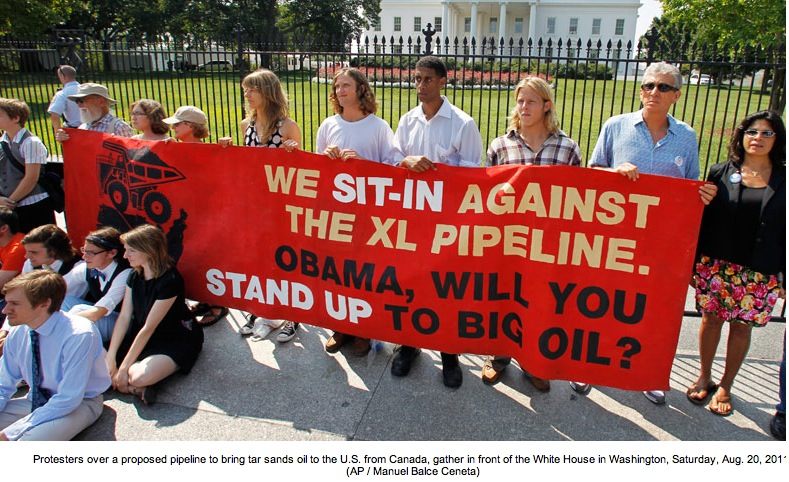
Keystone Pipeline All About Exporting Oil Overseas – Report


 The United States is awash in oil with four times as many oil rigs pumping domestic oil today than eight years ago and declining  demand

Canada needs overseas markets for its dirty oil

[Excerpts from my September 2nd article on the proposed Keystone XL pipeline — Stephen]

The only reason U.S. citizens may be forced to endure a risky, Canadian-owned oil pipeline called Keystone XL is so oil companies with billion-dollar profits can get the dirty oil from Canada’s tar sands down to the Gulf of Mexico to export to Europe, Latin America or Asia, according to a new report by Oil Change International released Wednesday.

“Keystone XL will not lessen U.S. dependence on foreign oil, but rather transport Canadian oil to American refineries for export to overseas markets,” concludes the report, titled “Exporting Energy Security“.

….

“The oil industry would have done the Northern Gateway [pipeline] first but gambled that resistance to the [Keystone XL] pipeline would be far weaker in the mid-west,” he told IPS.

They were wrong.

Read full article:

U.S. Awash in Oil and Lies, Report Charges | More Oil Development Risks Catastrophe – Scientists Say

Nature is our reality. The economy is simply a game we invented.

Put a glass lid over Japan, Germany or England and they wouldn’t last long.

[excerpts from my Nov 2010 article on why losing species matters to everyone — Stephen]

Japan imports more than 60 percent of its food and most of Europe’s ecosystems have been trashed, with only 17 percent in reasonable shape, according to a first-ever assessment. The only reason those countries haven’t collapsed is they are rich enough to help themselves to nature’s ecological resources and services like food, timber, materials from the rest of the world.

Countries of the North are like desperate bio-pirates, addicted to plundering the richer ecosystems of the South for food, raw materials and cheap labour. Increasingly, the South is resisting and seeking redress. Part of that redress, and the only way to end the escalating loss of species – an estimated 5,000 to 30,000 extinctions per year – is to transform the growth economy

“Japan played a central role in the growth economy. We need to move to a subsistence economy,” Mushakoji told IPS.

……From:

An Awakening to the Unravelling of the Web Life

Too many of us, taking too much and having too big an impact. Will need 27 planet Earths by 2050

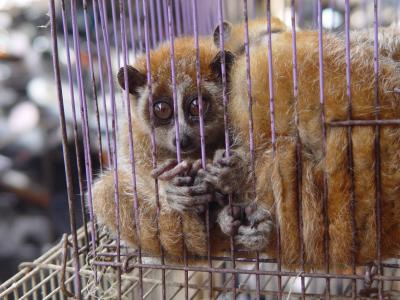
Slow loris from an illegal wildlife market in Southeast Asia

This story was featured on the IPS wire and on the Al Jazeera network . It’s about a study showing that national parks, conservation and protected areas have not and cannot halt the decline in biodiversity that is our life support system. It is hopeless without addressing the root cause of this and all other environmental problems: too many of us, taking too much and having too big of an impact. On our present course we’ll need 27 planet Earths by 2050 they conclude. — Stephen 

By Stephen Leahy

UXBRIDGE, Canada, Jul 29, 2011 (IPS)

Protecting bits of nature here and there will not prevent humanity from losing our life support system. Even if areas dedicated to conserving plants, animals, and other species that provide Earth’s life support system increased tenfold, it would not be enough without dealing with the big issues of the 21st century: population, overconsumption and inefficient resource use.

Without dealing with those big issues, humanity will need 27 planet Earths by 2050, a new study estimates.

The size and number of protected areas on land and sea has increased dramatically since the 1980s, now totaling over 100,000 in number and covering 17 million square kilometres of land and two million square kilometres of oceans, a new study reported Thursday.

This independent environmental journalism depends on public support. Click here learn more.

But impressive as those numbers look, all indicators reveal species going extinct faster than ever before, despite all the additions of new parks, reserves and other conservation measures, according to the study published in the journal Marine Ecology Progress Series.

“It is amazing to me that we haven’t dealt with this failure of protected areas to slow biodiversity losses,” said lead author Camilo Mora of University of Hawaii at Manoa.

“We were surprised the evidence from the past 30 years was so clear,” Mora told IPS.

The ability of protected areas to address the problem of biodiversity loss – the decline in diversity and numbers of all living species – has long been overestimated, the study reported. The reality is that most protected areas are not truly protected. Many are “paper parks”, protected in name only. Up to 70 percent of marine protected areas are paper parks, Mora said.

The study shows global expenditures on protected areas today are estimated at six billion dollars per year, and many areas are insufficiently funded for effective management. Effectively managing existing protected areas requires an estimated 24 billion dollars per year – four times the current expenditure.

“Ongoing biodiversity loss and its consequences for humanity’s welfare are of great concern and have prompted strong calls for expanding the use of protected areas as a remedy,” said co-author Peter Sale, a marine biologist and assistant director of the United Nations University’s Institute for Water, Environment and Health.

“Protected areas are a false hope in terms of preventing the loss of biodiversity,” Sale told IPS.  Continue reading

Lend Your Car, Save, and Save the World

Cars are parked 22 hours a day on average yet world will have 2.5 billion cars in 2050

The costs of car ownership and travel are far higher than anyone realizes: a 100 km total trip costs between 65 and 80 dollars when parking, fuel, wear and tear, insurance, depreciation, repairs are included. A car is usually parked and unused 22 hours a day but still incurs costs. Why not let someone use the car when you’re not and make some money at the same time Robin Chase told me for this article. She’s launched Buzzcar in France as part of a strategy for reducing carbon emissions and congestion in cities.   — Stephen

Why do car owners get so much more public space than bus riders, bicyclists or walkers?

By Stephen Leahy

BERLIN, Jun 2, 2011 (IPS)

The world’s more than 850 million cars and small trucks are parked 20 to 22 hours a day. Why not use these vehicles more efficiently by letting other people drive them when the owners aren’t, asks Robin Chase, CEO of Buzzcar, a car- sharing network to be launched shortly in France.

“Sharing vehicles is much more efficient and represents a huge opportunity,” Chase told some 800 attendees from more than 50 countries at the OECD’s annual International Transport Forum (ITF) in Leipzig last week. The Forum is an intergovernmental organisation for the transport sector involving 52 different nations.

The ITF projects there will be three times as many cars – an eye-popping 2.5 billion – by 2050 according to its Transport Outlook 2011 report released at the meeting. Adding that many more vehicles in a sustainable way is an “extraordinary challenge”, said Jack Short, Secretary General of the ITF.

The vast majority of this growth will come from the developing countries since travel by passenger vehicle in a number of high-income countries has not increased, and even declined in some countries. Short acknowledged making such projections is risky because many factors such as lower economic growth, congestion in cities or new technologies will have an impact on levels of car ownership in future.

And the Transport Outlook report did not factor in the potential for car-sharing to offer personal mobility without car ownership.

Buzzcar is a car sharing service where car-owners in a city or town allow their idle cars to be used by other local citizens in exchange for getting about 70-75 per cent of the rental fee, Chase told IPS in an interview. Even when a car is parked it costs their owners money, she says. The average cost of owning and operating car is 8,000 to 12,000 dollars a year even if it sits parked 22 hours a day. (update: more like $9,000 to 14,000 according to auto clubs)

Buzzcar is an opportunity for car owners to get better value out of their vehicles and to help with ever- rising costs of car ownership. More importantly car sharing reduces the need for car ownership overall, she says.

This independent environmental journalism depends on public support. Click here learn more.

Chase was a co-founder of Zipcar, a U.S.-based car-rental network with more than a half million members where people rent cars by the hour from easy-to-access neighbourhood lots or stations. Zipcar owns some 8,000 rental cars. She then went on to start GoLoco, a ride sharing company in which people pay to ride along with others in the network, and the drivers take a cut of the fees. Continue reading

Costs for Nuclear Energy Skyrocket While Cost of Renewables Plummet

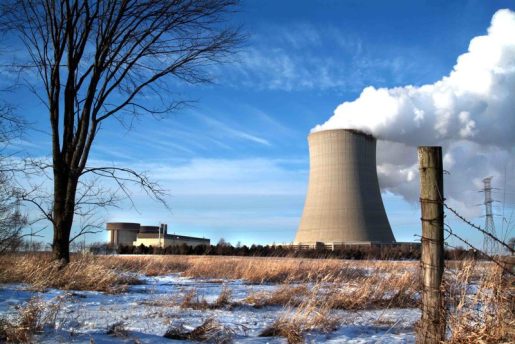
Darlington Nuclear Plant on Lake Ontario

[This is a repost about the financial costs and risks of nuclear technology (written before the Fukushima I Nuclear Power Plant disaster).   If a country is going to spend $10 billion to generate energy and reduce carbon emissions what technology truly offers the best return on a full cost-accounting basis? The latter calculation is not simple or uncontroversial. Two years ago Canada balked at the costs of new nuclear plants now it plans to build some without knowing the price tag.  — Stephen ]

By Stephen Leahy*

BERLIN, Jul 31, 2009 (IPS)

With costs of nuclear energy skyrocketing while the costs of renewables are falling quickly why is nuclear energy back on the table?

One reason is a powerful U.S. lobby where 14 energy companies spent 48 million dollars in 2007 alone to convince American politicians to give the industry huge loan guarantees because they cannot get financing anywhere else, says Ellen Vancko, a nuclear energy analyst at the Union of Concerned Scientists, a U.S.-based non governmental organisation (NGO).

This lavish lobbying effort by the energy and nuclear power sector has been ongoing since the mid-1990s, according to the Center for Responsive Politics, a U.S. NGO and now totals at least 953 million dollars.

Even more has been spent to convince the public that nuclear is one of the keys to energy security so that there is significant public support for new reactors, a Gallup Environment Poll reported this year.

“There are lots of senators and members of congress talking about nuclear as a clean, renewable energy resource,” Vancko says.

The other reason is the French.

France gets about 77 percent of its power from 58 reactors and is often cited as the model for other countries. “France is a special case. The entire industry is 85 percent owned by the government,” says Mycle Schneider, a Paris-based energy and nuclear policy analyst.

The industry gets direct and indirect subsidies, government loans and loan guarantees “on practically anything they want”, Schneider told IPS.

And despite a well-polished reputation for efficiency and low-cost, the French nuclear industry has been plagued by cost-overruns, equipment failures, and relatively low levels of reliability. Even though French reactors are all of similar design, the cost to build a plant in 1998 was 3.5 times higher than the first plants built in 1974, says Steve Thomas, professor of energy policy at the University of Greenwich in the U.K.
Unlike wind or solar energy or virtually any other technology, the costs of nuclear go up over time rather than down even in pro-nuclear France, he said. “I think that is rather telling about the technology,” Thomas told IPS.

The current Finnish nuclear experience echoes the industry’s long history.

Backed byFrench government loan guarantees, Areva, the French government-owned nuclear energy company began construction in 2005 on what is supposed to be the world’s largest and safest nuclear plant at Olkiluoto, Finland.

Plagued by thousands of construction and design problems it is currently 2 to 3 billion dollars over budget and three to four years behind schedule.

“It’s a total disaster for Areva,” Schneider says. Areva will have to sell another 12 reactors to cover the cost overruns thus far or else French taxpayers will, he said.

“The hype around a nuclear power revival or renaissance was based on nothing and is effectively dead.”

Last month Canada backed out of ordering two 1,200-megawatt reactors because cost estimates of 10,000 dollars/kW were three times higher than expected. [update Feb 2011 – Ontario now holding hearings to spend $33 billion to build two new reactors and upgrade others and bans offshore wind!]

However there is real danger that the nuclear industry will continue to promote itself as a ‘silver-bullet’ solution to climate change and give politicians the kind of mega-projects that gets them publicity, warns Schneider.

Equally important is that corporate shareholders of large utility companies can do very well financially on such projects when governments guarantee to cover any losses.

“The worst thing about new nuclear is that it steals billions of public dollars from other more effective things like energy efficiency,” he says.

(Second of two part series)

-30-

Part one:

Lobbyists Push for Nuclear Energy and put Taxpayers on the hook for 360 billion to 1.6 trillion dollars (again)

U.S. Awash in Oil and Lies, Report Charges | More Oil Development Risks Catastrophe

Canada’s Alberta Tar Sands Mining Pits

By Stephen Leahy

UXBRIDGE, Canada, Sep 2, 2011 (IPS)

With four times as many oil rigs pumping domestic oil today than eight years ago and declining domestic demand, the United States is awash in oil.

The country’s oil industry is primarily interested in who will pay the most on the global marketplace. They call that “energy security” when it suits, but in reality it is “oil company security” through maximising profits, say energy experts like Steve Kretzman of Oil Change International, an NGO that researches the links between oil, gas and coal companies and governments.

The only reason U.S. citizens may be forced to endure a risky, Canadian-owned oil pipeline called Keystone XL is so oil companies with billion-dollar profits can get the dirty oil from Canada’s tar sands down to the Gulf of Mexico to export to Europe, Latin America or Asia, according to a new report by Oil Change International released Wednesday.

“Keystone XL will not lessen U.S. dependence on foreign oil, but rather transport Canadian oil to American refineries for export to overseas markets,” concludes the report, titled “Exporting Energy Security“.

Little of the 700,000 to 800,000 barrels of tar sands oil pumped through the 2,400-kilometre, seven-billion-dollar Keystone XL will end up in U.S. gas tanks because the refineries on the Gulf Coast are all about expanding export markets. One huge refinery operator called Valero has been touting the potential export revenues of tar sands oil to investors, the report found.

Because Keystone XL crosses national borders, President Barack Obama has to issue a permit declaring the pipeline serves the “national interest” in order to be approved.

“The only way Keystone XL could be considered in the national interest is if you equate that with profits for the oil industry,” said Kretzman, who wrote the report. Continue reading

The Oxymoron of Political Leadership and Political Will

Analysis by Stephen Leahy

VIENNA, Jun 29, 2011 (IPS)

Political will is all that’s needed to bring electricity to the 2.5 billion people with no or unreliable access to power, or to feed the one billion who go hungry every day, or to finally begin to slash carbon emissions to avoid dangerous climate change, or just about any other global problem.

Humanity has the technology, resources and even the money to solve these problems, agree scientists, corporate business leaders, heads of civil society organisations and United Nations agencies and government ministers. “All that is lacking is political will,” they almost always declare at the dozens of international conferences, summits and forums this reporter has attended for the past five years. And then everyone goes home.

What is this magical “political will” that can solve any problem?

via The Oxymoron of Political Leadership – IPS ipsnews.net.

On the Road to Green Energy for All

27 Jun 2011 09:33

By Stephen Leahy

VIENNA, Jun 27 (IPS)

Like our cave-dwelling ancestors of 200,000 years ago, nearly three billion people still use fire for cooking and heating. Of those, some 1.5 billion people have no access to electricity. For a billion more, their only access is to sporadic and unreliable electricity networks.Now an ambitious global effort is being launched by the United Nations to bring electricity to everyone on the planet by 2030.

“Energy is the issue for the next decade,” said Kandeh Yumkella, director-general of the United Nations Industrial Development Organization (UNIDO).

“Achieving the Millennium Development Goals (MDGs) is impossible without energy,” Yumkella said at the opening of the 2011 Vienna Energy Forum last week.

via On the Road to Green Energy for All – AlertNet.

Nuclear for the Poor, Renewables for the Rich?

By Stephen Leahy

VIENNA, Jun 27, 2011 (IPS)

In a debate about the future of energy, the global south wants to spend tens of billions of dollars on nuclear plants while the global north looks to spend hundreds of millions on decentralised, renewable energy.

At least those were the positions taken by representatives during the BBC TV’s World Debate programme filmed at the 2011 Vienna Energy Forum.

“We must have nuclear energy if India is to develop,” said Srikumar Banerjee, the chair of India’s Atomic Energy Commission.

via Nuclear for the Poor, Renewables for the Rich? – IPS ipsnews.net.