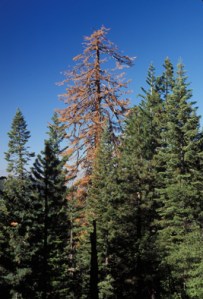
North American Trees Dying Twice as Fast

sugar-pine-dying-from-bark-beetle-attack-in-yosemite-national-parkimage-courtesy-of-jerry-franklinBy Stephen Leahy

UXBRIDGE, Canada, Jan 22 (IPS)

Our trees are dying. Throughout the western United States, cherished and protected forests are dying twice as fast as they did 20 years ago because of climate change, researchers reported Thursday in the journal Science.

Fire did not kill these trees, nor did some massive insect outbreak. The trees in this wide-ranging study were “undisturbed stands of old growth forests”, said Jerry Franklin, a professor of forest resources at the University of Washington and one of 11 co-authors of the report.

“The data in this study is from our most stable, resilient stands of trees,” Franklin told IPS.

What this means is that the United States’ best forests are getting thinner.

It is like a town where the birth rate is stable but the mortality rate for all ages doubled over the past two decades. “If that was happening in your hometown you’d become very concerned,” said Nate Stephenson, an ecologist with the U.S. Geological Survey (USGS).

This dramatic increase of in tree mortality applies to all kinds, sizes, ages and locations of trees. In the Pacific Northwest and southern British Columbia, the rate of tree death in older coniferous forests doubled in 17 years. In California, doubling mortality rates took a little longer at 25 years. For interior states it took 29 years. Continue reading

Carbon-Credit Gold: Who is going to get rich?

forest-fireBy Stephen Leahy

Paying the poor to conserve forests through a market scheme is the new star among initiatives in climate talks.

UXBRIDGE, Canada, Dec 15 (Tierramérica).- Climate experts meeting in Poznan, Poland, promised to create a new pot of carbon-credit gold for the rural poor as guardians of rural lands and forests.

But there are many who warn that the gold will flow only to corporate interests.

One of the most effective ways to combat climate change, caused by gases like carbon dioxide that trap heat in the atmosphere, is through biological sequestration of carbon in plants, trees and soils. That means reducing deforestation, increasing reforestation, and utilizing sustainable agriculture and grazing practices that conserve soil and water.

If these activities become part of a multi-billion-dollar global carbon finance regime, under a new 2009 climate treaty, there could be extraordinary benefits for the rural poor and the environment, according to Olav Kjørven, the former director of the United Nations Development Program’s (UNDP) Energy and Environment Group. Continue reading

Economics Killing Mother Nature

For 40 years some economists have known boosting GDP was perverse and suicidal — i.e. Hurricane Katrina was great for the US economy — and is laying waste to the planet’s ecosystems

By Stephen Leahy

BONN, May 30 (IPS) – The global biodiversity crisis that threatens life on Earth is driven by economic policies that fail to value nature, a new report finds.

It took the 2006 Stern Review to convince business and governments that combating climate change would be far less costly than ignoring it. Now another “Stern-like” report pegs the ecological damage to the planet’s land areas every year at 78 billion dollars due to ongoing loss of biodiversity.

“The developing world will never catch up with the developed world at the current level of biodiversity loss,” said Pavan Sukhdev, the lead author of the report and head of Deutsche Bank’s global markets business in India. Continue reading

GE Trees: Poor Countries Can’t Control

Courtsey of Museo d\'Arte Contemporanea, Turin, Italy

by Stephen Leahy

BONN, May 29 (IPS) – An intense North-South debate over genetically engineered trees has sidetracked delegates at a U.N. conference on biodiversity here: African nations want a global moratorium, while a few rich countries led by Canada say it should be up to individual countries to regulate.

While 168 nations that are part of the U.N. Convention on Biological Diversity (CBD) debate the issue, a new two-year U.N.-funded study warns that developing countries simply don’t have the capacity to manage or monitor biotechnology.

“Africa doesn’t have the technical and scientific capacity to fully debate let alone enforce rules around biosafety of biotechnology,” said the study’s co-author, Sam Johnston of the United Nations University Institute of Advanced Studies (UN-IAS) in Tokyo.

“Genetic contamination by GE plants is a huge issue and it’s increasing,” Johnston told IPS in Bonn.

Continue reading

Ethanol Worse Than Gasoline

oil-palm-seedling-in-burned-peat-forest-wetland-international.jpg

By Stephen Leahy
Feb 8 (IPS) – Biofuels are making climate change worse, not better, according to two new studies which found that total greenhouse gas emissions from biofuels are far higher than those from burning gasoline because biofuel production is pushing up food prices and resulting in deforestation and loss of grasslands.

Emissions from ethanol are 93 percent higher than gasoline,” said David Tilman, an ecologist at the University of Minnesota and co-author of one of the papers published Thursday in the journal Science.

“The bottom line is that using good farmland for biofuels increases greenhouse emissions,” he said.
Continue reading

Amazon Forest Could Cook the Planet

2_4amazon_forest.jpg


By Stephen Leahy

Dec 7 (IPS) – A two-degree Celsius rise in global temperatures could flip the Amazon forest from being the Earth’s vital air conditioner to a flamethrower that cooks the planet, warns a new report released at the climate talks in Bali, Indonesia Friday.

And we’re already past 0.6 degrees C., climate experts say.

Paradoxically, a two-degree C. rise in global temperatures cannot be prevented without a largely intact Amazon rainforest, says Dan Nepstad, a senior scientist at the Woods Hole Research Centre in the U.S. state of Massachusetts and author of the report “The Amazon’s Vicious Cycles: Drought and Fire in the Greenhouse”, issued by WWF, the global conservation organisation.

“The importance of the Amazon forest for the globe’s climate cannot be underplayed,” said Nepstad at a press conference from Nusa Dua on the island of Bali, the site of the United Nations Framework Convention on Climate Change (UNFCCC) conference running until Dec. 14. Continue reading

Forests, the Great Green Hope?

By Stephen Leahy


Credit:Tomasz Kuran

Mixed forest near Radziejowice, Poland.

Dec 3 (IPS) – Expanding European forests absorbed 126 million tonnes of carbon dioxide from 1990 to 2005 — equivalent to 11 percent of European Union emissions from human activities — while a U.N. target to plant one billion trees mainly in Africa has been surpassed.

“Forests reduced carbon dioxide more than twice the amount of Europe’s renewable energy programmes,” said Pekka Kauppi, who led the University of Helsinki study, published in the British journal Energy Policy on Nov. 29.

Better conservation, migration to cities, and conversion of surplus farmland are the reasons behind the growing and expanding forests, which are mainly in Latvia, Lithuania, Sweden, Slovenia, Bulgaria and Finland Kauppi, told IPS. The study is based on forestry statistics provided by governments and that were not independently verified.

The resulting “surprisingly high carbon dioxide removal” may be the major factor in Europe achieving its ambitious target of 20 percent reductions in greenhouse targets by 2020, Kauppi said.

“On a global scale, there is hope for the future if we stop deforestation and expand forests,” he added. Continue reading

The Coming Oxygen Crisis?

“I have no idea how this will affect oxygen levels but it is something we should be thinking about.”Bradley Cardinale, biologist, University of California,

By Stephen Leahy


Credit:NASA

The Amazon River and rainforest viewed from space.

Nov 6 (IPS) – Plants are the only source of oxygen on Earth — the only source. Studies around the world show that as plant species become extinct, natural habitats can lose up to half of their living plant biomass.

Half of the oxygen they produced is lost. Half of the water, food and other ecological services they provide are lost.

If a forest loses too many unique species, it can reduce the total number of plants in that forest by half, says Bradley Cardinale, lead author of the meta-analysis published this week in the Proceedings of the National Academy of Sciences (PNAS).

“Those unique species are not replaceable. Nothing takes their place. It was a really shocking finding for me,” Cardinale, a biologist at the University of California, Santa Barbara, told IPS. “That’s how much biodiversity matters.”

Continue reading

Satélites revelan caída de tala amazónica en Perú

Para los lectores españoles:

Satélites revelan caída de tala amazónica en PerúRecently-contacted Murunahua man, River Yurua, Peru. He was shot in the eye by loggers during first contact. © David Hill / Survival
Por Stephen Leahy

La deforestación peruana, intensa en las áreas cercanas a carreteras y explotaciones minerales, ha tenido escaso impacto en las selvas protegidas, afirman investigadores.

TORONTO, 13 ago (Tierramérica).- Las políticas de conservación de selvas redujeron el ritmo de la deforestación en la Amazonia peruana, afirma un nuevo estudio basado en detección satelital de alta precisión.

Aunque los bosques amazónicos de Brasil son los que concitan la mayor parte de la atención internacional, los 661 mil kilómetros cuadrados de selvas peruanas son reconocidos como un ecosistema único.

Pero los impactos de la actividad humana en toda la región han sido mal comprendidos hasta un estudio publicado el viernes 10 en la revista científica Science.

“Las reservas forestales y las áreas de conservación de Perú parecen estar funcionando bien”, dijo Greg Asner, director del estadounidense Observatorio Aéreo de la Carnegie Institution of Washington, con sede en California.

Continue reading

Pollute for Free – America’s Economic Model

copyright Pembina Institute

If ever there was a project where sustainable accounting is needed, Alberta tar sands oil extraction is it.” — Mindy S. Lubber

Mindy Lubber, president of Ceres, a leading coalition of investors and environmental groups working on sustainability issues notes in this article today that the current “accounting system meant that companies were long able to “externalize” natural resource costs. In other words, they could pollute for free without paying for environmental damage and cleanups. Society and taxpayers shouldered these costs instead.”

Reform of this not-grounded-in-reality accounting and economic system is essential to move towards sustainable societies.

Canada’s oil or tar sands that supply the US with much of its oil is devastating huge swaths of pristine boreal forest, ruining wild rivers and polluting the air of the north Lubber says. For more on the environmental impacts of the biggest industrial project on the planet see Destroying Canada’s Boreal Forest for America’s Oil