Roads Lead to Deforestation in Untouched Peruvian Amazon

Recently-contacted Murunahua man, River Yurua, Peru. He was shot in the eye by loggers during first contact. © David Hill / Survival

Satellites Show Logging Decline in Peruvian Amazon
By Stephen Leahy

Deforestation in the Peruvian Amazon, intense in zones near roads and mining operations, has had little impact in protected forests, say researchers.

Aug 13 (Tierramérica).- Rainforest conservation policies are reducing the rate of deforestation in the Peruvian Amazon, but roads are unquestionably the drivers of change, new satellite data reveal.

Although Brazil’s Amazon forests draw the most international attention, Peru’s 661,000 square kilometers of rainforests are recognized as a unique and important ecosystem.

However, the impacts of human activities throughout the region have been poorly understood, until a study published Aug. 10 in the journal Science.

“Peru’s forest reserves and conservation areas appear to be working well,” said Greg Asner, director of the Carnegie Airborne Observatory, at Stanford University in California.

Continue reading

Destroying Canada’s Forests for America’s Oil

“Nowhere else in the world where this much money is being invested”

cover 2.0**REVISED** Oil Stains in the Boreal Forest:

The Environmental Cost of Canada’s Oil Sands

An eBook by Stephen Leahy

Oil Stains in the Boreal Forest is a 30-page eBook presenting a factual overview of the environmental impacts of pumping more than 1.1 million barrels of oil — 175 million litres (50 million gallons) — each day to thirsty US markets.

Based on a 4-part investigative journalism series, leading scientific and environmental experts along with industry officials are interviewed.

Recipe for making a make a gallon of gasoline from the oil sands:

  • burn 1500 cubic feet of natural gas
  • use up 700 litres of water
  • dig up two tonnes of earth and rock
  • dump 948 litres (250 gallons) of mine tailings

And that’s just the beginning – now the crude has to be processed.

Oil Stains in the Boreal Forest   includes pictures of the destruction of virgin boreal forest, links to access additional information, and a peek at a new economic study that shows oil company profits are subsidized by not having to pay for their pollution.

Download your copy of the updated 2009 version 2.1 today for only $3.75
Oil Stains in the Boreal Forest: The Environmental Cost of Canada’s Oil Sands 2.1

eBook -Version 2.1 (2009) – full-color, 8 1/2 x 11″,  30 pages   (14 mb pdf download) 

Learn more about the author


Feeding the World Without Destroying It

Farming Will Make or Break the Food Chain
By Stephen Leahy

May 2 (IPS) – As the world population swells to nine billion by 2050, global biodiversity will be under extreme pressure unless new ways to grow food are developed, experts say.

An additional one billion hectares of wild lands — mainly forests and savanna — will be converted to food production fields by 2050. While this may provide enough food, it is likely to result in a massive decline in biodiversity, undermining ecosystems that provide vital services such as clean water and air, and capture carbon to slow the build-up of climate-altering gases in the atmosphere.

Sixty percent of the Earth’s ecosystems are in trouble right now, warned the Millennium Ecosystem Assessment report last year.

What state will they be in by 2050? Continue reading

Biofuels and Carbon Credits Behind Global Deforestation

Biofuels Boom Spurring Deforestation
By Stephen Leahy

Mar 21 (IPS/IFEJ) – Nearly 40,000 hectares of forest vanish every day, driven by the world’s growing hunger for timber, pulp and paper, and ironically, new biofuels and carbon credits designed to protect the environment.

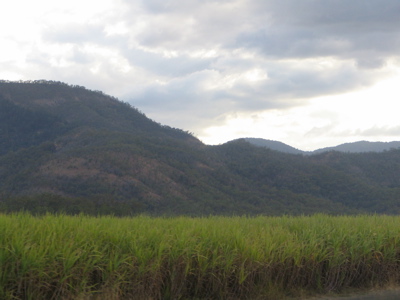
Sugarcane field Queensland Australia Copyright Renate Leahy 2004The irony here is that the growing eagerness to slow climate change by using biofuels and planting millions of trees for carbon credits has resulted in new major causes of deforestation, say activists. And that is making climate change worse because deforestation puts far more greenhouse gases into the atmosphere than the entire world’s fleet of cars, trucks, planes, trains and ships combined.

“Biofuels are rapidly becoming the main cause of deforestation in countries like Indonesia, Malaysia and Brazil,” said Simone Lovera, managing coordinator of the Global Forest Coalition, an environmental NGO based in Asunción, Paraguay. Continue reading

Shopping Our Way To Disaster – Connecting the Dots

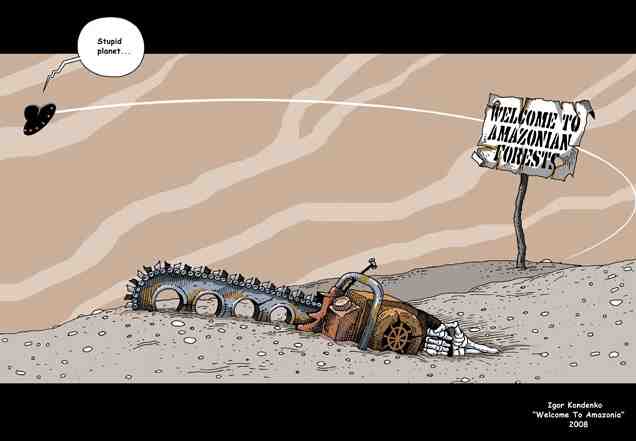
amazon-desert-chainsawBy Stephen Leahy

It’s well past time that people began to connect the dots between what they buy and the resulting environmental impacts such as global warming. In other words, consumption has consequences: big, nasty environmental consequences that inflict suffering mainly on the world’s poor experts say.

(IPS) (Originally published Jan 15 2007)

A Chinese-made $50 computer desk is likely the result of illegal clear-cutting in Indonesian rainforests. Buying such items fuels crime syndicates and emits huge amounts of global warming gases.

That North Americans, and to a lesser extent Europeans, are profligate consumers is well known. If everyone consumed like North Americans we’d need five planets to support us — only three planets are necessary if we all lived like Europeans, according to the World Wildlife Fund’s Living Planet Report.

The world collectively overshot the Earth’s capacity to support us in 1984, the report notes. In the 22 years since reaching that crucial tipping point, rates of consumption of resources have accelerated. Not just in North America and Europe but China and India, not to mention other parts of Asia and Latin America.

While this ever-accelerating consumption of resources the sign of a healthy global economy according to economists, it has also resulted in climate change, amongst many other environmental and social ills.

People don’t appreciate that their purchases have real environmental impacts,” said Monique Tilford, acting executive director of the Centre for a New American Dream (CNAD), a Maryland group promoting environmentally and socially responsible consumption. Continue reading

Will Forests Adapt to a Warmer World?

How is climate change affecting the world’s forests today and in the future

Copyright 2006 Renate Leahy
By Stephen Leahy

TORONTO, Nov 20 (IPS/IFEJ) – Deforestation remains the greatest current threat to the world’s forests, claiming 10 to 15 million hectares of tree-covered areas every year, but climate change may represent a bigger challenge in the long term, scientists say.

“We’re like a two-year-old playing with fire… We’re messing around with something dangerous and don’t really understand what will happen,” says William Laurance, of the Smithsonian Tropical Research Institute in Balboa, Panama, in reference to climate change and the Amazon rainforest.

Forests and other forms of life are now living on an “alien” planet where the levels of carbon dioxide and other greenhouse gases in the atmosphere are higher than they have been for a million years.

These unprecedented levels of greenhouse gases are creating a new, hotter planet with weather that is much more extreme than in the past.

What does this mean for the 20 percent of the Earth’s original forests that are still standing? Some scientists believe forests will grow faster in a warmer world. Others say they are more likely to burn, or suffer from disease or die from drought.

Full story here

Part of a series on sustainable development for IPS and IFEJ (International Federation of Environmental Journalists)

CARBON FORESTS: Can the Free Market Slow Deforestation?

Sumatra burning forest courtesy of Kim Worm Sorensen sml

By Stephen Leahy

IPS 28/10/2006

Tropical forests’ ability to store carbon dioxide and mitigate climate change makes them more valuable than alternative uses like pasture or lumber, and rich countries ought to pay tropical countries to preserve their forests, the World Bank says.

However, some environmentalists caution that while reducing deforestation is vital, a so-called carbon trading system is the wrong approach and too complicated to implement.

The world’s tropical forests have been shrinking at a rate of five percent per decade since the 1950s. In the past five years, more than 50 million hectares of tropical forest have been lost — an area nearly the size of France. Aside from the loss of biodiversity, destruction of ecosystems and other negative impacts, deforestation is a major source of human-made emissions of climate-altering greenhouse gases (GHGs).

In fact, deforestation contributes almost twice as much GHGs as does all road transport around the world.

“The trees are worth more alive, storing carbon, than they would be worth if burned and transformed to unproductive fields,” said Kenneth Chomitz, lead author of the World Bank report released Monday. Continue reading