Atlantic Bluefin Tuna Going Way of Northern Cod

tuna-hall-sml.jpgAtlantic Bluefin Tuna Going Way of Northern Cod
By Stephen Leahy

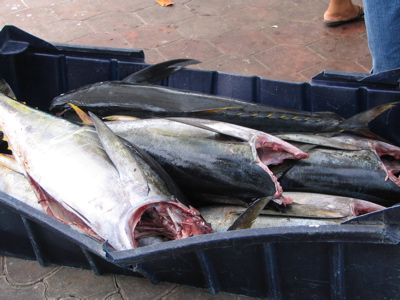
Aug 6 (IPS) – Fishing wiped out Atlantic Bluefin tuna stocks in Northern Europe 50 years ago, according to a new study, while ongoing pressure on the remaining stocks is pushing the entire species to the edge of extinction.

Every summer in the early 1900s, Northern European waters from Holland to northern Norway teemed with Atlantic Bluefin tuna, some three metres long and weighing 700 kilogrammes, according to historical fishing records. Few could catch the powerful, fast-swimming fish until the 1930s and 1940s when bigger, faster boats with better catch gear were designed.

“The Bluefin population crashed in the 1960s and more than 40 years later it still hasn’t recovered,” said Brian MacKenzie of the Technical University of Denmark, who led the study to be published in the journal Fisheries Research.yellow-fin-tua-galapagos.jpg
“You simply don’t see bluefins in these waters any more,” MacKenzie told IPS.

There is a clear parallel to the more recent collapse of once abundant Northern Cod stocks. Also fished into near extinction on the other side of the Atlantic, the Cod have not recovered despite a no-fishing ban for the past 15 years.

“I’m afraid what happened to the Bluefin is similar to what happened to the Northern Cod,” he said.

Continue reading

Drowning Country: Tuvalu Symbol of Catastrophe and Hope

Tiny Tuvalu Fights for Its Literal Survival
By Stephen Leahy


Credit:NASA

Funafuti atoll seen from 125 miles above the Eart

VIENNA, Jul 27 (IPS/IFEJ) – The second smallest nation on Earth hopes to turn itself into an example of sustainable development that others can emulate.

But the South Pacific island nation of Tuvalu and its 10,500 people may only have 50 years or less to set that example before it is swept away by rising sea levels due to climate change.

“Construction of the first ever biogas digestor on a coral island is complete,” said Gilliane Le Gallic, president of Alofa Tuvalu, a Paris-based group that is working with the local Tuvaluan government.

Located on a small islet near Tuvalu’s capital of Funafuti, the biogas digester uses manure from about 60 pigs to produce gas for cooking stoves. More importantly, more than 40 Tuvaluans have been trained at the newly opened Tuvalu National Training Centre on renewable energy.

“We are trying to create simple, workable models of sustainable development that can be reproduced by others elsewhere,” Le Gallic, a documentary filmmaker, told IPS from Paris.

Continue reading

Greenest Ethanol Still Unproven

Sugarcane field Queensland Australia Copyright Renate Leahy 2004Cellulosic Ethanol – Clean but Worth Unproven
By Stephen Leahy

Jun 30 (IPS) – With biofuels being blamed for rising food prices and offering limited environmental benefits, diverse luminaries like former U.S. vice-president Al Gore and Microsoft’s Bill Gates are throwing their considerable support behind cellulosic ethanol, a second generation biofuel.

copyright Pembina InstituteThe big benefit cellulosic ethanol has is that virtually any plant material — left-over corn stalks, sawdust, wood chips, native perennials grown on marginal lands — could be turned into ‘green gold’, a low-emission fuel for the transportation sector.

“Cellulosic ethanol would reduce carbon emissions 88 percent over gasoline,” says Bruce Dale, a chemical engineer at the Biomass Conversion Research Laboratory at Michigan State University.
Continue reading

Synthetic Lifeforms by Microbesoft

picture-6.pngGenome Guru Seeks Patent on Synthetic Life Form
 

By Stephen Leahy

Jun 11 (IPS) – Patent applications for the world’s first-ever human-made species have been made to patent offices around the world.

The Venter Institute, named for its founder and CEO, J. Craig Venter, has applied for a patent on a novel bacterium made entirely from synthetic DNA in the laboratory, according to a civil society organisation concerned that this new technology is outpacing ethics and safety protocols. Applications have reportedly been made to more than 100 patent offices over the past few months for the synthetic bacterium called “Mycoplasma laboratorium”. “In the tradition of ‘Dolly,’ (the first cloned animal) we have nicknamed this synthetic organism ‘Synthia'”, said Jim Thomas of ETC Group, a Canada-based organisation that recently won a 13-year legal battle against Monsanto’s species-wide soybean patent.

“These monopoly claims signal the start of a high-stakes commercial race to synthesise and privatise synthetic life forms,” Thomas told IPS. “Will Venter’s company become the ‘Microbesoft’ of synthetic biology?”

Continue reading

The Earth is Going Dark Scientists Say

From Big Melt to Big Swamp
By Stephen Leahy


Credit:Mette M.

Spitsbergen glacier in Norway, Arctic Ocean

Jun 5 (IPS) – The Earth is going dark. From the Arctic Ocean to the Himalayan mountains to the Russian tundra, ice and snow are in rapid and permanent retreat in response to global warming, a new U.N. report said Tuesday.

Glaciers, ice sheets, sea and river ice are all melting. The areas in the northern hemisphere covered by snow and ice have declined 1.3 percent per decade for the past four decades. And that’s expected to accelerate dramatically in the coming years.

“Around the Earth, white is being replaced by dark,” said Gunnar Sander of the Norwegian Polar Institute in Tromso, Norway.

The white — snow and ice — reflect sunlight while the dark — bare ground and open water — absorb the heat from sunlight, increasing the pace of global warming.

“This is affecting the heat balance of the planet,” Sander told IPS.

Continue reading

How to Kick-Start the 21st Century Eco-Economy

restore-cover-wri-sml.jpg Toward a Green Economy
By Stephen Leahy*


May 31 (IPS) – Humanity is facing historic and truly unprecedented challenges from climate change and the rapid decline of ecosystems that sustain life.

This article is final part of a three-part series published by IPS on natural capital and how future global prosperity and equity can be achieved through the preservation of ecosystems. See Part One: Like Enron, Earth Inc. Sliding Into Bankruptcy and Part Two: Global Warming is Real But I didn’t Do It 

The 2005 Millennium Ecosystem Assessment (MA) found that 83 percent of the planet’s natural systems are in serious decline or on the brink. Adding to this already dire situation are the twin pressures of population growth and increasingly consumptive lifestyles.

Global population is expected to soar from today’s 6.6 billion to 9 billion by 2050. Even though we crossed the point of sustainable use of natural resources in the mid-1980s, many of the 2.4 billion people living in China and India are striving mightily right now to approach the materialistic lifestyle of the average North American.

So how can we find our way around the global calamity the human race seems to be hurtling towards?

“Humanity needs a fundamentally new approach to managing the assets upon which we all depend,” said Janet Ranganathan, director of the People and Ecosystems programme at the World Resources Institute, an environmental group based in Washington.

“We need new ways of making decisions at all levels that fully value ecosystems and the services they provide us,” she said.

Continue reading

Global Warming Is Real But I Didn’t Do It


CLIMATE CHANGE:
Overcoming the Ostrich Effect
By Stephen Leahy

May 30 (IPS) – The vast majority of North Americans now declare that they want action on climate change. But whether people are truly willing to embrace “carbon-neutral” lifestyles — including giving up their gas-guzzling sports utility vehicles — remains an open question, say experts.

This article is part two of a three-part series published by IPS on natural capital and how future global prosperity and equity can be achieved through the preservation of ecosystems. See Part One: Like Enron, Earth Inc. Sliding Into Bankruptcy and Part Three: How to Kick-Start the 21st Century Eco-Economy

Scientists have made a strong case that the only way to stave off the worst impacts of climate change — floods, storms, wildfires, disease epidemics and sundry other unpleasant events — is by slashing greenhouse gas emissions a whopping 80 percent from the 1990 baseline by 2050. European policy-makers are already putting plans in place to meet that target.
North Americans, whose region is by far the worst polluter, are beginning to talk about reductions, but few understand the sweeping breadth of the changes needed to reach the 80 percent target.

“The American public’s awareness about global warming is extremely high, but that doesn’t mean very much,” said Anthony Leiserowitz, director of Strategic Initiatives at Yale University’s School of Forestry and Environmental Studies

Continue reading

XDR-TB Travel Bans, Leper Colonies Needed

With the current media buzz about XDR TB (extensively drug-resistant tuberculosis), a few brief facts from my Jan 22 2007 IPS article may offer some perspective about this serious health issue:

* South Africa’s international tourism boom and global trade and transport systems, the XDR-TB outbreak represents “a potentially explosive international health crisis”

* “The problem is a lot bigger than we know….I wouldn’t be surprised if it has spread to all the surrounding countries,” said Jerome Amir Singh, an HIV/AIDS expert at the Nelson R. Mandela School of Medicine, University of KwaZulu-Natal in Durban.

* Strains of drug-resistant TB first arose in the former Soviet bloc countries in the 1990s as a result of incomplete drug treatment regimes and deteriorating health care systems.

* About one-third of the world’s population carries the TB bacterium in their bodies

For more see Strict Quarantines Possible for African Outbreak of Deadly New Infectious TB Strain (XDR-TB)

See also this update from India: High incidence of drug-resistant TB found in India

Like Enron, Earth Inc. Sliding Into Bankruptcy

Earth Inc. Sliding Into Bankruptcy
By Stephen Leahy


Credit:WWF-Canon / Hartmut

Mangrove destruction for shrimp farming in Thailand.

May 29 (IPS) – Build a shrimp farm in Thailand by cutting down mangrove forests and you will net about 8,000 dollars per hectare. Meanwhile, the destruction of the forest and pollution from the farm will result in a loss of ecosystems worth 35,000 dollars/ha per year.

This article is part one of a three-part series on natural capital and how future global prosperity and equity can be achieved through the preservation of ecosystems. See Part Two: Global Warming is Real But I didn’t Do It    Part Three: How to Kick-Start the 21st Century Eco-Economy


Many leading development institutions and policy-makers still fail to understand that this ruthless exploitation for short-term profits could trigger an Enron-like collapse of “Earth, Inc.”, experts say.

For example, the World Bank and other economic development agencies would happily loan a shrimp farmer 100,000 dollars to clear more mangroves. Continue reading

No More Lions, Tigers or Bears in a Warmer World (and two steps to keep that from happening)

The really awful predications about rapid, massive extinction appear to be true” Jeremy Kerr, University of Ottawa

“Unless we do something there will be no tigers, lions or bears left in the wild for my grandchildren” Stuart Pimm, Duke University

Scientists Foresee Extinction Domino Effect
By Stephen Leahy


Credit:morgueFile

Sri Lankan monkey with its young.

May 17 (IPS) – Climate change is accelerating species extinctions and unraveling the intricate web of life, experts fear.

Birds, animals, insects and even plants are on the move around the Earth, trying to flee new and increasingly inhospitable local weather conditions. For some, including alpine species and polar bears, there is nowhere to go. And many others, like plants, lack the mobility to stay ahead of changing climatic conditions.

“We’re already seeing species moving, but they’re not moving fast enough to avoid potential extinction,” says Jeremy Kerr, an ecologist at the University of Ottawa in Canada.

“The really awful predications about rapid, massive extinction appear to be true, according to the early evidence,” Kerr told IPS.

One of those predictions came last year from the Millennium Ecosystem Assessment (MA), an unprecedented international four-year research effort. The MA warned that up to 30 percent of all species on Earth could vanish by 2050 due to unsustainable human activities. Continue reading