Carbon Markets Are NOT Cooling the Planet

Carbon markets have failed – prone to fraud – experts report

Climate change is the world’s biggest market failure so why would we expect carbon markets to save the day? There isn’t going to be a climate treaty for some years yet.It is simply too complex and politically charged. Don’t be too depressed about this. We are in uncharted waters as a species in trying to find an equitable way to manage the climate of our planet. But action is needed now and the best place is at our local neighbourhood level to save energy, use alternatives, build communities and inform people IMHO. — Stephen

By Stephen Leahy*

BONN, Jun 22, 2011 (Tierramérica)

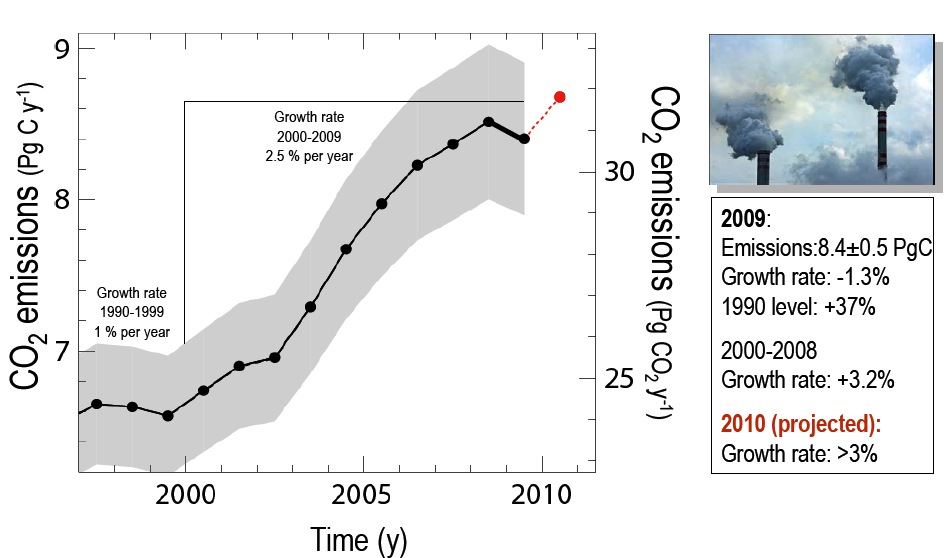
Carbon markets have been widely promoted as the only way to generate enough money to enable industries and countries to reduce their carbon dioxide emissions, which are largely responsible for global warming. The only problem is that nearly 20 years after their conception, they have failed to work, and have also been subject to fraud and other financial crimes.

Interpol, the world’s leading policing agency, has warned that carbon market schemes are easily taken advantage of by organised crime.

Earlier this year, carbon credits worth 38 million dollars went missing in the European Union’s carbon market after funds were transferred by computer hackers from the Czech Republic to Poland, Estonia and Liechtenstein before disappearing. That was the fourth time funds had been stolen or mislaid.

“A lawyer formerly involved in carbon trading told me that if markets are still trading carbon 10 or 15 years from now, then the global environment will be in very big trouble,” Steve Suppan, senior policy analyst at the U.S.-based Institute for Agriculture and Trade Policy (IATP), told Tierramerica.

“Carbon markets are open to fraud, misrepresentation and deceptive promotion,” Suppan said in an interview at the United Nations Framework Convention on Climate Change (UNFCCC) negotiating sessions held in Bonn Jun. 6-17.

These markets have had huge support from governments and they still do not work to effectively reduce greenhouse gas emissions, said Suppan, whose organisation works on trade, agriculture and environmental issues.
Continue reading

The Oxymoron of Political Leadership and Political Will

Analysis by Stephen Leahy

VIENNA, Jun 29, 2011 (IPS)

Political will is all that’s needed to bring electricity to the 2.5 billion people with no or unreliable access to power, or to feed the one billion who go hungry every day, or to finally begin to slash carbon emissions to avoid dangerous climate change, or just about any other global problem.

Humanity has the technology, resources and even the money to solve these problems, agree scientists, corporate business leaders, heads of civil society organisations and United Nations agencies and government ministers. “All that is lacking is political will,” they almost always declare at the dozens of international conferences, summits and forums this reporter has attended for the past five years. And then everyone goes home.

What is this magical “political will” that can solve any problem?

via The Oxymoron of Political Leadership – IPS ipsnews.net.

Final Update: COP 16 Cancun Climate Conference

19 Dec 2010

On reflection there was some progress at COP 16. Small island states, whose very existence is threatened, were satisfied the world is on its way to a significant climate treaty so that is something. Last year in Copenhagen, hardly anyone happy with the outcome. There is still a long and difficult road ahead. Not least because there remains a powerful and well-funded opposition to emission reductions in many countries.

In 2011 I hope to uncover more about that opposition while continuing to write about how the physical processes of climate change are not waiting for us to get our act together. Substantial changes are already underway. Changes to the global water cycle have been shown in the first global study of evapotranspiration rates as detailed in my article: “Climate Changes Herald a Future of Widespread Drought – Water Left High and Dry in Climate Talks”

The article also looks at some fairly dire drought projections for the coming decades.

For those experiencing a rough, early winter, I did the first article revealing how the melting Arctic may be bringing earlier and harsher winters to the UK, parts of Europe and North America. That story happened because of donations to help cover my costs of attending a polar science conference in Oslo were those new findings were presented. Science journalism isn’t easy or cheap to do. I was one of  few journalists in Oslo because hardly any media outlet covers travel costs any more – never mind paying a decent fee for a story. That’s why I am trying Community Supported Journalism where people support my efforts to inform people about the great issues of our time.

A warm thank you to those who sponsored some of the Cancun articles, contributing some much needed cash to help cover my costs.  Supporters names are prominently listed in the articles here. I can no longer continue to do environmental and science journalism without your help so thank you for helping out.

— Stephen

Just click the button to go to the PayPal Secure Donation* page & enter your sponsorship amount (fully secure, major Credit Cards accepted)

Your one-time or monthly contributions are vital for Community Supported Environmental Journalism (click for more info)

*More than 100,000 non-profits safely use PayPal Donate service

Europe to cook the world’s tropical forests for biofuels — British told to back off targets by its climate advisors

UPDATE 13 Sept: UK must cut biofuels target “so that tropical forests are not cut down to make way for biofuel crops, government climate advisors said last Friday.”

“Europe is going to cook the world’s tropical forests to fight climate change; it’s crazy” — Millions of Trees Burned for ‘Green Energy’ Burning trees for energy produces 1.5 times as much carbon as coal – study shows

By Stephen Leahy*

UXBRIDGE, Canada, Sep 24 ’09 (Tierramérica) (Revised Sept 1’10)

Millions of trees, especially from the developing countries of the South, are being shipped to Europe and burned in giant furnaces to meet “green energy” requirements … Read More

via Stephen Leahy, International Environmental Journalist

Biggest Conservation Agreement Ever — 2X the Size of Germany

By Stephen Leahy

UXBRIDGE, Canada, May 18, 2010 (IPS)

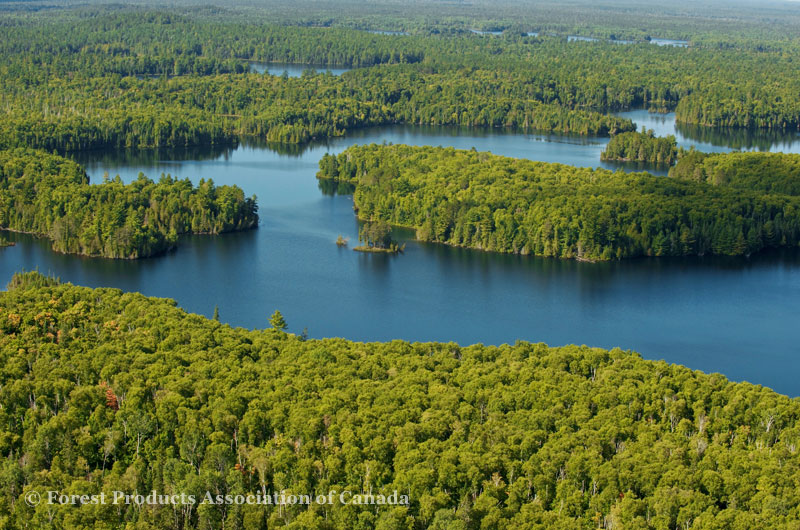
The decades-long war in Canada’s northwoods appears to be over. Environmental groups and Canadian logging companies linked arms Tuesday morning and agreed to work together to sustainably manage and protect 720,000 square kilometres of Canada’s boreal forest – an area twice the size of Germany.

“This is the biggest conservation agreement on the entire planet,” said Richard Brooks, spokesperson for participating environmental organisations and forest campaign coordinator of Greenpeace Canada.

The vast northern boreal forest is a broad band that circles the top of the world below the Arctic. It is the last great forest ecosystem – larger even than the Amazon – and the largest terrestrial storehouse of carbon. Made up primarily of pine and spruce trees, Canada’s boreal covers more than five million square kilometers, representing more than a quarter of the remaining intact forest on the planet. Just eight to 10 percent is currently protected.

“This is our best and last chance to save woodland caribou, permanently protect vast areas of the boreal forest and put in place sustainable forestry practices,” Brooks said in a press conference.

“We estimate there is roughly 20 billion tonnes of carbon in the trees and soils that are part of this agreement.”

That is equivalent to the annual emissions from 18 billion cars, he estimated. Continue reading

Is Privatizing Air & Water Only Way to Save the Planet? — Copenhagen Talks

By Stephen Leahy*

COPENHAGEN, Dec 17 (Tierramérica)

In the last two years, the conclusion among decision-makers has been that the only way to solve the climate crisis is to turn carbon into a commodity and privatise the atmosphere.

Similar market-based solutions will be used to “solve” the growing water crisis, warned experts at the Klimaforum09, a parallel meeting a few kilometres away from the official 15th Conference of Parties (COP15) to the United Nations Framework Convention on Climate Change, held Dec. 7-18 in Copenhagen.

“Corporations do not want regulations and have convinced governments that they can deliver continued economic growth and save the planet,” said Maude Barlow, chair of the Council of Canadians, the largest citizens group in Canada and author of several books about water issues.

“It shows the power of the corporate lobby that nearly everyone, including many big NGOs, all see the market as the solution to climate change,” Barlow told Tierramérica.

Meanwhile, the climate justice movement is fighting against carbon trading and carbon offsets and advocating for real emissions cuts, while recognising that the commons – air and water – are a public trust, she said

See No Water in Copenhagen Talks

Learn About Community Supported Journalism

2020 Climate Deadline Is the Crucial “Litmus Test”

Chile—The fury of Chaitén volcano - nat geo

The atmosphere and the climate is a public good, a commons, and can’t be protected by the private sector.”

— Marianne Haug, Oxford Institute for Energy

By Stephen Leahy

VIENNA, Jun 29 2009 (IPS)

“So who here thinks there will be a meaningful deal in Copenhagen?”

Few of the more than 600 energy ministers, officials and experts from 80 countries attending the Vienna Energy Conference raised their hands in response to the conference moderator’s question about the final round of climate negotiations this December in Copenhagen.

“I don’t think there will be agreement on an emissions cap,” said Andre Amado, Brazil’s vice-minister for energy, science and technology.

Greenhouse gas emissions from the burning of fossil fuels must peak between 2015 and 2020 and then decline to prevent dangerous, irreversible climate change, scientists have warned. A strong international agreement on emissions targets for both the industrialised and developing world is widely believed to be the only way to ensure emissions peak and then decline.

“There will be agreement on technology transfer and reducing barriers for technology transfers,” to assist developing countries in cutting their emissions and adapting to the changing climate, Amado told participants last week in Austria’s capital city.

Continue reading

Heading for +2 degrees C (3.6 degrees F) Carbon Use Must Peak by 2015 Scientists Warn

Carbon overload - have to stop expanding
Carbon overload – have to stop expanding

By Stephen Leahy

“We shouldn’t forget that a 2-degree C global mean warming would take us far beyond the natural temperature variations that life on Earth has experienced since we humans have been around.”

ANCHORAGE, Alaska, Apr 30 (IPS)

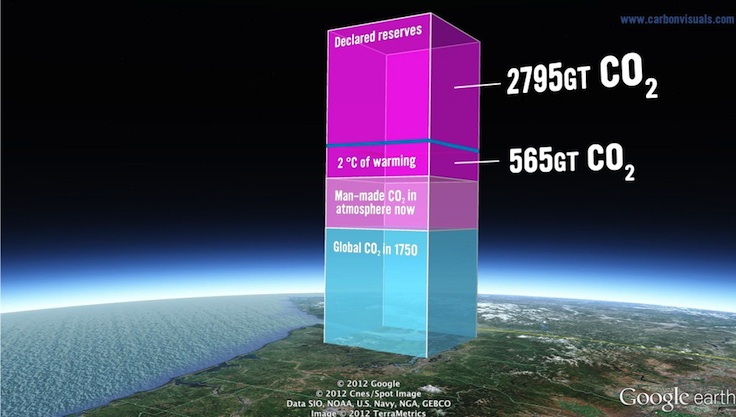
Climate scientists are calling for a phase-out of fossil fuels because humans are now pumping so much carbon dioxide (CO2) into the atmosphere that the ‘2-degree-C climate balloon’ will burst otherwise, new studies show.

That 2-degree C climate balloon has a maximum capacity of less than 1,400 gigatonnes of CO2 total emissions from the year 2000 to 2050, Malte Meinshausen and colleagues report in the current issue of Nature. The European Union and others consider a global temperature rise of more than 2 degrees C as dangerous and potentially catastrophic. Temperatures are already 0.8 C warmer than the pre-industrial period.

UPDATE Nov 2009 Prospect of a four-degree Celsius rise in global average temperatures in 50 years is alarming – but not alarmist, climate scientists now believe. Four Degrees of Devastation

The reality is that global emissions for the last seven years amounted to almost 250 gigatonnes of these long-lived greenhouse gases, meaning that the current and growing rates of fossil fuel emissions would burst the balloon in about 20 years – or less. Even if emissions are held to 1,400 gigatonnes maximum for the next 40 years, there is still a 50-percent probability of exceeding 2 degrees C, said Meinshausen, lead author of the study and climate researcher at the Potsdam Institute for Climate Impact Research.

Indigenous peoples from around the world also called for a phase-out of fossil fuels at the conclusion of the first Indigenous Peoples’ Global Summit on Climate Change in Anchorage, Alaska, that concluded last week.

“That call is well-supported by the evidence in this study,” Meinshausen told IPS.

Is this article of interest? It exists thanks to contributions from readers. Please click here to learn more about Community Supported Journalism.

Continue reading

Soaring Energy Costs May Force Low-CO2 Living

By Stephen Leahy

Jun 5 (IPS) – Climate change is a global problem but individuals and communities can take simple measures to cut their carbon emissions in half, experts said Thursday on World Environment Day.

The U.N. Environment Programme (UNEP) launched a “Kick the CO2 Habit” campaign in Wellington, New Zealand today to encourage low-carbon lifestyle choices at home and when travelling.

“The public have the power to change the future — have the power to personally and collectively influence economies to ‘Kick the CO2 Habit’,” said Achim Steiner, UNEP executive director.

UNEP released a kind of “Rough Guide” to low-carbon living, entitled “Kick the Habit: The UN Guide to Climate Neutrality“, which is available free online.

The knowledge and technology to dramatically reduce carbon emissions already exist, mainly through improvements in energy efficiency. What have been lacking in most countries are incentives to make changes. Now the hard stick of high energy prices has given the public new interest in reducing energy costs, which also reduce carbon emissions. Continue reading