Canada’s “Mordor” Ensures Climate Treaty Failure in Copenhagen

[Hello from snowy and cold Copenhagen. Tensions have ramped up as political leaders arrived but are mainly meeting in secret.

Ashamed to say Canada is a widely acknowledged as a public embarrassment here. And called a climate criminal by some. Several protests like the one I covered below and a smaller one earlier have focused on the Athabasca Tar Sands perhaps the world’s biggest source of carbon emissions.

Outside the artificial reality of the Bella Center ordinary people get it. Here is good video summary of what happened on Wed as civil society were gradually banned from the conference. It accords with my son’s version who was in the middle of all this as an observer. — Steve]


By Stephen Leahy

COPENHAGEN (IPS/TerraViva) Dec 14 2009

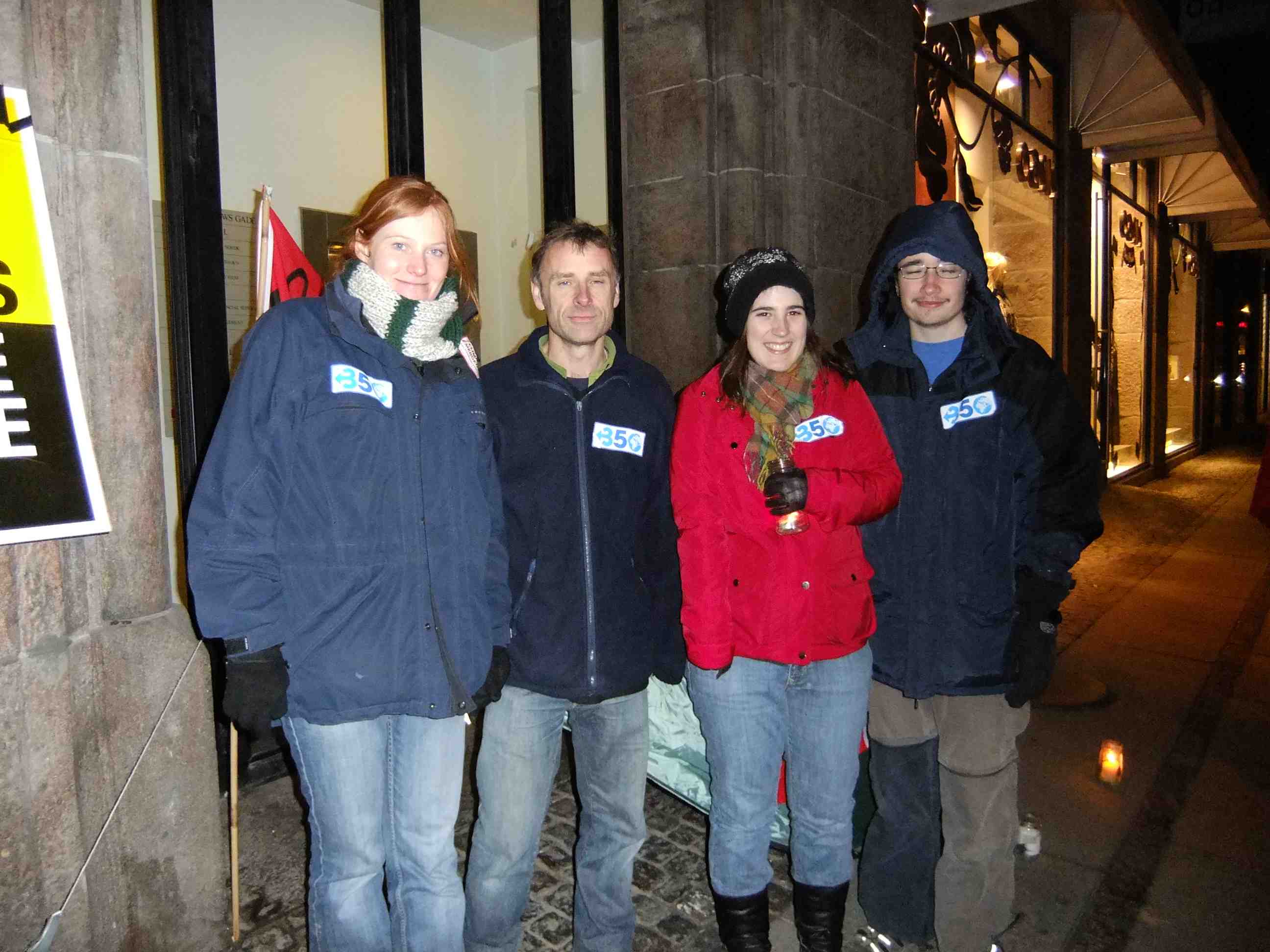
Climate activists jammed a small square near the police-barricaded Canadian Embassy here Monday for the second day of protests over the country’s tar sands development.

Simultaneous protests were held at the Canadian Embassy in London because British oil companies and financial institutions are deeply invested in the Canadian mega-project.

“As indigenous people, we are here at the international climate negotiations to speak about threats to our cultural survival and the direct life-threatening impacts of climate change in our communities,” said Clayton Thomas Muller, tar sands campaigner for the Indigenous Environmental Network.

“Canada has been blocking the climate negotiations and hasn’t kept Kyoto commitments…because of the tar sands,” he told a crowd of 75 to 100 people surrounded by four squads of riot police.

Boreal forests and wetlands the size of Greece are been destroyed in northern Alberta in an industrial project that turns millions of tonnes of sand and earth into oil, mainly for the U.S. market he said.

“All the efforts by Canadians to reduce their carbon emissions are undone by the tar sands,” said Canadian writer and activist Naomi Klein.

The tar sands are Canada’s largest single source of carbon dioxide (CO2) emissions and the major reason why Canada has refused to live up to its commitments to reduce emissions and is blocking negotiations, Klein told protesters.

“Canada is making a mockery of international law and of developing countries’ need for urgent emission reductions in rich countries,” she said.

Canadian Prime Minister Stephen Harper is here at the Dec. 7-18 U.N.-sponsored climate summit under false pretences, Klein charged.

Harper does not have the Canadian people’s permission to promote the tar sands or to favour Canadian interests over those of the planet,” she said.

The tar sands are “Canada’s Mordor”, said Maude Barlow, head of the Council of Canadians, the largest citizens’ group in Canada. She was referring to the devastated land of rock and fire in the “Lord of the Rings” trilogy.

“What else can you call a project that leaks 11 million litres of toxic waste a day into rivers and groundwater?” Barlow said in this very un-Mordor upscale shopping district of downtown Copenhagen.

The tar sands project has the largest toxic waste containment ponds on the planet – easily visible from space. Last week, a report revealed the extent of the leaks to be an estimated 11 million litres a day.

Shockingly, this is based on the oil companies’ own self-reported data, says Environmental Defence, the Canadian advocacy, research and education group that compiled the report.

It calculated that four billion litres of leakage a year will grow to 25 billion in a decade based on current growth of the tar sands and aging of the enormous dams that hold back the waste.

“There is no question Harper will stand up for  the oil sector [in the climate talks here],” Barlow said.

Their [oil industry] footprints are all over this negotiation and that is why it will fail.”

-30-

Corrected 2/2/12

For more on the Tar Sands see:

Oil Stains in the Boreal Forest: The Environmental Cost of Canada’s Oil Sands – Revised V2.1Oil Stains in the Boreal Forest: The Environmental Cost of Canada’s Oil Sands – Revised V2.1

Tar Sands, Riot Police & Hope in Copenhagen

By Stephen Leahy

COPENHAGEN, Dec 12 (IPS/TerraViva)

A small group of protesters stood outside the Canadian Embassy in the cold Saturday night in Copenhagen to  shine a small spotlight of attention on the fact that Canada is home to the Alberta tar sands, the world’s largest and possibly most
polluting industrial project on the planet.

“It’s not just the huge CO2 emissions, it’s the water pollution, destruction of the forests, impacts on the food supply and all of the cancers the native people are getting,” said Janet Payne, an activist from the United Kingdom. “It’s dirty, toxic and huge.

Thousands of square kilometers of tar-laden soil and sands underlying Canada’s boreal forests are being mined, and then boiled with millions of liters of steaming water to extract the tar to produce 2.7 million barrels a day, mostly to feed the insatiable appetite for oil in the US.

“I feel strongly Canada is getting away with this Payne had participated in the day’s big march saying it was like a music festival but with a strong message to the world. “Everyone should be here. Climate change is affecting everything in the world; we all should be standing up.”

At the end of the interview three vans of Danish riot police pulled up and surrounded the group of eight protesters who were simply shivering on the sidewalk holding two small banners. The group was surrounded by police in full riot gear demanding to know what was going on.

Assuming this reporter was the leader, they asked me to explain what the protest was about, and I told them about the tar sands project. After the mandatory ID checks, permission was given to continue the protest and two officers said they’d join in once their shift was finished.

Maybe there is hope in Copenhagen.

Copenhagen: Rich Nations Betraying Poor In Climate Talks (surprised?)

By Stephen Leahy

COPENHAGEN, Dec 7 (IPS/TerraViva)

Betrayal and backsliding by rich countries marks the beginning of the final negotiations for a global climate treaty, according to many developing world participants at the U.N.-sponsored talks here.

“Developed countries express deep concern and commitment to action in their public statements, but it is completely different in the negotiating rooms,” said Algerian negotiator Kamel Djemouai, chair of the Africa group, which represents more than 50 African countries.

“What you hear in public is not what is being done,” Djemouai told delegates at a side meeting at the COP 15 climate meetings here.

At the last round of climate talks in Barcelona, African countries boycotted the meetings, saying that industrialised countries had set carbon-cutting targets too low to substantially reduce global greenhouse gas emissions. Climate change is already having significant impact on Africa and those impacts are a form of discrimination, Djemouai said.

“Science tells us that when the global average temperature is one degree C. higher, it will be two degrees C. hotter in Africa,” he added. Continue reading

+4 Degrees C By 2060? Alarming But Not Alarmist

07_00_01_News_Panonoramica

By Stephen Leahy

UXBRIDGE, Canada, Oct 9, 2009 (IPS)

The prospect of a four-degree Celsius rise in global average temperatures in 50 years is alarming – but not alarmist, climate scientists now believe.

Eighteen months ago, no one dared imagine humanity pushing the climate beyond an additional two degrees C of heating, but rising carbon emissions and inability to agree on cuts has meant science must now consider the previously unthinkable.

“Two degrees C is already gone as a target,” said Chris West of the University of Oxford’s UK Climate Impacts Programme.

“Four degrees C is definitely possible…This is the biggest challenge in our history,” West told participants at the “4 Degrees and Beyond, International Climate Science Conference” at the University of Oxford last DeadTrees CO2 release naturalweek.

A four-degree C overall increase means a world where temperatures will be two degrees warmer in some places, 12 degrees and more in others, making them uninhabitable.

It is a world with a one- to two-metre sea level rise by 2100, leaving hundreds of millions homeless. This will head to 12 metres in the coming centuries as the Greenland and Western Antarctic ice sheets melt, according to papers presented at the conference in Oxford.

Four degrees of warming would be hotter than any time in the last 30 million years, and it could happen as soon as 2060 to 2070.

“Political reality must be grounded in physical reality or it’s completely useless,” John Schellnhuber, director of the Potsdam Institute for Climate Impact Research, told the conference.

Schellnhuber recently briefed U.S. officials from the Barack Obama administration, but he says they chided him that his findings were “not grounded in political reality” and that “the [U.S.] Senate will never agree to this”.

He had told them that the U.S. must reduce its emissions from its current 20 tonnes of carbon per person average to zero tonnes per person by 2020 to have an even chance of stabilising the climate around two degrees C.

China’s emissions must peak by 2020 and then go to zero by 2035 based on the current science, he added.

“Policymakers who agreed to a two-degree C goal at the G20 summit easily fool themselves about what emission cuts are needed,” Schellnhuber said.

Even with a two-degree rise, most of the world’s coral reefs will be lost, large portions of the ocean will become dead zones, mountain glaciers will largely vanish and many other ecosystems will be at risk, Schellnhuber warned. And there is the risk of reaching a tipping point where the warming rapidly accelerates. Continue reading

2020 Climate Deadline Is the Crucial “Litmus Test”

Chile—The fury of Chaitén volcano - nat geo

The atmosphere and the climate is a public good, a commons, and can’t be protected by the private sector.”

— Marianne Haug, Oxford Institute for Energy

By Stephen Leahy

VIENNA, Jun 29 2009 (IPS)

“So who here thinks there will be a meaningful deal in Copenhagen?”

Few of the more than 600 energy ministers, officials and experts from 80 countries attending the Vienna Energy Conference raised their hands in response to the conference moderator’s question about the final round of climate negotiations this December in Copenhagen.

“I don’t think there will be agreement on an emissions cap,” said Andre Amado, Brazil’s vice-minister for energy, science and technology.

Greenhouse gas emissions from the burning of fossil fuels must peak between 2015 and 2020 and then decline to prevent dangerous, irreversible climate change, scientists have warned. A strong international agreement on emissions targets for both the industrialised and developing world is widely believed to be the only way to ensure emissions peak and then decline.

“There will be agreement on technology transfer and reducing barriers for technology transfers,” to assist developing countries in cutting their emissions and adapting to the changing climate, Amado told participants last week in Austria’s capital city.

Continue reading

Desperately Seeking Leadership on Climate

penguin palm tree

Civil society will have to provide unrelenting leadership if  global carbon emissions are to peak in less than 10 years and go ‘negative’, experts say.

By Stephen Leahy

UXBRIDGE, Canada, Jan 15 2009 (IPS)

Global emissions of carbon dioxide must reach a peak in less than 10 years and then begin a rapid decline to nearly zero by 2050 to avoid catastrophic disruption to the world’s climate, according to a new report.

Emissions of carbon dioxide will actually need to “go negative” – with more being absorbed than emitted – during the second half of this century, according to “State of the World 2009: Into a Warming World” released by the U.S.-based Worldwatch Institute this week.

“2009 is a pivotal year to deal with climate change,” said Christopher Flavin, president of well-respected Worldwatch Institute (WI), a U.S.-based environmental think tank.

“Humanity will face grave danger if we don’t move forward now,” Flavin told IPS.

Climate change is happening faster and with larger impacts than previously predicted, concludes the 26th annual “State of the World” report, devoted entirely to the challenges and opportunities of global climate change.

Even an additional warming of 2 degrees Celsius poses unacceptable risks to key natural and human systems, warned climate scientist W.L. Hare, one of the report’s 47 contributors.

SN852512 Continue reading

You Go First Carbon Politics Threatens Us All

mage showing iceberg off Baffin Island, Nunavut, Canada with meltwater ponds in the foreground. Arctic warming has been associated with a rapid decline in Arctic summer sea ice extent. Image credit- Sandy BriggsBy Stephen Leahy

NY-ÅLESUND, Svalbard, Norway, Jun 15 (IPS)

Political and business leaders may agree in principle that climate change is a serious threat, but there is a startling lack of consensus and a ‘you-go-first’ attitude on taking action, even amongst a small group of high-level decision makers disconnected from their cell phones here in the Arctic.

“We want to reduce China’s CO2 (carbon dioxide) emissions, but we are a market-driven economy,” Liu Yanhua, China’s vice minister for science and technology, told 30 participants at the Ny-Ålesund Symposium located at a scientific research centre called Kings Bay on the western coast of Spitsbergen Island about 1,200 kilometers from the North Pole.

“Climate change is a matter of economy, of energy,” said Yanhua, a former scientist at the Chinese Institute of Geography.

It is also an issue of generational equity, since at current rates all fossil fuels will be consumed in 50 to 80 years, leaving nothing for future generations, he said.

China’s CO2 emissions have soared 150 percent in the last 20 years, Yanhua acknowledged, and are now the highest of any country, including the United States. China’s carbon intensity – the amount of carbon emitted per unit of production – is 10 times higher than Germany’s and major efficiency improvements are needed, he said. Continue reading