Killer Heat Waves and Floods Linked to Climate Change

More than 5 million affected by flooding in Pakistan Sept 2011 - a repeat of 2010.
More than 5 million affected by flooding in Pakistan Sept 2011 – a repeat of 2010.

“The first law of humanity is not to kill your children.”

By Stephen Leahy

UXBRIDGE, Canada, Feb 27 2013 (IPS)

Killer heat waves, floods and storms are increasingly caused by climate change, new research reveals.

Scientists in Germany say they have found how greenhouse gases from burning fossil fuels are helping to trap the jet stream, resulting in extraordinary weather such as the 2010 Pakistan flood and the 2011 heat wave in the United States.

Human-driven climate change repeatedly disturbs the flow of atmospheric waves around the globe’s Northern hemisphere, said lead author Vladimir Petoukhov of the Potsdam Institute for Climate Impact Research (PIK) in Germany.rossby.waves1_

Giant atmospheric waves called Rossby waves are meanders in the strong, high-altitude winds known as jet streams and have a major influence on weather. These wave movements are caused by the difference in temperatures between the cold air from the Arctic and hot air from the tropics.

When the waves shift north, they suck warm air from the tropics to Europe, Russia, or the U.S., and when they swing down, they do the same thing with cold air from the Arctic, said Petoukhov.

“During several recent extreme weather events, these planetary waves almost freeze in their tracks for weeks,” he said. “So instead of bringing in cool air after having brought warm air in before, the heat just stays.”

This unnatural pattern is due to human heating of the climate through emissions of greenhouse gases that result from burning fossil fuels, according to the study published this week in Proceedings of the National Academy of Sciences.

However, this heating of the atmosphere is wildly uneven. The Arctic is warming two to three times faster than the global temperature rise of 0.8C and that affects the Rossby waves and is slowing the jet stream.

“(Our research) complements previous research that already linked such phenomena to climate change,” said Hans Joachim Schellnhuber, a co-author of the study. Continue reading


Green Energy Solves Dual Crises of Poverty and Climate

native-windmill-art1Dirty fossil fuel energy leads to 350,000 premature deaths in Europe

By Stephen Leahy

UXBRIDGE, Canada, Feb 25 2013 (IPS)

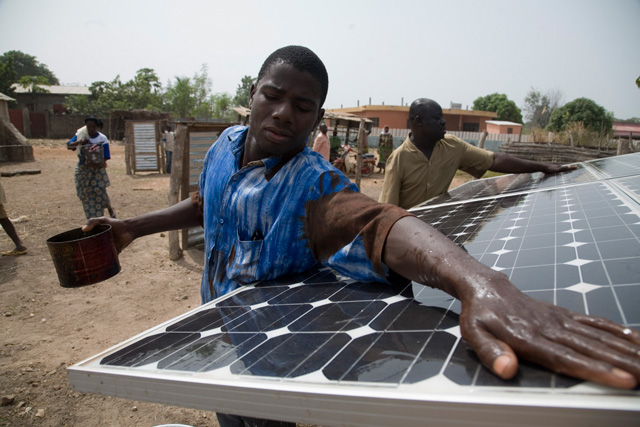
Green energy is the only way to bring billions of people out of energy poverty and prevent a climate disaster, a new study reveals.

Conservative institutions like the World Bank, the International Energy Agency and accounting giant Price Waterhouse Coopers (PwC) all warn humanity is on a path to climate catastrophe unless fossil fuel energy is replaced by green energy.

The U.N.’s Sustainable Energy for All initiative intends to bring universal access to modern energy, doubling the share of renewable energy globally, and doubling the rate of improvement in energy efficiency by 2030.

If those targets are met and similar efforts undertaken to reduce deforestation, then climate disaster can be avoided, said Joeri Rogelj of the Institute for Atmospheric and Climate Science in Zurich  who headed the analysis published Sunday in the journal Nature Climate Change.

“Poverty eradication, sustainable development and the transition away from fossil fuel energy go hand in hand,” Rogelj told IPS. Continue reading

In Canada Being Green Brings Police Surveillance

Man wanting a safe climate for his grandchild arrested in Ottawa

Harper government calls environmentalists “extremists” and “radicals”

By Stephen Leahy

UXBRIDGE, Canada, Feb 20 2013 (IPS)

Canada’s police and security agencies think citizens concerned about the environment are threats to national security, and some are under surveillance, documents reveal.

The RCMP, the national police force, and Canada’s spy agency CSIS are increasingly conflating terrorism and extremism with peaceful citizens exercising their democratic rights to organise petitions, protest and question government policies, said Jeffrey Monaghan, a researcher with the Surveillance Studies Centre at Queen’s University in Kingston, Ontario.

Protests and opposition to Canada’s resource-based economy, especially oil and gas production, are now viewed as threats to national security, Monaghan said. This conclusion is based on official security documents obtained under freedom of information laws over the last five years.

It is governments and the fossil fuel industry who are the extremists, threatening the prosperity of future generations.
For the past two years, officials in Canada’s Stephen Harper government have been calling environmentalists “radicals” and accusing environmental organisations of money laundering.

“The Harper government has a strong interest in suppressing environmental activism,” Monaghan told IPS.

By branding activists as extremists or radicals, many people will not want to be involved. Surveillance and other security activities will have a similar “chilling effect”, he fears.

“There could be an incredibly profound impact on public participation,” Monaghan noted.

Continue reading

Jail Before Climate-Wrecking Tar Sands, Canadians Say

Tar sands protest Sept 2011, Ottawa Pic by R Leahy

[Repost: After the rally against Keystone XL in Washington last Sunday, a reminder that Canadians are willing to be arrested to stop growth of climate-destroying tar sands. — Stephen ]

By Stephen Leahy

OTTAWA, Sep 27, 2011 (IPS)

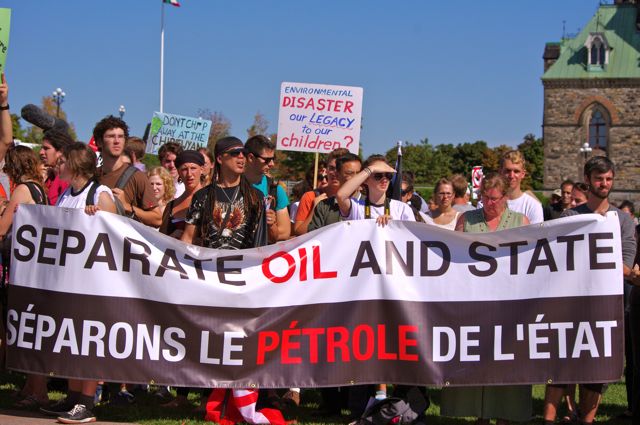
More than 200 Canadians engaged in civil disobedience, with 117 arrested in Canada’s quiet capital city on Monday. The reason? To protest the Stephen Harper right-wing government’s open support for the oil industry and expanding production in the climate-disrupting tar sands.

The normally placid and polite Canadians shouted, waved banners and demanded the closure of the multi-billion-dollar tar sands oil extraction projects in northern Alberta to protect the global climate and the health of local people and environment.

“People are here because they know that if we don’t turn away from the tar sands and fossil fuels soon it will be too late,” Peter McHugh, a spokesperson for Greenpeace Canada, told IPS.

“The tar sands are unsustainable. Canadians are willing to shift away from fossil fuels but our government isn’t,” Gabby Ackett a university student and protester, told IPS as she stood in front of a long line of police.

In what was proudly touted as “civil” civil disobedience, protesters aged 19 to 84 were arrested for using a step-stool to climb a low barrier separating them from the House of Commons, the seat of Canadian government. The police were friendly and accommodating because the organisers had promised there would be no violence.

“We live downstream and see the affects of tar sands pollution on the fish and the birds,” said George Poitras, a former chief of the Mikisew Cree First Nation in northern Alberta.

“Some our young people have rare forms of cancer,” Poitras told more than 500 protesters.

“Expanding the tar sands is not the way to go in a world struggling with climate change,” he said. Continue reading

80 percent of Arctic Ice Lost Compared to 30 Years Ago

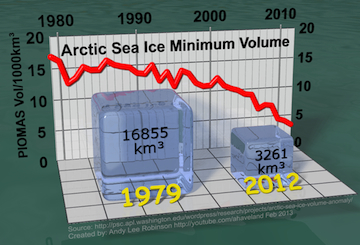
arctic-sea-ice-min-volume-comparison-1979-2012-small

[This is my first exclusive blog post – virtually everything else on this site are my published articles. Not sure if I’ll have time to do more. Let me know what you think – Stephen ]

A new study released Feb 13 revealed that the volume of Arctic sea ice is declining rapidly. Ice volume in September 2012 had fallen 80 percent compared with the volume of ice in September 1980 according to the latest data from European Space Agency satellite, CryoSat-2. As the Arctic heats up Most of the ice loss has been in recent years. Between 2003 and 2012 the volume declined a whopping 36 percent. Summers with a sea ice-free Arctic are only a few years away, scientists now agree. This will have significant and permanent impacts on weather patterns in the Northern Hemisphere.

My previous article  Ice-Free Arctic Is “Uncharted Territory” documented last September’s one year record area decline of 18 percent. Here’s what this means:

The impacts are already being felt across the entire northern hemisphere. The loss of sea ice in recent years has been affecting weather patterns, recent research has shown. The all-important jet stream – the west-to-east winds that are the boundary between the cold Arctic and the warm mid-latitudes – is slowing down, moving north and become more erratic.

When continent-sized areas of the Arctic Ocean flip from the all-white ice to dark blue, tremendous amounts of heat are absorbed from the 24-hour summer sun. When the bitter cold Arctic winter sets in over the next few weeks, all the heat in the ocean must be released into the atmosphere before ice can form again.

The Arctic will be ice-covered in winter for decades to come but what’s fundamentally changed is that every fall, unprecedented amounts of heat and water vapour will be released into the atmosphere.

“The polar meltdown shows we’re teetering on the brink of climate change catastrophe,” said Shaye Wolf, climate science director at the Center for Biological Diversity’s Climate Law Institute.

As the sea ice declines, Arctic temperatures increase, thawing more and more permafrost, which will release more climate-heating carbon and methane. Permafrost is frozen soil, sediment and rock spanning 13 million square kilometres of the land in Alaska, Canada, Siberia and parts of Europe. It has twice the carbon that the atmosphere currently holds.

A Swedish study released Feb 17 has found a link between sea ice declines and increases in methane emissions. Methane has 40x the warming of carbon. This is may lead to an even faster meltdown of the Arctic risking the release of huge amounts of permafrost carbon and methane.

US Climate Rally Draws “Line in the Sand” on Keystone Pipeline

The tar sands in Alberta, Canada. Credit: howlmonteal/cc by 2.0The tar sands in Alberta, Canada. Credit: howlmonteal/cc by 2.0

By Stephen Leahy

UXBRIDGE, Canada, Feb 16 2013 (IPS)

The largest climate rally in U.S. history is expected Sunday in Washington DC with the aim of pressuring President Barack Obama to reject the Keystone XL tar sands pipeline.

Activists are calling Keystone “the line in the sand” regarding dangerous climate change, prompting the Sierra Club to suspend its 120-year ban on civil disobedience. The group’s executive director, Michael Brune, was arrested in front of the White House during a small protest against Keystone on Wednesday.

“The Keystone XL pipeline is part of the carbon infrastructure that will take us to dangerous levels of climate change,” said Simon Donner, a climate scientist at the University of British Columbia.

To permit the pipeline would represent a heartbreaking acquiescence to climate change on the part of President Obama and our national leaders.

“By itself, Keystone won’t have much of an impact on the climate, but it is not happening on its own,” Donner told IPS.

Carbon emissions are increasing elsewhere, and the International Energy Agency recently warned humanity is on a dangerous path to four degrees C of warming before the end of this century. Children born today will experience this. Preventing that dire future is inconsistent with expanding tar sands production, Donner said.

arctic-sea-ice-min-volume-comparison-1979-2012-smallA new study released this week revealed that the volume of Arctic sea ice is declining rapidly. Ice volume has fallen 80 percent since 1980, according to the latest data from European Space Agency satellite, CryoSat-2. Summers with a sea ice-free Arctic are only a few years away, scientists now agree. This will have significant and permanent impacts on weather patterns in the Northern Hemisphere.

“Keystone XL is the key to opening up the expansion of the tar sands industry,” said Jim Murphy, senior counsel with the National Wildlife Federation.

“By rejecting the Keystone XL tar sands pipeline, we can keep this toxic oil in the ground,” Murphy said in a statement.

Continue reading

Climate Inaction Is a Clear Failure of Democracy

Jersey shore Superstorm Sandy flood

Re-engineering our societies to prosper on green alternatives is only option

By Stephen Leahy

UXBRIDGE, Canada, Jan 4 2013 (IPS)

Around the world, 2012 was the year of extreme weather, when we unequivocally learned that the fossil fuel energy that powers our societies is destroying them. Accepting this reality is the biggest challenge of the brand new year.

Re-engineering our societies and lifestyles to prosper on green alternatives is the penultimate challenge of this decade.There is no more important task for all of us to engage in because climate change affects everything from food to water availability.

A number of scientific analyses have demonstrated we already have the technology to re-engineer our society to thrive on green alternative energy. The newest of these was published Wednesday in the prestigious journal Nature. It plainly states that politics is the real barrier, not technology nor cost. (It is far cheaper to act than not.)

Keeping global warming to less than two degrees C is mainly dependent on “when countries will begin to take serious action to reduce greenhouse gas emissions”, according to the study “Probabilistic cost estimates for climate change mitigation”.

Climate change has already pushed global temperatures up 0.8 degrees C, with significant consequences. No climate scientist thinks two degrees C will be “safe”. Many countries, especially least-developed countries and small island states, want the global target to be less than 1.5C of heating. Even then large portions of the Arctic and Antarctic will continue to melt raising sea levels, albeit at a slower rate.

Delay in making the shift to non-fossil fuel energy sources will be very costly. Waiting until 2020 to curb global emissions will cost twice as much compared with peaking emissions by 2015, the Nature analysis shows.

Serious action to reduce greenhouse gas emissions means 65 percent of current coal power plants will have to be shut down in the next decade or two, a previous Nature study reported by IPS shows.

Continue reading

Local and National Actions Key to Combating Climate Change

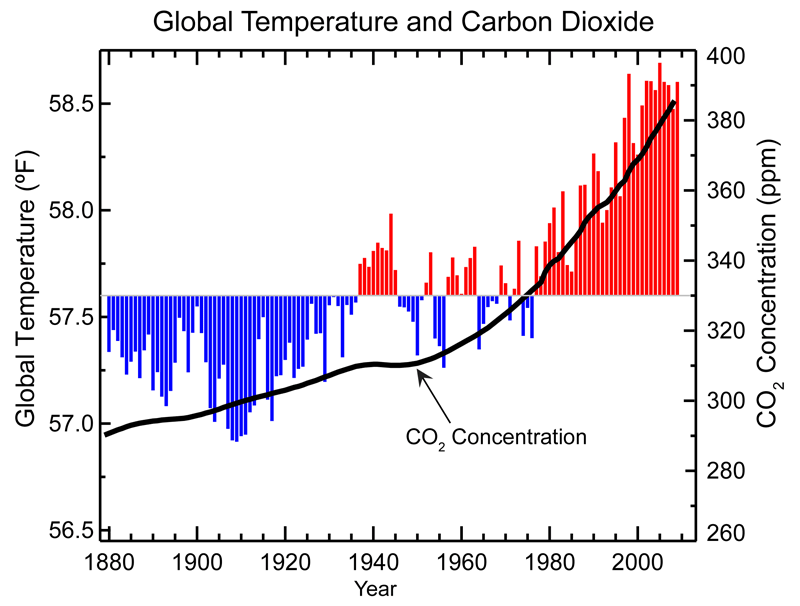
global-temp-and-co2-1880-2009

New study reveals a major trend is underway. More and more countries are acting on climate – only Canada going backward

By Stephen Leahy

UXBRIDGE, Canada, Jan 15 2013 (IPS) 

A majority of major economies have made significant progress in addressing climate change, with countries like South Korea and China taking aggressive action so they can benefit from energy- and resource-efficient economies, a new report released Monday found.

The study by GLOBE International and Grantham Research Institute profiled 33 major economies in an annual examination of climate and energy legislation. 32 of them, including the United States, made significant progress in 2012, while only Canada regressed.

“The study reveals a major trend is underway. More and more countries are acting on climate,” said Adam Matthews, secretary general of GLOBE International, an organisation of legislators.

While major international climate conferences such as the Conference of the Parties (COP) held in Doha in November and December 2012 have made little progress, cities, states and national governments around the world are taking action.

The political reality, Matthews told IPS, is that local and national climate regulations and legislation must come first. “An environment minister in Doha couldn’t commit his country to an ambitious carbon reduction target unless the country has already decided to chart a new economic course,” he said. Continue reading

Green Approaches to Water Safest and Cheapest Solution

Wetlands regulate, clean and cool water. Mare Aux Cochons high-altitude wetlands, Seychelles Islands (ReneeLeahy copyright)

By Stephen Leahy

UXBRIDGE, Canada, Jan 18 2013 (IPS)

After Hurricane Sandy swept through the northeast of the United States late October 2012, millions of New Yorkers were left for days without electricity.  But they still had access to drinking water, thanks to New York City’s reliance on protected watershed areas for potable water.

Instead of using electric-powered water treatment plans, New York City brings its high-quality drinking water through aqueducts connected to protected areas in the nearby Catskill/Delaware forests and wetlands – just one example of how protecting watersheds can provide residential areas with drinking water and flood and pollution protection at bargain basement prices.

New York saved between four and six billion dollars on the cost of water treatment plants by protecting forests and compensating farmers in the Catskills for reducing pollution in lakes and streams.

In 2011, countries around the world invested more than eight billion dollars in similar watershed projects around the world, according to the State of Watershed Payments 2012 report released Thursday. That year, China led the way, accounting for 91 percent of watershed investment.

“Whether you need to save water-starved China from economic ruin or protect drinking water for New York City, investing in natural resources is emerging as the most cost-efficient and effective way to secure clean water and recharge our dangerously depleted streams and aquifers,” said Michael Jenkins, president of Forest Trends, a non-governmental organisation (NGO) in the United States, which compiled the report. Continue reading

Climate Change Opportunity to Boost Economies – European Vision

[This re-post of an article showing countries moving to renewable energy to create jobs and reduce dependence on expensive, polluting and climate destroying fossil fuels. — Stephen]

By Stephen Leahy

BONN, Jun 20, 2011 (IPS)

If we’re lucky, by the time a tough but fair international treaty to meet the climate change challenge is finalised, it will be largely unnecessary. The snail’s pace of negotiations certainly gives countries plenty of time to understand the financial, social and environmental advantages of kicking their dangerous addiction to fossil fuels.

That may be a cynical optimist’s hope, but the European Union is already moving in that direction.

Climate change is now seen as an opportunity to deal with the economic downturn in Europe,” said Jürgen Lefevere, a European Commission negotiator at the United Nations Framework Convention on Climate Change (UNFCCC) negotiating session that ended late Friday in Bonn.

“It is no longer just an environmental issue for us,” Lefevere said at a final press conference.

China also understands the opportunity.

Renewable energy sources like wind and solar now account for 11.4 percent of China’s electricity, and that figure will be 20 percent by 2020, says Liu Qiang, a researcher at the Energy Research Institute of the National Development Reform Commission, China.

“China takes this very seriously,” Qiang said, noting that there are significant investments and research in smarter electrical grids and energy storage in China.

Looking to 2050, the era of fossil fuels will be over in a world of vibrant economies and societies powered entirely by clean, cheap and renewable energy, says Niklas Hoehne, director of Energy and Climate Policy at Ecofys, an energy consulting company based in the Netherlands.

“The cost is about two to three percent of global GDP (gross domestic product) from now until 2035, and then the costs decline,” said Hoehne, a co-author of the Ecofys technical study called “The Energy Report“, which demonstrates how the world could reach 100 percent renewable energy by 2050.

That investment is far less than the costs of climate change will be without major reductions in emissions, he told IPS. Continue reading