In Canada Being Green Brings Police Surveillance

Man wanting a safe climate for his grandchild arrested in Ottawa

Harper government calls environmentalists “extremists” and “radicals”

By Stephen Leahy

UXBRIDGE, Canada, Feb 20 2013 (IPS)

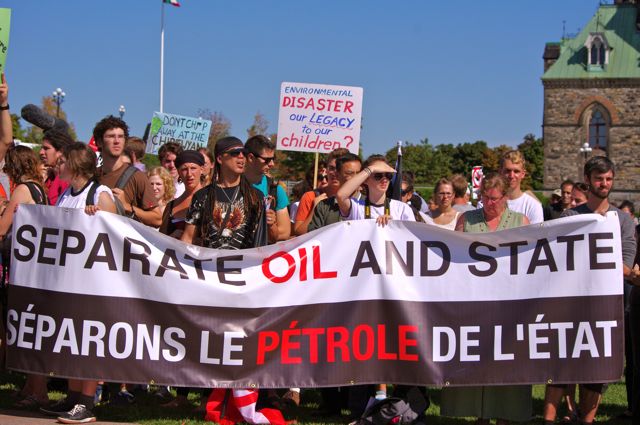
Canada’s police and security agencies think citizens concerned about the environment are threats to national security, and some are under surveillance, documents reveal.

The RCMP, the national police force, and Canada’s spy agency CSIS are increasingly conflating terrorism and extremism with peaceful citizens exercising their democratic rights to organise petitions, protest and question government policies, said Jeffrey Monaghan, a researcher with the Surveillance Studies Centre at Queen’s University in Kingston, Ontario.

Protests and opposition to Canada’s resource-based economy, especially oil and gas production, are now viewed as threats to national security, Monaghan said. This conclusion is based on official security documents obtained under freedom of information laws over the last five years.

It is governments and the fossil fuel industry who are the extremists, threatening the prosperity of future generations.
For the past two years, officials in Canada’s Stephen Harper government have been calling environmentalists “radicals” and accusing environmental organisations of money laundering.

“The Harper government has a strong interest in suppressing environmental activism,” Monaghan told IPS.

By branding activists as extremists or radicals, many people will not want to be involved. Surveillance and other security activities will have a similar “chilling effect”, he fears.

“There could be an incredibly profound impact on public participation,” Monaghan noted.
Continue reading

80 percent of Arctic Ice Lost Compared to 30 Years Ago

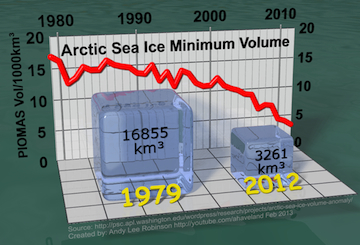
arctic-sea-ice-min-volume-comparison-1979-2012-small

[This is my first exclusive blog post – virtually everything else on this site are my published articles. Not sure if I’ll have time to do more. Let me know what you think – Stephen ]

A new study released Feb 13 revealed that the volume of Arctic sea ice is declining rapidly. Ice volume in September 2012 had fallen 80 percent compared with the volume of ice in September 1980 according to the latest data from European Space Agency satellite, CryoSat-2. As the Arctic heats up Most of the ice loss has been in recent years. Between 2003 and 2012 the volume declined a whopping 36 percent. Summers with a sea ice-free Arctic are only a few years away, scientists now agree. This will have significant and permanent impacts on weather patterns in the Northern Hemisphere.

My previous article  Ice-Free Arctic Is “Uncharted Territory” documented last September’s one year record area decline of 18 percent. Here’s what this means:

The impacts are already being felt across the entire northern hemisphere. The loss of sea ice in recent years has been affecting weather patterns, recent research has shown. The all-important jet stream – the west-to-east winds that are the boundary between the cold Arctic and the warm mid-latitudes – is slowing down, moving north and become more erratic.

When continent-sized areas of the Arctic Ocean flip from the all-white ice to dark blue, tremendous amounts of heat are absorbed from the 24-hour summer sun. When the bitter cold Arctic winter sets in over the next few weeks, all the heat in the ocean must be released into the atmosphere before ice can form again.

The Arctic will be ice-covered in winter for decades to come but what’s fundamentally changed is that every fall, unprecedented amounts of heat and water vapour will be released into the atmosphere.

“The polar meltdown shows we’re teetering on the brink of climate change catastrophe,” said Shaye Wolf, climate science director at the Center for Biological Diversity’s Climate Law Institute.

As the sea ice declines, Arctic temperatures increase, thawing more and more permafrost, which will release more climate-heating carbon and methane. Permafrost is frozen soil, sediment and rock spanning 13 million square kilometres of the land in Alaska, Canada, Siberia and parts of Europe. It has twice the carbon that the atmosphere currently holds.

A Swedish study released Feb 17 has found a link between sea ice declines and increases in methane emissions. Methane has 40x the warming of carbon. This is may lead to an even faster meltdown of the Arctic risking the release of huge amounts of permafrost carbon and methane.

Ice-Free Arctic Is “Uncharted Territory”

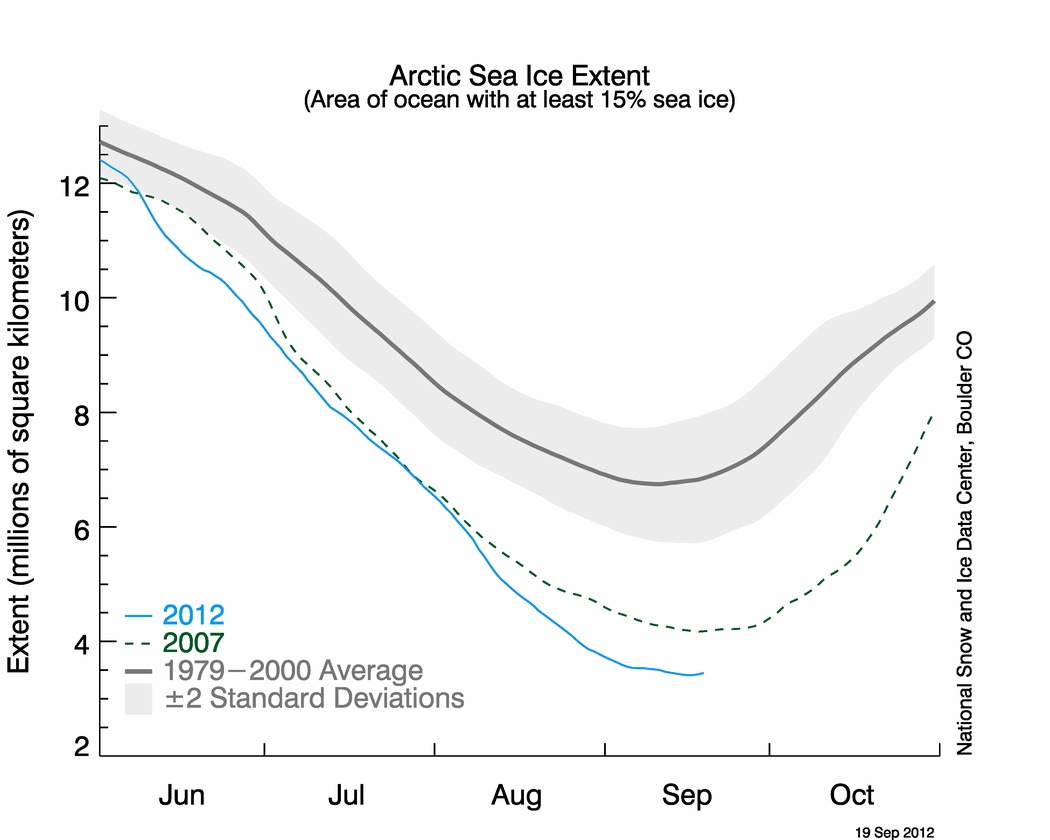
Arctic sea ice extent. Area of ocean with at least 15 percent sea ice as of Sept 12, 2012. Credit: National Snow and Ice Data Center.

Arctic ice half of what it was 30 years ago. Now affecting weather patterns

Heading for +4C and catastrophe – CBD

By Stephen Leahy

UXBRIDGE, Canada, Sep 20 2012 (IPS)

The melt of Arctic sea ice has reached its lowest point this year, shrinking 18 percent from last year’s near-record low.

Summer ice this year is half what it was 30 years ago and is now affecting weather patterns. The massive declines in ice in recent summers have shocked scientists and Arctic experts. Some predict that in just a few years we will witness an event that hasn’t happened in millions of years: the complete loss of summer ice.

“We are now in uncharted territory,” said Mark Serreze, director of the National Snow and Ice Data Center (NSIDC) in Colorado.

“Few of us were prepared for how rapidly the changes would actually occur” as a result of the burning fossil fuels that are warming the planet, said Serreze.

“We could see an essentially ice-free Arctic ocean in late summer by the year 2030,” he told IPS.

Not long ago experts thought the soonest the Arctic would be ice-free was 2070. Now it’s anywhere from four to 18 years away.

The impacts are already being felt across the entire northern hemisphere. The loss of sea ice in recent years has been affecting weather patterns, recent research has shown. The all-important jet stream – the west-to-east winds that are the boundary between the cold Arctic and the warm mid-latitudes – is slowing down, moving north and become more erratic.Measurement of CO2 levels in atmosphere

“Europe, eastern Asia and eastern North America is connected to unique physical processes in the Arctic,” said James Overland of the NOAA/Pacific Marine Environmental Laboratory in the United States.

“In future, cold and snowy winters will be the rule rather than the exception” in these regions, Overland told IPS in Oslo in 2010.

The summer’s record loss of Arctic sea ice may mean a cold winter for the UK and northern Europe, Jennifer Francis, a researcher at Rutgers University, told the Guardian last week.

The region has been prone to bad winters after summers with very low sea ice, such as 2011 and 2007, Francis said. Continue reading

Eliminate GDP and Economic Growth to Create the Real Green Economy Indigenous Peoples Say

Wind-solar electricity generation built by indigenous Telengits community in Russia's Altai  Mountains.   Photo:  Foundation for Sustainable Development of Altai

Wind-solar electricity generation built by indigenous Telengits community in Russia’s Altai Mountains. Photo: Foundation for Sustainable Development of Altai

by Stephen Leahy

First published at National Geographic’s NewsWatch

The planet is in peril, 3,000 scientists and other experts concluded at the recent Planet Under Pressure conference in London. Climate change, overuse of nitrogen and loss of biodiversity are just three of the perils threatening to make much of our home uninhabitable.

World leaders will meet in Rio de Janeiro June 20-22 to address this at the Rio+20 Conference, 20 years after the very first Earth Summit.

Rio+20 needs to be the moment in human history when the nations of the world come together to find ways to ensure ‘the very survival of humanity,’ environmentalists and scientists have said.

A “Green Economy” will be one of the main ideas under discussion in Rio. The idea is to make a transition to an economic system that maximizes human well-being while operating within the planet’s environmental limits. Exactly how this could be accomplished has yet to be defined.

The current economic system rewards those who exploit and destroy nature, said Vicky Tauli-Corpuz, Executive Director, Tebtebba (Indigenous Peoples’ International Centre for Policy Research and Education).

The current system hinders and even blocks Indigenous peoples from practicing their traditional ways of living that actually represent “a real green economy” that can be sustainable, achieve well being and are climate-friendly, said Tauli-Corpuz, a member of the indigenous Kankana-ey Igorot community in the Philippines.

Please throw something in the tip jar before reading on. This is how I make my living.

Continue reading

“It is unacceptable that the Canadian public sits back and allows access to the science they’re funding to be denied them,” said Andrew Weaver, a climate scientist.

Stephen's avatarStephen Leahy, International Environmental Journalist

Canadian media coverage of climate change has fallen by 80 percent

By Stephen Leahy

VANCOUVER, Canada, Feb 21, 2012 (IPS)

Amid revelations of a well-funded U.S. organisation’s plans to deliberately distort climate science, scientists and journalists at a major scientific conference called on the Canadian government to stop its muzzling of scientists.

For the past four years, the Canadian government has been denying timely access to government scientists even when their findings are published in leading scientific journals, said scientists and journalists in a special session of the American Academy for the Advancement of Science meeting here in Vancouver, British Columbia.

“The Canadian public doesn’t know as much as they could about science and climate change,” said Margaret Munro, who is a science writer for Postmedia News, based in Vancouver.

“The more controversial the story, the less likely you are to talk to the scientists,” Munro told IPS.

Last…

View original post 582 more words

Wisdom of Elders Better Than Science or the Internet: “They Still Know How to Cook Mammoth”

Petr Kaurgin, a Chukchi reindeer herder from Siberia. Photo: Citt Williams

by Stephen Leahy

First published at National Geographic’s NewsWatch

 “Our elders are the best source of information. Better than science or the internet,” said Petr Kaurgin, a Chukchi reindeer herder from the remote Turvaurgin nomadic tribal community in north-eastern Siberia.

Kaurgin delivered his message to climate scientists from Intergovernmental Panel on Climate Change (IPCC) and other Indigenous peoples at the closing of the Climate Change Mitigation with Local Communities and Indigenous peoples workshop here in Cairns, Australia.

“We need to listen to the wisdom of the elders. We can use everything in nature. But we must not break or destroy things, ” he said through a translator.

It was -45C when Kaurgin left his home to bring his people’s message to climate experts here in the hot, wet tropical part of Australia. The IPCC is the world authority on the science of climate change. And along with the United Nations University (UNU) organized the workshop to figure out how to incorporate Indigenous peoples’ traditional knowledge.

“When we love the land where we live only then we are happy,” he said.

Kaurgin’s people and other local Siberian communities have been experiencing the impacts of climate change such as melting permafrost for the last 20 years said Tero Mustonen, Head of the Village of Selkie in North Karelia, Finland.

For complete article see Nat Geo’s NewsWatch

Durban May Be Last Chance to Stabilise Climate Under Two Degrees — Africa, Russia To Cook by 2020; Most of Canada and China by 2030

By Stephen Leahy

The International Energy Agency estimates that 80 percent of projected emissions from the power sector in 2020 are already locked in.

CHANGWON, South Korea , Oct 23, 2011 (IPS)

The window to limit global warming to less than two degrees C is closing so fast it can be measured in months, a new scientific analysis revealed Sunday.

Without putting the brakes on carbon emissions very soon, large parts of Africa, most of Russia and northern China will be two degrees C warmer in less than 10 years. Canada and Alaska will soon follow, the regional study shows.

“If one is sincerely committed to limit global temperature increase to below two degrees C… (governments) committing to a global peak emission level and peak year makes sense from a science perspective,” said Joeri Rogelj of the Institute for Atmospheric and Climate Science in Zurich, who headed the analysis published Sunday in the journal Nature Climate Change. [See NCC editorial “Crossing the threshold”]

Governments will be meeting in Durban, South Africa starting Nov. 28 to launch the next round of climate treaty negotiations, which so far have failed to ensure their goal of less than a two-degree C increase will be achieved.

IPS asked Rogelj if government delegates in Durban ought to set a specific year by which global emissions will peak and then decline to ensure the two-degree C target will be met.

“Committing to such targets would ensure that we embark globally on a technologically and economically feasible low-emission path,” Rogelj said.

Rogelj and a group of leading experts show in this state-of-the-art analysis that to have a 66-percent or better probability of staying below two degrees C this century, global carbon emissions must peak before 2020. Global emissions ought to be around 44 billion tonnes of CO2 in 2020. That is four billion tonnes (also called gigatonnes, Gt) less than the estimated emissions for 2010.

After 2020 emissions must decline rapidly, about two to three percent less each year until they fall to 20 Gt by 2050, according to the computer models. This is an emissions “pathway that will be very challenging to achieve”, Rogelj and colleagues conclude in their study.

Very challenging” is scientist-talk for something that will be extremely difficult to do. The International Energy Agency (IEA) estimated that 80 percent of projected emissions from the power sector in 2020 are already locked in, as they will come from power plants that are currently in place or under construction today.

“This significant increase in CO2 emissions and the locking in of future emissions due to infrastructure investments represent a serious setback to our hopes of limiting the global rise in temperature to no more than two degrees C,” said Dr. Fatih Birol, chief economist of the IEA, last May. Continue reading

Jail Before Climate-Wrecking Tar Sands, Canadians Say

By Stephen Leahy

OTTAWA, Sep 27, 2011 (IPS)

More than 200 Canadians engaged in civil disobedience, with 117 arrested in Canada’s quiet capital city on Monday. The reason? To protest the Stephen Harper right-wing government’s open support for the oil industry and expanding production in the climate-disrupting tar sands.

Maude Barlow, chairperson of the Council of Canadians, is arrested at the Sep. 26 tar sands protest. Credit:Renée Leahy/IPS

The normally placid and polite Canadians shouted, waved banners and demanded the closure of the multi-billion-dollar tar sands oil extraction projects in northern Alberta to protect the global climate and the health of local people and environment.

“People are here because they know that if we don’t turn away from the tar sands and fossil fuels soon it will be too late,” Peter McHugh, a spokesperson for Greenpeace Canada, told IPS.

“The tar sands are unsustainable. Canadians are willing to shift away from fossil fuels but our government isn’t,” Gabby Ackett a university student and protester, told IPS as she stood in front of a long line of police.

In what was proudly touted as “civil” civil disobedience, protesters aged 19 to 84 were arrested for using a step-stool to climb a low barrier separating them from the House of Commons, the seat of Canadian government. The police were friendly and accommodating because the organisers had promised there would be no violence.

“We live downstream and see the affects of tar sands pollution on the fish and the birds,” said George Poitras, a former chief of the Mikisew Cree First Nation in northern Alberta.

“Some our young people have rare forms of cancer,” Poitras told more than 500 protesters.

“Expanding the tar sands is not the way to go in a world struggling with climate change,” he said.

Carbon emissions from the tar sands production have increased 300 percent since 1990 and, at 45 to 50 million tonnes annually, are greater than most countries. And that does not include the carbon contained in the oil itself.

When burned, the 1.6 million barrels of oil that are extracted every day will add 346 million tonnes of carbon to the atmosphere this year alone. That’s almost the entire emissions of the country of Australia. The oil industry is making billion-dollar investments in the tar sands to more than double production by 2025. Continue reading

Record Arctic Ice Melt Threatens Global Security

Rapidly warming planet biggest threat to all nations

Military budget more than enough to convert USA to 100% renewable energy

Analysis by Stephen Leahy

UXBRIDGE, Canada, Sep 15, 2011 (IPS)

All the analysis and commentary about safety and security on the tenth anniversary of 9/11 ignored by far the biggest ongoing threat to global security: climate change.

Just days before Sunday’s commemoration of the attacks, German scientists pointed to yet another smoking gun of climate change: the Arctic sea ice reached a new historic minimum ice extent.

The rapidity with which the planet is losing its northern ice cap continues to astonish experts. The defrosting northern pole is one of the prime drivers of Earth’s climate system and is changing global weather patterns in unpredictable ways.

The Arctic ice melt is also accelerating the rate of climate change beyond what humanity is doing with every barrel of oil, tonne of coal or cubic metre of gas burned.

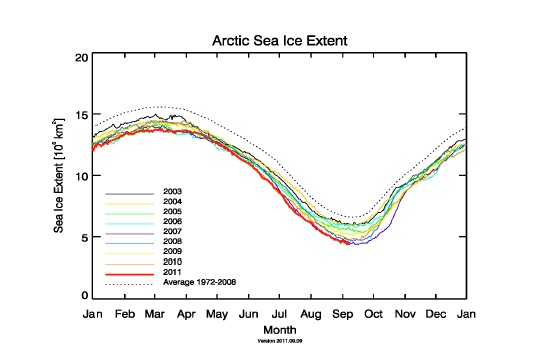
On Sep. 8, researchers at the University of Bremen in Germany reported that the Arctic ice melt bettered the previous minimum of 2007. Other research centres using different satellite and analysis tools say the extraordinary decline of ice in 2007 has not yet been exceeded this year and 2011 remains a close second.

Sea Ice Extent 2003-2011

“We think it will end up a little bit short of the record – not that it really matters,” said Mark Serreze, director of the National Snow and Ice Data Center in the U.S. city of Boulder, Colorado.

“What is extraordinary this year is that there was no weird weather pattern that created the perfect conditions for the record melt in 2007,” Serreze told IPS.

This independent environmental journalism depends on public support. Click here learn more.

This year, the summer weather was normal and yet it the ice vanished in similar amounts to 2007.

“That tells us the sea ice is too thin now to hold up under normal weather conditions,” he said.

Continue reading

April Heat Wave and Drought Breaks European Records

From the coldest December ever recorded to the warmest, driest April  Britain is just one of the countries being whipsawed by extreme weather. Normally wet Scotland is experiencing rare wildfires outbreaks this week. Europe’s wheat crop is at high risk due to very hot and dry temps.

My recent science articles explaining why weather extremes are becoming more common:

Why Our Weather is Weird ‘n Wild and Why It Is Getting Worse

The Yin and Yang of Climate Extremes We Will See More of

Will Year of Climate Extremes End Without Progress on Tackling Climate Change?