Fossil Fuel Lobby Following the Playbook of Big Tobacco Confusing the Public on Dangers of Climate Disruption

Fossil Energy Interests Sowing Confusion and Buying Legislative Delay on America’s Biggest Threat: Climate Change says Environmental Economist

Robert Repetto

UXBRIDGE, Canada, Mar 2, 2011 (IPS)

Powerful fossil energy interests are preventing the United States from making the necessary transition to 21st century energy sources, one of the country’s leading environmental economists documents in a just-published book.

Fossil energy interests are spending “hundreds of millions of dollars” lobbying U.S. politicians in Congress and funding groups to confuse the public about the serious risks climate change poses, says Robert Repetto, author of “America’s Climate Problem: The Way Forward” published by Earthscan.

IPS climate and environment correspondent Stephen Leahy spoke with Repetto about his new book.

Q: Why did you write this book?

A: We’re running out of time. The latest science shows that climate change is coming faster and posing greater risks than previously thought. We are at risk of triggering positive feedbacks that will lead to uncontrollable climate change.

This independent environmental journalism depends on public support. Click here learn more.

Meanwhile, America is locked in a climate-policy stalemate, with very few in the public comprehending the real risks climate change poses. Most don’t understand that climate change is happening now. They don’t link extreme weather events we’ve been experiencing with climate change. As a result they are not demanding that politicians take action.

Q: Why don’t most Americans understand the fact that climate change is already underway and poses serious risks?

A: Fossil (oil, coal, natural gas) energy interests are pouring hundreds of millions of dollars into sowing doubt and uncertainty to blunt public concern and to provide political cover to those politicians they are funding. In America, there is a very concerted effort by fossil energy interests that bankroll right-wing and libertarian “think tanks” like the Competitive Enterprise Institute to create an atmosphere of doubt and uncertainty, just like the tobacco companies did regarding the health effects of smoking. Continue reading
Arctic Ice Busts Yet Another Record – Lowest Ever For February

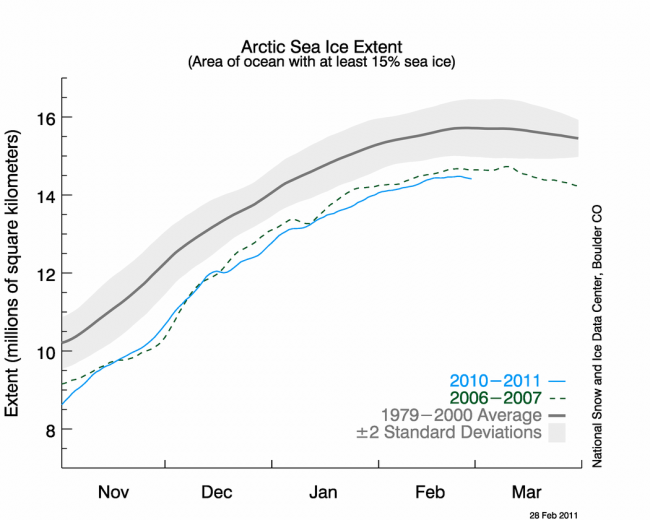
Since December of last year the Arctic sea ice has been breaking records with the lowest ever ice cover – lower than the shocker melt down of ice in 2007. This is the latest update from NOAA’s National Snow and Ice Data Center. It shows that the seasonal extant of Arctic sea ice at the end of February, 2011, stood at a record low, well below the prior record set in 2007 and almost 3 million square kilometers below the average for that winter date, when sea ice is usually within days of its greatest seasonal extant for the year.

I’ve written several articles on the latest arctic science and how the decline in sea ice affects weather in the northern hemisphere:

Arctic Melt Down Is Bringing Harder Winters and Permanently Altering Weather Patterns

Arctic Defrost Dumping Snow on U.S. and Europe

Arctic Sea Ice Record – New Satellite Image

Arctic Ice in Death Spiral, Thaws Permafrost — Risks Climate Catastrophe


Permafrost Melt Soon Irreversible Without Major Fossil Fuel Cuts

Thawing Permafrost Will Accelerate Climate Disruption

By Stephen Leahy

UXBRIDGE, Canada, Feb 17, 2011 (IPS)

Thawing permafrost is threatening to overwhelm attempts to keep the planet from getting too hot for human survival.

Without major reductions in the use of fossil fuels, as much as two-thirds of the world’s gigantic storehouse of frozen carbon could be released, a new study reported. That would push global temperatures several degrees higher, making large parts of the planet uninhabitable.

Once the Arctic gets warm enough, the carbon and methane emissions from thawing permafrost will kick-start a feedback that will amplify the current warming rate, says Kevin Schaefer, a scientist at the National Snow and Ice Data Center (NSIDC) in Boulder, Colorado. That will likely be irreversible.

This independent environmental journalism depends on public support. Click here learn more.

And we’re less than 20 years from this tipping point. Schaefer prefers to use the term “starting point” for when the 13 million square kilometres of permafrost in Alaska, Canada, Siberia and parts of Europe becomes a major new source of carbon emissions.

“Our model projects a starting point 15 to 20 years from now,” Schaefer told IPS. Continue reading

‘Snow Bomb’ Collapses 100s of Homes in S. Korea – Satellite Pix

More than 1 metre (three feet) last weekend – 50 cm more coming

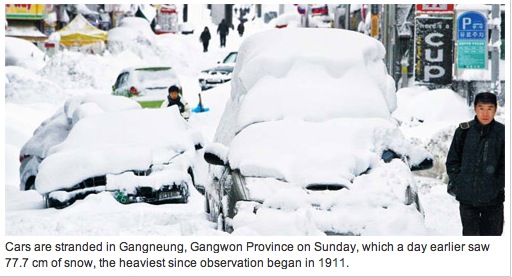
The heaviest snowfall in more than a century on South Korea’s east coast is causing widespread chaos. Hundreds of houses have collapsed under the weight of the snow. One newspaper described it as a snow bomb. The South Korean government has deployed 12,000 soldiers to rescue stranded residents.

Warmer than normal ocean temperatures are being blamed. This is similar to the warmer Arctic ocean temps in late Dec that contributed to the big snows and cold in North America, UK and parts of Europe.

[Update: Great sat pix from NASA showing the entire eastern half of Korea covered in snow. See also pix of Southern USA blanketed in more record-breaking snow last week]

NASA reports: “The heavy snowfall arrived on the heels of South Korea’s coolest January since the 1960s. The unusual cold might have been driven at least partly by the Arctic Oscillation (AO). A negative phase of the AO lowered temperatures in other parts of the Northern Hemisphere in January 2011.”

See also:

Arctic Defrost Dumping Snow on U.S. and Europe

The Great Groundhog’s Day Blizzard – Worst Winter Storm in 60 Years

Arctic Sea Ice Record – New Satellite Image

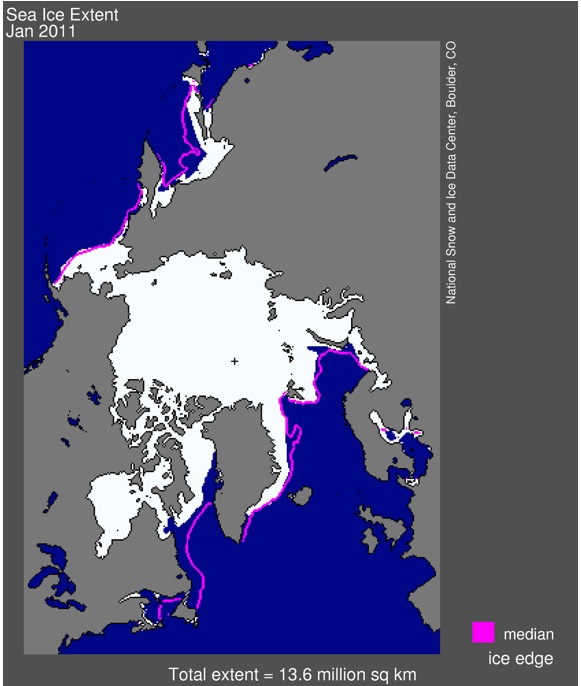
Arctic Hits Bottom – Lowest Jan Sea Ice Cover Ever*

1.27 million square kilometers below avg


The National Snow and Ice Data Center reported wednesday that the Arctic sea-ice extent averaged just 13.55 million square kilometers, the lowest January ice extent since satellite records began in 1979 (*and likely the lowest in thousands of years– SL). That’s a whopping 1.27 million square kilometers below the 1979 to 2000 average.

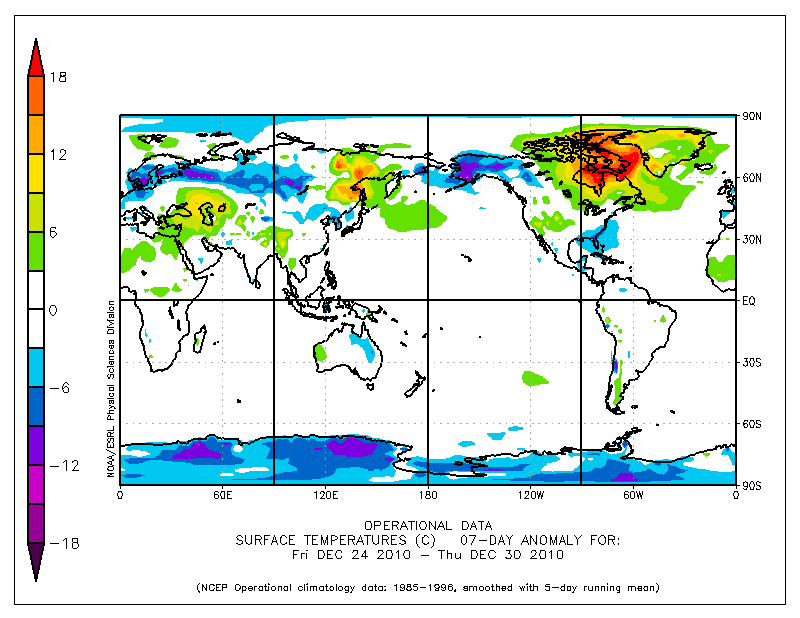
No surprise given the absurdly warm Arctic temperatures of +21C above normal in Dec/Jan.

I’ve written about why this is happening and the consequences several times in recent weeks:

Arctic Defrost Dumping Snow on U.S. and Europe

Arctic Melt Down Is Bringing Harder Winters and Permanently Altering Weather Patterns

East Coast Blizzard and Europe’s Snowmaggddon Reveal Fingerprints of Climate Change

The Arctic summer’s sea ice melt will likely be another record low pushing the world to an ice-free Arctic one summer in the new future. FYI weather-related records will continue to fall faster than dominos without drastic cuts to our fossil fuel emissions. And frankly I’m tired of writing about it. — Stephen

Watch the Earth Begin to Burn. 1884-2010 Global Temperatures — NASA Animation


Global Temperature Anomalies averaged from 2000 to 2004

NASA has made a this striking animation that shows a 130-year history of how global temperatures have become warmer in most parts of the world. The polar regions are warming fastest and quickest as is clearly shown. Here’s the temperature scale and more detailed explanation from NASA follows. — Stephen


Global Temperature Anomalies averaged from 1920 to 1924.

Source: NASA/Goddard Space Flight Center Scientific Visualization Studio

Five-Year Average Global Temperature Anomalies from 1880 to 2010

This analysis concerns only temperature anomalies, not absolute temperature. Temperature anomalies are computed relative to the base period 1951-1980. The reason to work with anomalies, rather than absolute temperature is that absolute temperature varies markedly in short distances, while monthly or annual temperature anomalies are representative of a much larger region. Indeed, we have shown (Hansen and Lebedeff, 1987) that temperature anomalies are strongly correlated out to distances of the order of 1000 km

This color-coded map displays a progression of changing global surface temperatures anomalies from 1880 through 2010. The final frame represents global temperature anomalies averaged from 2006 to 2010.

Ice-cold Atlanta (and eastern US) Is Likely Connected to Arctic Hothouse

But first…

That’s a great cartoon.

Climate change seems to be behind the shockingly warm temps across much of the eastern Arctic all winter and is likely responsible for the snow has fallen across much of the southern US. Much of Arctic ice sea melted last summer, allowing the Arctic ocean to warm up which then took longer to freeze i.e. late Dec/ Jan. And that changed the wind circulation patterns bringing polar air far south. (See my previous post that explains what is happening East Coast Blizzard and Europe’s Snowmaggddon Reveal Fingerprints of Climate Change

And for a collection of global temp graphs see this post
Arctic Hothouse Turns Europe into an Icebox )

And finally here’s a short video by Peter Sinclair of Climate Denial Crock of the Week explaining this: Global Warming. Winter Weirding.

]

This is part of Community Supported Environmental Journalism, independent reporting supported by citizens in several countries thru one-time, weekly or monthly or in-kind donations.

Arctic Hothouse Turns Europe into an Icebox

Here’s a temperature map from mid December illustrating the super warm Arctic region and the icy cold Europe in the mid-latitudes. [[ see also temp anomaly chart showing Hudson Bay to Greenland is 18C above normal this week]]

My previous post explains what is going on: East Coast Blizzard and Europe’s Snowmaggddon Reveal Fingerprints of Climate Change

— Stephen

And here is the Arctic sea ice extent – lowest ever for December.

As of Jan 2 Canada’s Hudson Bay is still not completely frozen over – likely the latest freeze up in a very long time. (10,000s of years?)


East Coast Blizzard and Europe’s Snowmaggddon Reveal Fingerprints of Climate Change

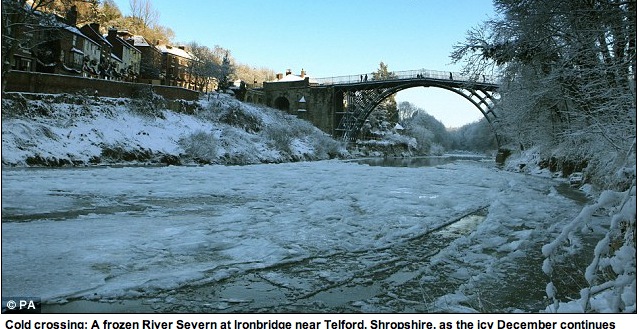
Coldest Christmas on Record on the UK -18C

In Oslo last June climate researcher’s told me the melting Arctic ice will likely produce colder winters in the eastern United States and Europe. Looks like they were right. Winter freeze up in the sunless Arctic ocean was two months late this year because of a near record ice loss last summer that is expected to continue if not accelerate in future years.

Several research programs have been studying the impacts of this huge loss in Arctic sea ice and presented their findings for first time at the International Polar Year Oslo Science Conference. My summary from 15 June:

Climate change has warmed the entire Arctic region, melting 2.5 million square kilometres of sea ice, and that, paradoxically, is producing colder and snowier winters for Europe, Asia and parts of North America.

“The exceptional cold and snowy winter of 2009-2010 in Europe, eastern Asia and eastern North America is connected to unique physical processes in the Arctic,” said James Overland of the NOAA/Pacific Marine Environmental Laboratory in the United States.

In future, cold and snowy winters will be the rule rather than the exception” in these regions, Overland told IPS.

Thanks to support from readers and the organizers of the conference I was able to attend that polar science conference. No media/publication would front any travel money to help me get there. I was one of a small handful of jurnos there and the first to write a piece documenting the link between global warming and bitter winter weather.

This independent environmental journalism depends on public support. Click here learn how this works.

My full article from Oslo is here: Arctic Melt Down Is Bringing Harder Winters and Permanently Altering Weather Patterns


‘Don’t Worry Be Happy’ Canada Sees Global Warming “Prosperity” Instead of Calamity

By Stephen Leahy

UXBRIDGE, Canada, Oct 8, 2010 (IPS)

The first comprehensive look at the expected impacts of climate change on Canada offers an embarrassing and misleading “don’t worry, be happy” vision, citing more golf days and better access to northern deposits of oil and gas courtesy of global warming, critics say.

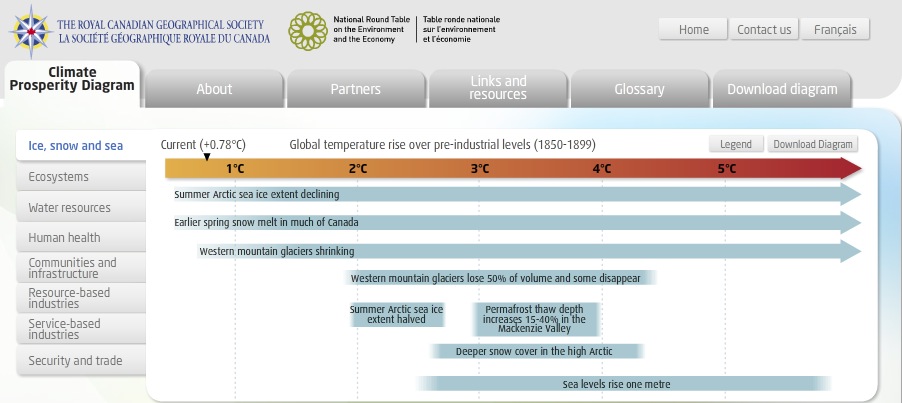
“The chart needs to be withdrawn,” said climate scientist Danny Harvey of the University of Toronto. “It is full of bad science and utterly downplays the serious impacts of climate change.”

The chart Harvey referred to is the “Degrees of Change” interactive diagram released this week as part of a national educational initiative called “Climate Prosperity” by the prestigious Royal Canadian Geographical Society and the National Round Table on the Environment and the Economy (NRTEE).

How can we (Canada) talk about profiting from climate change when most of the world will suffer devastating impacts, in part because of our emissions?” Harvey said.

“It is disgusting.”

In a release about the Climate Prosperity initiative, David McLaughlin, NRTEE president and CEO, said, “Adapt and prosper will be increasingly central to Canadian governments, communities, and businesses as these effects become more and more evident.”

NRTEE officials did not respond to IPS requests for an interview.

Is this article of interest? It exists thanks to contributions from readers. Please click here to learn more about Community Supported Journalism.

Continue reading