The Coming Oxygen Crisis?

“I have no idea how this will affect oxygen levels but it is something we should be thinking about.”Bradley Cardinale, biologist, University of California,

By Stephen Leahy


Credit:NASA

The Amazon River and rainforest viewed from space.

Nov 6 (IPS) – Plants are the only source of oxygen on Earth — the only source. Studies around the world show that as plant species become extinct, natural habitats can lose up to half of their living plant biomass.

Half of the oxygen they produced is lost. Half of the water, food and other ecological services they provide are lost.

If a forest loses too many unique species, it can reduce the total number of plants in that forest by half, says Bradley Cardinale, lead author of the meta-analysis published this week in the Proceedings of the National Academy of Sciences (PNAS).

“Those unique species are not replaceable. Nothing takes their place. It was a really shocking finding for me,” Cardinale, a biologist at the University of California, Santa Barbara, told IPS. “That’s how much biodiversity matters.”

Continue reading

3 Reasons Why Gore Should Not Have Won Nobel Prize

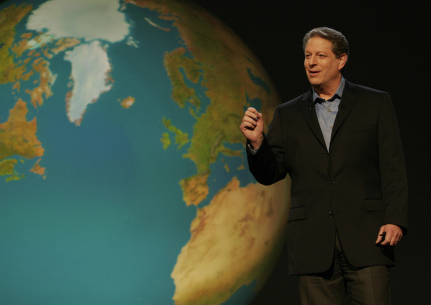
al-gore.pngThis year’s Nobel Prize for Peace went to Al Gore and the UN’s Intergovernmental Panel on Climate Change (IPCC) for their efforts to awaken the world about the risks of climate change. That’s great news but I’d have preferred to see the other candidate for the prize, Canadian Inuit Sheila Watt-Cloutier share the award with the IPCC not Gore.

Three Reasons Why Gore Should Not Have Won:

1. Watt-Cloutier has been a passionate and eloquent communicator about the fact that indigenous people of the Arctic, and indigenous peoples elsewhere, have taken the first and hardest climate change hits so far. It would be been fairer and more representative of the reality to award the prize to an indigenous person.watt-cloutier.png

2. For eight long years Al Gore was second in command of the largest greenhouse gas emitting country in the world. And yet emissions climbed and climbed even though Gore knew climate change was a real and pressing emergency. When running for President Gore barely mentioned GW and then the world had to suffer thru the other GW — George W Bush and his blind and selfish intransigence.

3. Al Gore’s GW solutions are mostly wrong. Biofuels are a bad idea and only make rich agri-corporations richer. Carbon trading markets are an equally bad idea — enshrines the rich countries’ right to pollute our common atmosphere. A moratorium on coal and a carbon tax are some of his better ideas. However, Gore fails to address the root of the problem which is an economic system based on endless growth on a tiny planet with an awful lot of people.

“People do want to do the right thing, but they just don’t realise that the Arctic is melting and they are responsible,” Watt-Cloutier told me in 2004. From Global Warming Will Decimate Arctic Peoples and also see Inuit Sue America Over Climate Change

Inuit Sue America over Climate Change

By Stephen Leahy

The Inuit people of the Arctic regions are preparing to charge the United States with human rights violations, saying that country is the leading culprit behind climate change, which threatens their way of life — and their very survival.

Originally published in Latin America Feb 15 2005 by Tierramérica

The sharp increase in temperatures in the Arctic has led to dramatic losses of sea ice and melting permafrost (the layer of ground that normally remains frozen year round), which have destroyed buildings and roads and forced relocations of entire native Inuit villages. Continue reading

GW Dramatically Rearranging Arctic Landscape

By Stephen Leahy


Credit:micropolisnews

A lone glacier drifts in the Canadian Arctic, Aug. 14, 2007.

Oct 4 (IPS) – The hot breath of global warming has now touched some of the coldest northern regions of world, turning the frozen landscape into mush as temperatures soar 15 degrees C. above normal.

Entire hillsides, sometimes more than a kilometre long, simply let go and slid like a vast green carpet into valleys and rivers on Melville Island in Canada’s northwest Arctic region of Nunavut this summer, says Scott Lamoureux of Queens University in Canada and leader of one the of International Polar Year projects.

“The entire landscape is on the move, it was very difficult to find any slopes that were unaltered,” said Lamoureux, who led a scientific expedition to the remote and uninhabited island. Continue reading

Pres. Bush: The Skunk at His Own Garden Party

By Stephen Leahy


Credit:White House Photo/Chris Greenberg

President George W. Bush addresses the Major Economies Meeting on Energy Security and Climate Change on Sep. 28, 2007.

Sep 29 (IPS) – After years of denial, the U.S. White House-sponsored summit on climate change ended Friday with President George W. Bush admitting that global warming was real and humans were responsible and asking for heads of state to join him at yet another summit next year (when his presidency ends).

It’s doubtful if anyone of consequence will attend that future gab-fest since President Bush continues to push voluntary cuts to greenhouse gas emissions when the rest of the world, including much of the business sector, has already said that approach simply doesn’t work.

“President Bush has so little credibility on climate change,” said Chris Flavin, president of the Worldwatch Institute, a U.S.-based environmental group. Continue reading

GW Desperation Drives Slightly Mad Ideas

coral-sea-oz.jpg

Climate Change: Time For Some Slightly Mad Ideas?
By Stephen Leahy

Sep 28 (IPS) – Lack of governmental action on climate change is forcing scientists to consider radical climate geo-engineering schemes such as giant vertical pipes in the ocean and growing vast blooms of plankton to try and prevent the worst from happening.

Companies backing some of these schemes hope to profit from the rising public clamour for action and politicians desperate to avoid serious reductions in greenhouse gas emissions.

“I wasn’t in favour of geo-engineering before, but we haven’t done well in reducing emissions,” said Chris Rapley, director of the Science Museum in London and former head of the British Antarctic Survey.

In fact, the global community continues on the “business as usual” path in terms of emissions of greenhouse gases (GHGs), thus increasing the chances of catastrophic climate change, Rapley, a climate change expert, told IPS.

“Just look at how incredibly quick the Arctic sea ice is melting,” he said. Continue reading

“Climate change is like the Internet — it is never going away”

“Climate change is like the Internet — it is never going away.”
— Paul Dickinson, CEO of the Carbon Disclosure Project

Climate of Change Confronts Wall Street
By Stephen Leahy

Sep 24 (IPS) – Stockholders, investors and financial analysts are now demanding to know how climate change will affect companies’ bottom line, and a new report reveals large corporations’ risks and opportunities.

At the behest of institutional investors managing over 41 trillion dollars, several hundred large corporations voluntarily revealed how they are responding to this new reality in a report released Monday at a major event on New York’s Wall Street, where former U.S. President Bill Clinton will also speak.

“Climate change will change the way we do everything,” said Paul Dickinson, CEO of the Carbon Disclosure Project, an independent not-for-profit organisation.

“Nothing will go back to the way things were,” Dickinson told IPS.

Continue reading

Facebook: Last Hope for Environment?

facebook-header.png

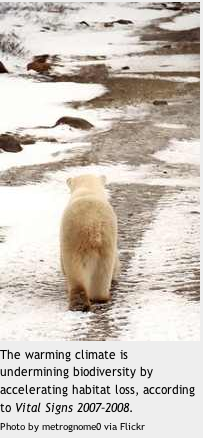
Global trends indicate a looming environmental catastrophe, and engaging high school students around the world may be the only hope.

By Stephen Leahyvital-signs.png

Sept 14’07 (IPS)
Governments, the corporate sector and media continue to champion industrial and economic growth at the cost of escalating impacts on the environment, concludes the latest report from the Washington-based Worldwatch Institute, “Vital Signs 2007-2008“.

For a number of years, the “Vital Signs” report has tracked 44 trends that are shaping the future, and they document a record level of industrial growth, says Erik Assadourian, Vital Signs project director.

“‘Vital Signs’ also documents the escalating impacts of such growth on the environment,” Assadourian told IPS in an interview from Barcelona.

The scale of the environmental crisis, in which catastrophic climate change is just one of many, is undermining the ecosystems that support life on Earth.

“Climate change and other environmental problems are symptoms of the root problem, which is the obsession with consumerism,” he said.

Vital Signs reports that in 2005, more wood was removed from forests than in any previous year. Fossil fuel usage dumped 7.6 billion tonnes of carbon emissions into the atmosphere. Meat production hit a record 276 million tonnes (43 kilogrammes per person) in 2006. Rising meat consumption is driving rising soybean demand to feed cattle, which in turn is a driver of deforestation as tropical forests are turned into soy fields.

And on it goes: global seafood consumption breaks records, steel and aluminium production too. None of this is sustainable — another three or four or five planets would be needed to maintain these levels of production and consumption. Continue reading

Future Belongs to the Shrub

picture-3.png 21st Century May Belong to the Shrub
By Stephen Leahy

Sep 1 (IPS) – As atmospheric carbon dioxide levels continue to climb shrubs and other woody plants will likely dominate grasslands, altering pastoral lifestyles around the world, a U.S. study has found.

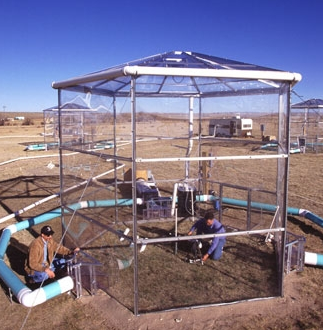
In the first experiment of its kind done on native grassland, U.S. scientists artificially doubled carbon dioxide (CO2) levels over enclosed sections of prairie in Colorado, a state in the western United States, for five years. To their surprise, one shrub species, Artemisia frigida — commonly known as fringed sage — thrived under those conditions. In fact, it grew 40 times faster than normal, dominating other plant species.

“This kind of response to higher CO2 levels is almost unprecedented,” said Jack Morgan, a plant physiologist at the U.S. Department of Agriculture, and lead author of the study, published Aug. 28 in the ‘Proceedings of the National Academy of Sciences‘ (PNAS), a science journal.

“Fringed sage is a minor species on the landscape normally. We were not expecting to see this,” Morgan told IPS.

Continue reading

Dirt: The Silent Global Crisis

Dirt Isn’t So Cheap After All


By Stephen Leahy

Aug 30 (IPS) – Soil erosion is the “silent global crisis” that is undermining food production and water availability, as well as being responsible for 30 percent of the greenhouse gases driving climate change.

“We are overlooking soil as the foundation of all life on Earth,” said Andres Arnalds, assistant director of the Icelandic Soil Conservation Service.

“Soil and vegetation is being lost at an alarming rate around the globe, which in turn has devastating effects on food production and accelerates climate change,” Arnalds told IPS from Selfoss, Iceland, host city of the International Forum on Soils, Society and Climate Change which starts Friday.

Along with many other international partner institutions, Iceland is marking the centenary of its Soil Conservation Service by convening this forum of experts.

Every year, some 100,000 square kilometres of land loses its vegetation and becomes degraded or turns into desert.

“Land degradation and desertification may be regarded as the silent crisis of the world, a genuine threat to the future of humankind,” Arnalds said.

Food production has kept pace with population growth by increasing 50 percent between 1980 and 2000. But it is an open question whether there will be enough food in 2050 with an estimated three billion more mouths to feed.

That means more food has to be produced within the next 50 years than during the last 10,000 years combined he noted.

“Global food production per hectare is already declining,” said Zafar Adeel, director of the United Nations University’s Canadian-based International Network on Water, Environment and Health.

There are a number of reasons for this decline, including the fact that soil degradation is producing growing shortages of water. Soil and vegetation act as a sponge that holds and gradually releases water, Adeel explained.

The newest challenge to food production and conserving land and water resources is the boom in vegetable-based biofuels, says Andrew Campbell, Australia’s first National Landcare Facilitator.

“Soils are under greater pressure than ever before,” Campbell said in an interview. “Governments around the world are subsidising crops to produce biofuels.”

For complete article see Dirt Isn’t So Cheap After All.