Satélites revelan caída de tala amazónica en Perú

Para los lectores españoles:

Satélites revelan caída de tala amazónica en PerúRecently-contacted Murunahua man, River Yurua, Peru. He was shot in the eye by loggers during first contact. © David Hill / Survival
Por Stephen Leahy

La deforestación peruana, intensa en las áreas cercanas a carreteras y explotaciones minerales, ha tenido escaso impacto en las selvas protegidas, afirman investigadores.

TORONTO, 13 ago (Tierramérica).- Las políticas de conservación de selvas redujeron el ritmo de la deforestación en la Amazonia peruana, afirma un nuevo estudio basado en detección satelital de alta precisión.

Aunque los bosques amazónicos de Brasil son los que concitan la mayor parte de la atención internacional, los 661 mil kilómetros cuadrados de selvas peruanas son reconocidos como un ecosistema único.

Pero los impactos de la actividad humana en toda la región han sido mal comprendidos hasta un estudio publicado el viernes 10 en la revista científica Science.

“Las reservas forestales y las áreas de conservación de Perú parecen estar funcionando bien”, dijo Greg Asner, director del estadounidense Observatorio Aéreo de la Carnegie Institution of Washington, con sede en California.

Continue reading

Atlantic Bluefin Tuna Going Way of Northern Cod

tuna-hall-sml.jpgAtlantic Bluefin Tuna Going Way of Northern Cod
By Stephen Leahy

Aug 6 (IPS) – Fishing wiped out Atlantic Bluefin tuna stocks in Northern Europe 50 years ago, according to a new study, while ongoing pressure on the remaining stocks is pushing the entire species to the edge of extinction.

Every summer in the early 1900s, Northern European waters from Holland to northern Norway teemed with Atlantic Bluefin tuna, some three metres long and weighing 700 kilogrammes, according to historical fishing records. Few could catch the powerful, fast-swimming fish until the 1930s and 1940s when bigger, faster boats with better catch gear were designed.

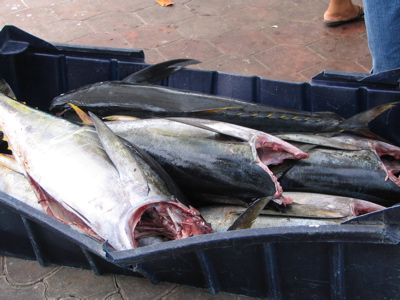
“The Bluefin population crashed in the 1960s and more than 40 years later it still hasn’t recovered,” said Brian MacKenzie of the Technical University of Denmark, who led the study to be published in the journal Fisheries Research.yellow-fin-tua-galapagos.jpg

“You simply don’t see bluefins in these waters any more,” MacKenzie told IPS.

There is a clear parallel to the more recent collapse of once abundant Northern Cod stocks. Also fished into near extinction on the other side of the Atlantic, the Cod have not recovered despite a no-fishing ban for the past 15 years.

“I’m afraid what happened to the Bluefin is similar to what happened to the Northern Cod,” he said.

Continue reading

Carbon Project Endangers the Galápagos

img_0235.jpg


By Stephen Leahy

A company is preparing to enrich seawater with iron in order to promote phytoplankton growth and the absorption of carbon from the atmosphere near the environmentally-protected Galápagos Islands.

PUERTO AYORA, Galápagos, Ecuador, Jul 9 ’07 (Tierramérica).- Later this month a U.S. company, Planktos Inc., plans to dump 100 tons of iron dust into the ocean near Ecuador’s Galápagos Islands, despite opposition from environmental groups and marine scientists.This will be the first-ever commercial effort to reduce carbon dioxide in the atmosphere, one of the main gases blamed for climate change, by using iron particles to create a 10,000-square-kilometer “plankton bloom”.

Planktos says the extra volume of these small, floating organisms will absorb large amounts of CO2 from the atmosphere and take it deep into the sea. And this method may be the fastest and most powerful tool to battle climate change.

img_0508.jpg

“The currents will likely bring the bloom into the [Galápagos] Marine Reserve,” covering 133,000 sq. km, the world’s third largest marine reserve, says Washington Tapia, director of the Galápagos National Park, which includes the reserve. Continue reading

Aliens of the Deep Seas

350 Degrees Is Bathwater to These Animals
By Stephen Leahy


Credit:NASA

Hydrothermal vent


PUERTO AYORA, Galapagos Islands, Ecuador , Jul 5 (IPS) – Marine scientists returned to the Galapagos Islands this week to celebrate a discovery that Charles Darwin never dreamt of: bizarre animals that live in total darkness around active deep-sea volcanoes.

Thirty years ago, researchers found the first chimney spewing super-hot water — called a hydrothermal vent — 2,500 metres below the surface on the sea floor, with its own thriving  animal community. That life could prosper without sunlight or photosynthesis changed forever the very definition of what constitutes “life” on the Earth. And it opened a new window on the possibilities of life elsewhere in the universe.

After all, if a tiny shrimp can live in total darkness, under tonnes of pressure in a toxic chemical soup boiling away at 350 degrees C, why could not life take hold on some distant planetoid where conditions might not be so harsh?
Continue reading

Coke Spraying with Roundup Damages DNA in Ecuador/Colombia

New Studies Reveal DNA Damage from Anti-Coca Herbicide
42_330_x62_538622.jpgBy Stephen Leahy

Scientific studies have collected evidence of the negative effects of the glyphosate-based herbicide Roundup on human and animal health. The chemical is used in aerial spraying to eliminate illicit coca crops in Colombia.

TORONTO, Jun 11 (Tierramérica).- U.S.-funded aerial spraying of suspected coca plantations in Colombia near the Ecuador border has severely damaged the DNA of local residents, a new study has found.

Blood samples from 24 Ecuadorians living within three kilometers of the northern border had 600 to 800 percent more damage to their chromosomes than people living 80 km away, found scientists from the Pontificia Catholic University in Quito, Ecuador.

The border residents who were tested had been exposed to the common herbicide glyphosate — sold by the U.S. agribusiness giant Monsanto under the brand Roundup –during a series of aerial sprayings by the Colombian government begun in 2000, part of the anti-drugs and counterinsurgency Plan Colombia, financed by Washington.

The Ecuadorians suffered a variety of ailments immediately following the spraying, including intestinal pain and vomiting, diarrhea, headaches, dizziness, numbness, burning of eyes or skin, blurred vision, difficulty in breathing and rashes, says the study, which is to be published in the journal Genetics and Molecular Biology.

But the extensive damage to DNA (deoxyribonucleic acid) found in the randomly selected individuals may activate the development of cancer or other developmental effects resulting in miscarriages, according to lead researcher César Paz y Miño, head of human molecular genetics at the Catholic University of Ecuador. Continue reading

How to Kick-Start the 21st Century Eco-Economy

restore-cover-wri-sml.jpg Toward a Green Economy
By Stephen Leahy*


May 31 (IPS) – Humanity is facing historic and truly unprecedented challenges from climate change and the rapid decline of ecosystems that sustain life.

This article is final part of a three-part series published by IPS on natural capital and how future global prosperity and equity can be achieved through the preservation of ecosystems. See Part One: Like Enron, Earth Inc. Sliding Into Bankruptcy and Part Two: Global Warming is Real But I didn’t Do It 

The 2005 Millennium Ecosystem Assessment (MA) found that 83 percent of the planet’s natural systems are in serious decline or on the brink. Adding to this already dire situation are the twin pressures of population growth and increasingly consumptive lifestyles.

Global population is expected to soar from today’s 6.6 billion to 9 billion by 2050. Even though we crossed the point of sustainable use of natural resources in the mid-1980s, many of the 2.4 billion people living in China and India are striving mightily right now to approach the materialistic lifestyle of the average North American.

So how can we find our way around the global calamity the human race seems to be hurtling towards?

“Humanity needs a fundamentally new approach to managing the assets upon which we all depend,” said Janet Ranganathan, director of the People and Ecosystems programme at the World Resources Institute, an environmental group based in Washington.

“We need new ways of making decisions at all levels that fully value ecosystems and the services they provide us,” she said.

Continue reading

Destroying Canada’s Forests for America’s Oil

“Nowhere else in the world where this much money is being invested”

cover 2.0**REVISED** Oil Stains in the Boreal Forest:

The Environmental Cost of Canada’s Oil Sands

An eBook by Stephen Leahy

Oil Stains in the Boreal Forest is a 30-page eBook presenting a factual overview of the environmental impacts of pumping more than 1.1 million barrels of oil — 175 million litres (50 million gallons) — each day to thirsty US markets.

Based on a 4-part investigative journalism series, leading scientific and environmental experts along with industry officials are interviewed.

Recipe for making a make a gallon of gasoline from the oil sands:

  • burn 1500 cubic feet of natural gas
  • use up 700 litres of water
  • dig up two tonnes of earth and rock
  • dump 948 litres (250 gallons) of mine tailings

And that’s just the beginning – now the crude has to be processed.

Oil Stains in the Boreal Forest   includes pictures of the destruction of virgin boreal forest, links to access additional information, and a peek at a new economic study that shows oil company profits are subsidized by not having to pay for their pollution.

Download your copy of the updated 2009 version 2.1 today for only $3.75
Oil Stains in the Boreal Forest: The Environmental Cost of Canada’s Oil Sands 2.1

eBook -Version 2.1 (2009) – full-color, 8 1/2 x 11″,  30 pages   (14 mb pdf download) 

Learn more about the author


Can Capitalism Be Green?

Copyright 2006 Renate LeahyCan Capitalism Be Green?

By Stephen Leahy

Experts say continuous economic growth, intrinsic to capitalism, is not viable on a planet with increasingly scarce natural resources.

May 7 (IPS/IFEJ) – Capitalism has proven to be environmentally and socially unsustainable, so future prosperity will have to come from a new economic model, say some experts. Just what this new model will look like is the subject of intense debate.

One current states that continuous growth can be environmentally compatible if clean and efficient technologies are adopted, and if economies stop producing material goods and move towards services. This is known as sustainable prosperity.

International agreements to fight global problems, like the thinning of the atmosphere’s ozone layer and climate change, used market principles to achieve compliance by the private sector.

But the problem is, “We are consuming 25 percent more than the Earth can give us each year,” says William Rees, of the School of Community and Regional Planning at the University of British Columbia.

Continue reading

Feeding the World Without Destroying It

Farming Will Make or Break the Food Chain
By Stephen Leahy

May 2 (IPS) – As the world population swells to nine billion by 2050, global biodiversity will be under extreme pressure unless new ways to grow food are developed, experts say.

An additional one billion hectares of wild lands — mainly forests and savanna — will be converted to food production fields by 2050. While this may provide enough food, it is likely to result in a massive decline in biodiversity, undermining ecosystems that provide vital services such as clean water and air, and capture carbon to slow the build-up of climate-altering gases in the atmosphere.

Sixty percent of the Earth’s ecosystems are in trouble right now, warned the Millennium Ecosystem Assessment report last year.

What state will they be in by 2050? Continue reading

Sushi, Moonies, Whales and $Commerce

Top U.S. Sushi Company Linked to Whaling
By Stephen Leahy

Blue whale, courtesy IFAW

Apr 11 (IPS) – An investigation has revealed that the U.S. supplier of sushi to more than 6,000 restaurants is associated with a Japanese company that sells millions of tins of whale meat.

Despite a global ban on killing whales, Japan’s Kyokuyo, a multinational seafood conglomerate, sells between 10 and 20 million cans of whale meat a year, according to an Environmental Investigation Agency (EIA) report released Tuesday. Continue reading