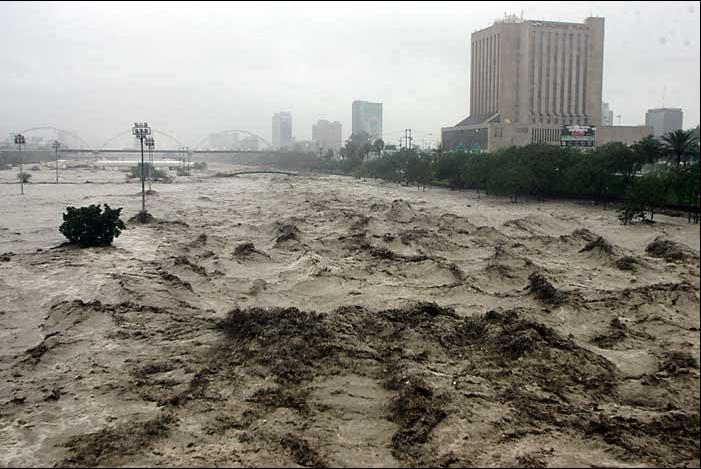
Durban May Be Last Chance to Stabilise Climate Under Two Degrees — Africa, Russia To Cook by 2020; Most of Canada and China by 2030

By Stephen Leahy

The International Energy Agency estimates that 80 percent of projected emissions from the power sector in 2020 are already locked in.

CHANGWON, South Korea , Oct 23, 2011 (IPS)

The window to limit global warming to less than two degrees C is closing so fast it can be measured in months, a new scientific analysis revealed Sunday.

Without putting the brakes on carbon emissions very soon, large parts of Africa, most of Russia and northern China will be two degrees C warmer in less than 10 years. Canada and Alaska will soon follow, the regional study shows.

“If one is sincerely committed to limit global temperature increase to below two degrees C… (governments) committing to a global peak emission level and peak year makes sense from a science perspective,” said Joeri Rogelj of the Institute for Atmospheric and Climate Science in Zurich, who headed the analysis published Sunday in the journal Nature Climate Change. [See NCC editorial “Crossing the threshold”]

Governments will be meeting in Durban, South Africa starting Nov. 28 to launch the next round of climate treaty negotiations, which so far have failed to ensure their goal of less than a two-degree C increase will be achieved.

IPS asked Rogelj if government delegates in Durban ought to set a specific year by which global emissions will peak and then decline to ensure the two-degree C target will be met.

“Committing to such targets would ensure that we embark globally on a technologically and economically feasible low-emission path,” Rogelj said.

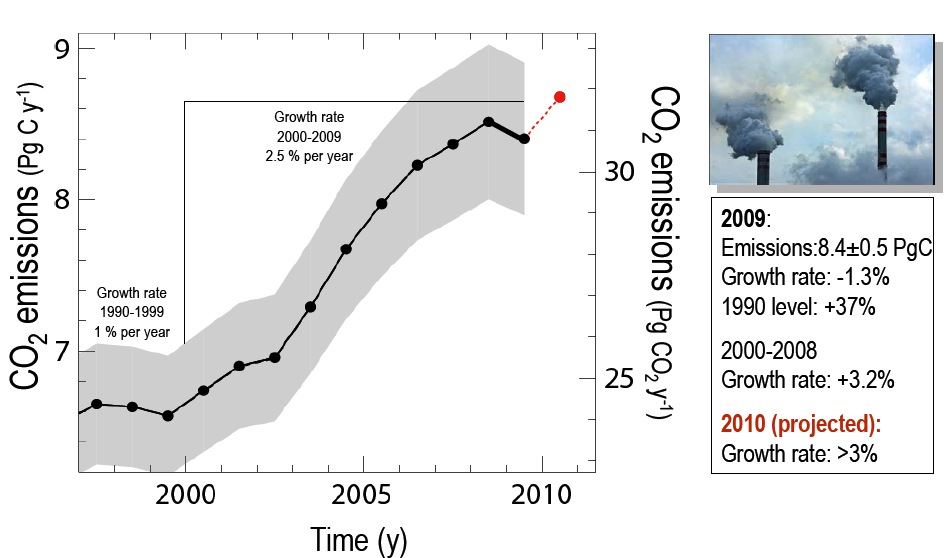
Rogelj and a group of leading experts show in this state-of-the-art analysis that to have a 66-percent or better probability of staying below two degrees C this century, global carbon emissions must peak before 2020. Global emissions ought to be around 44 billion tonnes of CO2 in 2020. That is four billion tonnes (also called gigatonnes, Gt) less than the estimated emissions for 2010.

After 2020 emissions must decline rapidly, about two to three percent less each year until they fall to 20 Gt by 2050, according to the computer models. This is an emissions “pathway that will be very challenging to achieve”, Rogelj and colleagues conclude in their study.

Very challenging” is scientist-talk for something that will be extremely difficult to do. The International Energy Agency (IEA) estimated that 80 percent of projected emissions from the power sector in 2020 are already locked in, as they will come from power plants that are currently in place or under construction today.

“This significant increase in CO2 emissions and the locking in of future emissions due to infrastructure investments represent a serious setback to our hopes of limiting the global rise in temperature to no more than two degrees C,” said Dr. Fatih Birol, chief economist of the IEA, last May. Continue reading
Cook Islands Aims for 100 Percent Green Energy by 2020

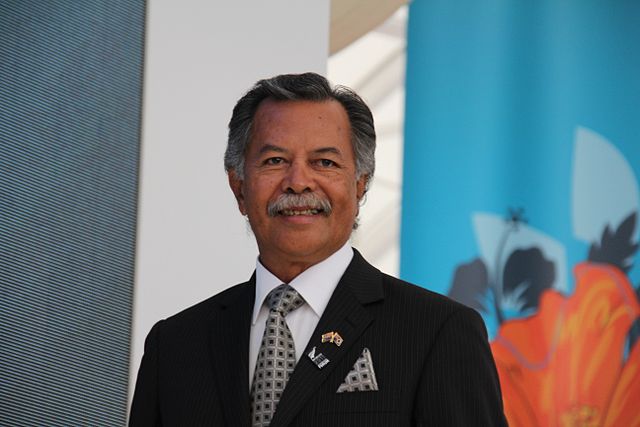
President of Cook Islands – Henry Puna

 Cook Islands’ Carbon Footprint is the size of a town of 3,000 in America

Stephen Leahy interviews HENRY PUNA, Prime Minister of the Cook Islands

VIENNA, Jul 13, 2011 (IPS) –

“One hundred percent renewable energy by 2020… It is ambitious but it is not impossible,” Henry Puna, prime minister of the Cook Islands, told IPS in a recent interview.

The Cook Islands is one of those low-lying island countries that will drown without serious cuts in the carbon emissions that are warming the planet and melting the world’s ice sheets.

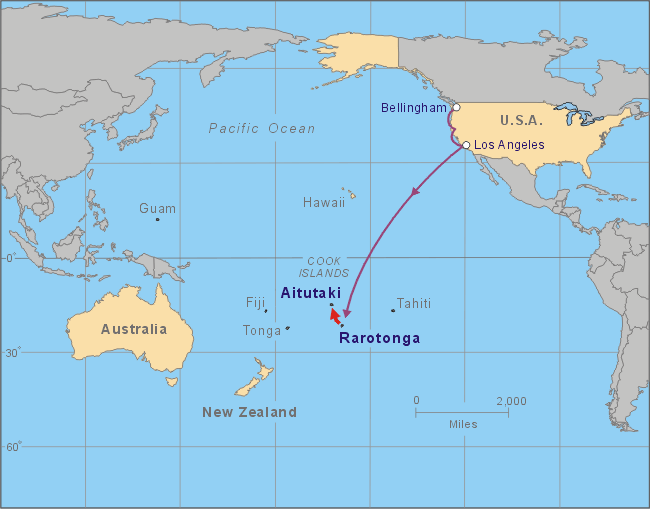
Home to just 14,000 people, the Cook Islands is made up of 15 small islands spread over an area the size of India in the middle of the South Pacific. The entire country’s carbon emissions are about equal to those of the average U.S. or Canadian town of 3,000 people.

With an action plan born of desperation, it wants to be the world’s first zero-carbon emissions country by 2020. With little renewable energy at present and dependent on foreign aid, the Cook Islands plans to generate half of its energy with renewables just four years from now and reach 100 percent by 2020.

IPS senior environmental correspondent Stephen Leahy spoke with Prime Minister Puna at the Vienna Energy Forum in June, where 1,200 delegates from 120 countries and over 40 government ministers discussed how to bring clean, reliable and affordable energy services to everyone on the planet.

Excerpts from the interview follow.

Q: The Cook Islands have a tiny carbon footprint. Why are you making this commitment to be 100-percent renewable?

A: Statistically, our carbon emissions don’t register. As a people we want to do something about climate change, if not for the world than for ourselves.

Nearly all of our energy comes from oil [diesel and petrol] and we spend half of our national budget on oil. That’s tens of millions of dollars that leaves our islands. We want to keep those millions in our local economy. Cook Islanders people are strongly supportive of our dream is to be the cleanest and greenest destination in the world. One day the world will want to know how we got to 100 percent.

Q: Are you hopeful the international community will finally agree to make the necessary carbon emissions cuts to keep global warming to less than two degrees C?

A: The reality is that things move very slowly at the international level. At the [Vienna] forum, I urged the international community to ensure that global carbon emissions peak by 2015 and begin to decline. We need to act fast. This is the decade where we must bring emissions of climate change under control.

Our circumstances differ, we have different life experiences….but we are all part of Mother Earth and should share responsibility to keep her livable for all of us and not just for some.

Q: Are Cook Islanders worried about climate change?

A: The Cooks are already suffering from sea level rise, coral bleaching, more frequent and stronger cyclones, changes in precipitation, and increases in coastal erosion. We live off the sea and the land – we depend on nature for our livelihoods. Anything affecting nature causes alarm amongst people. Climate change threatens our very survival. There is a general sense of apprehension about the future.

Q: What makes you believe you can achieve your ambitious target?

A: Yesterday, I visited Güssing [in Austria], an impoverished town in the 1990s that re-made itself by going 100-percent renewable energy. They got rid of fossil fuels and achieved energy independence. They also attracted lots of clean and green businesses and become a tourist centre.

I spent time with the mayor. They’re going to come to the Cooks and give us advice. They are willing to share their experience. I’m absolutely excited by this.

Q: Your country has few financial resources. Do you really think the Cooks can do what Güssing has done?

A: It’s a small town and we’re a small country. What I learned from Güssing is that if there is the political will backed by public support, then anything can happen. We already have a plan for a two- megawatt solar plant in one of our islands. We have support from Japan, New Zealand and UNDP [the United Nations Development Programme].

Q: What are some of the obstacles you have to overcome?

A: The technology to generate all of our energy already exists but energy storage is the key. We also need to make sure some of this will be able to be used and maintained by isolated communities without the technical skills.

Q: Any final thoughts?

A: Knowing we are taking action helps us feel good even if the world does nothing. We’re not doing this just for the Cook Islands. It is our contribution to improve the overall global environment.

First published as Q&A: Cook Islands Aims for 100 Percent Green Energy by 2020 – IPS ipsnews.net.

Carbon Markets Are NOT Cooling the Planet

Carbon markets have failed – prone to fraud – experts report

Climate change is the world’s biggest market failure so why would we expect carbon markets to save the day? There isn’t going to be a climate treaty for some years yet.It is simply too complex and politically charged. Don’t be too depressed about this. We are in uncharted waters as a species in trying to find an equitable way to manage the climate of our planet. But action is needed now and the best place is at our local neighbourhood level to save energy, use alternatives, build communities and inform people IMHO. — Stephen

By Stephen Leahy*

BONN, Jun 22, 2011 (Tierramérica)

Carbon markets have been widely promoted as the only way to generate enough money to enable industries and countries to reduce their carbon dioxide emissions, which are largely responsible for global warming. The only problem is that nearly 20 years after their conception, they have failed to work, and have also been subject to fraud and other financial crimes.

Interpol, the world’s leading policing agency, has warned that carbon market schemes are easily taken advantage of by organised crime.

Earlier this year, carbon credits worth 38 million dollars went missing in the European Union’s carbon market after funds were transferred by computer hackers from the Czech Republic to Poland, Estonia and Liechtenstein before disappearing. That was the fourth time funds had been stolen or mislaid.

“A lawyer formerly involved in carbon trading told me that if markets are still trading carbon 10 or 15 years from now, then the global environment will be in very big trouble,” Steve Suppan, senior policy analyst at the U.S.-based Institute for Agriculture and Trade Policy (IATP), told Tierramerica.

“Carbon markets are open to fraud, misrepresentation and deceptive promotion,” Suppan said in an interview at the United Nations Framework Convention on Climate Change (UNFCCC) negotiating sessions held in Bonn Jun. 6-17.

These markets have had huge support from governments and they still do not work to effectively reduce greenhouse gas emissions, said Suppan, whose organisation works on trade, agriculture and environmental issues.
Continue reading

Reducing Fossil Fuel Use Only Way to Save Dying Corals

Another important reason why continuing to burn more fossil fuels is very dangerous for all of us. Excerpts from July 2008 article — Stephen 

‘The world’s fossil fuel economy is like the Titanic — we know its going to hit an iceberg but it takes a very long time to stop a really big ship..’

By Stephen Leahy

FORT LAUDERDALE, U.S., July 12, 2008 (IPS)

The rapid decline of coral reefs around the world offers a potent warning that entire ecosystems can collapse due to human activities, although there is hope for reefs if immediate action is taken, coral experts agreed at the conclusion of a five-day international meeting Friday.

“Reefs are in serious trouble, but don’t write them off,” Terry Hughes, a marine ecologist at Australia’s James Cook University told 3,000 scientists, conservationists and policy makers attending at the 11th International Coral Reef Symposium (ICRS) in Fort Lauderdale, Florida.

“We can save reefs if we take immediate action,” Hughes said.

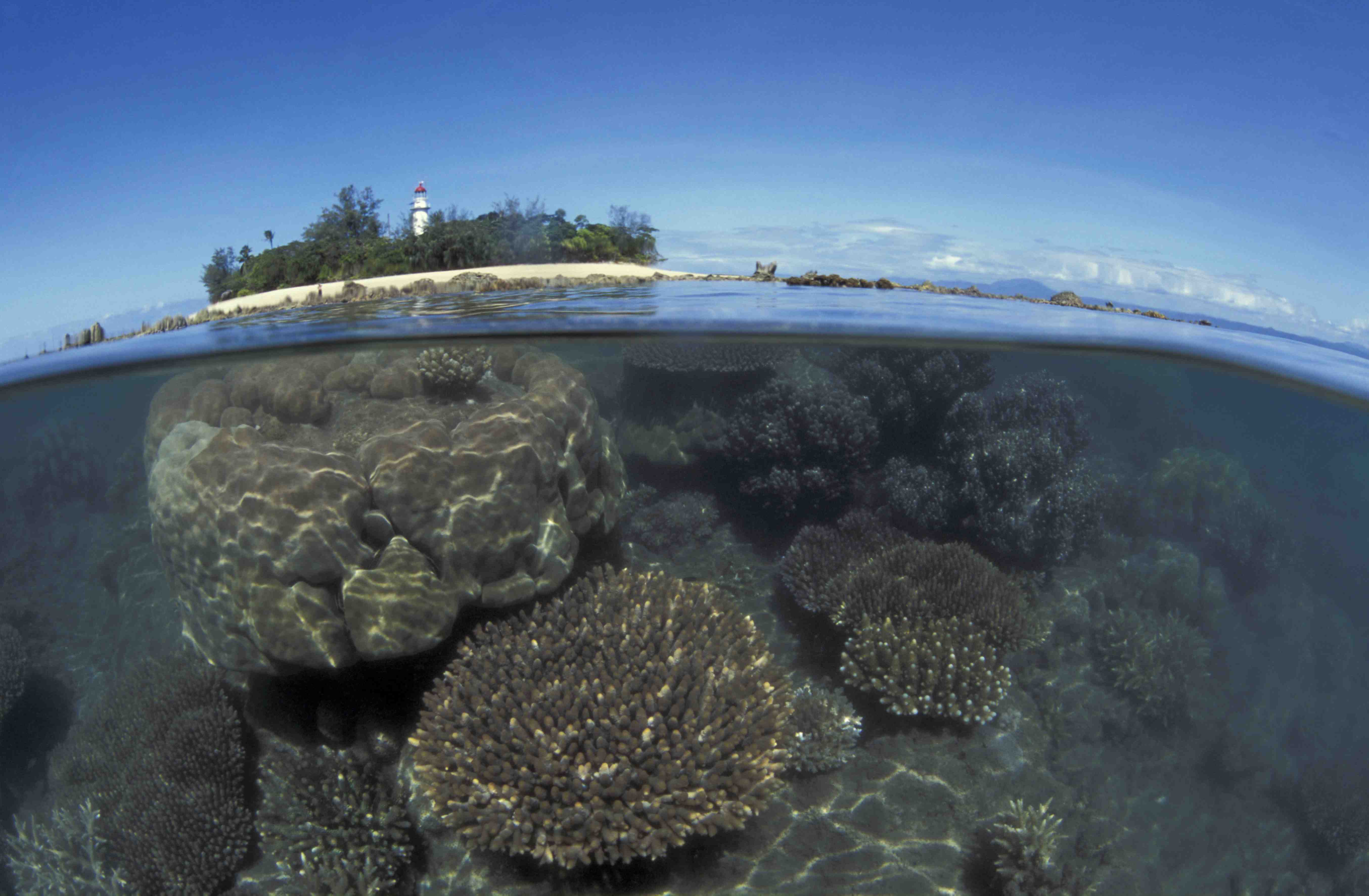
More than 20 percent of the world’s reefs have died, and large areas are failing due to a combination of climate change, overfishing, pollution and sea level rise. Most of the fabulous corals that attract tourists to the Caribbean are gone and half of remaining reefs in the U.S. are in serious decline.

[Update 2010 – Here’s a list of Stephen Leahy’s latest articles on corals Coral Reefs and Acid Oceans Series]

We may be facing ocean deserts in the future,” said Guillermo Dias-Pulido of Australia’s University of Queensland.

Continue reading

Rich Countries Largely Live Off Financial Transactions

[Excerpts from my Dec 2010 article on how rich countries move money around and produce little while preventing green development in Africa  — Stephen]

“The world’s big economies are largely living off financial transactions which are unconnected to development,” warns Supachai Panitchpakdi, secretary-general of United Nations Conference on Trade and Development.

In a rejection of failed neoliberal economic policies, Panitchpakdi said strong national policies on investments, taxation, protection of local industries, including subsidies, and changes to less restrictive intellectual property regimes are what is needed to green economies in Africa and elsewhere.

“Green economic development underpins environmental protection, economic growth and development,” he said.

Here’s a startling fact based in a new energy study:

Universal Access to Electricity Less Than Cost of Fossil Fuel Subsidies

Keystone Pipeline All About Exporting Oil Overseas – Report


 The United States is awash in oil with four times as many oil rigs pumping domestic oil today than eight years ago and declining  demand

Canada needs overseas markets for its dirty oil

[Excerpts from my September 2nd article on the proposed Keystone XL pipeline — Stephen]

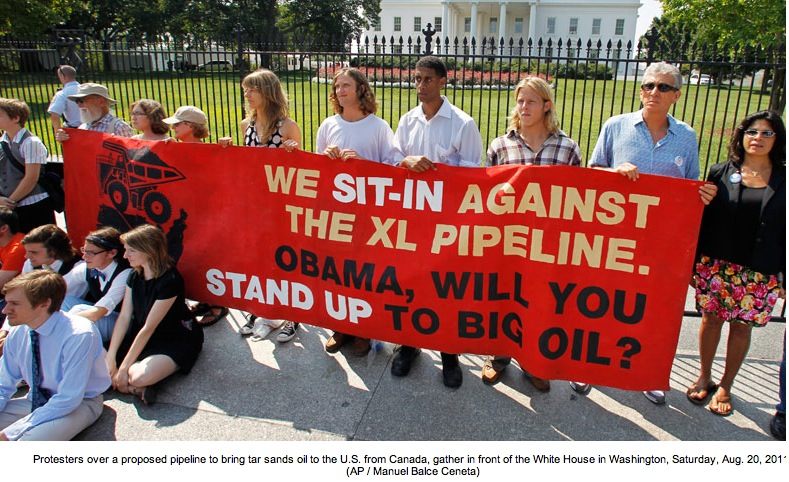
The only reason U.S. citizens may be forced to endure a risky, Canadian-owned oil pipeline called Keystone XL is so oil companies with billion-dollar profits can get the dirty oil from Canada’s tar sands down to the Gulf of Mexico to export to Europe, Latin America or Asia, according to a new report by Oil Change International released Wednesday.

“Keystone XL will not lessen U.S. dependence on foreign oil, but rather transport Canadian oil to American refineries for export to overseas markets,” concludes the report, titled “Exporting Energy Security“.

….

“The oil industry would have done the Northern Gateway [pipeline] first but gambled that resistance to the [Keystone XL] pipeline would be far weaker in the mid-west,” he told IPS.

They were wrong.

Read full article:

U.S. Awash in Oil and Lies, Report Charges | More Oil Development Risks Catastrophe – Scientists Say

Jail Before Climate-Wrecking Tar Sands, Canadians Say

By Stephen Leahy

OTTAWA, Sep 27, 2011 (IPS)

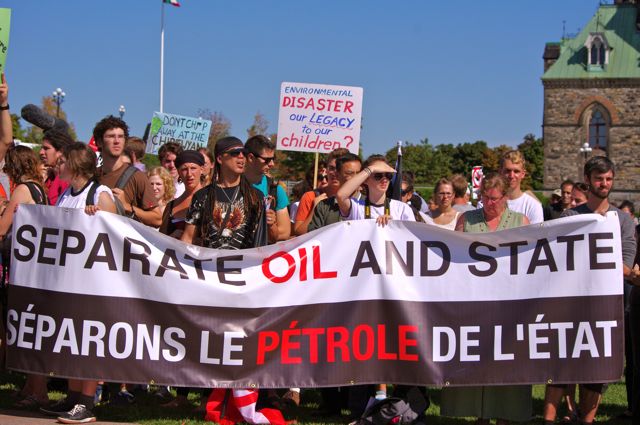
More than 200 Canadians engaged in civil disobedience, with 117 arrested in Canada’s quiet capital city on Monday. The reason? To protest the Stephen Harper right-wing government’s open support for the oil industry and expanding production in the climate-disrupting tar sands.

Maude Barlow, chairperson of the Council of Canadians, is arrested at the Sep. 26 tar sands protest. Credit:Renée Leahy/IPS

The normally placid and polite Canadians shouted, waved banners and demanded the closure of the multi-billion-dollar tar sands oil extraction projects in northern Alberta to protect the global climate and the health of local people and environment.

“People are here because they know that if we don’t turn away from the tar sands and fossil fuels soon it will be too late,” Peter McHugh, a spokesperson for Greenpeace Canada, told IPS.

“The tar sands are unsustainable. Canadians are willing to shift away from fossil fuels but our government isn’t,” Gabby Ackett a university student and protester, told IPS as she stood in front of a long line of police.

In what was proudly touted as “civil” civil disobedience, protesters aged 19 to 84 were arrested for using a step-stool to climb a low barrier separating them from the House of Commons, the seat of Canadian government. The police were friendly and accommodating because the organisers had promised there would be no violence.

“We live downstream and see the affects of tar sands pollution on the fish and the birds,” said George Poitras, a former chief of the Mikisew Cree First Nation in northern Alberta.

“Some our young people have rare forms of cancer,” Poitras told more than 500 protesters.

“Expanding the tar sands is not the way to go in a world struggling with climate change,” he said.

Carbon emissions from the tar sands production have increased 300 percent since 1990 and, at 45 to 50 million tonnes annually, are greater than most countries. And that does not include the carbon contained in the oil itself.

When burned, the 1.6 million barrels of oil that are extracted every day will add 346 million tonnes of carbon to the atmosphere this year alone. That’s almost the entire emissions of the country of Australia. The oil industry is making billion-dollar investments in the tar sands to more than double production by 2025. Continue reading

Lend Your Car, Save, and Save the World

Cars are parked 22 hours a day on average yet world will have 2.5 billion cars in 2050

The costs of car ownership and travel are far higher than anyone realizes: a 100 km total trip costs between 65 and 80 dollars when parking, fuel, wear and tear, insurance, depreciation, repairs are included. A car is usually parked and unused 22 hours a day but still incurs costs. Why not let someone use the car when you’re not and make some money at the same time Robin Chase told me for this article. She’s launched Buzzcar in France as part of a strategy for reducing carbon emissions and congestion in cities.   — Stephen

Why do car owners get so much more public space than bus riders, bicyclists or walkers?

By Stephen Leahy

BERLIN, Jun 2, 2011 (IPS)

The world’s more than 850 million cars and small trucks are parked 20 to 22 hours a day. Why not use these vehicles more efficiently by letting other people drive them when the owners aren’t, asks Robin Chase, CEO of Buzzcar, a car- sharing network to be launched shortly in France.

“Sharing vehicles is much more efficient and represents a huge opportunity,” Chase told some 800 attendees from more than 50 countries at the OECD’s annual International Transport Forum (ITF) in Leipzig last week. The Forum is an intergovernmental organisation for the transport sector involving 52 different nations.

The ITF projects there will be three times as many cars – an eye-popping 2.5 billion – by 2050 according to its Transport Outlook 2011 report released at the meeting. Adding that many more vehicles in a sustainable way is an “extraordinary challenge”, said Jack Short, Secretary General of the ITF.

The vast majority of this growth will come from the developing countries since travel by passenger vehicle in a number of high-income countries has not increased, and even declined in some countries. Short acknowledged making such projections is risky because many factors such as lower economic growth, congestion in cities or new technologies will have an impact on levels of car ownership in future.

And the Transport Outlook report did not factor in the potential for car-sharing to offer personal mobility without car ownership.

Buzzcar is a car sharing service where car-owners in a city or town allow their idle cars to be used by other local citizens in exchange for getting about 70-75 per cent of the rental fee, Chase told IPS in an interview. Even when a car is parked it costs their owners money, she says. The average cost of owning and operating car is 8,000 to 12,000 dollars a year even if it sits parked 22 hours a day. (update: more like $9,000 to 14,000 according to auto clubs)

Buzzcar is an opportunity for car owners to get better value out of their vehicles and to help with ever- rising costs of car ownership. More importantly car sharing reduces the need for car ownership overall, she says.

This independent environmental journalism depends on public support. Click here learn more.

Chase was a co-founder of Zipcar, a U.S.-based car-rental network with more than a half million members where people rent cars by the hour from easy-to-access neighbourhood lots or stations. Zipcar owns some 8,000 rental cars. She then went on to start GoLoco, a ride sharing company in which people pay to ride along with others in the network, and the drivers take a cut of the fees. Continue reading

Inheriting the Whirlwind of Extreme Events

This article looks at the huge upswing in extreme events around the world. Imagine this: the worst-ever tornado season, the worst flooding, and worst heatwave  have hit the US this year. And they may yet experience one the worst hurricane seasons. “24 Hours of Reality” online broadcast documented this Sept 15 to help people clear their heads of the fossil fuel propaganda and open their eyes to the crisis we are facing.  — Stephen

There are four anti-climate change lobbyists in Washington for every member of Congress.”

By Stephen Leahy

UXBRIDGE, Canada, Sep 15, 2011 (IPS)

The dramatic increase in extreme weather that has affected hundreds of millions across the planet is one of the clearest signs that burning billions of tonnes fossil fuels has seriously and permanently disrupted the global climate, experts say.

That is the reality former U.S. vice president Al Gore is focusing on Thursday through an unprecedented live online event called “24 Hours of Reality” broadcast from 24 time zones and reaching millions of viewers in multiple languages.

“In 30 years of weather forecasting I have never seen extreme weather events like those in the last two years globally,” said Jeff Masters, co-founder and Director of Meteorology for Weather Underground, the web’s first commercial weather service.

“I never thought we could have the greatest outbreak of tornados, the worst-ever flooding, record heatwaves and droughts all in one year,” Masters told IPS at a press conference last week in reference to the multi-billion-dollar extreme weather the U.S. has endured this year.

“The hurricane season is only half over and is on pace to be a record year as well,” he said.

Masters and other climate experts say is the “new normal” for the coming decades is the reason why. Burning of oil, gas, coal puts billions of tonnes of carbon dioxide into the atmosphere, where it traps more of the sun’s heat in what is known as the greenhouse effect.

This independent environmental journalism depends on public support. Click here learn more.

That additional heat warms the oceans and air and allows more moisture to be retained in the atmosphere, scientists have long since proven. The enormous amounts of additional heat and moisture now trapped in the atmosphere are the potent fuel for extreme events.

“More than 1,400 high temperature records were broken in July in the eastern U.S.,” said Jerry Meehl, a senior scientist at the National Center for Atmospheric Research. Continue reading

Record Arctic Ice Melt Threatens Global Security

Rapidly warming planet biggest threat to all nations

Military budget more than enough to convert USA to 100% renewable energy

Analysis by Stephen Leahy

UXBRIDGE, Canada, Sep 15, 2011 (IPS)

All the analysis and commentary about safety and security on the tenth anniversary of 9/11 ignored by far the biggest ongoing threat to global security: climate change.

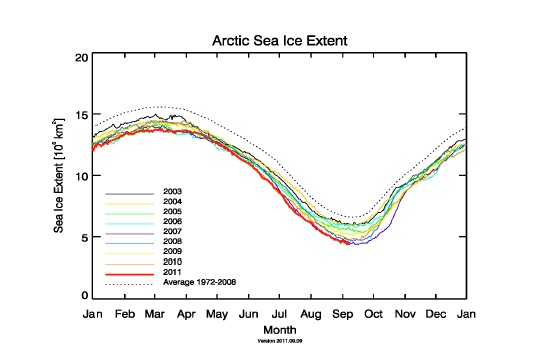
Just days before Sunday’s commemoration of the attacks, German scientists pointed to yet another smoking gun of climate change: the Arctic sea ice reached a new historic minimum ice extent.

The rapidity with which the planet is losing its northern ice cap continues to astonish experts. The defrosting northern pole is one of the prime drivers of Earth’s climate system and is changing global weather patterns in unpredictable ways.

The Arctic ice melt is also accelerating the rate of climate change beyond what humanity is doing with every barrel of oil, tonne of coal or cubic metre of gas burned.

On Sep. 8, researchers at the University of Bremen in Germany reported that the Arctic ice melt bettered the previous minimum of 2007. Other research centres using different satellite and analysis tools say the extraordinary decline of ice in 2007 has not yet been exceeded this year and 2011 remains a close second.

Sea Ice Extent 2003-2011

“We think it will end up a little bit short of the record – not that it really matters,” said Mark Serreze, director of the National Snow and Ice Data Center in the U.S. city of Boulder, Colorado.

“What is extraordinary this year is that there was no weird weather pattern that created the perfect conditions for the record melt in 2007,” Serreze told IPS.

This independent environmental journalism depends on public support. Click here learn more.

This year, the summer weather was normal and yet it the ice vanished in similar amounts to 2007.

“That tells us the sea ice is too thin now to hold up under normal weather conditions,” he said.

Continue reading