GW Dramatically Rearranging Arctic Landscape

By Stephen Leahy


Credit:micropolisnews

A lone glacier drifts in the Canadian Arctic, Aug. 14, 2007.

Oct 4 (IPS) – The hot breath of global warming has now touched some of the coldest northern regions of world, turning the frozen landscape into mush as temperatures soar 15 degrees C. above normal.

Entire hillsides, sometimes more than a kilometre long, simply let go and slid like a vast green carpet into valleys and rivers on Melville Island in Canada’s northwest Arctic region of Nunavut this summer, says Scott Lamoureux of Queens University in Canada and leader of one the of International Polar Year projects.

“The entire landscape is on the move, it was very difficult to find any slopes that were unaltered,” said Lamoureux, who led a scientific expedition to the remote and uninhabited island. Continue reading
Greenland Ice Collapse Producing Earthquakes

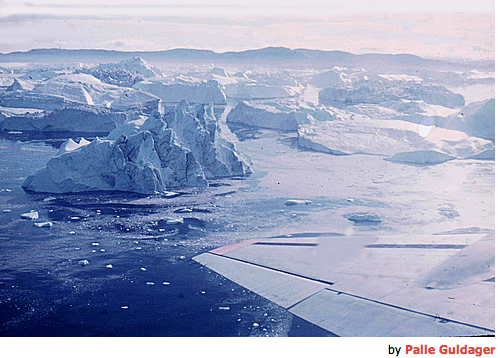
isfjorden-ved-jakobshavn-ilulissat.pngChilling from-the-scene update on my Greenland on Verge of Meltdown article in August: the Greenland ice cap is melting so quickly that it is triggering earthquakes as pieces of ice several cubic kilometres in size break off says Guardian reporter in Greenland.

UPDATE:
Here is a satellite view of Lulissat, Vestgronland Greenland just pan and zoom to the upper glacier to see the meltwater on the ice (not sure when this satellite pic was taken)
View Larger Map

Related stories:

The Earth is Going Dark Scientists Say
US Generals Say Warming Poses Major Security Threat

Climate Panel Report Called Too Conservative

Steve’s Hurricane Handbook 2007

hurri-handbk.png One year before Katrina devastated New Orleans and the Gulf Coast, scientists feared global warming was going to make hurricanes more powerful.

Five Little-Known Facts:

  1. “These are not natural disasters, they are environmental disasters.”
  2. NOAA study found that Katrina was only a Category 1 or perhaps 2 on landfall
  3. Storms in the NorthWest Pacific Ocean are 75 percent more powerful than they were 30 years ago
  4. Climate change has the potential to raise oceans temperatures high enough create future hypercanes — 600 kilometre per hour superstorms
  5. “The U.S. has a very big societal problem when it comes to coping with hurricanes” (ok, maybe you knew that)

This is a sampling of the little known information about hurricanes from respected scientists collected in the modestly titled “Steve’s Hurricane Handbook 2007 – Lessons Learned 2004-2006? “ (1.2 mb pdf). It’s a compendium of the most interesting quotes and facts about hurricanes from hurricane experts since 2004. Continue reading

Atlantic Bluefin Tuna Going Way of Northern Cod

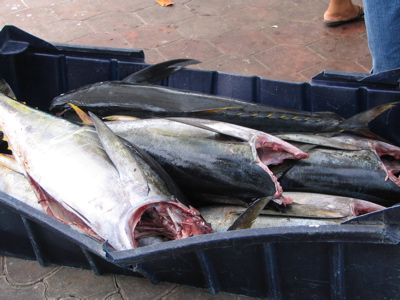
tuna-hall-sml.jpgAtlantic Bluefin Tuna Going Way of Northern Cod
By Stephen Leahy

Aug 6 (IPS) – Fishing wiped out Atlantic Bluefin tuna stocks in Northern Europe 50 years ago, according to a new study, while ongoing pressure on the remaining stocks is pushing the entire species to the edge of extinction.

Every summer in the early 1900s, Northern European waters from Holland to northern Norway teemed with Atlantic Bluefin tuna, some three metres long and weighing 700 kilogrammes, according to historical fishing records. Few could catch the powerful, fast-swimming fish until the 1930s and 1940s when bigger, faster boats with better catch gear were designed.

“The Bluefin population crashed in the 1960s and more than 40 years later it still hasn’t recovered,” said Brian MacKenzie of the Technical University of Denmark, who led the study to be published in the journal Fisheries Research.yellow-fin-tua-galapagos.jpg

“You simply don’t see bluefins in these waters any more,” MacKenzie told IPS.

There is a clear parallel to the more recent collapse of once abundant Northern Cod stocks. Also fished into near extinction on the other side of the Atlantic, the Cod have not recovered despite a no-fishing ban for the past 15 years.

“I’m afraid what happened to the Bluefin is similar to what happened to the Northern Cod,” he said.

Continue reading

Who Owns the Arctic?

arctic-oil-rig-on-ice.pngWith Russia planting its flag 14,000 feet under the North Pole yesterday, oil and gas exploration and conflict over territorial rights in the vast Arctic ocean basin is just beginning.

“The Arctic is one of the last frontiers, representing about 25 percent of the last unexplored potential oil and gas reserves in the world,” says Michael Byers, Canada research chair in Global Politics and International Law at the University of British Columbia

Sovereignty Claims Revived in the Arctic
By Stephen Leahy

(Originally published in 2006)

TORONTO, Apr 22 (Tierramérica) – An expedition is under way to help Canada and Denmark prove their sovereignty over certain areas of this frozen region, and its potential sources of petroleum and natural gas.

Canada and Denmark launched a joint expedition in early April to map the floor of the Arctic Ocean and help the two countries prove their claims of sovereignty over areas potentially rich in petroleum and natural gas.

Continue reading

Drowning Country: Tuvalu Symbol of Catastrophe and Hope

Tiny Tuvalu Fights for Its Literal Survival
By Stephen Leahy


Credit:NASA

Funafuti atoll seen from 125 miles above the Eart

VIENNA, Jul 27 (IPS/IFEJ) – The second smallest nation on Earth hopes to turn itself into an example of sustainable development that others can emulate.

But the South Pacific island nation of Tuvalu and its 10,500 people may only have 50 years or less to set that example before it is swept away by rising sea levels due to climate change.

“Construction of the first ever biogas digestor on a coral island is complete,” said Gilliane Le Gallic, president of Alofa Tuvalu, a Paris-based group that is working with the local Tuvaluan government.

Located on a small islet near Tuvalu’s capital of Funafuti, the biogas digester uses manure from about 60 pigs to produce gas for cooking stoves. More importantly, more than 40 Tuvaluans have been trained at the newly opened Tuvalu National Training Centre on renewable energy.

“We are trying to create simple, workable models of sustainable development that can be reproduced by others elsewhere,” Le Gallic, a documentary filmmaker, told IPS from Paris.

Continue reading

Carbon Project Endangers the Galápagos

img_0235.jpg


By Stephen Leahy

A company is preparing to enrich seawater with iron in order to promote phytoplankton growth and the absorption of carbon from the atmosphere near the environmentally-protected Galápagos Islands.

PUERTO AYORA, Galápagos, Ecuador, Jul 9 ’07 (Tierramérica).- Later this month a U.S. company, Planktos Inc., plans to dump 100 tons of iron dust into the ocean near Ecuador’s Galápagos Islands, despite opposition from environmental groups and marine scientists.This will be the first-ever commercial effort to reduce carbon dioxide in the atmosphere, one of the main gases blamed for climate change, by using iron particles to create a 10,000-square-kilometer “plankton bloom”.

Planktos says the extra volume of these small, floating organisms will absorb large amounts of CO2 from the atmosphere and take it deep into the sea. And this method may be the fastest and most powerful tool to battle climate change.

img_0508.jpg

“The currents will likely bring the bloom into the [Galápagos] Marine Reserve,” covering 133,000 sq. km, the world’s third largest marine reserve, says Washington Tapia, director of the Galápagos National Park, which includes the reserve. Continue reading

Aliens of the Deep Seas

350 Degrees Is Bathwater to These Animals
By Stephen Leahy


Credit:NASA

Hydrothermal vent


PUERTO AYORA, Galapagos Islands, Ecuador , Jul 5 (IPS) – Marine scientists returned to the Galapagos Islands this week to celebrate a discovery that Charles Darwin never dreamt of: bizarre animals that live in total darkness around active deep-sea volcanoes.

Thirty years ago, researchers found the first chimney spewing super-hot water — called a hydrothermal vent — 2,500 metres below the surface on the sea floor, with its own thriving  animal community. That life could prosper without sunlight or photosynthesis changed forever the very definition of what constitutes “life” on the Earth. And it opened a new window on the possibilities of life elsewhere in the universe.

After all, if a tiny shrimp can live in total darkness, under tonnes of pressure in a toxic chemical soup boiling away at 350 degrees C, why could not life take hold on some distant planetoid where conditions might not be so harsh?
Continue reading

The Earth is Going Dark Scientists Say

From Big Melt to Big Swamp
By Stephen Leahy


Credit:Mette M.

Spitsbergen glacier in Norway, Arctic Ocean

Jun 5 (IPS) – The Earth is going dark. From the Arctic Ocean to the Himalayan mountains to the Russian tundra, ice and snow are in rapid and permanent retreat in response to global warming, a new U.N. report said Tuesday.

Glaciers, ice sheets, sea and river ice are all melting. The areas in the northern hemisphere covered by snow and ice have declined 1.3 percent per decade for the past four decades. And that’s expected to accelerate dramatically in the coming years.

“Around the Earth, white is being replaced by dark,” said Gunnar Sander of the Norwegian Polar Institute in Tromso, Norway.

The white — snow and ice — reflect sunlight while the dark — bare ground and open water — absorb the heat from sunlight, increasing the pace of global warming.

“This is affecting the heat balance of the planet,” Sander told IPS.

Continue reading

Overfishing Sharks Leading to Ecological Collapse

As Sharks Vanish, Chaotic New Order EmergesWhite Shark courtesy of TOPP
By Stephen Leahy

Mar 29 (IPS) – Major declines in large sharks along the U.S. coast have in turn triggered declines in shellfish and reduced water quality, proof that the ocean’s food web is collapsing, a groundbreaking new study reveals.

With the virtual elimination of large sharks along the U.S. east coast, such as black tip and tiger sharks, the species they used to eat — small sharks, rays and skates – have boomed in numbers. Cownose ray populations increased 20-fold since 1970 and as a direct consequence, shellfish like scallops that the cownose ray eats have been nearly wiped out despite major conservation efforts.

The cascade of impacts resulting from overfishing large sharks goes further still, marine scientist Ransom Myers and coauthors document in a paper published Thursday in Science. The loss of scallops has reduced water quality because scallops and other shellfish filtre sea water. And the cownose ray is now feeding voraciously on other shellfish, like oysters and clams.
Continue reading