Final Update: COP 16 Cancun Climate Conference

19 Dec 2010

On reflection there was some progress at COP 16. Small island states, whose very existence is threatened, were satisfied the world is on its way to a significant climate treaty so that is something. Last year in Copenhagen, hardly anyone happy with the outcome. There is still a long and difficult road ahead. Not least because there remains a powerful and well-funded opposition to emission reductions in many countries.

In 2011 I hope to uncover more about that opposition while continuing to write about how the physical processes of climate change are not waiting for us to get our act together. Substantial changes are already underway. Changes to the global water cycle have been shown in the first global study of evapotranspiration rates as detailed in my article: “Climate Changes Herald a Future of Widespread Drought – Water Left High and Dry in Climate Talks”

The article also looks at some fairly dire drought projections for the coming decades.

For those experiencing a rough, early winter, I did the first article revealing how the melting Arctic may be bringing earlier and harsher winters to the UK, parts of Europe and North America. That story happened because of donations to help cover my costs of attending a polar science conference in Oslo were those new findings were presented. Science journalism isn’t easy or cheap to do. I was one of  few journalists in Oslo because hardly any media outlet covers travel costs any more – never mind paying a decent fee for a story. That’s why I am trying Community Supported Journalism where people support my efforts to inform people about the great issues of our time.

A warm thank you to those who sponsored some of the Cancun articles, contributing some much needed cash to help cover my costs.  Supporters names are prominently listed in the articles here. I can no longer continue to do environmental and science journalism without your help so thank you for helping out.

— Stephen

Just click the button to go to the PayPal Secure Donation* page & enter your sponsorship amount (fully secure, major Credit Cards accepted)

Your one-time or monthly contributions are vital for Community Supported Environmental Journalism (click for more info)

*More than 100,000 non-profits safely use PayPal Donate service

Climate Changes Herald a Future of Widespread Drought – Water Left High and Dry in Climate Talks

Serious droughts expected in large parts of the world in coming decades

By Stephen Leahy

CANCÚN, Dec 8, 2010 (IPS/TerraViva)

As the world heats up, continents are drying up, with severe droughts forecast in the future. But negotiators at the climate summit here seem to have forgotten about water in their endless discussions over forests, carbon trading and finances.

“The main impact of climate change is on the planet’s water cycle,” said Henk van Schaik of the Cooperative Programme on Water and Climate, a foundation based in the Netherlands.

“Climate-driven changes in the water cycle will affect large regions of the world,” van Schaik told TerraViva at a side event meeting here at COP 16 in Cancún .

The impact of climate on the world’s water resources is not addressed within the U.N. climate framework, said Anders Berntell of the Stockholm International Water Institute.

“Negotiators here see it as just another sector of the economy but it is a basic element for life. Water is the bloodstream of our planet,” Berntell said.

This article was made possible thanks to contributions from Hugh & Jo-Ann Roberston, Kevin Toner, Michael Sweatman, Ann Wakelin, Lynn Carey, Leif Knutsen, Nan Nolan, Chris Conrad, Godo Stoyke.

[Due to the high costs of covering such important events, support is needed from readers like you.Please consider making a small automatic monthly contribution as a fair exchange for these articles – for more information.] Continue reading

Will Year of Climate Extremes End Without Progress on Tackling Climate Change?

By Stephen Leahy*

CANCÚN, Mexico, Nov 29, 2010 (IPS/TerraViva)

This year will likely be the warmest ever recorded, with soaring ocean temperatures resulting in a near record die-off of tropical corals, extreme heat and drought in Russia and massive flooding in Pakistan – all signs that climate change has taken hold.

But despite the ever more compelling science regarding the urgency and risks of climate change and growing public support for action, representatives from nearly 200 countries meeting here in Cancún for the next two weeks are unlikely to produce a new binding agreement.

At best, matters such as forestry, climate finance and mitigation commitments will be further developed in the faint hope that the next big meeting in South Africa might produce some kind of deal.

“Carbon emissions continue to climb despite the economic recession and yet I have never seen such low expectations for a COP (Conference of the Parties),” said Richard Somerville, an eminent climate scientist at the Scripps Institution of Oceanography in California.

“The science is quite compelling regarding the need for urgent action. We don’t have another five years to reach an agreement,” Somerville told TerraViva.

In 2009, Somerville and others co-authored an update on the latest climate science called ‘The Copenhagen Diagnosis’ which concluded that global carbon emissions had to peak and begin to decline before 2020 to have any hope of keeping global warming to less than 2.0 degrees C.

However, the negotiators in Cancún will mostly not be acting on the science but on their national interests as directed by their political leadership, who largely do not understand climate change, he said.

“Developed countries think they can adapt to warmer temperatures. I don’t see how we can keep warming below 2.0 degrees C.,” Somerville said.
Continue reading

Watch This Video Before You Buy Any New Electronic Stuff


Consumption — buying so much stuff — is one things we have to do differently in 21st century. see Rising Wealth Spells Disaster for the Planet, Study Finds

Electronic gadgets, toys, TVs. phones, computers, IPods and so on are made of toxic and sometimes rare materials. There is lack of proper recycling programs as I have documented in several articles below. But there is an absolutely brilliant new video on all this from the Story of Stuff folks. This is best introduction to the real costs and consequences of the fact that most our electronics stuff  are actually “designed for the dump”  — Stephen.

Tsunami of E-Waste Could Swamp Developing Countries

Is Your Old TV Poisoning a Child in China? Where Your e-waste Goes

30 Million Lead-laden TVs Dumped on Poor Countries

Do consider making a small automatic monthly contribution as a fair exchange for these articles.

A Reporter’s Diary: EXCLUSIVE COVERAGE OF UN CONVENTION ON BIOLOGICAL DIVERSITY FROM NAGOYA, JAPAN

NOTE: The following are excerpts from my personal notes to friends and supporters written during the heat, confusion and massive information dump of a major international conference. Often written late at night I attempted to offer some personal perspective into what was going on and what I was up to. — Stephen

Tuesday, 19 Oct – Geopolitical obstacles getting in the way

I’m here at the big UN conference on biodiversity. It’s 430 am here, the first day ended about 9 pm. It’s 12-ring cat circus like the Copenhagen climate meeting but the mood here is more positive. There are similar geopolitical obstacles getting in the way of slowing the loss of species and ecosystems. Another major difference is the lack of little public awareness of the fact that we cannot continue to shred nature’s web of life without suffering dire consequences.

I’ll try and do my bit – write 10 -12 articles over next two weeks. I wanted to thank a couple of supporters who helped out to cover some of the travel costs. I want to keep you informed of what’s going on here but these notes take a couple of hours to do.

This week is a story about an important development in Africa: In sincere efforts to make one last major attempt to transform Africa’s poverty and hunger are we imposing our worldview on Africa yet again? Bill Gates and others are donating hundreds of millions to create a New Green Revolution for Africa. This difficult and controversial story took over a week to do and wrote the final draft during my 17 hr flight here.

My other story connects the dots between extreme weather this summer and climate change. No single storm is directly attributable to CC BUT without CC it is unlikely the Russian heat wave and floods in Pakistan would have occurred. (PS those were events were two sides of the same coin)

Finally I received a number of letters, mostly positive but a couple saying I was too negative in last week’s article ‘Don’t Worry Be Happy’ Canada Sees Global Warming “Prosperity” Instead of Calamity’. Any organization that puts out a chart of climate impacts at 4 – 5C of global warming and fails to mention the scale of the calamity that would result is delusional or deceptive. Some take the stunningly selfish and naive view we can ‘adapt’ by turning up the AC.

Do consider making a small automatic monthly contribution as a fair exchange for these articles.

Greenest wishes, Steve


Wednesday, 20 Oct – Diversity R Us

There is an astonishing diversity of people here. Last nite I talked to an Amazonian Indian who took 10 days to get here, had wine accidentally spilled on me by a reindeer herder from Finland and found the lost passport of a Brazilian diplomat. And that is a five minute snap shot. It is a very big world with so many different people it is incredible they have all come here to try and address a common issue. That they can’t agree on what kinds of actions and how to implement should not come as a surprise.

Sunday, 24 Oct – Canada won’t play nice (yet again)

Canada is blocking agreement on a key measure to get a new international agreement to protect biodiversity here. This is not new. In recent years Canada has gone out its way to snub international UN agreements including the outright refusal to fulfill its legal obligations under the Kyoto Protocol. Hard to believe the same government lobbied hard for a seat on the UN security council and actually expected to be rewarded.

Sadly there is no one reporting for Canadian publications to document the irony. (And as a result Canadian’s aren’t really aware of what their government is up to.) Continue reading

An Awakening to the Unravelling of the Web Life – Will Action Follow?

Youth Demand Need a Voice.  Halting Biodiversity Decline Impossible Without Economic Transformation

Analysis by Stephen Leahy 

NAGOYA, Japan, Nov 1, 2010 (IPS)

The international community has finally awoken to the other great trans-boundary challenge of our time, with a new international agreement to halt the unravelling of the web of life that sustains humanity.

The new agreement by 193 nations that are part of the U.N. Convention on Biological Diversity includes a commitment to reduce the rate of species loss by half by 2020, as well as the historic Nagoya Protocol on access and benefit sharing of genetic resources.

This awakening only applies to the few early risers. The vast majority remain asleep, unaware of our utter dependence on the living things that are the one and only source of oxygen, water, food and fuel. And unaware that nature is our reality while the economy is simply a complicated game we created.

Japan imports more than 60 percent of its food and most of Europe’s ecosystems have been trashed, with only 17 percent in reasonable shape, according to a first-ever assessment. The only reason those countries haven’t collapsed is they are rich enough to help themselves to nature’s ecological resources and services like food, timber, materials from the rest of the world.

Put a glass lid over Japan, Germany or England and they wouldn’t last long.

“We exploited the biological resources abroad, especially in the South. This is why we, the people of Aichi, Nagoya, must apologise…for the deterioration of the ecosystems and biodiversity we have caused,” says a public appeal by civil society from Nagoya, the host city of the U.N. Convention on Biological Diversity (CBD) for the last two weeks of October.

The Japanese government wanted no part of this apology, says Kinhide Mushakoji, one of the organisers and a professor at the Osaka University of Economics and Law. The appeal was signed by 156 organisations in Japan.
Continue reading

Biodiversity Pact Signed To Halt Species Extinctions and Protect the Web of Life

By Stephen Leahy*

NAGOYA, Japan, Oct 31, 2010 (Tierramérica)

The delegates to the 10th Conference of Parties (COP 10) to the Convention on Biological Diversity ended up with a relatively weak plan for the Herculean task of halting the disappearance of species. The exception was a pact on the use of genetic resources.

Delegates from 193 countries agreed to put under protection 17 percent of land and 10 percent of oceans by 2020 to stop the loss of plant and animal diversity in their ecosystems.

Currently less than 10 percent of land and less than one percent of the oceans are protected. Previous targets had been 25 and 15 percent, respectively

But among the items agreed was the “Nagoya Protocol on Access to Genetic Resources and the Fair and Equitable Sharing of Benefits Arising from Their Utilisation,” the most notable achievement of COP 10 — which had been in negotiations for 18 years.

The Nagoya Protocol establishes mechanisms for making use of the genetic material in plants, animals and microbes for food, medicines, industrial products, cosmetics and other applications.

Is this article of interest? It exists thanks to contributions from readers. Please click here to learn more about Community Supported Journalism.

Continue reading

Runaway Global Economy Decimating Nature — World Bank Offers A Solution

By Stephen Leahy

NAGOYA, Japan, Oct 28, 2010 (IPS)

One-fifth of all birds, fish and animals are threatened with extinction – as many as six million unique and irreplaceable forms of life – an authoritative new assessment warned Wednesday.

Deforestation, agricultural expansion, overfishing, invasive alien species and climate change are the specific causes, but the main engine of destruction is an economic system that is blind to the reality that there is no economy or human well-being without nature, experts here say.

“Without global conservation efforts the situation would be massively worse,” noted Simon Stuart, chair of the International Union for Conservation of Nature (IUCN) Species Survival Commission, which launched the study at the 10th Conference of the Parties to the Convention on Biological Diversity (CBD) in Nagoya, Japan.

Published in the peer-reviewed journal Science, it is the most comprehensive assessment ever done of the world’s vertebrates – mammals, birds, amphibians, reptiles and fishes – Stuart said.

Every year, 52 species of mammals, birds and amphibians move one step down a three-step path to extinction, according to the study, which utilised data for 25,000 species from the IUCN Red List of Threatened Species.

Southeast Asia has experienced the most dramatic recent losses, largely driven by the planting of export crops like oil palm, commercial hardwood timber operations, agricultural conversion to rice paddies and unsustainable hunting, the study found. Parts of Central America, the tropical Andes of South America, and even Australia have also all experienced marked losses, in particular due to the impact of the deadly chytrid fungus on amphibians.

“The backbone of biodiversity is being eroded,” said the eminent U.S. ecologist and writer Edward O. Wilson of Harvard University.

Is this article of interest? It exists thanks to contributions from readers. Please click here to learn more about Community Supported Journalism.

Continue reading

Geoengineering on a Desperate Planet — UN Declares Global Moratorium

By Stephen Leahy

NAGOYA, Japan, Oct 25, 2010 (Tierramérica)

[Update 30 October 2 am. Global moratorium passes.]

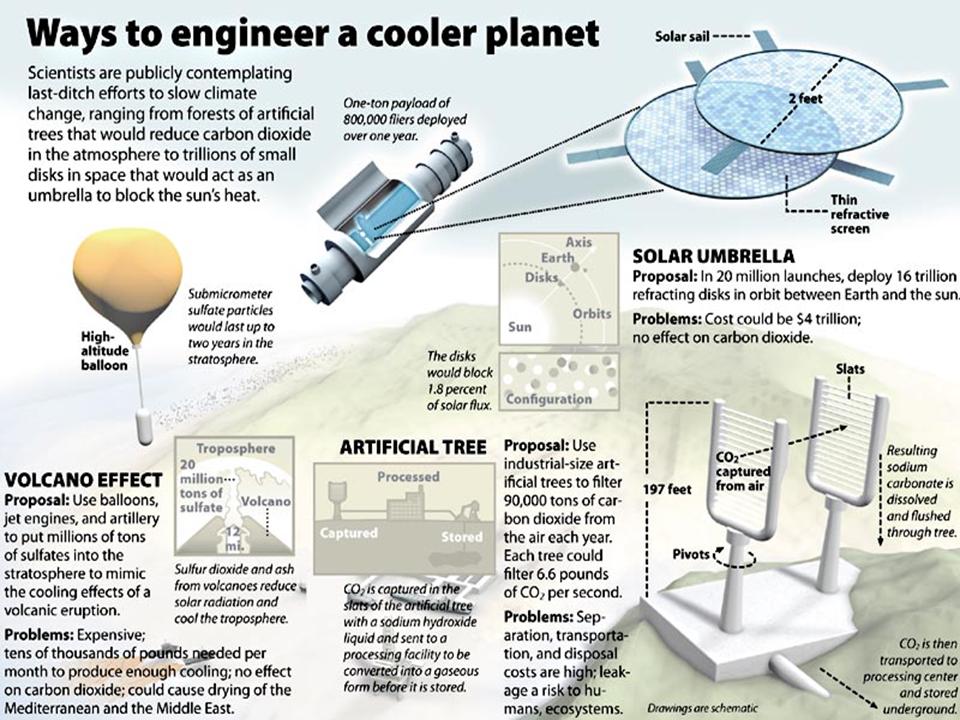
Delegates to the world summit on biodiversity here are calling for a moratorium on climate engineering research, like the idea of putting huge mirrors in outer space to reflect some of the sun’s heating rays away from the planet.

Climate engineering or geoengineering refers to any large-scale, human- made effort to manipulate the planet to adapt to climate change.

Representatives from Africa and Asia expressed concern about the negative impacts of geoengineering during the opening week of the 10th Conference of Parties (COP 10) to the United Nations Convention on Biological Diversity (CBD), Oct. 18-29. They were joined by civil society organisations in calling for a moratorium on geoengineering experiments.

The geoengineering proposals include installing giant vertical pipes in the ocean to bring cold water to the surface, pumping vast amounts of sulphates into the stratosphere to block sunlight, or blowing ocean salt spray into clouds to increase their reflectivity.

The geoengineering proposals include installing giant vertical pipes in the ocean to bring cold water to the surface, pumping vast amounts of sulphates into the stratosphere to block sunlight, or blowing ocean salt spray into clouds to increase their reflectivity.

Broadly speaking, there are two main geoengineering approaches: solar radiation management and carbon sequestration, in other words, absorbing carbon dioxide from the atmosphere to reduce the concentration of this greenhouse-effect gas.

Is this article of interest? It exists thanks to contributions from readers. Please click here to learn more about Community Supported Journalism.

To manage the sun’s rays, there are ideas like releasing sulphates into the atmosphere or placing giant mirrors in outer space. For absorbing carbon, the possible approaches include ocean fertilisation, in which iron or nitrogen is added to seawater to stimulate the growth of phytoplankton to sequester the carbon deep in the ocean.

“Some of the proponents of these technologies think it’s easier to ‘manage the sun’ than get people to take a bus” to reduce carbon in the atmosphere, said Pat Mooney, executive director of the ETC Group, an international environmental organisation headquartered in Canada. [etc “Geopiracy” report]

“Politicians in rich countries see geoengineering as ‘Plan B’ so they don’t have to make the hard choices of reducing emissions causing climate change,” Mooney told Tierramérica.

Continue reading

Palau Announces Massive Marine Sanctuary to Protect Whales, Dolphins, Sharks

By Stephen Leahy

NAGOYA, Japan, Oct 25, 2010 (IPS)

One of Japan’s closest allies declared over the weekend that all of its oceans – more than 600,000 square kilometres – would be a sanctuary for whales, dolphins, dugongs, sharks and other species.

“There will be no hunting or harassment of marine mammals and other species in our waters,” said the Honourable Harry Fritz, minister of the environment, natural resources and tourism of the Republic of Palau.

“We urge other nations to join our efforts to protect whales, dolphins and other marine animals,” Fritz said at a press conference during Oceans Day at the meeting of the Conference of the Parties to the Convention on Biological Diversity in Nagoya, Japan.

Japan has long sought to overturn the global ban on commercial whaling and has actively solicited and received Palau’s support for many years. Japan is its second largest source of development aid after the United States. Japanese tourists frequent the islands since many people speak some Japanese.

“Palau now supports conserving marine mammals, along with sharks and other species,” said Susan Lieberman, director of international policy for the Pew Environment Group, a large U.S. NGO.

“This is a very significant announcement,” Lieberman told IPS.

Is this article of interest? It exists thanks to contributions from readers. Please click here to learn more about Community Supported Journalism. Continue reading