Food Crisis Needs this New Vision for Agriculture

By Stephen Leahy


JOHANNESBURG, Apr 15 (IPS) – The results of a painstaking examination of global agriculture are being formally presented Tuesday with the release of the final report for the International Assessment of Agricultural Science and Technology for Development (IAASTD).

The assessment has explored how agriculture can be reinvented to feed the world’s expanding population sustainably in an era of multiple challenges — not least those presented by climate change and a growing food crisis that has led to outbreaks of violence in a number of developing countries.

The expertise of some 400 scientists and other specialists was tapped for the IAASTD; governments of wealthy and developing nations also contributed to the assessment, along with civil society and the private sector. Continue reading

CLIMATE CHANGE: A Vision Worth Fighting For

By Stephen Leahy*

BROOKLIN, Canada, Apr 3 (IPS) – Sweeping societal change is a slow and erratic business. The civil rights movement in the United States went nowhere for decades and then exploded in the 1960s. Not long ago, smokers could light up anywhere they pleased in Canada and the U.S. Now they are mostly confined to a few outdoor areas and as a consequence, far fewer people smoke.

“There’s been a major shift in values regarding smoking,” said Anthony Leiserowitz, director of the Yale Project on Climate Change at Yale University.

Anti-smoking laws, higher taxes, and knowledge about the health impacts of second-hand smoke were all factors driving the shift, Leiserowitz told IPS.

While most people are concerned about climate change, they view it as a largely abstract problem, and fail to equate it with devastating weather events such as Hurricane Katrina in August 2005, he said.

[ *This story is part three of a four-part examination of the psychological and behavioural changes needed to dial down the temperature on our global greenhouse. Part one: Climate Change Reshaping Civilization Part two: Climate River in Full Flood Part four: CLIMATE CHANGE: A Game With Too Many Free Riders ]

However, that might be changing. Australians suffering record droughts made more intense by climate change elected a new prime minister in 2007 in part because the incumbent refused to act on carbon dioxide emissions.

“Arguably, John Howard (the former prime minister) was the first national leader to lose their job over climate,” Leiserowitz said. Continue reading

Ending The Oil Addiction: Galápagos Islands

img_0501.jpg

By Stephen Leahy*

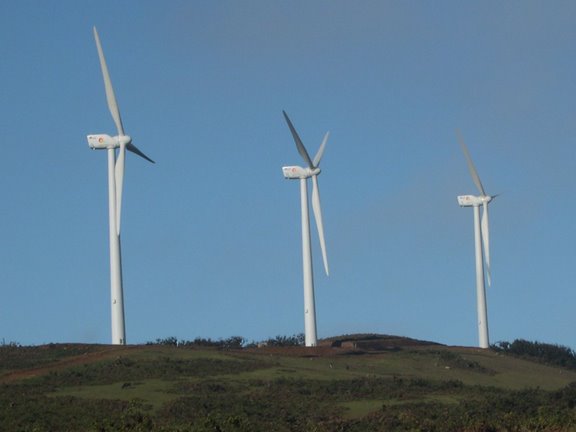
TORONTO, Feb 29 (Tierramérica) – Ecuador has taken the first step towards ending the oil dependence of its Galápagos Islands, in the eastern Pacific Ocean, with the official opening of a 10.8 million dollar wind energy facility on the island of San Cristóbal.

Ecuador’s President Rafael Correa toured the facility as part of a celebration of the 500th anniversary of the discovery of the Galápagos, and proposed to declare the islands fossil fuel free by 2015.

Located 1,000 kilometres off the coast of Ecuador, the archipelago comprises 17 small and 13 large islands that are home to 30,000 people and visited by more than 120,000 tourists each year.

Nearly everything is imported from the mainland, including vast quantities of diesel fuel for energy and transport. In 2001, a tanker ship struck a reef off the coast of San Cristóbal, one of the main islands, spilling 150,000 gallons of fuel into the ocean. Continue reading

Protecting Canada’s Water from the US

07102005-dry-mud-fish-manaquiri-amazonas-state-greenpeace.jpg

Under the North American Free Trade Agreement (NAFTA), Canada lost control over its energy resources. Now, with “NAFTA-plus”, Canada could also lose control over its freshwater resources, say experts in this Sept 2007 article CANADA: Losing Control of Water Through NAFTA and SPP

Now the Canadian Water Issues Council (CWIC) has written a model law to protect Canadian waters.

“There is a growing risk that North Americans may commit the ultimate ecological error by beginning to move large amounts of water over long distances, resulting in massive economic losses and ecosystem collapse in many donor regions,” says Ralph Pentland, CWIC’s Acting Chairman.

“The model legislation, drafted by the Council, addresses the need for a national approach to protecting this vital resource.”

See webcast of panel discussion on this and what it may take to turn this into real law.

Fidel Castro Endorses “Plan B” To Save Civilization

castro.pngFidel Castro, yes El Presidente Fidel Castro of Cuba, writes in an Jan 31st article posted in English by the Cuban News Agency about a recent visit with Brazilian President Lula:

I talked to him, of course, about the climate change, and the little attention paid by a great number of leaders of the industrialized world to this issue.

When I spoke with him on January 15 in the afternoon, I could not make reference to the article that would be published only three days later, written by Stephen Leahy from Toronto. This article announces a new book by Lester Brown called Mobilizing to Save Civilization. “

Castro goes on to quote extensively — with a few translation errors — from my IPS article: How to Halt Collapse of Civilization – new bk.

Who knew that Castro was deeply concerned about climate change? And he aptly summarizes the complete absence of discussion about climate change during the US Presidential primaries. Sure the economy may be in trouble, but there is no economy without a stable climate system.
See also: Plan B 3.0: Mobilising to Save Civilisation

Organic Cure for Brain-damaging Pesticides Found in US Children

organic-banana-box.jpg

Children eating a normal diet have low levels of organophosphates — the family of pesticides spawned by the creation of nerve gas agents in World War II — according to a recent research says the Seattle Post-Intelligencer.

But once they switched to eating only organic foods these pesticides disappeared within 36 hours from the kids’ bodies.

Malathion and chlorpyrifos were the principal chemicals Emory University’s School of Public Health study found. Death or serious health problems have been documented in thousands of cases with high-level exposures. But impacts at low levels have been more difficult to determine. Animal studies do show chronic dietary exposure to chlorpyrifos results in neurological impairment i.e. brain and nervous system affects.

bio-fruit-counter-austria.jpgThe P-I article also details what foods have highest levels pesticides.

I wrote a detailed article about an earlier study by Emory U: Overweight? Hungry? Blame “Hollow Food”

Other related stories about organic foods/agriculture:

Food Additives Make Kids Hyperactive – Organic Better?

Organic Agriculture Reduces Climate Change, Poverty and Hunger

Organic Provides 3X More Food Per Acre in Poor Countries – podcast

Biofuels: Another Good Reason to Hate American Policy

biofuel-gsi-rpt-1.png

By Stephen Leahy

Jan 25 (IPS) – U.S. biofuels production is driving up food prices around the world, giving billions of poor people a very good reason to hate U.S. policy, say environmentalists.

“The U.S. has led the fight to stem global hunger, now we are creating hunger,” said Lester Brown, president of the Earth Policy Institute, an environmental think tank in Washington.

The booming U.S. ethanol industry is diverting enormous amounts food into fuel: 81 million tonnes of grain in 2007 and 114 million tonnes this year, equaling 28 percent of the entire U.S. grain harvest, Brown told IPS.

Previous eras of high grain prices were mainly the result of bad weather, but these price hikes are the result of government policy, he said.”Grain prices are at record or near-record highs and they will go higher,” he said. “We might be the first society in history to use public tax dollars to drive up its own food prices.” Continue reading

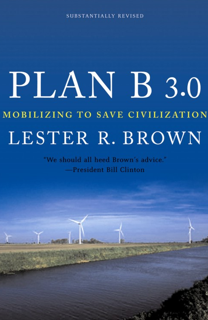
How to Halt Collapse of Civilization – new bk

plan-b-30-cover.png

By Stephen Leahy

Jan 17 (IPS) – Imagine it’s a glorious new era and everything you’ll do as part of your normal day helps to stabilise the climate and the global population, eradicate poverty, and restore the earth’s damaged ecosystems.

Sound unrealistic?

It better not be because that is what it will take to prevent the end of human society as we know it, according to a new book, “Plan B 3.0: Mobilising to Save Civilisation“.

The crisis we face is both dire and urgent, requiring a transformative effort like the mobilisation of nations during World War II, says author Lester Brown, president of the Earth Policy Institute, an environmental think tank in Washington. Continue reading

America’s Biofuel Gladiators

Turning food into biofuel pits the car owners of the world against the two billion poor who struggle to get enough to eat says Lester Brown of the World Policy Institute.

Who do you think is going to win?

“This will be seen as one of the great tragedies in history,” says Brown.

See previously published articles on biofuels/energy:
Ethanol: The Great Big Green Fraud — Government subsidies amount to $15 billion in 2007

Greenest Ethanol Still Unproven – Cellulosic ethanol is long way off and may not be a solution

Biofuels and Carbon Credits Behind Global Deforestation

ENERGY REVOLUTION NEEDED NOW – Efficiency improvement is fastest, cheapest and easiest

Oil Sands Projects Ignore Environment – New Report

syncrude-open-pit.jpg

Canada’s oil sand companies continue to pollute the air, water and landscape of a large portion of northern Alberta to supply America’s oil.

Canadian pollution regulations are far less stringent than the US and voluntary for the most part. Now a groundbreaking study by the Pembina Institute and the World Wildlife Fund, released Thursday, shows government reliance on industry to voluntarily do the right thing for the land, water and air of northern Alberta has failed.

For the complete story on the Oil Sands Project that supplies much of America’s oil see: Destroying Canada’s Boreal Forest for America’s Oil – 30-page eBook

See also:

Oil Sands Toxins Poison Food