Snow Cover Turning to Lakes in the Himalayas

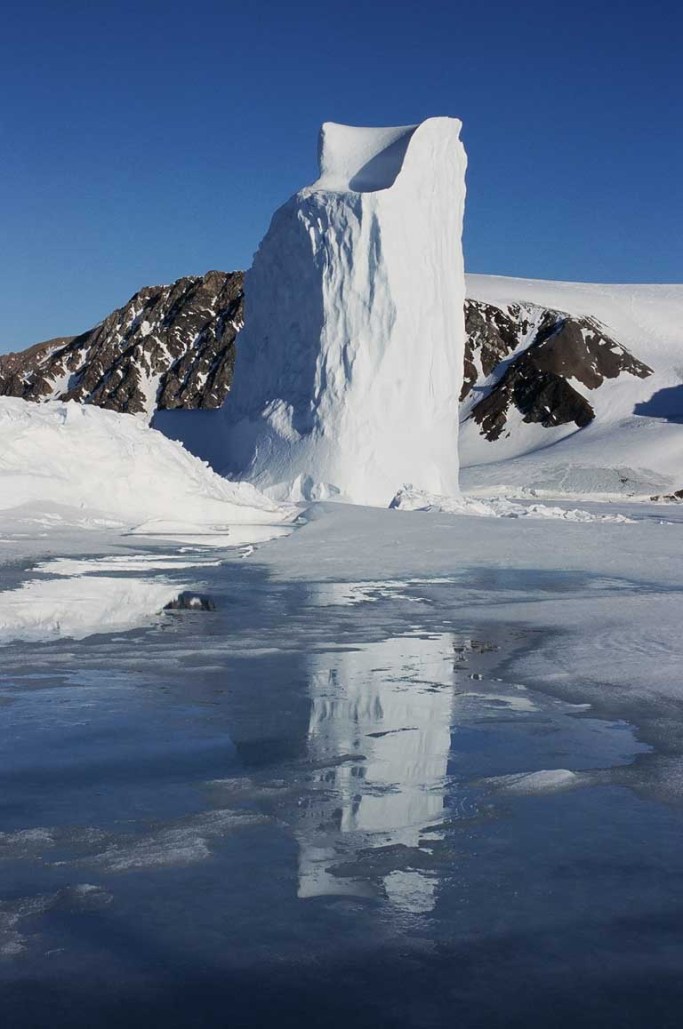
Iceberg in Glacier Strait, Nunavut, Canada, Image credit- Sandy Briggs.By Stephen Leahy

UXBRIDGE, Canada, May 7 (IPS) – As climate change takes hold, even the mighty Himalayas and Hindu Kush mountain ranges are now losing their snow and ice.

These are the world’s greatest repositories of snow and ice outside of the polar regions, and yet they may melt away in just 20 to 30 years, leaving more than a billion people desperately short of water, experts concluded in San Diego this week.

“There’s been a super-rapid decline in the glaciers of the region,” said Charles Kennel, senior strategist at the University of California San Diego Sustainability Solutions Institute and former director of Scripps Institution of Oceanography.

Kennel told IPS that nearly all of the 20,000 glaciers in the Himalaya-Hindu Kush mountain ranges are in retreat and the meltwater from some has created enormous lakes held back by rockslides that will inevitably burst, endangering anyone living in the valleys below. The World Wildlife Fund calculates there are 2,000 glacial lakes forming in Nepal and around 20 are in danger of bursting. Several have already flooded valleys in the past two decades in Nepal and Tibet.

“We are trying to make it known that the Himalayas are to the issue of the world’s water supply problem what the Amazon rain forest is to the issue of deforestation,” he said in reference to the “Ice, Snow, and Water” workshop convened at UC San Diego this week that included scientists from India, Nepal, Singapore and China. Continue reading
Ethanol and Biofuels: Almost Everything You Need to Know

“The U.S. has led the fight to stem global hunger, now we are creating hunger,” said Lester Brown, president of the Earth Policy Institute.

Series of the latest articles that provide almost everything you need to know about why ethanol and biofuels will not reduce global warming but simply drive up fuel and food costs.

maize - mexicoEthanol Worse Than Gasoline

Only Green Part of Most Biofuels is the Wealth (Subsidies) They Generate

Ethanol: The Great Big Green Fraud

International Enviro Standards Needed for Biofuels

Six Experts On Why Ethanol is a Dumb Idea

Food & Fuel: Can Sorghum Be The New Magic Bullet Biofuel??

Biofuels: Another Good Reason to Hate American Policy

(Cellulosic) Greenest Ethanol Still Unproven

Cell Phone Service, But No Toilets or Drinking Water for the Poor

By Stephen Leahy

[Why are there mobile phone networks and not sanitation networks?]

UXBRIDGE, Canada, Oct 20 (IPS) – It is a fact of the 21st century that some of the poorest regions of the world have good mobile phone coverage but no toilets or safe drinking water.

Simply installing toilets where needed and ensuring safe water supplies would do more to end crippling poverty and improve world health than any other possible measure, according to an analysis released Monday by the United Nations University (UNU).

“Water problems, caused largely by an appalling absence of adequate toilets in many places, contribute tremendously to some of the world’s most punishing problems, foremost among them the inter-related afflictions of poor health and chronic poverty,” said Zafar Adeel, director of the U.N. University’s Canadian-based International Network on Water, Environment and Health. Continue reading

Record Glacier Melt Down Leads to Drought

By Stephen Leahywinter-melt-gatineau.jpg

Mar 17 (IPS) – Glaciers, the world’s freshwater towers, continue their record-breaking meltdown, a new U.N. report shows.

The average rate of thinning and melting more than doubled between 2004 and 2006, reports the World Glacier Monitoring Service (WGMS), a centre based at the University of Zurich in Switzerland.

“The latest figures are part of what appears to be an accelerating trend with no apparent end in sight,” said Wilfried Haeberli, director of the WGMS.

The accelerated glacier meltdown is a clear indicator that climate change has taken hold and millions if not billions will be affected, warned Achim Steiner, executive director of the U.N. Environment Programme (UNEP).

Glaciers feed the rivers that people are completely dependent on — 360 million on the Ganges in India and 388 million on the Yangtze in China alone. Reduced water or irregular water flows will make it more difficult to grow crops in these regions and other parts of the world. Rapidly melting glaciers also produce floods and raise sea levels. On average, there is one metre water of fresh water in every 1.1 metres of glacier ice. Continue reading

Protecting Canada’s Water from the US

07102005-dry-mud-fish-manaquiri-amazonas-state-greenpeace.jpg

Under the North American Free Trade Agreement (NAFTA), Canada lost control over its energy resources. Now, with “NAFTA-plus”, Canada could also lose control over its freshwater resources, say experts in this Sept 2007 article CANADA: Losing Control of Water Through NAFTA and SPP

Now the Canadian Water Issues Council (CWIC) has written a model law to protect Canadian waters.

“There is a growing risk that North Americans may commit the ultimate ecological error by beginning to move large amounts of water over long distances, resulting in massive economic losses and ecosystem collapse in many donor regions,” says Ralph Pentland, CWIC’s Acting Chairman.

“The model legislation, drafted by the Council, addresses the need for a national approach to protecting this vital resource.”

See webcast of panel discussion on this and what it may take to turn this into real law.

Oil Sands Projects Ignore Environment – New Report

syncrude-open-pit.jpg

Canada’s oil sand companies continue to pollute the air, water and landscape of a large portion of northern Alberta to supply America’s oil.

Canadian pollution regulations are far less stringent than the US and voluntary for the most part. Now a groundbreaking study by the Pembina Institute and the World Wildlife Fund, released Thursday, shows government reliance on industry to voluntarily do the right thing for the land, water and air of northern Alberta has failed.

For the complete story on the Oil Sands Project that supplies much of America’s oil see: Destroying Canada’s Boreal Forest for America’s Oil – 30-page eBook

See also:

Oil Sands Toxins Poison Food

Ethanol: The Great Big Green Fraud

gsi-biofuel.jpg

Subsidising biofuels is just about the dumbest way to go.” – Todd Litman, director of the Victoria Transport Policy Institute — Subsidies for 2007 est $13-$15 billion

…increasing biofuel production is a “total disaster” for starving people Jean Ziegler, the United Nations Special Rapporteur on the Right to Food

By Stephen Leahy

Oct 20 2007 (IPS)

A raft of new studies reveal European and American multibillion dollar support for biofuels is unsustainable, environmentally destructive and much more about subsidising agri-business corporations than combating global warming.

Not only do most forms of biofuel production do little to reduce greenhouse gas emissions, growing biofuel crops uses up precious water resources, increasing the size and extent of dead zones in the oceans, boosting use of toxic pesticides and deforestation in tropical countries, such studies say.

And biofuel, powered by billions of dollars in government subsidies, will drive food prices 20-40 percent higher between now and 2020, predicts the Washington-based International Food Policy Research Institute.

“Fuel made from food is a dumb idea to put it succinctly,” says Ronald Steenblik, research director at the International Institute for Sustainable Development’s Global Subsidies Initiative (GSI) in Geneva, Switzerland.

Biofuel production in the U.S. and Europe is just another way of subsidising big agri-business corporations, Steenblik told IPS.

“It’s (biofuel) also a distraction from dealing with the real problem of reducing greenhouse gas emissions,” he asserts. Continue reading

CANADA: Losing Control of Water Through NAFTA and SPP

By Stephen Leahy

“The SPP (Security and Prosperity Partnership ) is like putting the monkeys in charge of the peanuts.”

[UPDATED Feb 12’08]

TORONTO, Sep 22 2007 (Tierramérica) – Under the North American Free Trade Agreement, Canada lost control over its energy resources. Now, with “NAFTA-plus”, it could also lose control over its freshwater resources, say experts.Canada’s water is on the trade negotiating table despite widespread public opposition and assurances by Canadian political leaders, said Adèle Hurley, director of the University of Toronto’s Programme on Water Issues at the Munk Centre for International Studies.A new report released Sep. 11 by the programme reveals that water transfers from Canada to the United States are emerging as an issue under the auspices of the Security and Prosperity Partnership (SPP). The SPP — sometimes called “NAFTA-plus” — is a forum set up in 2005 in Cancún, by the three partners, Canada, United States and Mexico.

Economic integration as envisioned by the powerful but little-known SPP is slowly changing the lives of Canadians, says Andrew Nikiforuk, author of the report “On the Table: Water Energy and North American Integration“.

The SPP is comprised of business leaders and government officials who work behind the scenes and are already responsible for changes to border security, easing of pesticide rules, harmonisation of pipeline regulations and plans to prepare for a potential avian flu outbreak, Nikiforuk writes.

“The SPP is run by corporate leaders; governments are irrelevant,” said Ralph Pentland, a water expert and acting chairman of the Canadian Water Issues Council.

UPDATE: The Canadian Water Issues Council has written a model law to protect Canadian waters. For more see: Protecting Canada’s Water from the US Continue reading