Trashing the Oceans: 3 to 6 X More Trash Than Plankton – ‘Using Oceans as Universal Sewer’ — Cousteau

This is a repost from last year. Sad to see  little progress on this issue. — Stephen

“There is no reason for delay. Governments and industry need to take action and people have to stop pointing fingers at each other and get on with it.”

California nearly became the first U.S. state to ban plastic bags, but a multi-million-dollar lobby effort by industry killed the proposed legislation

By Stephen Leahy

HONOLULU, Hawaii, U.S., Mar 28, 2011 (IPS)

Every day, billions of plastic bags and bottles are discarded, and every day, millions of these become plastic pollution, fouling the oceans and endangering marine life.

No one wants this, but there is wide disagreement about how to stop it.

“Every time I stick my nose in the water, I am shocked. I see less and less fish and more and more garbage,” said Jean-Michel Cousteau, son of the legendary marine ecologist Jacques Cousteau, who has spent four decades making documentaries and educating people about the oceans.

Please throw something in the tip jar before reading on. This is how I make my living.

On trips to the remote and uninhabited northwestern Hawaiian Islands, Cousteau found miles and miles of plastic bottles, cigarette lighters, television tubes, spray cans, broken toys, and thousands of other pieces of plastic on the beaches and thousands of tonnes of derelict fishing nets in the reefs.

“We are using the oceans as a universal sewer,” he told some 440 participants from the plastics manufacturing, food and beverage sectors, environmental organisations, scientists and policy-makers from over 35 countries at the Fifth International Marine Debris Conference in Honolulu, Hawaii, which ended Mar. 25. Continue reading

Selling Nature to Save Nature and Ourselves?

Humanity faces unprecedented challenge of climate change combined with food, water and energy shortages

“Markets are preconditioned on inequality and will only make matters worse”

By Stephen Leahy

THE HAGUE, Jul 5, 2011 (IPS)

Avoiding the coming catastrophic nexus of climate change, food, water and energy shortages, along with worsening poverty, requires a global technological overhaul involving investments of 1.9 trillion dollars each year for the next 40 years, said experts from the U.N. Department of Economic and Social Affairs (UN-DESA) in Geneva Tuesday.

“The need for a technological revolution is both a development and existential imperative for civilisation,” said Rob Vos, lead author of a new report, “The Great Green Technological Transformation”.

Absent in the U.N. report is a call for the other necessary transformation: what to do with the market-driven economic system that has put humanity on this catastrophic collision course? Attempts to “green” capitalism are failing and will fail, according to many of the more than 200 social science researchers at a groundbreaking international conference in The Hague titled NATURE INC? QUESTIONING THE MARKET PANACEA IN ENVIRONMENTAL POLICY AND CONSERVATION Jun. 30 to Jul. 2.

“We must start tackling and questioning some core capitalist dictums, such as consumerism, hyper-competition, the notion that ‘private’ is always better, and especially economic growth,” says Bram Büscher, the conference co-organiser and researcher at the Institute of Social Studies (ISS) at Erasmus University in The Hague, Netherlands.

Equally important is to stop looking at nature as a collection of economic objects and services that “must only benefit some specific idea of human economic progress”, Büscher told IPS.

Governments, the World Bank, the United Nations and development agencies, international conservation organisations and others have all come to see markets as the only way to mobilise enough money to end deforestation, increase the use of alternative energy, boost food production, alleviate poverty, reduce pollution and solve a host of other serious and longstanding problems.

Started as a small gathering of academics, Nature Inc? became a major event as hundreds of experts from around the world wished to participate. Büscher believes the main reason for this is that many are actively doing research on environmental and conservation issues and are increasingly running into new market schemes like carbon credit trading, payments for ecosystem services, biodiversity derivatives and new conservation finance mechanisms, and so on.

“Payments for ecosystem services are the newest tropical ‘miracle’ crop,” said Kathleen McAfee of San Francisco State University.

The market is putting new values on tropical forests as carbon sinks, reservoirs of biodiversity or ecotourism destinations, McAfee said during the conference. Continue reading

Brazil’s Forest Code and Land Speculators To Amp Up Amazon Deforestation Rates

90% of Forest in Apuí Converted into Pasture But the Real Profit is in Land Sales

By Stephen Leahy*

UXBRIDGE, Canada, Jul 28, 2011 (Tierramérica)

Many migrants from southern Brazil who clear forests in Brazil’s state of Amazonas are making their living as small-scale land speculators and not as farmers or as cattle ranchers, new research has found.

This on-the-ground reality and the proposed changes to Brazil’s Forest Code are likely to ramp up deforestation rates again, despite the country’s commitment to reduce deforestation 80 percent by 2020, experts say.

The Forest Code (Law 4771) was adopted in 1965 and has undergone numerous reforms, the most recent in 2001. This past May 24, an overwhelming majority in the Chamber of Deputies voted in favor of a bill to relax its requirements with regard to forest conservation. The bill is currently under study in the Senate. [Update Dec 28 2011]

A detailed study conducted in the municipality of Apuí along the Transamazon Highway in Amazonas found that many families in the region earned little income from cattle.

Instead, they were clearing the land in order to claim land titles to sell the land to large corporate ranchers, according to the study “Forest Clearing Dynamics and the Expansion of Landholdings in Apuí, a Deforestation Hotspot on Brazil’s Transamazon Highway”, published in the journal Ecology and Society in June.

From the early 1990s the population of Apuí has tripled, and the municipality has had some of the highest rates of deforestation in all of the state of Amazonas. Approximately 90 per cent of the area has been converted into pasture, the study found.

“These families are always moving into new forest areas to deforest so they can claim land title. And after a few years they sell it for a much higher price,” said study co-author Gabriel Carrero of the Institute for Conservation and Sustainable Development of Amazonas (IDESAM). Continue reading

Plastic Circulating Endlessly in Oceans Killing Huge Numbers of Birds, Turtles, Fish and Marine Animals

“Degradable or compostable plastic should be banned….bio-plastics simply break down into microplastic particles”– scientist

By Stephen Leahy

HONOLULU, Hawaii, U.S., Mar 24, 2011 (IPS)

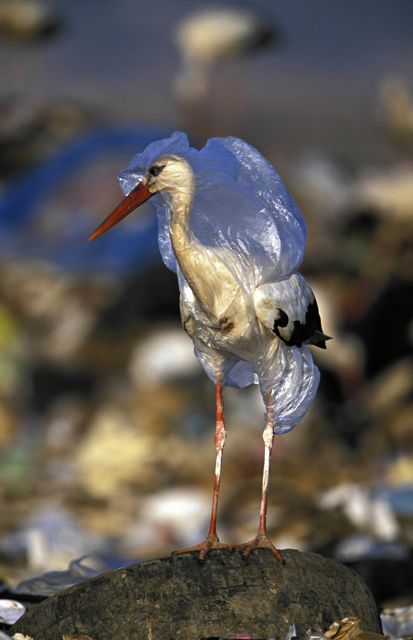
That plastic bottle or plastic take-away coffee lid that has 20 minutes of use can spend decades killing countless seabirds, marine animals and fish, experts reported here this week.

On remote Pacific island atolls, diligent albatross parents unknowingly fill their chicks’ bellies with bits of plastic that resemble food. The chicks die of malnutrition, and when their bodies decay all those plastic bottle tops, disposable lighters, and the ubiquitous bits of plastic detritus get back into the environment in a cruel perversion of ‘recycling’.

There is now so much plastic in the oceans it is likely that virtually every seabird has plastic in its belly if its feeding habits mean it mistakes plastic bits for food. The same is true for sea turtles, marine animals or fish, experts say.

Northern fulmars, a common seabird numbering in the millions, have a collective 45 tonnes worth of plastic bits in their bellies, estimates Jan Andries van Franeker, a biologist with the Institute for Marine Resources and Ecosystem Studies at the University of Wageningen in Holland.

At least 95 percent of fulmars in the North Sea where van Franeker has been working for three decades have one to several dozen bits of plastic in their stomachs. The same is true for related species like the tiny Wilson’s storm petrels, which unknowingly transport an estimated 35 tonnes of plastic from their wintering grounds in the North Atlantic to breeding grounds in the Antarctic, he says.

“If a seabird’s feeding habits mean it could mistake plastic for food, then it will likely have plastic in its stomach,” he said in an interview at the week long Fifth International Marine Debris Conference, which ends Friday in Honolulu, Hawaii. Continue reading

Too many of us, taking too much and having too big an impact. Will need 27 planet Earths by 2050

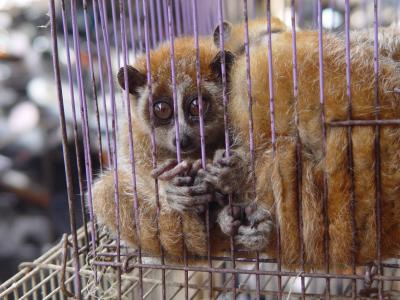
Slow loris from an illegal wildlife market in Southeast Asia

This story was featured on the IPS wire and on the Al Jazeera network . It’s about a study showing that national parks, conservation and protected areas have not and cannot halt the decline in biodiversity that is our life support system. It is hopeless without addressing the root cause of this and all other environmental problems: too many of us, taking too much and having too big of an impact. On our present course we’ll need 27 planet Earths by 2050 they conclude. — Stephen 

By Stephen Leahy

UXBRIDGE, Canada, Jul 29, 2011 (IPS)

Protecting bits of nature here and there will not prevent humanity from losing our life support system. Even if areas dedicated to conserving plants, animals, and other species that provide Earth’s life support system increased tenfold, it would not be enough without dealing with the big issues of the 21st century: population, overconsumption and inefficient resource use.

Without dealing with those big issues, humanity will need 27 planet Earths by 2050, a new study estimates.

The size and number of protected areas on land and sea has increased dramatically since the 1980s, now totaling over 100,000 in number and covering 17 million square kilometres of land and two million square kilometres of oceans, a new study reported Thursday.

This independent environmental journalism depends on public support. Click here learn more.

But impressive as those numbers look, all indicators reveal species going extinct faster than ever before, despite all the additions of new parks, reserves and other conservation measures, according to the study published in the journal Marine Ecology Progress Series.

“It is amazing to me that we haven’t dealt with this failure of protected areas to slow biodiversity losses,” said lead author Camilo Mora of University of Hawaii at Manoa.

“We were surprised the evidence from the past 30 years was so clear,” Mora told IPS.

The ability of protected areas to address the problem of biodiversity loss – the decline in diversity and numbers of all living species – has long been overestimated, the study reported. The reality is that most protected areas are not truly protected. Many are “paper parks”, protected in name only. Up to 70 percent of marine protected areas are paper parks, Mora said.

The study shows global expenditures on protected areas today are estimated at six billion dollars per year, and many areas are insufficiently funded for effective management. Effectively managing existing protected areas requires an estimated 24 billion dollars per year – four times the current expenditure.

“Ongoing biodiversity loss and its consequences for humanity’s welfare are of great concern and have prompted strong calls for expanding the use of protected areas as a remedy,” said co-author Peter Sale, a marine biologist and assistant director of the United Nations University’s Institute for Water, Environment and Health.

“Protected areas are a false hope in terms of preventing the loss of biodiversity,” Sale told IPS.  Continue reading

8.7 Million Species Run Spaceship Earth and Our Life Support System

Charonia tritonis Credit: David Burdick

We share the planet with 8.7 million species. We’re unconcerned about the ongoing loss of 200 species a day since we fail to realize they are our life support system. And we don’t know how many or which species are needed to keep things running. There is metaphor in the article to make that clearer I hope. We are not even close to coming to grips with this issue.  — Stephen

“If the decline in species around us is not significant then I ask what is?”

By Stephen Leahy

UXBRIDGE, Canada, Aug 23, 2011 (IPS)

 The life support system that generates the planet’s air, water, and food is powered by 8.7 million living species according to the newest and best estimate. We know next to nothing about 99 percent of those unique species – except that lots of them are going extinct.

“It is like a complicated engine where we only know about the major pieces. If we lose one or some of the small hidden pieces that play a critical role the engine might stop working,” said Camilo Mora of the University of Hawaii and Dalhousie University in Halifax, Canada.

Many species may vanish before we even know of their existence, of their unique niche and function in ecosystems,” Mora told IPS.

Until now there wasn’t even a decent guesstimate about how many species exist currently: three million? 100 million? Now a new validated analytical technique has pined down the big number to 8.7 million species (give or take 1.3 million).

The analysis published Tuesday in the journal ‘PLoS Biology’ estimated there are 6.5 million species found on land and 2.2 million – about 25 percent of the total – dwelling in the ocean depths.

This independent environmental journalism depends on public support. Click here learn more.

“Not knowing the answer to this fundamental question really highlights our ignorance about life on this planet,” said Boris Worm of Dalhousie University, co-author of the study along with Mora.

“We’re so fixated on the human enterprise we don’t recognise nature’s enterprise… the 8.7 million species that run the planet and provide the air we breathe, the water we drink and the soil we grow our crops in,” Worm told IPS. “If the decline in species around us is not significant then I ask what is? This is all we have on this planet, the only planet that holds life.” Continue reading

Super Cyclone Yasi leaves cassowary in greater peril

The 6ft bird was at risk before the storm hit Australia. Now its survival is even more doubtful

[As Yasi hit the Queensland coast Feb 2 I wondered about how it might affect the endangered cassowary having been confronted by one of these amazing and sometimes aggressive birds in the jungle near Mission Beach a few years ago. Sorry to say it doesn’t look good for a truly incredible species. — Stephen]

By Roger Maynard

Sunday, 27 February 2011

The cassowary, one of the world’s largest birds, beaten for size and weight only by the ostrich and emu, is in a fight for its life. The flightless bird has talons that can tear open a human with one swipe, but it is normally a placid and shy fruit-eater. Now it is in peril as food supplies run low in the wake of Cyclone Yasi, which flattened vast swathes of rainforest in northern Queensland earlier this month.

Emergency food drops have already been made in the Mission Beach area, south of Cairns. The Queensland government has set up more than 50 feeding stations to supplement the birds’ diet.

Graham Lauridon, a local vet, said the main threat is to younger cassowaries, unable to fend for themselves, who have to compete for food with adult birds. “There’s a strong likelihood we will lose quite a few in the next six months,” he said.

via Cyclone puts cassowary in greater peril – Nature, Environment – The Independent.

A Reporter’s Diary: EXCLUSIVE COVERAGE OF UN CONVENTION ON BIOLOGICAL DIVERSITY FROM NAGOYA, JAPAN

NOTE: The following are excerpts from my personal notes to friends and supporters written during the heat, confusion and massive information dump of a major international conference. Often written late at night I attempted to offer some personal perspective into what was going on and what I was up to. — Stephen

Tuesday, 19 Oct – Geopolitical obstacles getting in the way

I’m here at the big UN conference on biodiversity. It’s 430 am here, the first day ended about 9 pm. It’s 12-ring cat circus like the Copenhagen climate meeting but the mood here is more positive. There are similar geopolitical obstacles getting in the way of slowing the loss of species and ecosystems. Another major difference is the lack of little public awareness of the fact that we cannot continue to shred nature’s web of life without suffering dire consequences.

I’ll try and do my bit – write 10 -12 articles over next two weeks. I wanted to thank a couple of supporters who helped out to cover some of the travel costs. I want to keep you informed of what’s going on here but these notes take a couple of hours to do.

This week is a story about an important development in Africa: In sincere efforts to make one last major attempt to transform Africa’s poverty and hunger are we imposing our worldview on Africa yet again? Bill Gates and others are donating hundreds of millions to create a New Green Revolution for Africa. This difficult and controversial story took over a week to do and wrote the final draft during my 17 hr flight here.

My other story connects the dots between extreme weather this summer and climate change. No single storm is directly attributable to CC BUT without CC it is unlikely the Russian heat wave and floods in Pakistan would have occurred. (PS those were events were two sides of the same coin)

Finally I received a number of letters, mostly positive but a couple saying I was too negative in last week’s article ‘Don’t Worry Be Happy’ Canada Sees Global Warming “Prosperity” Instead of Calamity’. Any organization that puts out a chart of climate impacts at 4 – 5C of global warming and fails to mention the scale of the calamity that would result is delusional or deceptive. Some take the stunningly selfish and naive view we can ‘adapt’ by turning up the AC.

Do consider making a small automatic monthly contribution as a fair exchange for these articles.

Greenest wishes, Steve


Wednesday, 20 Oct – Diversity R Us

There is an astonishing diversity of people here. Last nite I talked to an Amazonian Indian who took 10 days to get here, had wine accidentally spilled on me by a reindeer herder from Finland and found the lost passport of a Brazilian diplomat. And that is a five minute snap shot. It is a very big world with so many different people it is incredible they have all come here to try and address a common issue. That they can’t agree on what kinds of actions and how to implement should not come as a surprise.

Sunday, 24 Oct – Canada won’t play nice (yet again)

Canada is blocking agreement on a key measure to get a new international agreement to protect biodiversity here. This is not new. In recent years Canada has gone out its way to snub international UN agreements including the outright refusal to fulfill its legal obligations under the Kyoto Protocol. Hard to believe the same government lobbied hard for a seat on the UN security council and actually expected to be rewarded.

Sadly there is no one reporting for Canadian publications to document the irony. (And as a result Canadian’s aren’t really aware of what their government is up to.) Continue reading

Northern “Biopirates” Gobbling up Living Resources of the Global South

By Stephen Leahy

PARIS, Feb 1, 2010 (IPS)

Rich countries are like biopirates, looting far-away lands for food, raw materials and cheap labour. They’re plundering other richer ecosystems because they’ve largely destroyed their own. And they’re blocking global efforts to create an independent scientific assessment panel that is likely point the finger at the real reason species are going extinct at 1,000 times their natural pace, experts say.

European politicians were “shocked” to learn that just 17 percent of Europe’s ecosystems were in decent shape, Dominique Richard of the European Environmental Agency told participants on the final day of the U.N.-hosted Biodiversity Science Policy Conference in Paris.

“We’ve just completed our first complete assessment of the state of biodiversity in Europe and the results really shocked policymakers,” said Richard, a European biodiversity expert.

Most of Europe’s natural systems that provide essential services like food, clean air and water, climate regulation and so on have been in decline for years. But no one in Europe really notices.

That’s because the rich are “geosphere people” who help themselves to nature’s ecological services anywhere in the world, said Ashok Khosla, an eminent Indian environmentalist and founder of the Delhi-based Development Alternatives Group, who was representing the International Union for Conservation of Nature.

Is this article of interest? It exists thanks to contributions from readers. Please click here to learn more about Community Supported Journalism.

The poor, on the other hand, are “ecosystem people” who depend directly on local resources for their livelihoods, Khosla told delegates. The ecosystem people cannot afford to get their food or water elsewhere, so if they degrade their own ecosystems, they suffer the direct consequences. Continue reading

Palau Announces Massive Marine Sanctuary to Protect Whales, Dolphins, Sharks

By Stephen Leahy

NAGOYA, Japan, Oct 25, 2010 (IPS)

One of Japan’s closest allies declared over the weekend that all of its oceans – more than 600,000 square kilometres – would be a sanctuary for whales, dolphins, dugongs, sharks and other species.

“There will be no hunting or harassment of marine mammals and other species in our waters,” said the Honourable Harry Fritz, minister of the environment, natural resources and tourism of the Republic of Palau.

“We urge other nations to join our efforts to protect whales, dolphins and other marine animals,” Fritz said at a press conference during Oceans Day at the meeting of the Conference of the Parties to the Convention on Biological Diversity in Nagoya, Japan.

Japan has long sought to overturn the global ban on commercial whaling and has actively solicited and received Palau’s support for many years. Japan is its second largest source of development aid after the United States. Japanese tourists frequent the islands since many people speak some Japanese.

“Palau now supports conserving marine mammals, along with sharks and other species,” said Susan Lieberman, director of international policy for the Pew Environment Group, a large U.S. NGO.

“This is a very significant announcement,” Lieberman told IPS.

Is this article of interest? It exists thanks to contributions from readers. Please click here to learn more about Community Supported Journalism. Continue reading