Who Wants a Sustainable, Pollution-Free New York by 2030?

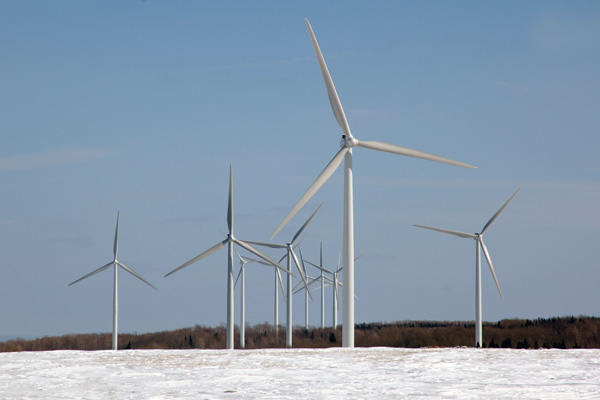
Wind turbines on the Tug Hill plateau in upstate New York

By Stephen Leahy

UXBRIDGE, Canada, Mar 19 2013 (IPS)

As usual, midtown Manhattan is packed with whisper-quiet cars and trams while thousands walk the streets listening to the birds of spring sing amongst the gleaming, grime-free skyscrapers in the crystal-clear morning air.

Welcome to New York City in April 2030.

I think the public will be 100 percent behind this, if they know about it.

This is not a fantasy. It is a perfectly doable goal, said Stanford University energy expert Mark Jacobson. In fact, the entire state of New York could be powered by wind, water and sunlight based on a detailed plan Jacobson co-authored.

It’s not only doable, powering New York on green energy is “sustainable and inexpensive” and would save lives and health costs, Jacobson told IPS.

Each year, air pollution kills 4,000 people in New York State and costs the public 33 billion dollars in health costs, according to the study Jacobson co-authored with experts from all over the U.S. It will be published in the journal Energy Policy.

Full Story

Public Pays for Fukushima Clean Up While Nuclear Industry Profits

Japan Fukushima Dai-ichi nuclear power plant March 31 2011

By Stephen Leahy

UXBRIDGE, Canada, Mar 12 2013 (IPS)

Two years after Japan’s Fukushima Daiichi nuclear disaster, the country faces 100 to 250 billion dollars in cleanup and compensation costs, tens of thousands of displaced people and widespread impacts of radiation.

The nuclear industry and its suppliers made billions from building and operating Fukushima’s six reactors, but it is the Japanese government and its citizens who are stuck with all the costly “fallout” of the disaster.

“People’s lives were destroyed and we will be paying trillions of yen in tax money because of the Fukushima disaster,” said Hisayo Takada, an energy campaigner with Greenpeace Japan.

“The nuclear industry, other than Tepco (Tokyo Electric Power Co), has paid nothing as they are specially protected by the law,” Takada told IPS.

On Mar. 11, 2011, Japan experienced a 9.0 magnitude earthquake and resulting tsunami that badly damaged Tepco’s Fukushima Daiichi nuclear plant. Three of six reactors suffered a meltdown, and reactor unit four was damaged. The Fukushima accident has been rated at the highest level (7) of the International Atomic Energy Agency scale, the same as the Chernobyl accident.

A year after the disaster, Tepco was taken over by the Japanese government because it couldn’t afford the costs to get the damaged reactors under control. By June of 2012, Tepco had received nearly 50 billion dollars from the government.

The six reactors were designed by the U.S. company General Electric (GE). GE supplied the actual reactors for units one, two and six, while two Japanese companies Toshiba provided units three and five, and Hitachi unit four. These companies as well as other suppliers are exempted from liability or costs under Japanese law.

Full story here

Canada Losing Its Seasons — Winter is in full retreat

arctic-sea-ice-min-volume-comparison-1979-2012-small

By Stephen Leahy

UXBRIDGE, Canada, Mar 11 2013 (IPS) 

“Canada is not a country, it’s winter,” Canadians say with pride. But the nation’s long, fearsome winters will live only in memory and song for Canadian children born this decade.Winters are already significantly warmer and shorter than just 30 years ago. The temperature regimes and plant life of the south have marched more than 700 kilometres northward, new research shows.

The frozen north is leaving and won’t be back for millennia due to heat-trapping carbon emissions from burning fossil fuels, experts say.

By 2091, the north will have seasons, temperatures and possibly vegetation comparable to those found today 20 to 25 degrees of latitude further south, said Ranga Myneni of the Department of Earth and Environment, Boston University.

“If we don’t curb carbon emissions, Arctic Sweden might be more like the south of France by the end of the century,” Myneni, co-author of the Nature Climate Change study published Sunday, told IPS.

Full story here

Canada Has Become a Petro-State, Happily Drilling for Profits as the World Warms

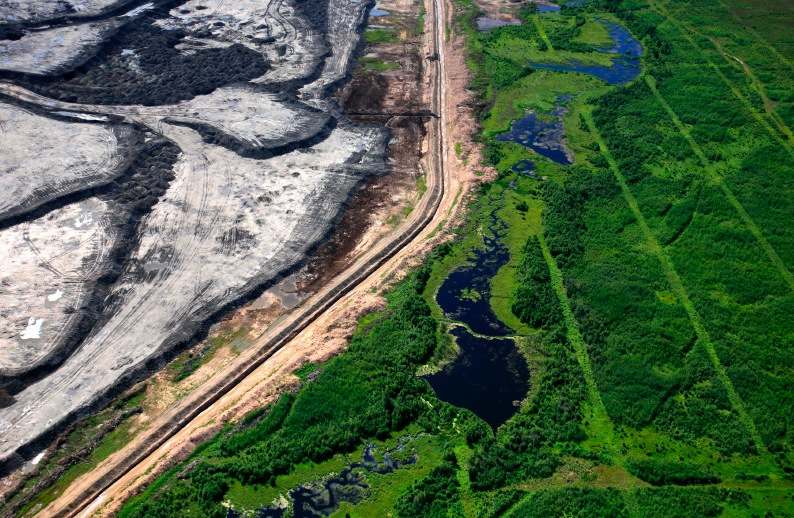
tar sands - visible from space,tarnished earth

Thu, 2013-03-07 08:00 STEPHEN LEAHY

What’s happened to Canada? To the dismay of many a country with an international reputation for relatively progressive environmental policies (at least compared to the United States) is rushing headlong to dig up all the oil, gas, and coal it can. The country’s leaders can scarcely muster the effort to pretend to want to limit climate-heating carbon emissions.

And the Canadian business establishment and media have largely gone along with the program. Put it all together, and you have a country that has become a full-blown “petrostate.”

People are starting to notice. Last December at the UN climate talks in Doha, Qatar, Canada beat out tough contenders like Saudi Arabia to be elected “Colossal Fossil” by environmental organizations from around the planet. Canada had the dishonor of being the most uncooperative country out of 193 nations at the climate summit. It was the sixth year in a row that international environmental groups gave Canada their ‘highest’ award for its persistent efforts to block any agreement on reducing carbon emissions.

What’s happened to Canada is that it has experienced a steady takeover by the fossil fuel industry.

Canada’s is now the world’s fifth largest crude oil producer and the biggest supplier of oil to the US. Canada is also the third largest producer of natural gas and one of the top ten miners of coal. This enormous boom in fossil fuel production has been underway since the late 1990s. Like Saudi Arabia, fossil energy is by far Canada’s biggest export and has become the dominant economic and political focus.

Full story click below:

Blame Canada is a four part series revealing how Canada has become a fossil-fuelled energy superpower that’s going to wreck its future and the global climate.

Green Energy Solves Dual Crises of Poverty and Climate

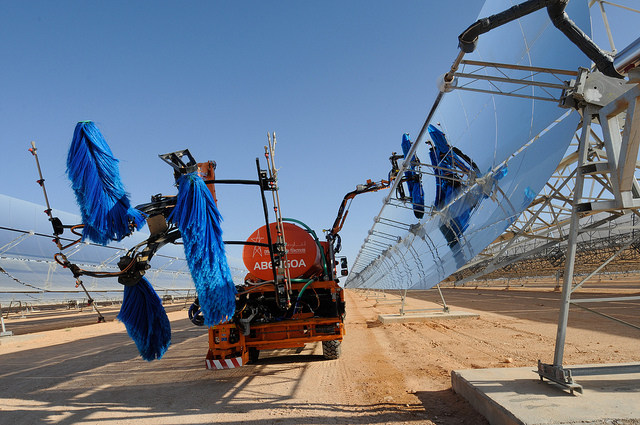
Ain Beni Mathar Integrated Combined Cycle Thermo-Solar Power Plant

By Stephen Leahy

UXBRIDGE, Canada, Feb 25 2013 (IPS) 

Green energy is the only way to bring billions of people out of energy poverty and prevent a climate disaster, a new study reveals.

Conservative institutions like the World Bank, the International Energy Agency and accounting giant Price Waterhouse Coopers (PwC) all warn humanity is on a path to climate catastrophe unless fossil fuel energy is replaced by green energy.

The U.N.’s Sustainable Energy for All initiative intends to bring universal access to modern energy, doubling the share of renewable energy globally, and doubling the rate of improvement in energy efficiency by 2030.

Poverty eradication, sustainable development and the transition away from fossil fuel energy go hand in hand.

If those targets are met and similar efforts undertaken to reduce deforestation, then climate disaster can be avoided, said Joeri Rogelj of the Institute for Atmospheric and Climate Science in Zurich  who headed the analysis published Sunday in the journal Nature Climate Change.


Thawing Permafrost May Be “Huge Factor” in Global Warming

Siberian permafrost -- Ted Schuur
Siberian permafrost — Ted Schuur

UXBRIDGE, Canada, Feb 14 2013 (IPS)

Thawing permafrost is emitting more climate-heating carbon faster than previously realised. Scientists have now learned that when the ancient carbon locked in the ice thaws and is exposed to sunlight, it turns into carbon dioxide 40 percent faster.

“This really changes the trajectory of the debate” over when and how much carbon will be released as permafrost thaws due to ever warmer temperatures in the Arctic, says researcher Rose Cory of the University of North Carolina.

There are 13 million square kilometres of permafrost in Alaska, Canada, Siberia and parts of Europe. As previously reported by IPS, a 2011 study estimated that global warming could release enough permafrost carbon to raise global temperatures three degrees C on top of what will result from human emissions from oil, gas and coal.

Human emissions are headed for four degrees C of global heating,warned the International Energy Agency (IEA) this week. A rapid “decarbonization of electricity supply” is needed to avoid that future, the IEA said as it released a new book titled “Electricity in a Climate-Constrained World”.

“The solutions are well-known: increased energy efficiency, greater research and development of low-carbon energy production, and putting a realistic price on carbon,” the book says

Full story here

Green Approaches to Water Treatment Gaining Ground Around World

Pool of water in oz forest rslpix

By Stephen Leahy

UXBRIDGE, Canada, Jan 18 2013 (IPS)  

After Hurricane Sandy swept through the northeast of the United States late October 2012, millions of New Yorkers were left for days without electricity.  But they still had access to drinking water, thanks to New York City’s reliance on protected watershed areas for potable water.

Instead of using electric-powered water treatment plans, New York City brings its high-quality drinking water through aqueducts connected to protected areas in the nearby Catskill/Delaware forests and wetlands – just one example of how protecting watersheds can provide residential areas with drinking water and flood and pollution protection at bargain basement prices.

New York saved between four and six billion dollars on the cost of water treatment plants by protecting forests and compensating farmers in the Catskills for reducing pollution in lakes and streams.

Full story here

Weird Weather Will Only Get Weirder

New York City flooding

By Stephen Leahy

UXBRIDGE, Canada, Jan 29 2013 (IPS) 
 
Weird is the only way to describe January temperatures whipsawing between record warm and arctic cold over a span of a few days. Experts say that is what climate change looks like: weird, record-shattering weather.

Here’s a fact that goes beyond weird to astonishing. Anyone who is 27 years old or younger has never lived through a month that was colder than the global 20th century average. In other words, we’ve had 334 consecutive months with above average temperatures, according to the U.S. National Oceanic and Atmospheric Administration.

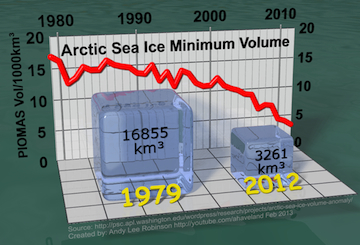
Last summer, the Arctic sea ice shrunk to half of what it used to be during summers only three decades ago. Our planet’s weather is driven largely by the two cold polar regions and the warm tropics. With the Arctic defrosting, it should be no surprise our weather is getting weird. And that it’s not going to get better.

National Legislation Key to Combating Climate Change

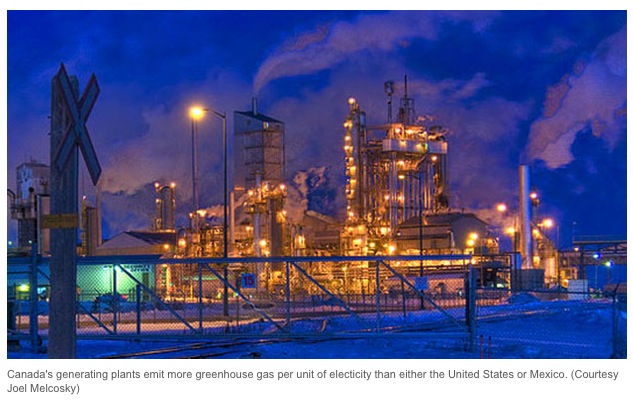
Canada's fossil fuel electricity has highest carbon emissions

By Stephen Leahy

UXBRIDGE, Canada, Jan 15 2013 (IPS)

A majority of major economies have made significant progress in addressing climate change, with countries like South Korea and China taking aggressive action so they can benefit from energy- and resource-efficient economies, a new report released Monday found.

The study by GLOBE International and Grantham Research Institute profiled 33 major economies in an annual examination of climate and energy legislation. 32 of them, including the United States, made significant progress in 2012, while only Canada regressed.

“The study reveals a major trend is underway. More and more countries are acting on climate,” said Adam Matthews, secretary general of GLOBE International, an organisation of legislators.

Fossil Energy Interests Buy Politicians – and they’re cheap says economist

[This interview with economist Robert Repetto (now at Yale) was published two years ago. It is more relevant than ever in showing how fossil fuel money influences politics and prevents real action on climate. — Stephen]

‘What else can you do with coal except burn it? Railways make a lot of money shipping coal’

By Stephen Leahy

UXBRIDGE, Canada, Mar 2, 2011 (IPS)

Powerful fossil energy interests are preventing the United States from making the necessary transition to 21st century energy sources, one of the country’s leading environmental economists documents in a just-published book.

Fossil energy interests are spending “hundreds of millions of dollars” lobbying U.S. politicians in Congress and funding groups to confuse the public about the serious risks climate change poses, says Robert Repetto, author of  “America’s Climate Problem: The Way Forward”.

IPS climate and environment correspondent Stephen Leahy spoke with Repetto about his new book.

Q: Why did you write this book?

A: We’re running out of time. The latest science shows that climate change is coming faster and posing greater risks than previously thought. We are at risk of triggering positive feedbacks that will lead to uncontrollable climate change.

Meanwhile, America is locked in a climate-policy stalemate, with very few in the public comprehending the real risks climate change poses. Most don’t understand that climate change is happening now. They don’t link extreme weather events we’ve been experiencing with climate change. As a result they are not demanding that politicians take action.

Q: Why don’t most Americans understand the fact that climate change is already underway and poses serious risks? Continue reading