For an Ailing Planet, the Cure Already Exists

Measure of concentration of CO2 in the atmosphere by year

By Stephen Leahy

UXBRIDGE, Canada, Jun 1, 2012 (IPS)

The planet’s climate recently reached a new milestone of 400 parts per million (ppm) of carbon dioxide in the Arctic.

The last time Earth saw similar levels of climate-heating carbon dioxide (CO2) was three million years ago during the Pliocene era, where Arctic temperatures were 10 to 14 degrees C higher and global temperatures four degrees C hotter.

Research stations in Alaska, Greenland, Norway, Iceland and even Mongolia all broke the 400 ppm barrier for the first time this spring, scientists reported in a release Thursday. A global average of 400 ppm up from the present 392 ppm is still some years off.

If today’s CO2 levels don’t decline – or worse, increase – the planet will inevitably reach those warmer temperatures, but it won’t take a thousand years. Without major cuts in fossil fuel emissions, a child born today could live in a plus-four-degree C superheated world by their late middle age, IPS previously reported. Such temperatures will make much of the planet unliveable.

In a four-degree warmer world, climate adaptation means “put your feet up and die” for many people in the world, said Chris West of the University of Oxford’s UK Climate Impacts Programme in 2009.

This week the International Energy Agency reported that the nations of the world’s CO2 emissions increased 3.2 percent in 2011 compared to 2010. This is precisely the wrong direction: emissions need to decline three percent per year to have any hope of a stable climate.

By 2050, in a world with more people, carbon emissions must be half of today’s levels.

Impossible? No. A number of different energy analyses show how it can be done. Continue reading

Water is far more valuable and useful than oil

Average water footprint of bottle of cola

The water footprint of a half-litre bottle of water is 5.5 litres – yet well over a billion people live in areas with chronic scarcity

By Stephen Leahy

I have a confession: I knocked back 320 pints at the pub last night. I actually only had two shots of a decent single malt but it took 320 pints of water to grow and process the grain used to make the whisky. That’s a whole lot of water considering the average bathtub holds 60 to 80 litres.

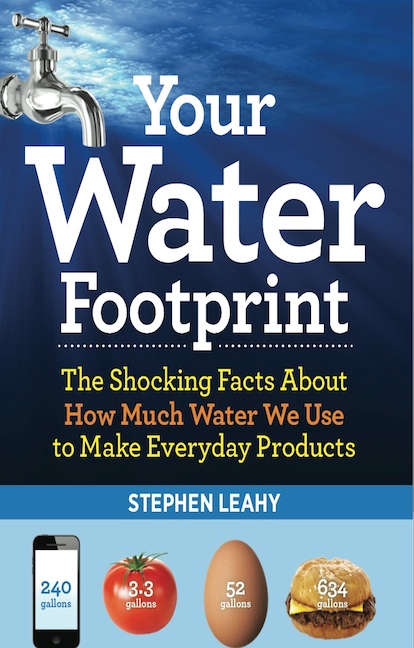
Even after 20 years of covering environmental issues in two dozen countries I had no idea of the incredible amounts of water needed to grow food or make things. Now, after two years working on my book Your Water Footprint: the shocking facts about how much water we use to make everyday products, I’m still amazed that the t-shirt I’m wearing needed 3,000 litres to grow and process the cotton; or that 140 litres went into my morning cup of coffee. The rest of my breakfast swallowed 1,012 litres: small orange juice (200 litres); two slices of toast (112 litres); two strips of bacon (300 litres); and two eggs (400 litres).

Water more valuable and useful than oil

Researching all this I soon realised that we’re surrounded by a hidden world of water. Litres and litres of it are consumed by everything we eat, and everything we use and buy. Cars, furniture, books, dishes, TVs, highways, buildings, jewellery, toys and even electricity would not exist without water. It’s no exaggeration to say that water is far more valuable and useful than oil.

front cover resized1A water footprint adds up the amount of water consumed to make, grow or produce something. I use the term consumed to make it clear that this is water that can no longer be used for anything else. Often water can be cleaned or reused so those amounts of water are not included in the water footprints in the book. The water footprint of 500ml of bottled water is 5.5 litres: 0.5 for the water in the bottle and another five contaminated in the process of making the plastic bottle from oil. The five litres consumed in making the bottle are as real water as the 500ml you might drink but hardly anyone in business or government accounts for it.

The incredible amounts of water documented in Your Water Footprint are based primarily on research done at the University of Twente in the Netherlands, where Arjen Hoekstra originated the concept of water footprints. The amount consumed to make something varies enormously depending on where the raw materials come from and how they are processed. Wheat grown in dry desert air of Morocco needs a lot more water than wheat grown in soggy Britain. For simplicity, the amounts in the book are global averages.

One of the biggest surprises was learning how small direct use of water for drinking, cooking and showering is by comparison. Each day the average North American uses 300 to 400 litres. (Flushing toilets is the biggest water daily use, not showers.) 400 litres is not a trivial amount; however, the virtual water that’s in the things we eat, wear and use each day averages 7,500 litres in North America, resulting in a daily water footprint of almost 8,000 litres. That’s more than twice the size of the global average. Think of running shoes side by side: the global shoe is a size 8; the North American a size 18. By contrast, the average water footprint of an individual living in China or India is size 6.

Peak water is here

Water scarcity is a reality in much of the world. About 1.2 billion people live in areas with chronic scarcity, while 2 billion are affected by shortages every year. And as the ongoing drought in California proves, water scarcity is an increasing reality for the US and Canada. Water experts estimate that by 2025 three in five people may be living with water shortages.

While low-flow shower heads and toilets are great water savers, the water footprint concept can lead to even bigger reductions in water consumption. For example green fuels may not be so green from a water consumption perspective. Biodiesel made from soybeans has an enormous water footprint, averaging more than 11,000 litres per litre of biodiesel. And this doesn’t include the large amounts of water needed for processing. Why so much water? Green plants aren’t “energy-dense,” so it takes a lot of soy to make the fuel.

Beef also has a big footprint, over 11,000 litres for a kilo. If a family of four served chicken instead of beef they’d reduce their water use by an astonishing 900,000 litres a year. That’s enough to fill an Olympic size pool to a depth of two feet. If this same family of opted for Meatless Mondays, they’d save another 400,000 litres. Now they could fill that pool halfway.

We can do nearly everything using less water. It’s all about smart substitutions and changes, rather than sacrifice and self-denial, but we can’t make the right choices unless we begin to see and understand the invisible ways in which we rely on water.

First published at The Guardian

We Have Five Years to Stop Building Coal Plants and Gas-Powered Cars

Measurement of CO2 levels in atmosphere

By Stephen Leahy

[Authors note: One of the most difficult and important articles I’ve written in 20 years of environmental journalism. Originally published Sept 6 2014 @Vice Motherboard]


Here’s the frightening implication of a landmark study on CO2 emissions:

By 2018, no new cars, homes, schools, factories, or electrical power plants should be built anywhere in the world, ever again, unless they’re either replacements for old ones or carbon neutral. Otherwise greenhouse gas emissions will push global warming past 2˚C of temperature rise worldwide, threatening the survival of many people currently living on the planet.

Every climate expert will tell you we’re on a tight carbon budget as it is—that only so many tons of carbon dioxide (CO2) can be pumped into the atmosphere before the global climate will overheat. We’ve already warmed temperatures 0.85˚C from pre-industrial levels, and the number rises every year. While no one thinks 2˚ C is safeper se, it’s safer than going even higher and running the risk that global warming will spiral out of our control completely.

Last year, the latest Intergovernmental Panel on Climate Change (IPCC) report established a global carbon budget for the first time. It essentially stated that starting in 2014, the carbon we can afford is up to around 1,000 billion tons of CO2. In other words, our cars, factories, and power plants can only emit 1,000 billion tons (1,000 Gt, or gigatons) of CO2 into the atmosphere if we want to have a greater than 50/50 chance of keeping our climate below 2˚C of warming.

Even considering that humanity pumped 36 gigatons of CO2 into the atmosphere last year alone, 1,000 Gt still seems like a big budget. It might even seem like we have room to spare.

Maybe not.

WORLDWIDE, WE’VE BUILT MORE COAL-BURNING POWER PLANTS IN THE PAST DECADE THAN IN ANY PREVIOUS DECADE

New research shows that we may not have been paying attention to the entire CO2 emissions picture. We’ve only been counting annual emissions, and not the fact that building a new coal or gas power plant is in reality a commitment to pumping out CO2 for the lifespan of a given plant—which usually ranges from 40 to 60 years. These future emissions are known as a carbon commitment.

A new study has tallied the carbon commitments from all existing coal and gas power plants by looking at their annual CO2 emissions and current age. The study assumes an operating life of 40 years. A 38-year old coal plant will have far smaller future CO2 emissions, and thus smaller carbon commitment than one built today. The study, “Commitment accounting of CO2 emissions,” determined that most new power plants that went online in 2012 have a very large carbon commitment—19 Gt of CO2.

Building new power plants means more carbon commitments to eat into our 2˚C carbon budget. Build enough giant coal plants today, and their future emissions would tie up the entire budget, leaving no room for any other source of CO2 emissions.

Meanwhile, the rate at which new plants are built far outpaces the closure of old plants. Many US coal plants operate for longer than 40 years; the oldest is currently around 70 years.

“Worldwide, we’ve built more coal-burning power plants in the past decade than in any previous decade, and closures of old plants aren’t keeping pace with this expansion,” said study co-author Steven Davis of the University of California, Irvine.

Image: Flickr

Fossil Fuels Power Plant Carbon Commitment: 300 Gt

In the study, Davis and co-author Robert Socolow of Princeton University calculated that the existing coal and gas power plant carbon commitment turns out to be very large—more than 300 Gt.

Non-Power Plant Carbon Commitment: 400 Gt 

The reality of carbon commitment applies to any new fossil-fuel burning infrastructure, including office buildings and homes using gas heating or automobiles and planes burning jet fuel. All of these have an operating life of several or many years during which they will emit CO2 from now until they are ‘retired.’ These future emissions also count as a carbon commitment. In another upcoming study, Davis calculated the carbon commitments from other CO2 sources, including from the transport, industry, commercial and residential sectors. He estimates that as of 2013 this carbon commitment exceeded 400 Gt.

Together with the power plant commitment of 300 Gt laid out in the current study, that’s more than 700 Gt in carbon commitments on a global carbon budget of 1000 Gt. That leaves less than 300 Gt for future power plants, steel mills, cement plants, buildings, and other stuff that burns fossil fuels.

At current rates we’ll have accounted for the remainder of the budget in only five years.

Here’s how it breaks down:

Estimated Annual Emissions 2014-2018: 200 Gt

Global CO2 emissions from all sources amounted to 36 Gt in 2013. Annual emissions have been growing at a rate of 2 to 3 percent per year. Without major efforts to reduce emissions, another 200 gigatons of CO2 will be emitted between 2014 and 2018.

Estimated New Carbon Commitments 2014-2018: 100 Gt

Davis and Socolow determined that carbon commitments from new fossil fuel burning infrastructure will average at least 20 Gt per year, totaling 100 Gt over five years.

300 + 400 +200 +100 = 1,000 Gigatons of Carbon, Locked in by 2018

Unless coal and gas power plants or other major sources of CO2 are shut down before the end of their life span, the 1,000 Gt global carbon budget will be fully allocated sometime in 2018. No one will notice, because things won’t look or feel too much different than today. CO2 is akin to a slow, trans-generational poison. The climate impacts of blowing the carbon budget won’t be felt until 2030 or 2040 —and for a long time after.

WE’VE BEEN HIDING WHAT’S GOING ON FROM OURSELVES: A HIGH-CARBON FUTURE IS BEING LOCKED IN BY THE WORLD’S CAPITAL INVESTMENTS

Even the climate experts won’t notice much, because annual CO2 emissions have been the sole focus of countries and the United Nations process to address climate change said Davis.

“That’s like driving down the highway and only looking out of the side window,” Davis told me.

Politicians, business leaders, investors, planners, bureaucrats and whole lot of other people should be looking out the front window and paying attention to the hard reality of carbon commitments. If Davis and Socolow’s calculations are correct, it means no new coal or gas power plants can go online after 2018 unless they’re replacing retired plants. It means freezing the size of the global automobile fleet, and the industrial and commercial sectors, unless their energy efficiency increases. And so on.

The fact that much of our current and future infrastructure carries huge carbon commitments is blindingly obvious, but receives little attention.

Can’t solve a problem by making it worse

“If you build it, there will be emissions year after year. This should be a fundamental part of the decision to build most things,”” Davis said.

Ignoring the reality of carbon commitments means we’re investing heavily in technologies that make the problem worse, he said.

“We’ve been hiding what’s going on from ourselves: A high-carbon future is being locked in by the world’s capital investments,” said co-author Robert Socolow. Any plan or strategy to cut CO2 emissions has to give far greater prominence to those investments. Right now the data shows “we’re embracing fossil fuels more than ever,” Socolow told me.

So what can we do to begin to prepare for a jam-packed carbon budget? First, we need to stop building fossil fuel-reliant power plants.

Surprisingly, it appears the Australia is a pioneer here, despite recently rolling back its pioneering carbon tax. Thanks to wide-spread adoption of solar energy on homes and business the country’s electricity use is in steep decline. For the first time in its history, no new coal or gas power capacity will be needed to maintain supply over the next 10 years, according to the Australian Energy Market Operator. Germany too is rapidly adopting clean energy sources like wind and solar, so as to avoid building coal or nuclear power.

Next, we need to think about meeting energy demand by improving efficiency, instead of building more power generation.

Potential energy efficiency gains of 50 percent are possible across many sectors in most countries, Socolow said, and could reduce the number of fossil fuel energy power plants.

The US is the king of energy waste by most estimates. This costs Americans an estimated $130 billion a year, according to the Alliance to Save Energy. But despite the potential for huge cost and emission reductions, governments everywhere put nearly all their energy research efforts into new sources of energy like new power plants rather than helping to develop energy-efficient cars, buildingsm and appliances. It’s 2012 international study also found that improving energy efficiency provides by far the best bang-for-the-buck for energy security, improved air quality, reduced environmental and social impacts and carbon emission reductions.

However, efficiency improvements take time, and there is precious little time left to make the CO2 emissions cuts to stay below 2˚C, said Socolow.

While refusing to say a planet that’s 2˚C hotter is inevitable, he did say that all efforts to reduce emissions must be undertaken as soon as possible: “3˚C is a whole lot better than 5˚C, the current path we’re on.”

Oil, Coal and Gas Industry Destroying Our Childrens’ Future

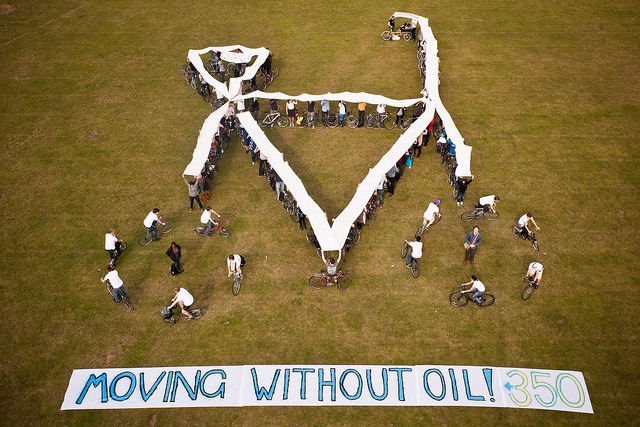
“moving aerial” of a bike sml

By Stephen Leahy

UXBRIDGE, Canada, Jan 4 2013 (IPS)

Around the world, 2012 was the year of extreme weather, when we unequivocally learned that the fossil fuel energy that powers our societies is destroying them. Accepting this reality is the biggest challenge of the brand new year.

Re-engineering our societies and lifestyles to prosper on green alternatives is the penultimate challenge of this decade. There is no more important task for all of us to engage in because climate change affects everything from food to water availability.

A number of scientific analyses have demonstrated we already have the technology to re-engineer our society to thrive on green alternative energy. The newest of these was published Wednesday in the prestigious journal Nature. It plainly states that politics is the real barrier, not technology nor cost. (It is far cheaper to act than not.)

Keeping global warming to less than two degrees C is mainly dependent on “when countries will begin to take serious action to reduce greenhouse gas emissions”, according to the study “Probabilistic cost estimates for climate change mitigation”.

Climate change has already pushed global temperatures up 0.8 degrees C, with significant consequences. No climate scientist thinks two degrees C will be “safe”. Many countries, especially least-developed countries and small island states, want the global target to be less than 1.5C of heating. Even then large portions of the Arctic and Antarctic will continue to melt raising sea levels, albeit at a slower rate.

Delay in making the shift to non-fossil fuel energy sources will be very costly. Waiting until 2020 to curb global emissions will cost twice as much compared with peaking emissions by 2015, the Nature analysis shows.

Serious action to reduce greenhouse gas emissions means 65 percent of current coal power plants will have to be shut down in the next decade or two, a previous Nature study reported by IPS shows.

US Fossil Emissions now and how much they need to decline

Instead of serious action, global emissions continue to break new records, rising about three percent per year. It appears 2012 will be about 52 gigatonnes (billion metric tonnes of CO2 equivalents). This is our annual climate scorecard, the most important number in human history. That number needs to fall to be between 41 and 47 gigatonnes (Gt) by 2020 to have a reasonable chance of staying below two degrees C of warming. Continue reading

Weird Weather Will Only Get Weirder

New York City flooding

By Stephen Leahy

UXBRIDGE, Canada, Jan 29 2013 (IPS) 
 
Weird is the only way to describe January temperatures whipsawing between record warm and arctic cold over a span of a few days. Experts say that is what climate change looks like: weird, record-shattering weather.

Here’s a fact that goes beyond weird to astonishing. Anyone who is 27 years old or younger has never lived through a month that was colder than the global 20th century average. In other words, we’ve had 334 consecutive months with above average temperatures, according to the U.S. National Oceanic and Atmospheric Administration.

Last summer, the Arctic sea ice shrunk to half of what it used to be during summers only three decades ago. Our planet’s weather is driven largely by the two cold polar regions and the warm tropics. With the Arctic defrosting, it should be no surprise our weather is getting weird. And that it’s not going to get better.

National Legislation Key to Combating Climate Change

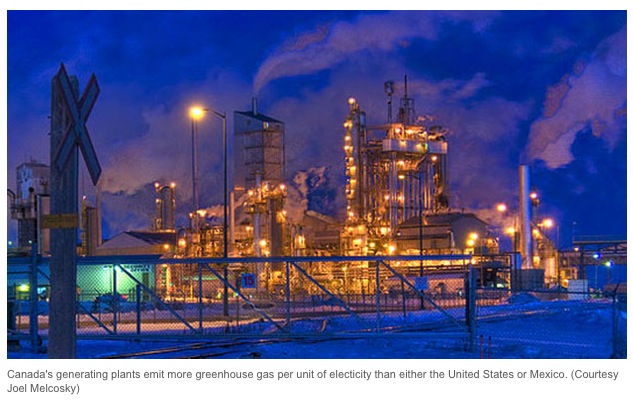
Canada's fossil fuel electricity has highest carbon emissions

By Stephen Leahy

UXBRIDGE, Canada, Jan 15 2013 (IPS)

A majority of major economies have made significant progress in addressing climate change, with countries like South Korea and China taking aggressive action so they can benefit from energy- and resource-efficient economies, a new report released Monday found.

The study by GLOBE International and Grantham Research Institute profiled 33 major economies in an annual examination of climate and energy legislation. 32 of them, including the United States, made significant progress in 2012, while only Canada regressed.

“The study reveals a major trend is underway. More and more countries are acting on climate,” said Adam Matthews, secretary general of GLOBE International, an organisation of legislators.

Critics Brand Climate Talks Another Lost Opportunity

findlay ohio flooding AP

By Stephen Leahy

DOHA, Qatar, Dec 11 2012 (IPS)

Rich countries came to the U.N. climate talks in Doha intent on delaying needed action on climate change for another three years and a still to be hammered out new global treaty.

This delay will be extraordinarily expensive and risky.

Every year that fossil fuel emissions fail to decline adds to the cost and reduces the odds that a global temperature rise can be kept below two degrees C.

“Science says emissions need to peak in 2015,” said Kumi Naidoo, executive director of Greenpeace International, as the final plenary of COP 18 concluded last Saturday night, a full day late.

The 195 parties to the U.N. Framework Convention on Climate Change (UNFCCC) approved a set of documents called “The Doha Climate Gateway” that does not increase emission reductions or guarantee much-needed financial help to poor countries suffering present and future impacts of climate change.

“Doha is a betrayal of people living with impacts now. And it is a sellout of our children and grandchildren’s future,” said Naidoo.

“The fossil fuel industry won,” said Alden Meyer, the Union of Concerned Scientists’ director of strategy and policy, who has attended nearly every one of these climate negotiations over the past 18 years.

“The science is clear that four-fifths of known fossil fuel reserves must stay in the ground but we continue to burn them like there is no tomorrow,” Meyer said.

“Doha became more of a trade fair…Negotiators protected the interests of corporations and not the needs of people,” he told IPS.

More than 16,000 delegates participated in the two-week conference of the parties (COP) in Doha, Qatar, a country rich in oil and gas in the heart of the Middle East fossil fuel empire.

Meyer, along with representatives from more than 700 civil society organisations, blamed the U.S. for blocking proposals for greater emissions cuts. The U.S. also refused to commit a singly penny to assisting countries hard hit by climate change. U.S. negotiators did acknowledge poor countries were suffering costly damages and losses.

The world has already warmed 0.8 degrees C, altering weather patterns and increasing extreme events which have led to nearly 400,000 deaths and more than 1.2 trillion dollars being lost every year, according a 2011 study.

A delegate from Bangladesh told IPS that climate-related damages cost his country three to four percent of its annual GDP. Climate change, which is also driven by deforestation and land conversion for agriculture, is undercutting development and will push his country’s and other countries’ economies into a steady decline, he said.

To help governments cope, industrialised nations promised to put 100 billion dollars a year into a Green Climate Fund by 2020. To bridge the gap until then, developing nations asked for 60 billion dollars in total by 2015. Britain, Germany and a few other countries promised to contribute six billion dollars.

But the U.S., Canada, Japan and others agreed only to more talks next year.

“The U.S. spends 60 billion dollars on its military marching bands,” said Naidoo.

The only hope is to build a robust grassroots movement to force countries to act in the interest of the public and future generations, he said.

“We have to build a new social movement like (the one) that overcame slavery,” agreed Oxfam International climate change policy advisor Tim Gore.

“We reject what our leaders are doing here. We are more angry, more impassioned to defeat this process,” said Gore.

The COP process is an obstacle because a few big countries can easily block the will of the majority, said Mohamed Aslam, former environment minister and chief negotiator for the Republic of the Maldives.

“The signs of global warming are obvious and we know that the safe limit is to stay below 1.5 C…and yet we are failing to act,” Aslam said in a press conference.

The U.N. spends millions of dollars on these negotiations and they are going nowhere, he said. “We are running out of time. (We) need to take this to another fora,” he said.

What is lacking is a real commitment to reduce global emissions, said Christina Figueres, executive secretary of the United Nations Framework Convention on Climate Change (UNFCCC).

“What needs to change most is political will,” Figueres told IPS.

In Doha, the U.N. secretary-general announced a world leaders’ summit in 2014 to hammer out emission reduction targets to keep warming below two degrees C. The Doha Climate Gateway confirmed details for a new negotiation track to have a new global climate treaty ready for ratification in 2015 and go into force in 2020.

Under this agreement all countries will likely be obligated to make emission cuts, varying in depth and timing. Without additional cuts before 2020, reductions afterwards will need to be rapid and massive, moving to a zero-fossil fuel emission society in a few decades based on the science.

The Doha agreement includes a second phase of the Kyoto Protocol with the European Union, Australia and a few other countries agreeing to cut fossil fuel emissions between 2013 and 2020. However, they did not set new targets, agreeing instead to a mandatory review of targets in 2014.

The nations involved only represent 12 percent of global emissions, and do not include large developing country emitters like China, India and Brazil. The U.S. has never participated, while Canada and Japan have opted out of the second phase but are supposed to make to make comparable cuts but offered nothing new.

“Rich countries think they can protect themselves from the impacts, leaving the poor with no clear pathway to the future,” said Mohamed Adow of Christian Aid.

“Our leaders have let us down. Civil society will have to lead to get the future we really want,” said Adow.

Original IPS story

Be Part of a New Collaborative Approach to Media Coverage of Climate

Screen Shot 2013-10-17 at 10.09.20 PM

Frustrated by the lack of interest in climate coverage by mainstream media, 15 young journalists on 4 continents want to bring a new collaborative approach to climate change journalism. This is a voluntary effort to both increase and improve reporting called the Climate News Mosaic (CNM).


They need your help for their first collaborative project to connect what’s happening at the UN climate conference (COP) in Warsaw this November with climate impacts/perspectives on the ground from their home countries.

Here’s how it will work:

* 2 or 3 journalists will go to the COP in Warsaw to report and co-ordinate. The rest will be back home doing local coverage on climate. Everyone contributes and shares interviews, links to reports, sources, A/V and so on.

* Members (mainly freelancers) do articles, audio and video for their own outlets. Some 25-30 original stories in at least 4 languages will be made available for use in whole or in part by any media outlet anywhere in the world.

* A live blog placed on a number non-profit news sites like IPSEarth Journalism Network , and others will bring the public a wealth of current info on what is happening at the Warsaw COP but also from other countries. (i.e. a short video from Warsaw, a photo from a rally in San Francisco, a soundbite from a press conference in Nairobi, a quote from an interview with an Italian scholar.)

Learn more about CNM participants on this global map with short bios.

I’m sort of the mentor having used crowd-sourced funding to support my science and climate journalism the past 4 years. That support kept me going and in 2012 I was a co-winner of the Prince Albert/United Nations Global Prize for media coverage of climate change.

For-profit media owners are simply not interested in good science and environment reporting. Coverage of climate change has been in sharp decline since the UN climate summit in Copenhagen in 2009. Even the New York Times closed its environment desk this year. It’s not that there isn’t a lot to report on. Quite the opposite.

Here’s how you can help:

Please spread the word about this project. We need to raise $6000 for travel, accomodation and other costs to do the Warsaw COP reporting.  Please click on Indiegogo to contribute what you can. (There are ‘perks’ for contributors including a Google Hangout.)

This is a fresh new idea: Independent journalists in different countries working together to provide all of us with the news and information on the most important issue of our time.

Please join in and help out.

Fossil Energy Interests Buy Politicians – and they’re cheap says economist

[This interview with economist Robert Repetto (now at Yale) was published two years ago. It is more relevant than ever in showing how fossil fuel money influences politics and prevents real action on climate. — Stephen]

‘What else can you do with coal except burn it? Railways make a lot of money shipping coal’

By Stephen Leahy

UXBRIDGE, Canada, Mar 2, 2011 (IPS)

Powerful fossil energy interests are preventing the United States from making the necessary transition to 21st century energy sources, one of the country’s leading environmental economists documents in a just-published book.

Fossil energy interests are spending “hundreds of millions of dollars” lobbying U.S. politicians in Congress and funding groups to confuse the public about the serious risks climate change poses, says Robert Repetto, author of  “America’s Climate Problem: The Way Forward”.

IPS climate and environment correspondent Stephen Leahy spoke with Repetto about his new book.

Q: Why did you write this book?

A: We’re running out of time. The latest science shows that climate change is coming faster and posing greater risks than previously thought. We are at risk of triggering positive feedbacks that will lead to uncontrollable climate change.

Meanwhile, America is locked in a climate-policy stalemate, with very few in the public comprehending the real risks climate change poses. Most don’t understand that climate change is happening now. They don’t link extreme weather events we’ve been experiencing with climate change. As a result they are not demanding that politicians take action.

Q: Why don’t most Americans understand the fact that climate change is already underway and poses serious risks? Continue reading

Climate Change B.S. Detector: Sorting Fact from Fiction

which makes more sense sml

By Stephen Leahy

Uxbridge Cosmos, Feb 2013

There is quite a bit of misinformation about climate science and climate change (global warming). This is the most important issue of our time but it can be a complex subject. Here are some tips to help sort fact from fiction based on my experience of writing about science and climate change for the past 15 years.

Tip #1: Consider the source

It’s important to know where the information is coming from. Are they an expert or someone with an impressive looking website but no climate science training? No one goes to an engineer if they want their appendix removed.

If someone says a group of retired NASA scientists claim there is no evidence carbon dioxide causes global warming, I check to see if they are climate scientists — they’re not. Then I go to the official NASA website and in a big headline it says: “97% of climate sciences agree” climate change is happening.  This is followed by a long list of well-regarded scientific societies from around the world who also agree.

Tip#2 Verify

A reader once sent me a link to a “science” article from Investor’s Business Daily that said increased activity of the sun was entirely responsible for the current warming according to the Max Planck Institute for Solar System Research, a well-known research centre in Germany. A quick check of the Max Planck Institute’s website revealed their actual conclusion: “Solar activity affects the climate but plays only a minor role in the current global warming.”

Tip#3 Brush up on some science

Our atmosphere traps and retains the suns heat which is called the greenhouse effect. Without this the Earth would be more like the moon: +100C in the day and -170C at night. Carbon dioxide (CO2) is a greenhouse gas that helps keep the planet warm by retaining some of the sun’s heat.  John Tyndall proved this 150 years ago in 1861. In the last 100 years our burning of oil, gas and coal has added 40% more CO2 to the atmosphere. That extra CO2 has warmed the planet 0.8C globally and 1.5C to 2.0C in Canada so far.

Tip # 4: Follow the money

Ask this question who has the most to gain or lose? Climate scientist’s largely rely on getting research money from governments. Scientists are smart people who are good with numbers so if they just wanted to make money they’d be working on Bay St or Wall St.

On the other hand the oil, coal and gas companies represent by far the richest industry in human history. In 2010 their revenues were estimated to be $5 trillion, far more than Canada’s $1.7 trillion gross domestic product (GDP) that year. (A trillion is one thousand billion. A trillion seconds is nearly 32,000 years).

The five biggest oil companies made a record $137 billion in profits in 2011. Surprisingly Canada’s largely foreign-owned oil and gas industry still receives $1.3 billion a year in public subsidies despite many promises to end this taxpayer handout.abyess cartoon 2012Toon05

Some fossil fuel companies have been caught sowing confusion and doubt about climate change just like the tobacco companies did regarding the link between smoking and lung cancer. Fossil fuel interests fund organizations that look official or science-based and they publish reports, write opinion pieces or do media interviews stating that global warming is a hoax and there is no real need to burn less oil, gas or coal. One of these organizations is Canada’s Friends of Science and its related site ClimateChange101 that received funding from Calgary oil company Talisman Energy to put out false and long-debunked critiques of climate science.

Here’s two of the best sources I use to help me sort fact from fiction:

For climate science go to “Skeptical Science”, a volunteer community with clearly written, rock solid science-based answers on climate.

For everything else go to “DeSmogBlog – Clearing the PR Pollution that Clouds Climate Science” . There is now a Canadian version “DeSmogCanada”  that I will be contributing to.

No one really wants to think about climate change and what it means for our children’s future. It is too difficult, too painful to even consider. But avoiding or denying global warming and its dangers prevents us from taking action to minimize future impacts. Inaction and delay are truly terrifying. However taking action at the personal, family and community levels is liberating and empowering. We need to start a conversation about this.

Uxbridge’s Stephen Leahy is the 2012 co-winner of the Prince Albert/United Nations Global Prize for Climate Change reporting . He is the senior science and environment correspondent at IPS,  Inter Press Service News Agency, based in Rome. His work is also published in National Geographic, The Guardian (UK), New Scientist, Al Jazeera, Earth Island Journal and others.

Or Just Print This Cheat Sheet Will Help You Win Every Climate Argument (thanks to Mother Jones)climate-flowchart_FINAL2sml