“Do you want an economy, or a planet we can all live on? I don’t want my future compromised by inaction on climate” — 16 year old from India

Children begged world leaders to craft a new climate treaty and left Copenhagen empty-handed. Their story.

By Stephen Leahy

COPENHAGEN, Dec 5 2009 (IPS/TerraViva)

Young people from 44 countries are demanding that world leaders take decisive action on climate change. The time for talk is over, they declared at the end of a weeklong Children’s Climate Forum here.

“Our plates are empty due to drought. Our future is at risk, and we demand that something be done,” they wrote in a declaration titled “Our World, Our Future” signed by 164 participants aged 14 to 17 at the conclusion of the forum.

I don’t want my future compromised by inaction on climate,” said Bipra Biswambhara, 16, of India.

Biswambhara and many of her fellow delegates were “shocked to learn how many people and parts of the world are already affected by climate change”, she told TerraViva. “We youth are committed to taking action in our home communities,” she said.

“We must have pity for future generations to come,” said Mohamed Axam Maumoon, 15, of the Maldives, a low-lying chain of islands that will likely vanish under rising oceans if temperatures rise two degrees C.

Is this article of interest? It exists thanks to contributions from readers. Please click here to learn more about Community Supported Journalism.

“We are not alone, everyone is being affected,” Maumoon said. As a result there was a strong feeling of cooperation and common cause throughout the week, he said. “If we all work together we can have a bright future.” Continue reading

2020 Climate Deadline Is the Crucial “Litmus Test”

Chile—The fury of Chaitén volcano - nat geo

The atmosphere and the climate is a public good, a commons, and can’t be protected by the private sector.”

— Marianne Haug, Oxford Institute for Energy

By Stephen Leahy

VIENNA, Jun 29 2009 (IPS)

“So who here thinks there will be a meaningful deal in Copenhagen?”

Few of the more than 600 energy ministers, officials and experts from 80 countries attending the Vienna Energy Conference raised their hands in response to the conference moderator’s question about the final round of climate negotiations this December in Copenhagen.

“I don’t think there will be agreement on an emissions cap,” said Andre Amado, Brazil’s vice-minister for energy, science and technology.

Greenhouse gas emissions from the burning of fossil fuels must peak between 2015 and 2020 and then decline to prevent dangerous, irreversible climate change, scientists have warned. A strong international agreement on emissions targets for both the industrialised and developing world is widely believed to be the only way to ensure emissions peak and then decline.

“There will be agreement on technology transfer and reducing barriers for technology transfers,” to assist developing countries in cutting their emissions and adapting to the changing climate, Amado told participants last week in Austria’s capital city.

Continue reading

You Go First Carbon Politics Threatens Us All

mage showing iceberg off Baffin Island, Nunavut, Canada with meltwater ponds in the foreground. Arctic warming has been associated with a rapid decline in Arctic summer sea ice extent. Image credit- Sandy BriggsBy Stephen Leahy

NY-ÅLESUND, Svalbard, Norway, Jun 15 (IPS)

Political and business leaders may agree in principle that climate change is a serious threat, but there is a startling lack of consensus and a ‘you-go-first’ attitude on taking action, even amongst a small group of high-level decision makers disconnected from their cell phones here in the Arctic.

“We want to reduce China’s CO2 (carbon dioxide) emissions, but we are a market-driven economy,” Liu Yanhua, China’s vice minister for science and technology, told 30 participants at the Ny-Ålesund Symposium located at a scientific research centre called Kings Bay on the western coast of Spitsbergen Island about 1,200 kilometers from the North Pole.

“Climate change is a matter of economy, of energy,” said Yanhua, a former scientist at the Chinese Institute of Geography.

It is also an issue of generational equity, since at current rates all fossil fuels will be consumed in 50 to 80 years, leaving nothing for future generations, he said.

China’s CO2 emissions have soared 150 percent in the last 20 years, Yanhua acknowledged, and are now the highest of any country, including the United States. China’s carbon intensity – the amount of carbon emitted per unit of production – is 10 times higher than Germany’s and major efficiency improvements are needed, he said. Continue reading

Heading for +2 degrees C (3.6 degrees F) Carbon Use Must Peak by 2015 Scientists Warn

Carbon overload - have to stop expanding
Carbon overload – have to stop expanding

By Stephen Leahy

“We shouldn’t forget that a 2-degree C global mean warming would take us far beyond the natural temperature variations that life on Earth has experienced since we humans have been around.”

ANCHORAGE, Alaska, Apr 30 (IPS)

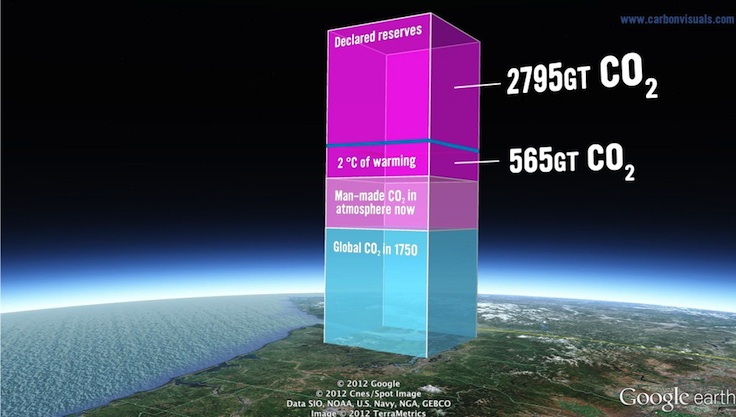
Climate scientists are calling for a phase-out of fossil fuels because humans are now pumping so much carbon dioxide (CO2) into the atmosphere that the ‘2-degree-C climate balloon’ will burst otherwise, new studies show.

That 2-degree C climate balloon has a maximum capacity of less than 1,400 gigatonnes of CO2 total emissions from the year 2000 to 2050, Malte Meinshausen and colleagues report in the current issue of Nature. The European Union and others consider a global temperature rise of more than 2 degrees C as dangerous and potentially catastrophic. Temperatures are already 0.8 C warmer than the pre-industrial period.

UPDATE Nov 2009 Prospect of a four-degree Celsius rise in global average temperatures in 50 years is alarming – but not alarmist, climate scientists now believe. Four Degrees of Devastation

The reality is that global emissions for the last seven years amounted to almost 250 gigatonnes of these long-lived greenhouse gases, meaning that the current and growing rates of fossil fuel emissions would burst the balloon in about 20 years – or less. Even if emissions are held to 1,400 gigatonnes maximum for the next 40 years, there is still a 50-percent probability of exceeding 2 degrees C, said Meinshausen, lead author of the study and climate researcher at the Potsdam Institute for Climate Impact Research.

Indigenous peoples from around the world also called for a phase-out of fossil fuels at the conclusion of the first Indigenous Peoples’ Global Summit on Climate Change in Anchorage, Alaska, that concluded last week.

“That call is well-supported by the evidence in this study,” Meinshausen told IPS.

Is this article of interest? It exists thanks to contributions from readers. Please click here to learn more about Community Supported Journalism.

Continue reading

Say Goodbye to Coral Reefs

severely-degraded-reef-flat-at-kelso-reef-great-barrier-reef-australiaimage-c2a9-cathie-page-very-sml

Coral reefs will be the first global ecosystem to collapse in our lifetimes.

By Stephen Leahy

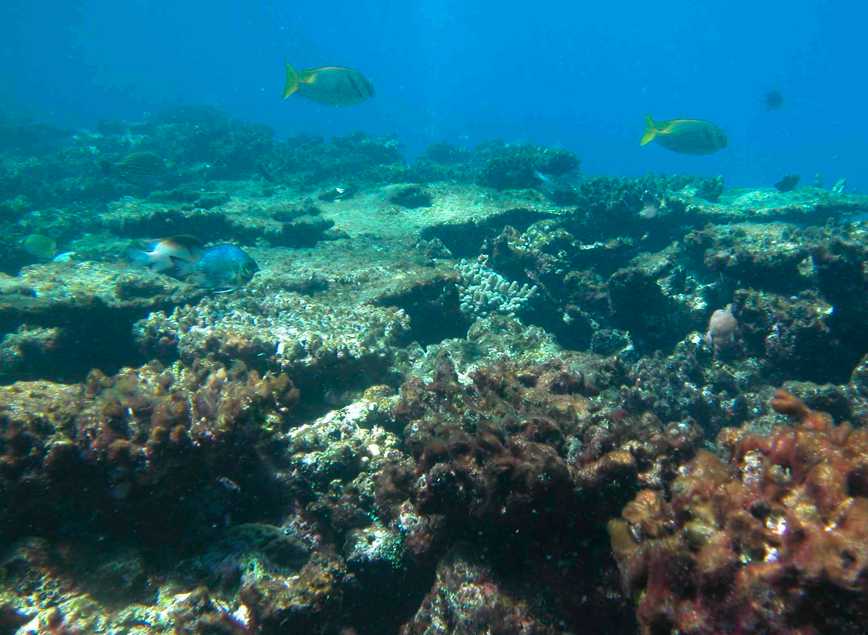
GIJON, Spain, May 22 (IPS) – The one-two punch of climate change that is warming ocean temperatures and increasing acidification is making the oceans uninhabitable for corals and other marine species, researchers said at a scientific symposium in Spain.

And now other regions are being affected. Acidic or corrosive waters have been detected for the first time on the continental shelf of the west coast of North America, posing a serious threat to fisheries, Richard Feely, an oceanographer with the U.S. National Oceanic and Atmospheric Administration (NOAA), told attendees in Gijon, Spain Wednesday.

More than 450 scientists from over 60 countries are participating in the “Effects of Climate Change on the World’s Oceans” symposium.

“Surface waters off the coast of San Francisco had concentrations of carbon dioxide that we didn’t expect to see for at least another 100 years,” Feely told IPS. Continue reading

“We’re Running the Risk of Unstoppable Climate Change” — Oceanographer

Interview with leading marine scientist Chris Reid

“I’m afraid it is going to take a major catastrophe in the developed world…”

GIJON, Spain, Jun 4 (IPS) – Warming seawater, melting sea ice and glaciers, sea level rise, storm intensification, changes in ocean currents, growing “dead zones”, and ocean acidification are just some of the signs that the oceans that cover 71 percent of our watery planet are changing.

Changes in the oceans also means major impacts on the land and the atmosphere. “Policy makers and the public do not realize that the oceans are the drivers of the climate system,” says Chris Reid, recently retired professor of oceanography at the Sir Alister Hardy Foundation for Ocean Science in Plymouth, England.

Reid will be producing a report this summer on the impacts the altered oceans are having and will have on the global climate.

IPS environment correspondent Stephen Leahy spoke to Reid at an international scientific symposium held late last month in Gijon, Spain on the effects of climate change on the world’s oceans.

IPS: What is happening in the oceans that will affect the global climate?

CR: The oceans have absorbed 30 percent of all human emissions of carbon dioxide (CO2) since the start of the industrial age. There is now good evidence that the oceans are absorbing less carbon as a result of climate change. The warming of surface waters, glacial and sea ice meltwater, acidification and so on are inhibiting or slowing a number of the oceans’ mechanisms for absorbing carbon from the atmosphere and safely storing them in the deep ocean.

IPS: How will that affect us?

CR: It means the atmospheric concentrations of CO2 will rise much faster than has been previously projected by climate scientists. Human carbon emissions are already on pace for the worst case scenario as envisioned by the IPCC (Intergovernmental Panel on Climate Change). These changes in the oceans means the rate of warming will increase, bringing even more severe hurricanes and cyclones, flooding events and so on.

IPS: Cyclones like the one that recently devastated Burma?

CR: Yes. Research presented at this meeting shows that South Korea and Japan are experiencing more powerful cyclones. While a single event can’t be precisely connected to climate change, the Burma cyclone fits what is expected with climate change. Continue reading

Greedy Canada Tries to Poison UN Climate Talks

dry-mud-fish-sml-manaquiri-amazonas-state-greenpeace.jpg

By Stephen Leahy

Dec 10 (IPS) – The family has just finished up an expensive seven-course restaurant meal, and the late-arriving cousins can only snack on bread sticks. When the bill arrives, the truculent, rich uncles — Canada, Japan and the United States — insist that the cousins, although poor and still very hungry, ought to pay a full share.

And then Uncle Canada suggests that he pay less because he has a big appetite and can’t help himself.

With the fate of the planet in the balance, many critics say that is the current state of the negotiations ongoing in Bali at the international climate change talks. And that is despite an urgent appeal by more than 200 of the world’s leading climate scientists late last week.

“Drastic reductions are needed…we have no time to lose,” said Richard Somerville of the Scripps Institution of Oceanography at University of California at a press conference in Nusa Dua, on the island of Bali. Political leaders from virtually every nation will finalise the next steps to a new climate change treaty under the United Nations Framework Convention on Climate Change (UNFCCC) at the end of this week. Continue reading