“Forests diebacks are taking place all around the world. The evidence is quite sobering,” said tropical biologist Daniel Nepstad of IPAM in Belem, Brazil.
This reinforces the urgent need to reduce emissions of fossils fuels and to develop a global land strategy to turn sources of CO2 into sinks for CO2, he said.
“Most of the evidence shows climate change is speeding up. Meanwhile political action on climate is slowing down,” Nepstad added.
Last week the Japanese govt injected $billions into Tepco, owners of the damaged Fukushima nuke plant that still poses a huge threat. Many more billions are needed to make it safe.
The nuclear energy industry only exists thanks to what insurance experts call the “mother of all subsidies”, and the public is largely unaware that every nuclear power plant in the world has a strict cap on how much the industry might have to pay out in case of an accident.
In Canada, this liability cap is an astonishingly low 75 million dollars. In India, it is 110 million dollars and in Britain 220 million dollars. If there is an accident, governments – i.e. the public – are on the hook for all costs exceeding those caps.
Japan has a higher liability cap of 1.2 billion dollars, but that is not nearly enough for the estimated 25 to 150 billion dollars in decommissioning and liability costs for what is still an ongoing disaster at its Fukushima Daiichi nuclear plant. Seven weeks…
Lopiso Lagebo, 25, comes from Kambata, a small town 800km away from Metahar. He starts working at 0500, cuts up to 5 tons (5,000 kg) of sugar cane a day and earns $0.8. The company recruits most of the work force around his home town, where land shortage drives the workers to emigrate. Caption and Photo: Alfredo Bini/Cosmos http://www.facebook.com/alfredobini
[I wrote this article three years ago revealing a global land grab by rich investors that is now estimated to be more than 200 million hectares – my recent update here – Stephen]
By Stephen Leahy*
ANCHORAGE, Alaska, USA, May 5 , 2009 (Tierramérica)
More than 20 million hectares of farmland in Africa and Latin America are now in the hands of foreign governments and companies, a sign of a global “land grab” that got a boost from last year’s food crisis.
Rich countries that are short on land or water at home are looking to secure food-producing lands elsewhere as a way to ensure food security for their populations, said Joachim von Braun, director of the International Food Policy Research Institute (IFPRI).
“There is a major lack of transparency in these land deals,” von Braun said in a telephone press conference from Washington.
The IFPRI study, “‘Land Grabbing’ by Foreign Investors in Developing Countries,” by von Braun and Ruth Meinzen-Dick, which was presented last week, estimates that 15 to 20 million hectares have been acquired or are in the process of being sold.
Von Braun pointed out that this is equivalent to about 25 percent of all the farmland in Europe.
Because hard data is difficult to come by – the study was based primarily on information from press reports – IFPRI conservatively estimates that the deals represent 20 to 30 billion dollars being invested by China, South Korea, India and the Gulf States, mainly in Africa.
“About one-quarter of these investments are for biofuel plantations,” von Braun said. Continue reading →
A number of marine diatom cells (Pleurosigma), which are an important group of phytoplankton in the oceans. Credit: Michael Stringer
“There’s a synergistic effect between increased ocean acidity and natural light”
“It’s clear we are conducting a giant experiment on the planet and we don’t know what we are doing.”
By Stephen Leahy
UXBRIDGE, Canada, May 8, 2012 (IPS)
Without major reductions in the use of fossil fuels, sunlight will kill an unknown number of ocean phytoplankton, the planet’s most important organism, a new study reports this week.
Not only are phytoplankton, also known as marine algae, a vital component in the ocean’s food chain, they generate at least half of the oxygen we breathe.
In the not so distant future, sunlight, the very source of life for phytoplankton, will likely begin to kill them because of the ocean’s increasing acidity, researchers from China and Germany have learned.
“There’s a synergistic effect between increased ocean acidity and natural light,” says Ulf Riebesell of the Helmholtz Centre for Ocean Research in Kiel, Germany.
Riebesell added that it was also possible “phytoplankton could adapt”.
Researchers were surprised to discover that diatoms, one of the most important and abundant types of phytoplankton, fared very badly during shipboard experiments conducted by co-author Kunshan Gao, from the State Key Laboratory of Marine Environmental Science at Xiamen University, Xiamen China.
Previous experiments in labs like Riebesell’s found that diatoms actually did better in high-acid seawater, unlike most other shell- forming plankton. Burning fossil fuels has made the oceans about 30 percent more acidic researchers discovered less than 10 years ago. Oceans absorb one third of the carbon dioxide (CO2) emitted from using fossil fuels.
The good news is this has slowed the rate of global warming. The bad news is oceans are now more acidic and it will get worse as more CO2 is emitted. This is basic, well-understood ocean chemistry. Continue reading →
+15,000 temperature records already broken in the US this year
By Stephen Leahy
UXBRIDGE, Canada, May 4, 2012 (IPS)
What are you doing on Saturday? Peter Nix, a retiree, will be standing on a railway track on Canada’s west coast blocking a coal train destined to ship U.S. and Canadian coal to Asia.
Nix will be joined by dozens of people near White Rock, British Columbia on May 5. They will be in good company as tens of thousands of people around the world participate in global day of action to “connect the dots” between climate change and extreme weather.
“There will be at least 1,200 actions in more than 100 countries,” says Jamie Henn, communications director for 350.org, a U.S.-based environmental group.
Please throw something in the tip jar before reading on. This is how I make my living.
There’s been a general perception that climate change is a future problem but with all the extreme weather disasters and weather records the public is being to realise that climate change is here, says Henn.
“Recent opinion surveys show the more than 60 percent of the U.S. public are connecting extreme weather to climate change,” Henn told IPS.
The U.S. public is not wrong, say scientists.
“All weather events are affected by climate change because the environment in which they occur is warmer and moister than it used to be,” Kevin Trenberth, senior scientist at the U.S. National Center for Atmospheric Research, told IPS previously. Continue reading →
[Updated May 11 2012: At last a serious plan to phase out these subsidies will be on the table at the Rio+20 meet in June. I will be following this closely – with your help – Stephen ]
Experts say the subsidy madness must stop. With unemployment high can governments facing recession summon the will to end the fossil fuel industries’ FREE RIDE?
By Stephen Leahy
BERLIN, Jun 29, 2010 (IPS)
Every day, governments give away an estimated two billion dollars of taxpayer money to the fossil fuel industry. This unmatched largesse to a highly profitable sector by countries verging on bankruptcy or unable to feed large numbers of their own people is “complete madness”, according to many experts.
In Toronto Sunday, at the conclusion of G20 summit, countries agreed the madness must be constrained if not stopped.
“I was impressed. I think the commitment to phase out…
This is a repost from last year. Sad to see little progress on this issue. — Stephen
“There is no reason for delay. Governments and industry need to take action and people have to stop pointing fingers at each other and get on with it.”
California nearly became the first U.S. state to ban plastic bags, but a multi-million-dollar lobby effort by industry killed the proposed legislation
By Stephen Leahy
HONOLULU, Hawaii, U.S., Mar 28, 2011 (IPS)
Every day, billions of plastic bags and bottles are discarded, and every day, millions of these become plastic pollution, fouling the oceans and endangering marine life.
No one wants this, but there is wide disagreement about how to stop it.
“Every time I stick my nose in the water, I am shocked. I see less and less fish and more and more garbage,” said Jean-Michel Cousteau, son of the legendary marine ecologist Jacques Cousteau, who has spent four decades making documentaries and educating people about the oceans.
Please throw something in the tip jar before reading on. This is how I make my living.
On trips to the remote and uninhabited northwestern Hawaiian Islands, Cousteau found miles and miles of plastic bottles, cigarette lighters, television tubes, spray cans, broken toys, and thousands of other pieces of plastic on the beaches and thousands of tonnes of derelict fishing nets in the reefs.
“We are using the oceans as a universal sewer,” he told some 440 participants from the plastics manufacturing, food and beverage sectors, environmental organisations, scientists and policy-makers from over 35 countries at the Fifth International Marine Debris Conference in Honolulu, Hawaii, which ended Mar. 25. Continue reading →
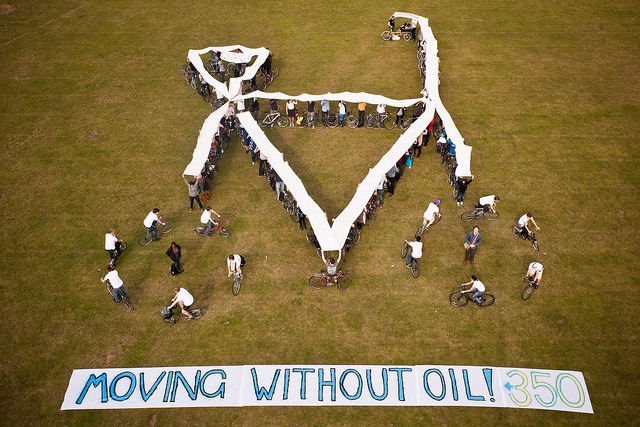
In North America the cost of owning and operating a private automobile amounts to 8,000 to 12,000 dollars a year of after-tax income, according to automobile clubs. Many families have two vehicles that their biggest expense by far. There better ways to be mobile.
Car Ownership Declines in Europe as Cities’ Focus on Walking, Bikes & Public Transit
Cost of Personal Car Ownership Tops $10,000 a year
By Stephen Leahy
CHANGWON, South Korea, Nov 1, 2011 (Tierramérica)
Berlin is a big capital city of a country famed for making excellent automobiles, but it can no longer afford roads and is now moving people by transit, bike and especially through walking.
Berlin is not alone. Paris, Tokyo, Seoul, Bogotá, New York City and other major cities simply cannot afford the cost, the pollution, the noise and the congestion of more cars. They are embracing a new concept called EcoMobility – mobility without private cars.
“EcoMobility is not only walking, cycling and public transportation. It is about these three systems clicking together: connectivity is the key,” Gil Peñalosa, former director of parks and recreation in Bogotá, Colombia, told those attending the EcoMobility Changwon 2011 congress.
Wind-solar electricity generation built by indigenous Telengits community in Russia’s Altai Mountains. Photo: Foundation for Sustainable Development of Altai
The planet is in peril, 3,000 scientists and other experts concluded at the recent Planet Under Pressure conference in London. Climate change, overuse of nitrogen and loss of biodiversity are just three of the perils threatening to make much of our home uninhabitable.
World leaders will meet in Rio de Janeiro June 20-22 to address this at the Rio+20 Conference, 20 years after the very first Earth Summit.
Rio+20 needs to be the moment in human history when the nations of the world come together to find ways to ensure ‘the very survival of humanity,’ environmentalists and scientists have said.
A “Green Economy” will be one of the main ideas under discussion in Rio. The idea is to make a transition to an economic system that maximizes human well-being while operating within the planet’s environmental limits. Exactly how this could be accomplished has yet to be defined.
The current economic system rewards those who exploit and destroy nature, said Vicky Tauli-Corpuz, Executive Director, Tebtebba (Indigenous Peoples’ International Centre for Policy Research and Education).
The current system hinders and even blocks Indigenous peoples from practicing their traditional ways of living that actually represent “a real green economy” that can be sustainable, achieve well being and are climate-friendly, said Tauli-Corpuz, a member of the indigenous Kankana-ey Igorot community in the Philippines.
Please throw something in the tip jar before reading on. This is how I make my living.
Here’s a thoughtful article written by my son who is working on a farm in Tasmania. Normally he is a historical tour guide in Europe. He’s not part of any organization but just decided to take action for sake of his generation’s future. It is amazing what he and his friends are up to. — Stephen
By Derek Leahy
FRANKLIN, TASMANIA
I sat down in a café in Franklin, Tasmania the other day trying to sort out all that has transpired these past few weeks. You see, May 5thcould very well become a massive day of action. A lot of people from all over the world want to make their voices heard the week of May 5th. International Stop the Tar Sands Day’s circle of friends just got bigger.
Anyway, I sat down in an practically empty café (Franklin is a pretty small town), opened…










 FRANKLIN, TASMANIA
 Stephen Leahy, International Environmental Journalist