Climate March 100% is Possible – Ottawa, Canada. Credit: Renee Leahy
The Paris climate talks began today following a weekend where a record-breaking 785,000 people in 175 countries marched in support of strong climate action. In addition almost 1.8 million people of faith signed a petition for compassionate climate action.With nearly 150 Heads of State on hand the COP 21 negotiations began Monday. Hopes are high there will be a strong, new global agreement to tackle climate change. Unlike six years ago in Copenhagen at COP 15, there is now broad public support for action on climate and virtually all leaders now take the issue very seriously.One of the very first side meetings outside of the negotiations today featured the World Bank, the leaders of Germany, Mexico, Chile, Canada and others calling for a global price on carbon. [Watch it here]The world simply cannot afford to continue polluting the atmosphere with carbon said World Bank President Jim Yong Kim.
“We need to drastically cut CO2 emissions… or we will push another 100 million people into poverty” Kim said.
Global price on carbon inevitable
Putting a price on carbon is now seen as an inevitable in the creation of a low carbon economy that will eventually take the world to zero CO2 emissions he said.
“The price of solar has fallen 50 per cent since Copenhagen,” said Keya Chatterjee of the US Climate Action Network.
There has also been huge growth in the numbers of climate activists and in public support for real action on climate over the past six years Chatterjee said in a press conference.
The only question now is how much has political will grown, she said.
A great deal of political will is needed to overcome the many remaining obstacles to a comprehensive, ambitious, and universal climate agreement. These obstacles include finance, equity, legal status of the agreement and so on will become clear over the next two weeks.
For now hope is also back after a six year absence.
A historic climate change conference is taking place in Paris, France from November 30 to December 11th. World leaders from more than 195 nations will meet to work on a new international climate deal, with the aim of keeping global warming below 2 degrees Celsius.
The award-winning Climate News Mosaic (CNM)will provide a free daily live blog to track all progress, major announcements and events, latest scientific reports, as well as happenings in and outside of the conference halls with stories, photos, videos, soundbites from experienced journalists from different countries.
The live blog will also feature climate news updates, reactions and short reports from a variety of countries for a unique mix of global and local coverage.
The Climate News Mosaic (CNM) is the award-winning collaboration of independent environmental journalists from Canada, the Philippines, Germany, Italy, Costa Rica, Brazil and many more. In 2014 CNM won the international HostWriter Prize for its collaborative coverage of the UN Climate Change Conference in Warsaw (COP 19). The live blog was hosted on nine news sites including the Inter Press News Service, Climate Home, Earth Journalism Network.
Stay up-to-date. Follow @climatemosaic on Twitter for the latest news and information in follow-up to the summit and elsewhere (hashtag: #climate2015)
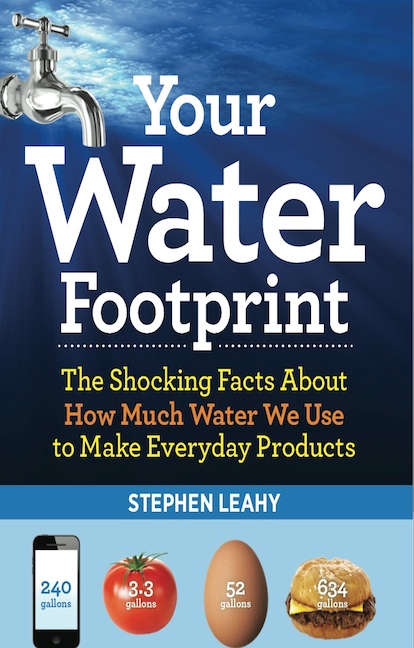
In Your Water Footprint (Firefly Books), Stephen Leahy introduces readers to the Virtual Water Concept and to readers’ awareness of how much water is used in our everyday activities. Leahy is an environmental journalist from Uxbridge, Ontario.
The juries based their decision on the relevance of each book’s content to the importance of science in today’s world, as well as the author’s ability to connect the topic to the interests of the general trade reader.
“The Fitzhenry Family Foundation is excited to award two pieces of work that ultimately encourage protection of the earth’s resources and animal welfare,” said Holly Doll. “It’s important to us that Canadians are encouraged to read about science and the environment at both young reader and adult levels.”
Derek and Stephen Leahy at entrance to UN climate conference COP 15 in Copenhagen
One night in a bar a Russian journalist who I’d just met says: “This global warming is too complicated for people to know if it’s real or not”.
“You don’t think climate change is happening?” I asked with surprise since we were both covering a big United Nations climate conference.
“No one has been able to give me a good explanation to prove it’s real,” said Yuri (not his real name).
“I can explain it to you in less than one minute,” I replied.
Yuri was sceptical but I went ahead and said:
“The moon has no atmosphere so it is scorching hot (+100C) during the day and bitterly cold (-150C) at night. The Earth has an atmosphere made up of oxygen, nitrogen, carbon dioxide (CO2) and other gases. Over 150 years ago scientists proved that CO2 traps heat from the sun. We also know without any doubt that burning fossil fuels like oil, gas and coal emits CO2.
Measurements, not computer models or theories, measurements show that there is now 42% more CO2 in the atmosphere than 150 years ago before massive use of fossil fuels. That extra CO2 is like putting another blanket on at night even though you are already nice and warm. The Earth is now 1.0 C hotter on average according to the latest measurements. Heat is a form of energy and with so much more energy in our atmosphere our weather system is becoming supercharged resulting in stronger storms, worse heat waves, major changes in when and where rain falls and more.
That’s it.
After a long silence Yuri says “I guess that makes sense…”.
I’m not sure he was convinced but the truth is that climate change is not that complicated.
One additional thing to know is that CO2 is forever. Every little CO2 molecule we add to the atmosphere will continue to trap the sun’s heat for hundreds and thousands of years.
What: A candid, 15 minute explanation on why the UN climate negotiations are so difficult and the likely result in Paris. Intended for a general audience.
Who: Stephen Leahy is an independent, environmental journalist who has covered climate negotiations around the world. He is co-winner of the 2012 Prince Albert/United Nations Global Prize for reporting on Climate Change.
Cars and trucks are extraordinarily expensive. The full cost of driving 100 km is between between $50 and $75 when fuel, wear and tear, insurance, depreciation, and repairs are included. The cost of owning and operating a car, van, SUV or truck ranges between $9,000 to $15,000 a year depending on the purchase price of the vehicle according to automobile clubs like the CAA . That’s a big chunk of aftertax income spent each and every year. Double this for two-car families.
If you pay $50 at the pump about $33 will go directly to oil companies. The gas station gets around a dollar and the rest is for provincial and federal taxes.
Finally ask yourself how many hours a day your vehicle isn’t being used? Most are parked 22 hours a day.
Why not give your car a day off once a week? A ‘No Car Day’ is easy to do, saves money and reduces emissions of climate-heating carbon dioxide (CO2). The average passenger vehicle emits around 4.8 tonnes of CO2 a year.
The biggest savings by far is to get rid of one vehicle. When you consider the full costs of ownership, the $9 000 to $15,000 saved will let you rent vehicles or taking taxi as needed with plenty of cash left over. For maximum savings use the bus or train. A bus from Uxbridge is only $10 to downtown Toronto — 75 km one way. Using your car that 75 km trip really costs $45 not including parking.
New study – drive less lose weight guaranteed: If drivers nationwide traveled 1 mile less by car each day, not only would fuel consumption fall, but annual health care costs could drop by billions of dollars as fewer people would be classified as obese or overweight, Jacobson estimates.
Eighty minutes of lively, thought-provoking ideas about the impact, use, and health of water in Canadian and global society
SPATZ THEATRE, 1855 TROLLOPE ST., HALIFAX
MONDAY, MAY 25, 2015, 7:00 P.M.
Featuring:
Stephen Leahy, International environmental journalist, author of the critically acclaimed book Your Water Footprint: The Shocking Facts about How Much Water We Use to Make Everyday Products.Your Water Footprint. Stephen will talk about The Virtual World of Water
Dave Courchene (Nii Gaani Aki Inini – Leading Earth Man), founder and leader, Turtle Lodge
Susanna Fuller, Ecology Action Centre
John Geiger, Royal Canadian Geographical Society
Angela Giles, Council of Canadians
Chris Henderson, Lumos Energy
Kevin McMahon, Documentary director and producer
Alanna Mitchell, Science journalist and author
John Smol, Canada Research Chair in Environmental Change
This is what a few Arctic ice experts were saying in 2008 when I covered a special meeting in Quebec City. The ice had reached shocking record lows in September of 2007 + 2008. Turns out the Arctic ice is more resilient and will still be there in September of this year. However it will likely be the lowest amount of ice in the past million years. – SL]
“We’re going to see huge changes in the Arctic ecosystem“
QUEBEC CITY, Canada, Dec 13 2008 (IPS)
In just a few summers from now, the Arctic Ocean will lose its protective cover of ice for the first time in a million years, according to some experts attending the International Arctic Change conference here.
“Things are happening much faster in the Arctic. I think it will be summer ice-free by 2015,” said David Barber, an Arctic climatologist at the University of Manitoba.
Such a “dramatic and serious loss of sea ice will affect everyone on the planet,” Barber told IPS.
Critically Acclaimed New Book Investigating The Enormous Amounts Of ‘Hidden’ Water We Consume Every Day
It takes more than 7,600 liters (2,000 gallons) of water to make a single pair of jeans. That morning cup of coffee required 140 liters (37 gallons) of water before it found its way to your table—water that was used to grow, process and ship the coffee beans. When we spend money on food, clothes, cellphones or even electricity, we are buying water — a shockingly large amount of water.
Your Water Footprintprovides essential information to reduce your water use which will help you save money, be prepared for shortages and ensure our children and grandchildren will have abundant fresh water. Water-wise choices is all about smart substitutions and changes, rather than sacrifice and self-denial.
David Cadman and Park Won Soon at the ICLEI World Congress 2015 in Seoul, South Korea
By Stephen Leahy
Report from 2015 World Congress: National Governments Should Be Helping Green Cities
Cities are responsible for 70 per cent of global CO2 emissions but they can save the planet by greening one community at a time said Vancouver’s David Cadman at the close of the ICLEI World Congress 2015, the triennial sustainability summit of local governments in Seoul, South Korea.
“We can do it. We must do it,” Cadman, the retiring president of Local Governments for Sustainability, told some 1,500 delegates from nearly 1,000 cities and local governments in 96 countries on April 11.
The majority of climate actions and most plans to reduce CO2 emissions are happening at the city level, Cadman told DeSmog Canada in Seoul.
Vancouver and 50 other cities have committed to 100 per cent renewable energy and 500 more are part of ICLEI’s Cities Climate Registry that documents verifiable CO2 emission reduction actions and commitments that amounted to 2.8 billion tons a year in 2014.
Cadman, a former City of Vancouver councillor, has been president of ICLEI since 2006. It’s an international organization headquartered in Bonn, Germany, with 280 staff and 23 other offices scattered around the globe. ICLEI, which stands for International Council for Local Environmental Initiatives, started 25 years ago in Toronto to help cities become more sustainable. It now goes by the more manageable name of “Local Governments for Sustainability,” but still uses the original acronym.
Canada’s federal and provincial governments were very strong supporters in the early days but the past decade has been very different.
Canada Chained to Fossil Fuel Sector
“We seem to be chained to the fossil energy industry in Canada and it’s pulling us down. Cities and organizations can hardly dare to speak out about this now,” he said.
Germany was only too happy to bring ICLEI to Bonn eight years ago and has been generous with its support, along with the European Union. Now the organization is experiencing what is being called an “Asian pivot,” with the mayor of Seoul, Park Won Soon, as the new president.
Park has helped Seoul to become one of the world’s leaders on sustainable development. With 11 million people and growing fast, Seoul will reduce its energy use and increase renewable generation including rolling out 40,000 solar panels to households by 2018 and 15,000 electric vehicles. By 2030, CO2 emissions will be cut 40 per cent.
“Action on climate will be by local governments no matter what national governments decide,” Park Won Soon told DeSmog Canada.
“We need to act quickly, we need to act energetically,” the mayor said.
China’s megacities are also joining ICLEI. At the congress, Hailong Li, deputy secretary general of the China Eco-city Council said the country will have 100 low-carbon eco-cities by 2017. That will drive down the costs of energy efficiency and renewable energy, Li said.
China also intends to become an expert on eco-construction and to market its expertise to the rest of the developing world.
By 2030 another 3.5 billion people will be living in cities so it is absolutely critical that the infrastructure be sustainable said Cadman who will continue to be active as special representative to the new ICLEI President.
“I’m 70 now and need to reduce my workload. My wife says she’d like me to be around a bit longer.”
Canadian cities could also do more and sooner if they had the support of provincial and federal governments, he said. That may be changing at the provincial level with growing support for various forms of carbon taxes that will help generate funds and financial incentives to reduce emissions.
“The provinces are doing the heavy-lifting on climate while the Harper government sits on the sidelines.”
Fossil fuels are in decline — divestment is taking off and investments are shifting to renewable energy. There’ll be no pipelines to the West Coast and no new investments in the oilsands, Cadman said.
Even in B.C., the hoped-for markets for LNG may not exist with China building gas pipelines to tap reserves in Iran and Russia, he said.
“Canada needs to move away from selling raw resources, but is any political party ready to go there?”


 One of the very first side meetings outside of the negotiations today featured the World Bank, the leaders of Germany, Mexico, Chile, Canada and others calling for a global price on carbon. [Watch it here]The world simply cannot afford to continue polluting the atmosphere with carbon said World Bank President Jim Yong Kim.





 Stephen Leahy, International Environmental Journalist