Put a glass lid over Japan, Germany or England and they wouldn’t last long.
[excerpts from my Nov 2010 article on why losing species matters to everyone — Stephen]
Japan imports more than 60 percent of its food and most of Europe’s ecosystems have been trashed, with only 17 percent in reasonable shape, according to a first-ever assessment. The only reason those countries haven’t collapsed is they are rich enough to help themselves to nature’s ecological resources and services like food, timber, materials from the rest of the world.
Countries of the North are like desperate bio-pirates, addicted to plundering the richer ecosystems of the South for food, raw materials and cheap labour. Increasingly, the South is resisting and seeking redress. Part of that redress, and the only way to end the escalating loss of species – an estimated 5,000 to 30,000 extinctions per year – is to transform the growth economy
“Japan played a central role in the growth economy. We need to move to a subsistence economy,” Mushakoji told IPS.
“Should you and I pay for the kind of accurate news reporting that is needed to fill us in on what is happening to the planet?
If we’re not willing to pick up the tab to stay better informed, who will?”
Renowned Swiss journalist Daniel Wermus and Director of the Media21 Global Journalism Network in Geneva asks those questions in an April 2010 article about my launch of Community Supported Journalism in 2009. [Updated from Sept 2010] — Stephen
I meet international freelance journalists quite often. Most make it clear that budget cuts have made it increasingly difficult for just about anyone, especially freelancers, to get into print. It is usually the freelancers who are most willing to risk their lives to get the stories that need reporting the most. If the day arrives when they can no longer carry out their professions, we will all have a serious problem.
Muckraker: A reporter or writer who investigates and publishes reports involving a host of social issues, broadly including crime and corruption
Stephen Leahy, a Canadian, and one of the world’s best-known investigative reporters on environmental issues, has launched a challenge: if corporations won’t pay for the news, then it is up to communities and the public to fill the gap. A free society needs journalism, even if reporting the news is not commercially profitable.
Leahy’s model for supporting the news has the journalist make his pitch over the internet. The completed article can then be distributed by news agencies or magazines that are low on funds but high on public interest. That could be IPS, Reuters-Alertnet, Commondreams, InfoSud, The Essential Edge or any number of other publications and news outlets.
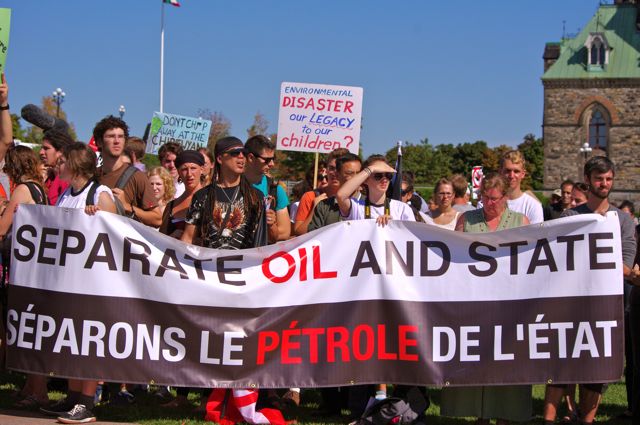
More than 200 Canadians engaged in civil disobedience, with 117 arrested in Canada’s quiet capital city on Monday. The reason? To protest the Stephen Harper right-wing government’s open support for the oil industry and expanding production in the climate-disrupting tar sands.
Maude Barlow, chairperson of the Council of Canadians, is arrested at the Sep. 26 tar sands protest. Credit:Renée Leahy/IPS
The normally placid and polite Canadians shouted, waved banners and demanded the closure of the multi-billion-dollar tar sands oil extraction projects in northern Alberta to protect the global climate and the health of local people and environment.
“People are here because they know that if we don’t turn away from the tar sands and fossil fuels soon it will be too late,” Peter McHugh, a spokesperson for Greenpeace Canada, told IPS.
“The tar sands are unsustainable. Canadians are willing to shift away from fossil fuels but our government isn’t,” Gabby Ackett a university student and protester, told IPS as she stood in front of a long line of police.
In what was proudly touted as “civil” civil disobedience, protesters aged 19 to 84 were arrested for using a step-stool to climb a low barrier separating them from the House of Commons, the seat of Canadian government. The police were friendly and accommodating because the organisers had promised there would be no violence.
“We live downstream and see the affects of tar sands pollution on the fish and the birds,” said George Poitras, a former chief of the Mikisew Cree First Nation in northern Alberta.
“Some our young people have rare forms of cancer,” Poitras told more than 500 protesters.
“Expanding the tar sands is not the way to go in a world struggling with climate change,” he said.
Carbon emissions from the tar sands production have increased 300 percent since 1990 and, at 45 to 50 million tonnes annually, are greater than most countries. And that does not include the carbon contained in the oil itself.
When burned, the 1.6 million barrels of oil that are extracted every day will add 346 million tonnes of carbon to the atmosphere this year alone. That’s almost the entire emissions of the country of Australia. The oil industry is making billion-dollar investments in the tar sands to more than double production by 2025. Continue reading →
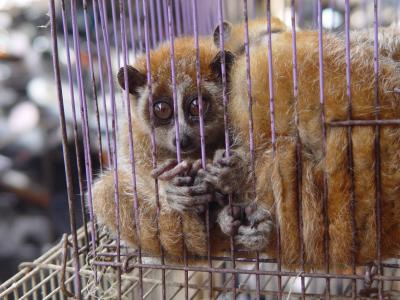
Slow loris from an illegal wildlife market in Southeast Asia
This story was featured on the IPS wire and on the Al Jazeera network . It’s about a study showing that national parks, conservation and protected areas have not and cannot halt the decline in biodiversity that is our life support system. It is hopeless without addressing the root cause of this and all other environmental problems: too many of us, taking too much and having too big of an impact. On our present course we’ll need 27 planet Earths by 2050 they conclude. — Stephen
By Stephen Leahy
UXBRIDGE, Canada, Jul 29, 2011 (IPS)
Protecting bits of nature here and there will not prevent humanity from losing our life support system. Even if areas dedicated to conserving plants, animals, and other species that provide Earth’s life support system increased tenfold, it would not be enough without dealing with the big issues of the 21st century: population, overconsumption and inefficient resource use.
Without dealing with those big issues, humanity will need 27 planet Earths by 2050, a new study estimates.
The size and number of protected areas on land and sea has increased dramatically since the 1980s, now totaling over 100,000 in number and covering 17 million square kilometres of land and two million square kilometres of oceans, a new study reported Thursday.
But impressive as those numbers look, all indicators reveal species going extinct faster than ever before, despite all the additions of new parks, reserves and other conservation measures, according to the study published in the journal Marine Ecology Progress Series.
“It is amazing to me that we haven’t dealt with this failure of protected areas to slow biodiversity losses,” said lead author Camilo Mora of University of Hawaii at Manoa.
“We were surprised the evidence from the past 30 years was so clear,” Mora told IPS.
The ability of protected areas to address the problem of biodiversity loss – the decline in diversity and numbers of all living species – has long been overestimated, the study reported. The reality is that most protected areas are not truly protected. Many are “paper parks”, protected in name only. Up to 70 percent of marine protected areas are paper parks, Mora said.
The study shows global expenditures on protected areas today are estimated at six billion dollars per year, and many areas are insufficiently funded for effective management. Effectively managing existing protected areas requires an estimated 24 billion dollars per year – four times the current expenditure.
“Ongoing biodiversity loss and its consequences for humanity’s welfare are of great concern and have prompted strong calls for expanding the use of protected areas as a remedy,” said co-author Peter Sale, a marine biologist and assistant director of the United Nations University’s Institute for Water, Environment and Health.
“Protected areas are a false hope in terms of preventing the loss of biodiversity,” Sale told IPS. Continue reading →
More than 16,000 people killed or injured on roads EVERY day
Health costs $500 billion ++
By Stephen Leahy
LEIPZIG, Germany, May 31, 2011 (IPS)
The leading killer of children over the age of five is not malaria or dysentery, but cars and trucks. And ninety percent of those children are killed on roads in developing countries.
Each day, 3,500 people are killed and 13,700 injured in road accidents around the world. That death and injury toll is expected to increase by nearly 50 percent over the next decade without serious efforts to improve road safety, says Etienne Krug, director of the Department of Violence and Injury Prevention and Disability at the World Health Organization (WHO).
Krug was here in Leipzig to the launch of the United Nations the Decade of Action for Road Safety at the Organisation for Economic Cooperation and Development’s annual International Transport Forum. The goal for the U.N. Decade is to stabilise the spiralling increase in death and injuries on the world’s roads.
“We have the potential to save five million of lives over the next decade through changes in road safety,” Krug told IPS.
“A cultural shift is needed to create the awareness of the need for road safety,” he said.
Around 90 percent of all road fatalities occur in emerging and developing countries, making it the sixth leading cause of death in those countries. The lack of road safety laws and enforcement combined with increasing vehicle usage and population growth are the major reasons for this, said Krug.
Only 15 percent of countries in the world have good legislation on drinking and driving or use of helmets when driving scooters and motorcycles. “We want to push that to 50 percent by the 2020,” he said.
Legislation and enforcement can make a huge difference. Vietnam enacted a helmet law two years ago and the use of helmets went from only 20 percent to over 90 percent, he said. Brazil recently enacted strict drinking and driving laws, while Mexico has made wearing seatbelts mandatory.
This is my final article in the Trashing the Ocean series. It looks at the results of the first major international effort to deal with the issue in 11 years. It’s less than satisfying effort largely due to the plastics lobby. One of the unofficial solutions: buy local and create local, sustainable communities says the guy who ‘discovered’ the pacific garbage patch. — Stephen
There are three to six kilogrammes of marine trash for every kilogramme of plankton…. California nearly became the first U.S. state to ban plastic bags, but a multi-million-dollar lobby effort by industry killed the proposed legislation
By Stephen Leahy
HONOLULU, Hawaii, U.S., Mar 28, 2011 (IPS)
Every day, billions of plastic bags and bottles are discarded, and every day, millions of these become plastic pollution, fouling the oceans and endangering marine life.
No one wants this, but there is wide disagreement about how to stop it.
“Every time I stick my nose in the water, I am shocked. I see less and less fish and more and more garbage,” said Jean-Michel Cousteau, son of the legendary marine ecologist Jacques Cousteau, who has spent four decades making documentaries and educating people about the oceans.
On trips to the remote and uninhabited northwestern Hawaiian Islands, Cousteau found miles and miles of plastic bottles, cigarette lighters, television tubes, spray cans, broken toys, and thousands of other pieces of plastic on the beaches and thousands of tonnes of derelict fishing nets in the reefs.
“We are using the oceans as a universal sewer,” he told some 440 participants from the plastics manufacturing, food and beverage sectors, environmental organisations, scientists and policy-makers from over 35 countries at the Fifth International Marine Debris Conference in Honolulu, Hawaii, which ended Mar. 25.
Humanity is risking its own health and survival in treating the oceans this way, Cousteau said. The oceans are the source of life on our planet. Through evaporation, oceans are the most important source of fresh water while phytoplankton generates at least half the oxygen we breathe.
“No one is away from the ocean. We are all intimately connected by every breath we take,” he said.
We share the planet with 8.7 million species. We’re unconcerned about the ongoing loss of 200 species a day since we fail to realize they are our life support system. And we don’t know how many or which species are needed to keep things running. There is metaphor in the article to make that clearer I hope. We are not even close to coming to grips with this issue. — Stephen
“If the decline in species around us is not significant then I ask what is?”
By Stephen Leahy
UXBRIDGE, Canada, Aug 23, 2011 (IPS)
The life support system that generates the planet’s air, water, and food is powered by 8.7 million living species according to the newest and best estimate. We know next to nothing about 99 percent of those unique species – except that lots of them are going extinct.
“It is like a complicated engine where we only know about the major pieces. If we lose one or some of the small hidden pieces that play a critical role the engine might stop working,” said Camilo Mora of the University of Hawaii and Dalhousie University in Halifax, Canada.
“Many species may vanish before we even know of their existence, of their unique niche and function in ecosystems,” Mora told IPS.
Until now there wasn’t even a decent guesstimate about how many species exist currently: three million? 100 million? Now a new validated analytical technique has pined down the big number to 8.7 million species (give or take 1.3 million).
The analysis published Tuesday in the journal ‘PLoS Biology’ estimated there are 6.5 million species found on land and 2.2 million – about 25 percent of the total – dwelling in the ocean depths.
“Not knowing the answer to this fundamental question really highlights our ignorance about life on this planet,” said Boris Worm of Dalhousie University, co-author of the study along with Mora.
“We’re so fixated on the human enterprise we don’t recognise nature’s enterprise… the 8.7 million species that run the planet and provide the air we breathe, the water we drink and the soil we grow our crops in,” Worm told IPS. “If the decline in species around us is not significant then I ask what is? This is all we have on this planet, the only planet that holds life.” Continue reading →
Cars are parked 22 hours a day on average yet world will have 2.5 billion cars in 2050
The costs of car ownership and travel are far higher than anyone realizes: a 100 km total trip costs between 65 and 80 dollars when parking, fuel, wear and tear, insurance, depreciation, repairs are included. A car is usually parked and unused 22 hours a day but still incurs costs. Why not let someone use the car when you’re not and make some money at the same time Robin Chase told me for this article. She’s launched Buzzcar in France as part of a strategy for reducing carbon emissions and congestion in cities. — Stephen
Why do car owners get so much more public space than bus riders, bicyclists or walkers?
By Stephen Leahy
BERLIN, Jun 2, 2011 (IPS)
The world’s more than 850 million cars and small trucks are parked 20 to 22 hours a day. Why not use these vehicles more efficiently by letting other people drive them when the owners aren’t, asks Robin Chase, CEO of Buzzcar, a car- sharing network to be launched shortly in France.
“Sharing vehicles is much more efficient and represents a huge opportunity,” Chase told some 800 attendees from more than 50 countries at the OECD’s annual International Transport Forum (ITF) in Leipzig last week. The Forum is an intergovernmental organisation for the transport sector involving 52 different nations.
The ITF projects there will be three times as many cars – an eye-popping 2.5 billion – by 2050 according to its Transport Outlook 2011 report released at the meeting. Adding that many more vehicles in a sustainable way is an “extraordinary challenge”, said Jack Short, Secretary General of the ITF.
The vast majority of this growth will come from the developing countries since travel by passenger vehicle in a number of high-income countries has not increased, and even declined in some countries. Short acknowledged making such projections is risky because many factors such as lower economic growth, congestion in cities or new technologies will have an impact on levels of car ownership in future.
And the Transport Outlook report did not factor in the potential for car-sharing to offer personal mobility without car ownership.
Buzzcar is a car sharing service where car-owners in a city or town allow their idle cars to be used by other local citizens in exchange for getting about 70-75 per cent of the rental fee, Chase told IPS in an interview. Even when a car is parked it costs their owners money, she says. The average cost of owning and operating car is 8,000 to 12,000 dollars a year even if it sits parked 22 hours a day. (update: more like $9,000 to 14,000 according to auto clubs)
Buzzcar is an opportunity for car owners to get better value out of their vehicles and to help with ever- rising costs of car ownership. More importantly car sharing reduces the need for car ownership overall, she says.
Chase was a co-founder of Zipcar, a U.S.-based car-rental network with more than a half million members where people rent cars by the hour from easy-to-access neighbourhood lots or stations. Zipcar owns some 8,000 rental cars. She then went on to start GoLoco, a ride sharing company in which people pay to ride along with others in the network, and the drivers take a cut of the fees. Continue reading →
This article looks at the huge upswing in extreme events around the world. Imagine this: the worst-ever tornado season, the worst flooding, and worst heatwave have hit the US this year. And they may yet experience one the worst hurricane seasons. “24 Hours of Reality” online broadcast documented this Sept 15 to help people clear their heads of the fossil fuel propaganda and open their eyes to the crisis we are facing. — Stephen
“There are four anti-climate change lobbyists in Washington for every member of Congress.”
By Stephen Leahy
UXBRIDGE, Canada, Sep 15, 2011 (IPS)
The dramatic increase in extreme weather that has affected hundreds of millions across the planet is one of the clearest signs that burning billions of tonnes fossil fuels has seriously and permanently disrupted the global climate, experts say.
That is the reality former U.S. vice president Al Gore is focusing on Thursday through an unprecedented live online event called “24 Hours of Reality” broadcast from 24 time zones and reaching millions of viewers in multiple languages.
“In 30 years of weather forecasting I have never seen extreme weather events like those in the last two years globally,” said Jeff Masters, co-founder and Director of Meteorology for Weather Underground, the web’s first commercial weather service.
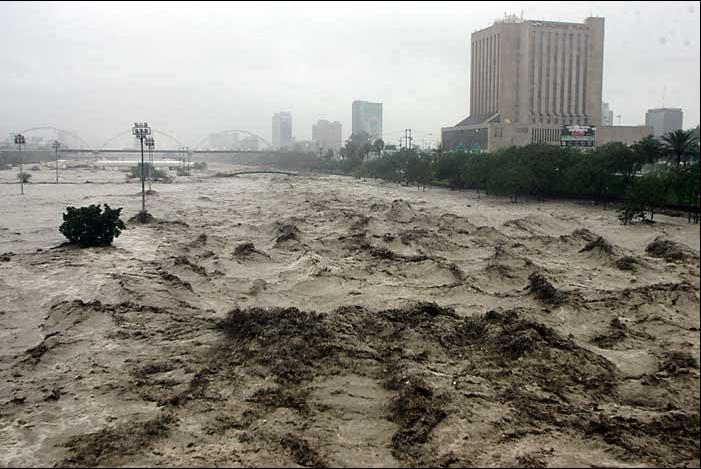
“I never thought we could have the greatest outbreak of tornados, the worst-ever flooding, record heatwaves and droughts all in one year,” Masters told IPS at a press conference last week in reference to the multi-billion-dollar extreme weather the U.S. has endured this year.
“The hurricane season is only half over and is on pace to be a record year as well,” he said.
Masters and other climate experts say is the “new normal” for the coming decades is the reason why. Burning of oil, gas, coal puts billions of tonnes of carbon dioxide into the atmosphere, where it traps more of the sun’s heat in what is known as the greenhouse effect.
That additional heat warms the oceans and air and allows more moisture to be retained in the atmosphere, scientists have long since proven. The enormous amounts of additional heat and moisture now trapped in the atmosphere are the potent fuel for extreme events.
“More than 1,400 high temperature records were broken in July in the eastern U.S.,” said Jerry Meehl, a senior scientist at the National Center for Atmospheric Research. Continue reading →
Rapidly warming planet biggest threat to all nations
Military budget more than enough to convert USA to 100% renewable energy
Analysis by Stephen Leahy
UXBRIDGE, Canada, Sep 15, 2011 (IPS)
All the analysis and commentary about safety and security on the tenth anniversary of 9/11 ignored by far the biggest ongoing threat to global security: climate change.
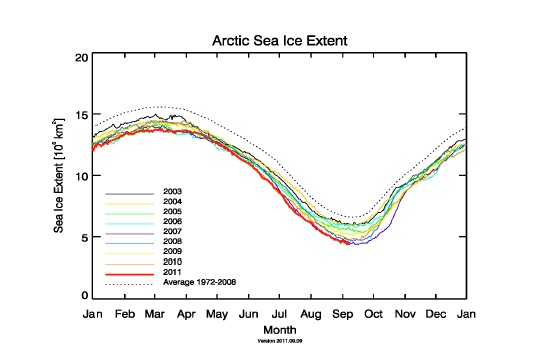
Just days before Sunday’s commemoration of the attacks, German scientists pointed to yet another smoking gun of climate change: the Arctic sea ice reached a new historic minimum ice extent.
The rapidity with which the planet is losing its northern ice cap continues to astonish experts. The defrosting northern pole is one of the prime drivers of Earth’s climate system and is changing global weather patterns in unpredictable ways.
The Arctic ice melt is also accelerating the rate of climate change beyond what humanity is doing with every barrel of oil, tonne of coal or cubic metre of gas burned.
On Sep. 8, researchers at the University of Bremen in Germany reported that the Arctic ice melt bettered the previous minimum of 2007. Other research centres using different satellite and analysis tools say the extraordinary decline of ice in 2007 has not yet been exceeded this year and 2011 remains a close second.
Sea Ice Extent 2003-2011
“We think it will end up a little bit short of the record – not that it really matters,” said Mark Serreze, director of the National Snow and Ice Data Center in the U.S. city of Boulder, Colorado.
“What is extraordinary this year is that there was no weird weather pattern that created the perfect conditions for the record melt in 2007,” Serreze told IPS.










 Stephen Leahy, International Environmental Journalist