Arctic Meltdown Signals Long-Term Trend

By Stephen Leahy

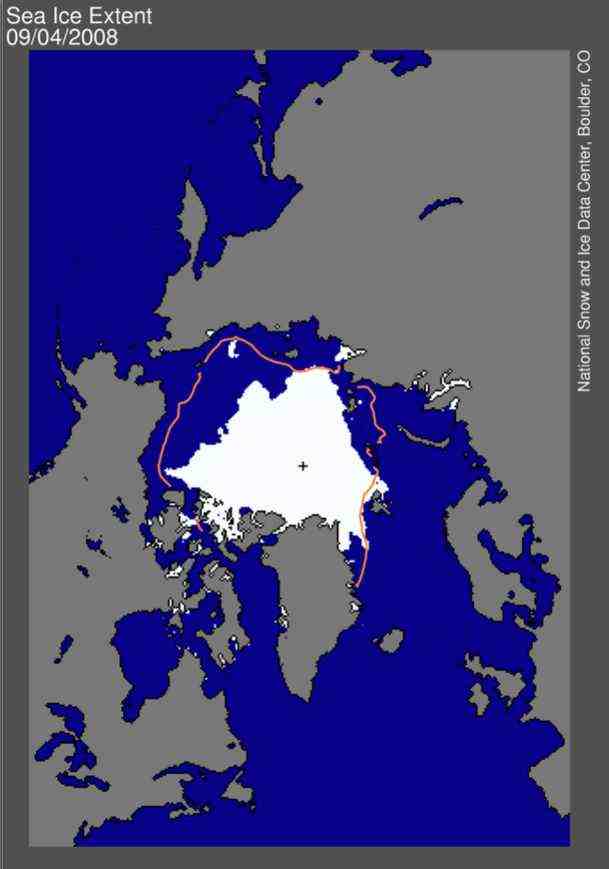
UXBRIDGE, Canada , Sep 5 (IPS) – Soaring temperatures have led to the collapse of several huge ice shelves in the Canadian Arctic over the past few weeks.

One 50 sq km ice shelf on the northern coast of Canada’s Ellesmere Island simply “vanished” over three days, exposing a coast that lay buried under ice for at least 4,000 years.

At the same time, the Arctic’s thick, year-round sea ice cover has declined to near the 2007 record of 2.6 million square kilometres less ice than the summer average minimum. This year’s ice loss is still huge — an area that’s far larger than the states of Alaska and Texas combined.

“My gut feeling is that the sea ice decline won’t beat last year’s record,” said Walter Meier of the National Snow and Ice Data Center at the University of Colorado in Boulder.

This year’s sea ice decline is expected to reach its peak in the next few days. “The (2008) decline is already the second largest loss of summer ice on record even though the weather was not as warm as last year,” Meier told IPS. Continue reading

Flying Blind Into Future Hurricane Seasons

“…New Orleans is at the same risk as it was before Katrina.”
– Stephen Leatherman, director of the International Hurricane Research Center

In just two years from now 40 percent of the current weather and science satellites will be out of service. NASA budget cuts means few if any replacements are on the way. Billions of dollars will go into manned space efforts instead.

“The [George W.] Bush administration has decided going to Mars and the International Space Station is more important,” said Judith Curry, chair of climate and remote sensing at Georgia Tech’s School of Earth and Atmospheric Sciences.

“Earth sciences has taken a huge hit at NASA. That’s not a good thing for those of us living on Planet Earth,” Curry said.

“This is a very serious issue.”

For more see:

Flying Blind Into a Monster Hurricane Season

Related stories:

Steve’s Hurricane Handbook 2007

Hurricane Katrina Only Cat 1/2 When It Hit New Orleans – NOAA

Cut Energy Costs 70%: Save Money, Live Better, Help the Climate

Making buildings more environmentally friendly is the easiest and most effective way to cut climate-changing carbon emissions, often slashing energy costs by up to 70 percent.

So why isn’t there a massive effort to “green up” existing buildings and set green standards for all new construction?

Apparently energy costs aren’t high enough. And then there are multi-billion-dollar government subsidies paid to the energy sector to lower the actual cost of energy, tilting the market away from green buildings towards the cheapest built structures.

FACT: The most efficient buildings today use about 70 percent less energy than conventional properties.

Despite proven environmental, economic and health benefits of green buildings they only account for 2% of all new commercial buildings and even smaller percentage of new homes. 

See full article:

Cut Energy Costs 70%: Save Money, Live Better, Help the Climate 

Canada, Home of the World’s Dirtiest Oil

A new multi-million government PR campaign claims Canada is a “clean energy superpower“. Meanwhile oil production from Canada’s oil sands — the world’s dirtiest oil — is ramping up from 1.2 million barrels a day to 3.5 million. Sadly yet another example of a government resorting to the “big lie”.

By the way virtually all of this oil goes to the US market.

I wrote a series of investigative articles for IPS on the enormous environmental impacts of Canada’s oil sands in 2006. That series has been updated and collected into an e-Book format (download for free).

Here’s an excerpt from Oil Stains in the Boreal Forest: The Environmental Cost of Canada’s Oil Sands

THE ‘RECIPE’ TO MAKE A TANK (75 litres/20 gallons) OF OIL SANDS GASOLINE :

* Dig up two tonnes of earth and rock
* Burn up to 1500 cubic feet of natural gas to boil approx 700 litres of fresh water to process the dirt
* Throw away 950 litres of toxic mine tailings and emit 480 kilograms of CO2, the main greenhouse gas causing global warming

REPEAT 1.2 million times a day (one barrel of oil makes about 75 litres of gasoline)

Note: this analysis does not include local air pollution, impacts on wildlife and local people from oil sands operations and pipelines.

Oil Stains in the Boreal Forest

FREE eBook!! Reveals environmental impacts of Canada’s oil sands industry – the world’s largest industrial project.

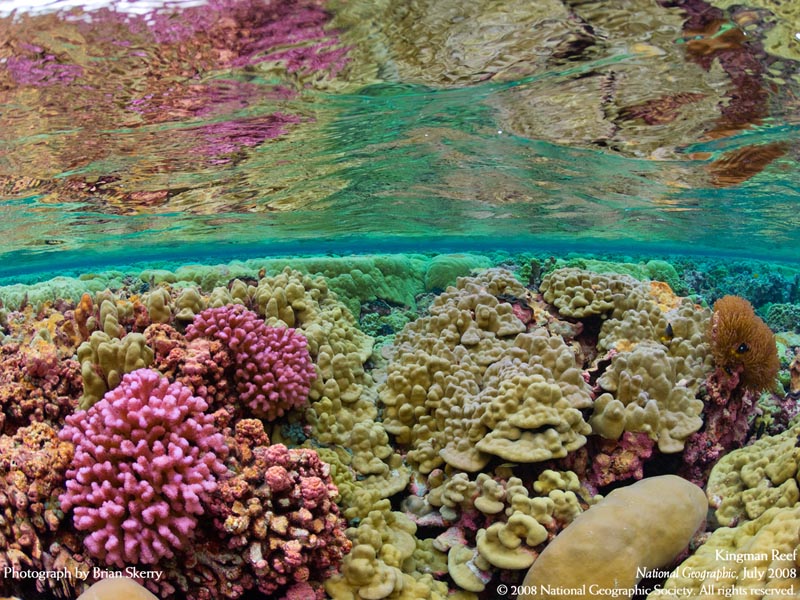
Lose Corals and We Will be Fighting for Our Own Survival

Interview with Marine Scientist Roberto Iglesias-Prieto

By Stephen Leahy

FORT LAUDERDALE, Florida, U.S., Jul 31 (Tierramérica)

“There would be no white sands on the beaches of Cancún without the Mesoamerican reef,” Professor Roberto Iglesias-Prieto, a marine ecophysiologist working at the Institute of Marine Sciences and Limnology of the National Autonomous University of Mexico, told Tierramérica.

Tourism is Mexico’s third leading source of revenue, and the country needs to invest much more in protecting its valuable coral systems, says the expert. But to explain the problems that coral reefs face “it is not enough to be an ecologist; one has to be an economist and political scientist as well,” he adds.

The Mesoamerican reef, which is off the Yucatán Peninsula and is shared by Mexico, Belize, Guatemala and Honduras, extends 1,100 kilometres, making it the largest in the Atlantic Ocean and the second largest in the world, after the Great Barrier Reef east of Australia.

Corals are crucial for the health of oceans and are home to 25 to 33 percent of marine life. The livelihoods of one billion people rely on coral reefs, directly or indirectly.

But the reefs are dying as a result of excessive fishing, pollution and climate change, which is heating up the water and causing acidification.

Few coral reefs will be healthy beyond 2050 if significant reductions in emissions from the burning of fossil fuels do not occur in the near term, most experts in this field agree.

Tierramérica’s Stephen Leahy spoke with Iglesias-Prieto during the 11th International Coral Reef Symposium in July in Fort Lauderdale, Florida.

Is this article of interest? It exists thanks to contributions from readers. Please click here to learn more about Community Supported Journalism.

Continue reading

Humans Have Halted The Next Ice Age

Interview with climate expert Sir David King:

Humanity is now the primary driver of our climate

BARCELONA, Spain, Jul 22 (IPS) – Humanity faces enormous challenges at the start of the 21st century, says Sir David King, Britain’s former chief scientific advisor and now director of the Smith School of Enterprise and the Environment at Oxford University in England.

The crises surrounding climate change, population growth, water, food and land are deeply interconnected, Sir David said at the opening of the Euroscience Open Forum in Barcelona, Friday. 

The Forum, known as ESOF, is a biannual gathering of scientists, researchers, policy makers and journalists that has become Europe’s largest scientific showcase. This year, 4,700 people registered for the five-day conference in Barcelona from Jul. 18- 22. 

In his role as chief scientific advisor, Sir David was outspoken in his warnings to political leaders that climate change is a far greater threat than terrorism and that the failure to reduce emissions from burning fossil fuels would make terrorism far worse and create millions of environmental refugees. 

IPS environmental correspondent Stephen Leahy spoke to Sir David at the symposium in Barcelona. 

IPS: Population growth rates are slowing, what is your concern? 

DK: Growth rates are beginning to slow. There are 6.8 billion people now and that will rise to 8 billion in 2028 and then peak at 9 billion in 2050, according to recent projections. However, that number of people will exert an impossible strain on the Earth’s natural resources. 

For example, there isn’t enough fresh water for more than 8.5 billion people at our current average usage. Food production is limited by water availability and the only way forward will be to use genetic modification to create drought-tolerant crops. We here in Europe need to change our minds on GM crops. Those anti-GM attitudes probably crippled research and are responsible for a large number of hunger fatalities in Africa.

IPS: What about the current global food crisis? Continue reading

Wetlands Loss Fuelling CO2 Feedback Loop

By Stephen Leahy

Uxbridge, CANADA, Jul 21 (IPS) – Wetlands are dangerous, scientists say, in the sense that they are ticking carbon bombs best left alone. To help stave off extreme climate change, existing wetlands should be enhanced and new wetlands created so they could capture more carbon.

“Wetlands hold massive stores of carbon — about 20 percent of all terrestrial carbon stocks,” said Eugene Turner, a leading wetlands expert at Louisiana State University’s Coastal Ecology Institute

However, wetlands, including peatlands, continue to be converted to other uses around the world, resulting in large emissions of carbon and methane, a potent greenhouse gas that has 21 times the warming impact of carbon dioxide. 

By itself, climate change is already degrading wetlands, especially in the Arctic and near Arctic regions where the once permanently frozen peatlands are thawing, Turner told IPS prior to the opening of the Eighth INTECOL International Wetlands Conference in Cuiaba, Brazil on Monday. 

“Researchers have been measuring huge releases of carbon and methane up there,” he said. “It’s crazy to add to that by draining or mismanaging other wetlands.” Continue reading

Cutting CO2 Only Way to Save Dying Corals

By Stephen Leahy

FORT LAUDERDALE, U.S., July 12 2008 (IPS)

The rapid decline of coral reefs around the world offers a potent warning that entire ecosystems can collapse due to human activities, although there is hope for reefs if immediate action is taken, coral experts agreed at the conclusion of a five-day international meeting Friday.

“Reefs are in serious trouble, but don’t write them off,” Terry Hughes, a marine ecologist at Australia’s James Cook University told 3,000 scientists, conservationists and policy makers attending at the 11th International Coral Reef Symposium (ICRS) in Fort Lauderdale, Florida.

“We can save reefs if we take immediate action,” Hughes said.

More than 20 percent of the world’s reefs have died, and large areas are failing due to a combination of climate change, overfishing, pollution and sea level rise. Most of the fabulous corals that attract tourists to the Caribbean are gone and half of remaining reefs in the U.S. are in serious decline.

[Update 08/10 – Here’s a list of Stephen Leahy’s latest articles on corals Coral Reefs and Acid Oceans Series]

We may be facing ocean deserts in the future,” said Guillermo Dias-Pulido of Australia’s University of Queensland.

Continue reading

A Third of Corals Face Extinction

By Stephen Leahy
FORT LAUDERDALE, U.S., Jul 10 (IPS) – One third of reef-building corals already face extinction because of climate change, the first-ever global assessment has found.

Reefs are made up of hundreds of coral species, and a two-year study to determine the current status of corals has discovered that 231 of the 704 species assessed will be “red-listed” Thursday. This means these 231 species meet the International Union for Conservation of Nature (IUCN) Red List Criteria for species at risk of extinction in the near future.

Previously, only 10 species of corals had been red-listed, mainly because no proper assessment had been done before.

“We were not expecting the numbers to be that high,” said Suzanne Livingstone of the IUCN’s Global Marine Species Assessment (GMSA) in Norfolk, Virginia. The paper was published Thursday in Science.

If the same assessment of corals had been done 20 years ago, only 13 of the 704 species would have been red-listed, Livingstone told IPS at the 11th International Coral Reef Symposium (ICRS) in Fort Lauderdale, Florida. However, in that short time span, climate change has warmed the oceans and begun to make them more acidic and corals are suffering.

“It’s frightening when you think about it,” she said.

Continue reading

Life Support Needed For Coral Reefs

By Stephen Leahy


FORT LAUDERDALE, U.S., Jul 8 (IPS) – Coral reefs need to be put on “life support” if they are to survive climate change, but their ultimate survival is dependant on major reductions in fossil fuel emissions, say experts.

“We’re going to hear lots of bad news about corals in the next few decades,” Rich Aronson, president of the International Society for Reef Studies, told 3,000 scientists, conservationists and policy makers at the 11th International Coral Reef Symposium (ICRS) in Fort Lauderdale, Florida Monday.

Climate change is making the ocean too warm and too acidic for most corals species to survive beyond the year 2050, many marine scientists now believe.

“The situation is serious to the point of desperation,” Aronson told IPS in an interview.

Past and present carbon emissions from burning fossil fuels have already altered the oceans, leading to declines in corals in many areas. This trend will continue for decades even if it were possible to eliminate all emissions today, scientists say. Current emissions are running at eight to nine gigatonnes a year and rising, resulting in dramatically altered oceans where few of the current coral species will be able to survive.

“This is a pivotal moment. We must act strongly and immediately if we are to have coral reefs as we know them,” Aronson said. Continue reading