Boost Food Production by Reducing Enviro Impacts


JOHANNESBURG, Apr 15 (IPS) – Over the past few years, Robert Watson has had what must qualify as one of the world’s tougher assignments: heading an initiative to help agriculture cope with the substantial challenges it faces presently, and the even bigger hurdles ahead.

The three-year International Assessment of Agricultural Science and Technology for Development (IAASTD) has sought to evaluate agricultural knowledge across the spectrum, with the help of governments, civil society, the private sector, and hundreds of experts.

Watson initiated the project while chief scientist at the World Bank; he currently serves as director of the IAASTD — also as chief scientist at the British environment and agriculture department.

The findings of the assessment are being formally presented Tuesday, this after they were reviewed at an intergovernmental plenary held in Johannesburg, South Africa, from Apr. 7-12. IPS environment correspondent Stephen Leahy chatted to Watson at this meeting about the landmark IAASTD. Continue reading

Food Crisis Needs this New Vision for Agriculture

By Stephen Leahy


JOHANNESBURG, Apr 15 (IPS) – The results of a painstaking examination of global agriculture are being formally presented Tuesday with the release of the final report for the International Assessment of Agricultural Science and Technology for Development (IAASTD).

The assessment has explored how agriculture can be reinvented to feed the world’s expanding population sustainably in an era of multiple challenges — not least those presented by climate change and a growing food crisis that has led to outbreaks of violence in a number of developing countries.

The expertise of some 400 scientists and other specialists was tapped for the IAASTD; governments of wealthy and developing nations also contributed to the assessment, along with civil society and the private sector. Continue reading

CLIMATE CHANGE: A Game With Too Many Free Riders

By Stephen Leahy*

BROOKLIN, Canada, Apr 4 (IPS) – The evidence is piling up that climate change threatens to bring a chaotic future unlike anything ever known. Taking collective action in time to avert the worst means rewarding climate-safe behaviour, punishing climate transgressors and publicly praising those who are trying to protect the environment, a new study suggests.

The nations of the world will come together to set a target and timeframe for reducing emissions from burning fossil fuels at the end of 2009 in Copenhagen, Denmark. Scientists have repeatedly stated the 2020 target must be 25 to 40 percent emission reductions from the 1990 emission baseline. Can the global community reach this collective target through individual efforts when everyone suffers individually if the target is missed?

The short answer: No.

At least that’s the result of an elegant experiment to examine people’s ability to deal with this kind of situation. “People do not act rationally, even to protect their own interest,” observed Manfred Milinski of the Max Planck Institute of Evolutionary Biology in Plon, Germany.

[ *This story is part four of a four-part examination of the psychological and behavioural changes needed to dial down the temperature on our global greenhouse. Part one: Climate Change Reshaping Civilization Part two: Climate River in Full Flood   Part three: CLIMATE CHANGE: A Vision Worth Fighting For ]

Continue reading

CLIMATE CHANGE: A Vision Worth Fighting For

By Stephen Leahy*

BROOKLIN, Canada, Apr 3 (IPS) – Sweeping societal change is a slow and erratic business. The civil rights movement in the United States went nowhere for decades and then exploded in the 1960s. Not long ago, smokers could light up anywhere they pleased in Canada and the U.S. Now they are mostly confined to a few outdoor areas and as a consequence, far fewer people smoke.

“There’s been a major shift in values regarding smoking,” said Anthony Leiserowitz, director of the Yale Project on Climate Change at Yale University.

Anti-smoking laws, higher taxes, and knowledge about the health impacts of second-hand smoke were all factors driving the shift, Leiserowitz told IPS.

While most people are concerned about climate change, they view it as a largely abstract problem, and fail to equate it with devastating weather events such as Hurricane Katrina in August 2005, he said.

[ *This story is part three of a four-part examination of the psychological and behavioural changes needed to dial down the temperature on our global greenhouse. Part one: Climate Change Reshaping Civilization Part two: Climate River in Full Flood Part four: CLIMATE CHANGE: A Game With Too Many Free Riders ]

However, that might be changing. Australians suffering record droughts made more intense by climate change elected a new prime minister in 2007 in part because the incumbent refused to act on carbon dioxide emissions.

“Arguably, John Howard (the former prime minister) was the first national leader to lose their job over climate,” Leiserowitz said. Continue reading

Climate River in Full Flood

Analysis by Stephen Leahy*

Apr 2 (IPS) – Rising levels of carbon dioxide (CO2) in Earth’s atmosphere can be compared to a flooding river, swamping low areas at first but inevitably bursting its banks.

But unlike normal seasonal flooding, humanity is largely responsible for the crisis by burning fossil fuels.

[ *This story is part two of a four-part examination of the psychological and behavioural changes needed to dial down the temperature on our global greenhouse. Part one: Climate Change Reshaping Civilization Part three: CLIMATE CHANGE: A Vision Worth Fighting For Part four: CLIMATE CHANGE: A Game With Too Many Free Riders ]

Today, a routine drive to the supermarket adds another fraction to the CO2 in the atmosphere, trapping a little more heat. And not just for today but the next 5,000 years. That is how long it takes before the carbon dioxide we release today is finally absorbed and safely tucked away. But for 5,000 years, that carbon will trap additional heat.

If climate change were a rising river near our street, we’d all be at the dikes, filling and carting sandbags with neighbours and strangers. We’d share our food, enjoy the camaraderie and remember forever our individual and collective effort with pride and satisfaction. Continue reading

Climate Change Reshaping Civilization

By Stephen Leahy*

Apr 1 (IPS) –Our fingers are glued to the global thermostat, pushing it ever higher, and climate catastrophe has already begun to reshape human civilisation.

Drought. Flood. Heat wave. Tornado and hurricane. Once sole products of natural forces, all are now amplified by the massive amounts of additional heat trapped in the atmosphere because of burning fossil fuels, scientists warn.

[ *This story is part one of a four-part examination of the psychological and behavioural changes needed to dial down the temperature on our global greenhouse. Part two: Climate River in Full Flood   Part three: CLIMATE CHANGE: A Vision Worth Fighting For  Part four: CLIMATE CHANGE: A Game With Too Many Free Riders ]

Such calamities are no longer distant in time or space. Tens of millions have already been impacted by unnaturally extreme and violent weather for at least the past two decades.

Annual emissions of heat-trapping carbon dioxide (CO2) are three times higher today than in the 1990s. Even if the impossible could be done — cease all CO2 emissions today — the average global temperature will continue to increase from the present 0.8 degrees C above normal to 1.6 – 1.8C, data shows. And that new global average temperature would remain higher than normal for the next 500 years because of the time it will take for the warming oceans to cool.

To prevent Earth from heating further than 2.0 C, a potentially catastrophic tipping point, carbon dioxide emissions would need to be completely eliminated and soon, say researchers in a new study published in March in the journal Geophysical Research Letters. Continue reading

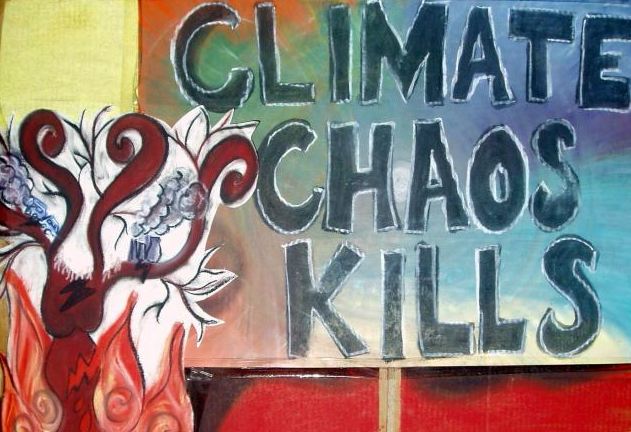
Call for Climate-safe Living

climate-chaos-kills-art-not-oil.jpg

“Our fingers are glued to the global climate thermostat. And in a feverish delirium where the present has been severed from the future, we dial it higher and higher.Foolishly and dangerously.”Coming soon on IPS, a new four-part article series that looks at the psychological and behavioural changes needed to dial down the temperature on our global greenhouse.Includes: Three Basic Principles for Climate-safe Living

Reduce. Eliminate. Demand. R.E.D.

Record Glacier Melt Down Leads to Drought

By Stephen Leahywinter-melt-gatineau.jpg

Mar 17 (IPS) – Glaciers, the world’s freshwater towers, continue their record-breaking meltdown, a new U.N. report shows.

The average rate of thinning and melting more than doubled between 2004 and 2006, reports the World Glacier Monitoring Service (WGMS), a centre based at the University of Zurich in Switzerland.

“The latest figures are part of what appears to be an accelerating trend with no apparent end in sight,” said Wilfried Haeberli, director of the WGMS.

The accelerated glacier meltdown is a clear indicator that climate change has taken hold and millions if not billions will be affected, warned Achim Steiner, executive director of the U.N. Environment Programme (UNEP).

Glaciers feed the rivers that people are completely dependent on — 360 million on the Ganges in India and 388 million on the Yangtze in China alone. Reduced water or irregular water flows will make it more difficult to grow crops in these regions and other parts of the world. Rapidly melting glaciers also produce floods and raise sea levels. On average, there is one metre water of fresh water in every 1.1 metres of glacier ice. Continue reading

Cut Energy Costs 70%: Save Money, Live Better, Help the Climate – Greener Buildings

f10-house-chicago-sml.jpgBy Stephen Leahy

Mar 13’08 (IPS)

Making buildings more environmentally friendly is the easiest and most effective way to cut climate-changing carbon emissions, often slashing energy costs by up to 70 percent.

So why isn’t there a massive effort to “green up” existing buildings and set green standards for all new construction?

North America’s buildings are responsible for a staggering 2,200 megatonnes of carbon dioxide (CO2) emissions — 35 percent of the continent’s annual total. A new report released Thursday says a rapid uptake of currently available and emerging advanced energy-saving technologies could slash emissions by 1,700 megatonnes (MT) of CO2 emissions by 2030.

A cut of that size would nearly equal the CO2 emitted by the entire U.S. transportation sector in 2000.

“Improving our built environment is probably the single greatest opportunity to protect and enhance the natural environment,” said Adrián Vázquez, executive director of the tri-national Commission for Environmental Cooperation (CEC) that produced the report, “Green Building in North America: Opportunities and Challenges”.

Continue reading

Oil vs Polar Bears in Alaska: Big Oil Sues Govt for Protecting Polar Bear Habitat

[Update Mar 3 2011: An Alaska oil industry trade group representing 15 oil & gas companies sued the US federal government because it banned drilling in 187,157 square miles as polar bear critical habitat. They claim plenty of polar bears without offering any evidence. And it’s not like Alaskan oil interests haven’t run the state for years. My article below documents how 30 million acres of polar bear habitat were auctioned off in a big hurry in 2008. It really is all about oil/gas $ VS survival of polar bears. — Stephen]

[Update: May 1 2010 – Alaska’s polar bears are now official listed as threatened. In April 2010, the Obama administration tried but failed to get the world’s 20-25,000 remaining polar bears listed as endangered species. What a difference a new administration makes .–Stephen]

By Stephen Leahy

BROOKLIN, Canada, Mar 11, 2008 (IPS)

A coalition of environmental groups sued the George W. Bush administration Monday for delaying a decision to protect polar bears threatened with extinction due to the melting ice in its Arctic habitat. Polar bears could be the first species officially threatened by climate change.

The huge loss of summer sea ice in 2007 has caused many scientists to project that the Arctic could be ice-free in summer by as soon as 2012. Although excellent swimmers, polar bears are not very good at catching seals in the water. Seals comprise the main diet for these giant bears, which are far larger than their grizzly bear cousins.

While legally required to make a decision Jan. 9, US Fish and Wildlife (U.S. FWS) officials have been silent. Meanwhile on Feb. 6, 2.6 billion dollars in oil and gas leases were auctioned off to energy companies on nearly 30 million acres of prime polar bear habitat in the Alaska’s Chukchi Sea.

This independent environmental journalism depends on public support. Click here learn more.

Coincidence? I doubt it, but I don’t have the smoking gun to prove it,” said Kassie Siegel of the Centre for Biological Diversity (CBD), an environmental non-governmental organisation based in Joshua Tree, California.

The CBD, along with Greenpeace and the Natural Resources Defence Council, filed the suit for missing the legal deadline for issuing a final decision on whether to list the polar bear under the Endangered Species Act due to global warming.

“There was absolutely no urgency to hold that lease sale and plenty of public opposition to it as well,” Siegel told IPS. Continue reading