No Safe Havens in Increasingly Acid Oceans

churning-ocean-smlOil, gas and coal are contaminating the world’s oceans from top to bottom, threatening the lives of more than 800 million people

By Stephen Leahy

UXBRIDGE, Canada, Oct 15 2013 (IPS) 

Oil, gas and coal are contaminating the world’s oceans from top to bottom, threatening the lives of more than 800 million people, a new study warns Tuesday.

“It took a year to analyse and synthesise all of the studies on the impacts of climate change on ocean species,” Camilo Mora, an ecologist at University of Hawai‘i in Honolulu and lead author, told IPS.

“We are seeing greater changes, happening faster, and the effects are more imminent than previously anticipated.” — Alex Rogers of the University of Oxford

Mora is also lead author of ground-breaking climate study published in Nature last week.

“It was very sad to see all the responses were negative. We were hoping there might be some safe havens,” he said.

The study found that carbon emissions from burning fossil fuels are overheating the oceans, turning them acidic and reducing the amount of oxygen in seawater. This is happening too fast for most marine species to adapt and ocean ecosystems around the world will collapse.

By 2100, no corner of the oceans that cover 70 percent of the Earth’s surface will be untouched.

“The impacts of climate change will be felt from the ocean surface to the seafloor. It is truly scary to consider how vast these impacts will be,” said Andrew Sweetman of the International Research Institute of Stavanger, Norway, co-author of the PLOS Biology study published Oct. 15.

This ambitious study examined all the available research on how current and future carbon emissions are fundamentally altering the oceans. It then looked at how this will impact fish, corals, marine animals, plants and other organisms. Finally the 29 authors from 10 countries analysed how this will affect the 1.4 to 2.0 billion people who live near the oceans or depend on them for their food and income.

“We are making a big mess of the oceans. Climate change is having a major impact illustrating the need for urgent action to reduce emissions,” said Mora. Continue reading
Stop All Investments in Fossil Fuel Infrastructure or All Will Suffer IPCC warns


Carbon overload - have to stop expanding
Carbon overload – have to stop expanding

By Stephen Leahy

UXBRIDGE, Canada, Apr 22 2014 (IPS) 

Hopefully, on Earth Day today, high-level ministers from all countries are thinking about what they can bring to the table at a key set of meetings on climate change in early May.

This will be the first opportunity for governments to discuss their proposed climate action plans in light of the finalIntergovernmental Panel on Climate Change (IPCC) report released last week.

“There is a clear message from science: To avoid dangerous interference with the climate system, we need to move away from business as usual.” — Professor Ottmar Edenhofer 

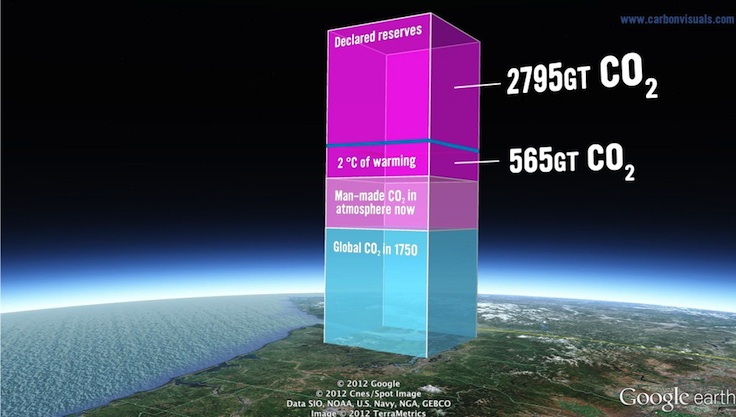
That report warned that carbon dioxide (CO2) emissions from burning fossil fuels are still rising far too fast, even with more than 650 billion dollars invested in renewable energy in the last three years. However, over the same time period even more money was invested in getting more fossil fuels out of the ground.

The latter investment is keeping humanity and the planet locked onto a devastating path of a global temperature increase of four to five degrees C, the IPCC’s Working Group III report warned.

Scientists and economists say that unlocking ourselves from disaster will require a massive reduction in emissions – between 40 percent and 70 percent – by midcentury. This is can be readily accomplished without inventing any new technology and at a reasonably low cost, reducing global economic growth by a comparatively tiny 0.06 percent.

“It doesn’t cost the world to save the planet,” economist Professor Ottmar Edenhofer, who led the IPCC team, said at a press conference.

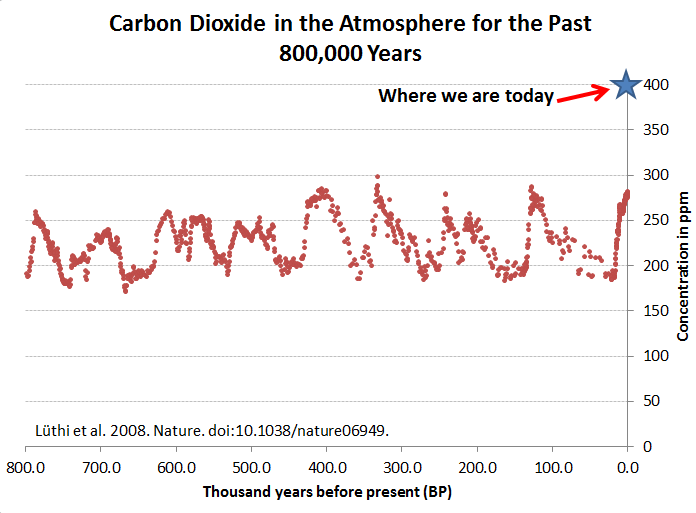
It does mean an end to investments in expanding fossil fuel infrastructure as the annual growth in CO2 emissions from burning oil, coal and gas must peak and decline in the next few years. The atmosphere already has 42 percent more CO2 than it did prior to 1800.

This extra CO2 is trapping more heat from the sun, which is heating up the oceans and land, creating the conditions that spawn super storms and extreme weather. And it will do so for the next 1,000 years since CO2 is a very durable molecule.

“There is a clear message from science: To avoid dangerous interference with the climate system, we need to move away from business as usual,” Edenhofer said.

Continue reading

Carbon Emissions: Most Important Number in Human History

terrifying co2 graph

By Stephen Leahy

UXBRIDGE, Canada, Dec 17 2012 (IPS) (Re-posted)

The most important number in history is now the annual measure of carbon emissions. That number reveals humanity’s steady billion-tonne by billion-tonne march to the edge of the carbon cliff, beyond which scientists warn lies a fateful fall to catastrophic climate change.

With the global total of climate-disrupting emissions likely to come in at around 52 gigatonnes (billion metric tonnes) this year, we’re already at the edge, according to new research.

To have a good chance of staying below two degrees C of warming, global emissions should be between 41 and 47 gigatonnes (Gt) by 2020, said Joeri Rogelj, a climate scientist at Switzerland’s Institute for Atmospheric and Climate Science in Zurich.

Only when we see the annual global emissions total decline will we know we’re making the shift to climate protection,” Rogelj told IPS.

Making the shift to a future climate with less than two degrees C of warming is doable and not that expensive if total emissions peak in the next few years and fall into the 41-47 Gt “sweet spot” by 2020, Rogelj and colleagues show in their detailed analysis published Sunday in the journal Nature Climate Change.

The study is the first to comprehensively quantify the costs and risks of emissions surpassing critical thresholds by 2020.

This shift means 65 percent of existing coal power plants will have to be shut down in the next decade or two. Continue reading

2013 Carbon Emissions On Deadly Path to 5C

global-carbon-budget-2010-e1371236101998

By Stephen Leahy

WARSAW, Nov 19 2013 (IPS)

Burning of fossil fuels added a record 36 billion tonnes of CO2 to the atmosphere in 2013, locking in even more heating of the planet.

Global CO2 emissions are projected to rise 2.1 percent higher than 2012, the previous record high, according to a new report released Tuesday by the Global Carbon Project.

“Going beyond two degrees C is very risky, it’s completely unknown territory.” — Corinne Le Quéré

This increase is slightly less than the 2000-2013 average of 3.1 percent, said lead author Corinne Le Quéré of the Tyndall Centre for Climate Change Research in the UK.

“This is the second year in a row of below average emissions. Perhaps this represents cautious progress,” Le Quéré told IPS.

Still, these hard numbers demonstrate that the U.N. climate talks have failed to curb the growth in emissions. And there is little optimism that the latest talks known as COP19 here in Warsaw will change the situation even with the arrival of high-level ministers Wednesday.

Global emissions continue to be within the highest scenario of the Intergovernmental Panel on Climate Change (IPCC), she said.

“This is a five-degree C trajectory. It’s absolutely tragic for humanity to be on this pathway,” Le Quéré said.

For full story

UN Climate Talks End In Dramatic Showdown But Little Progress

COP 19 Final Showdown between US and Fiji

By Stephen Leahy

WARSAW, Nov 24 2013 (IPS)

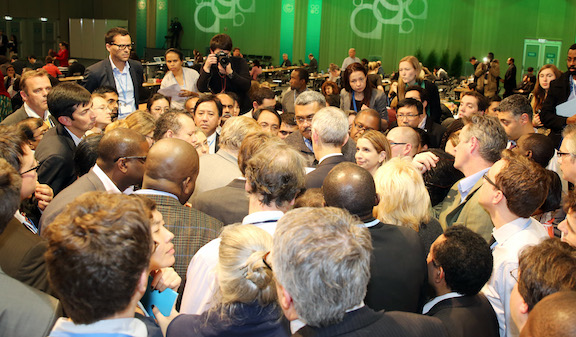
The U.N. climate talks in Warsaw ended in dramatic fashion Saturday evening in what looked like a schoolyard fight with a mob of dark-suited supporters packed around the weary combatants, Todd Stern of the United States and Sai Navoti of Fiji representing G77 nations.

It took two weeks and 36 straight hours of negotiations to get to this point.

At issue in this classic North versus South battle was the creation of a third pillar of a new climate treaty to be finalised in 2015. Countries of the South, with 80 percent of the world’s people, finally won, creating a loss and damage pillar to go with the mitigation (emissions reduction) and adaptation pillars.

Super-typhoon Haiyan’s impact on the Philippines just days before the 19th Conference of the Parties (COP19) amply illustrated the reality of loss and damages arising from climate change.  Philippines lead negotiator Yeb Saño made an emotional speech announcing “fast for the climate” at the COP19 opening that garnered worldwide attention, including nearly a million YouTube views

Click for complete story


Unseen World of Water and the Water Crisis

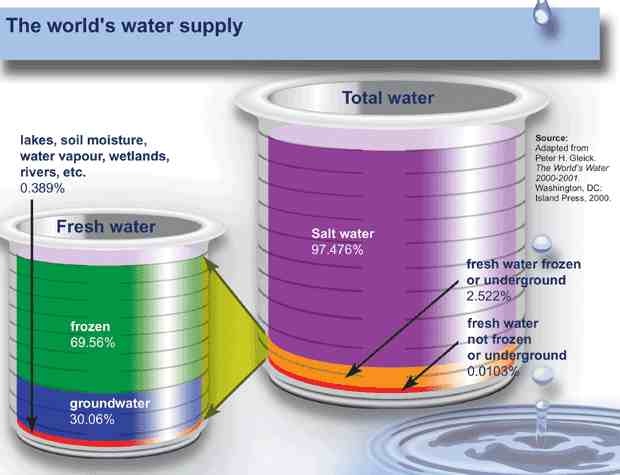
world water supply

By Stephen Leahy

UXBRIDGE, Canada, Mar 22 2013 (IPS)

How much water does it take to turn on a light? It took 10,000 litres to make your jeans. Another three big bathtubs of water was needed for your two-eggs-toast-coffee breakfast this morning.

We are surrounded by an unseen world of water: furniture, houses, cars, roads, buildings – practically everything we use and make needs water.

“There is no way to generate energy without water,” said Zafar Adeel, co-chair of the UN-Water Task Force on Water Security and director of the Institute for Water, Environment and Health in Canada.

Even solar panels need regular washing to perform well. Wind energy might be an exception, Adeel told IPS from a water conference in Beijing being held during World Water Week.

There is growing recognition that peak oil is nowhere near as important as peak water because there is no substitute for water. The growing shortage of water — 1.2 to 1.7 billion people face scarcity — has alarmed many. Water has been identified as an “urgent security issue”, by a group that last year included both former U.S. Secretary of State Hillary Clinton and the InterAction Council, an association of 37 former heads of state and government.

It’s important that “water security” be recognised by the U.N. Security Council as either as a trigger, a potential target, or a contributing factor to insecurity and potential conflict in many parts of the world, said Adeel.

Canada’s Plan to Get Rich by Trashing the Climate

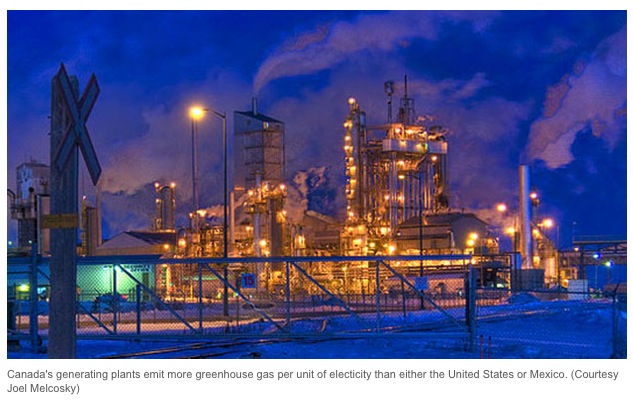
Canada's fossil fuel electricity has highest carbon emissions

By Stephen Leahy

Blame Canada is a four part series revealing how Canada has become a wealthy, fossil-fuelled energy superpower and an international climate pariah. For Part 1, click here.

Like every other country in the world, Canada has promised to help keep global warming to less than 2 degrees C. However Canada’s political and corporate leadership are committed to turning the country into a fossil-fuelled “energy superpower.”

With a drug lord’s just-providing-a-service hypocrisy Canada has openly declared it’s future is tied to the profits from dumping hundreds of millions of tonnes of climate-heating carbon into the atmosphere every year.

And the world’s new energy superpower plans to grow those annual emissions to 1.5 billion tonnes by 2020 giving one of the least populated countries a gigantic carbon bootprint.

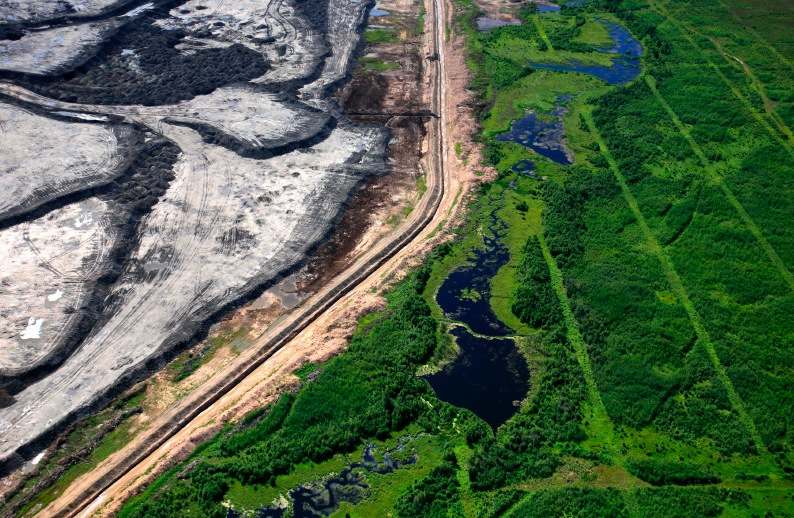
Most of this climate-wrecking carbon energy will come from Canada’s tar sands located just underneath the pristine boreal forest and wetlands of northern Alberta. The oil industry likes to call them “oil sands,” although there is no liquid oil only a tarry bitumen mixed deep in the sandy soil.

With an estimated 170 billion barrels, the tar sands are the third largest crude oil reserves. Extraordinary efforts involving colossal amounts of water, heat, chemicals and machinery are needed to get the bitumen out of the ground and into pipelines. This the world’s largest industrial project with more than $300 billion invested since 2001 by the oil industry.

Nowhere has fossil energy expansion or investment been faster or larger. Environmental activists call it “Canada’s Mordor.”

Who Wants a Sustainable, Pollution-Free New York by 2030?

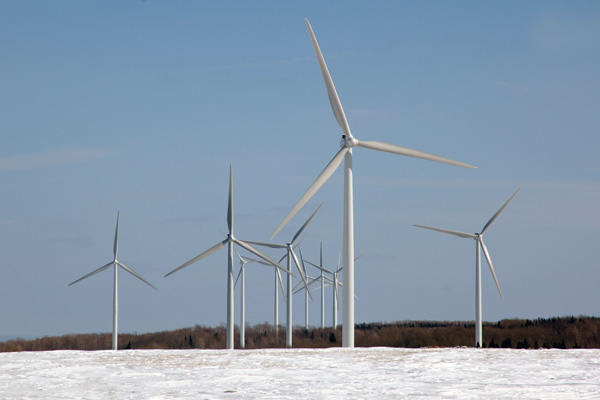
Wind turbines on the Tug Hill plateau in upstate New York

By Stephen Leahy

UXBRIDGE, Canada, Mar 19 2013 (IPS)

As usual, midtown Manhattan is packed with whisper-quiet cars and trams while thousands walk the streets listening to the birds of spring sing amongst the gleaming, grime-free skyscrapers in the crystal-clear morning air.

Welcome to New York City in April 2030.

I think the public will be 100 percent behind this, if they know about it.

This is not a fantasy. It is a perfectly doable goal, said Stanford University energy expert Mark Jacobson. In fact, the entire state of New York could be powered by wind, water and sunlight based on a detailed plan Jacobson co-authored.

It’s not only doable, powering New York on green energy is “sustainable and inexpensive” and would save lives and health costs, Jacobson told IPS.

Each year, air pollution kills 4,000 people in New York State and costs the public 33 billion dollars in health costs, according to the study Jacobson co-authored with experts from all over the U.S. It will be published in the journal Energy Policy.

Full Story

Canada Has Become a Petro-State, Happily Drilling for Profits as the World Warms

tar sands - visible from space,tarnished earth

Thu, 2013-03-07 08:00 STEPHEN LEAHY

What’s happened to Canada? To the dismay of many a country with an international reputation for relatively progressive environmental policies (at least compared to the United States) is rushing headlong to dig up all the oil, gas, and coal it can. The country’s leaders can scarcely muster the effort to pretend to want to limit climate-heating carbon emissions.

And the Canadian business establishment and media have largely gone along with the program. Put it all together, and you have a country that has become a full-blown “petrostate.”

People are starting to notice. Last December at the UN climate talks in Doha, Qatar, Canada beat out tough contenders like Saudi Arabia to be elected “Colossal Fossil” by environmental organizations from around the planet. Canada had the dishonor of being the most uncooperative country out of 193 nations at the climate summit. It was the sixth year in a row that international environmental groups gave Canada their ‘highest’ award for its persistent efforts to block any agreement on reducing carbon emissions.

What’s happened to Canada is that it has experienced a steady takeover by the fossil fuel industry.

Canada’s is now the world’s fifth largest crude oil producer and the biggest supplier of oil to the US. Canada is also the third largest producer of natural gas and one of the top ten miners of coal. This enormous boom in fossil fuel production has been underway since the late 1990s. Like Saudi Arabia, fossil energy is by far Canada’s biggest export and has become the dominant economic and political focus.

Full story click below:

Blame Canada is a four part series revealing how Canada has become a fossil-fuelled energy superpower that’s going to wreck its future and the global climate.

Green Approaches to Water Treatment Gaining Ground Around World

Pool of water in oz forest rslpix

By Stephen Leahy

UXBRIDGE, Canada, Jan 18 2013 (IPS)  

After Hurricane Sandy swept through the northeast of the United States late October 2012, millions of New Yorkers were left for days without electricity.  But they still had access to drinking water, thanks to New York City’s reliance on protected watershed areas for potable water.

Instead of using electric-powered water treatment plans, New York City brings its high-quality drinking water through aqueducts connected to protected areas in the nearby Catskill/Delaware forests and wetlands – just one example of how protecting watersheds can provide residential areas with drinking water and flood and pollution protection at bargain basement prices.

New York saved between four and six billion dollars on the cost of water treatment plants by protecting forests and compensating farmers in the Catskills for reducing pollution in lakes and streams.

Full story here