Carbon Capture Fraud: The $1.6 billion (and counting) Taxpayer Gift to Coal and Oil Industry

Could carbon capture and sequestration save the world?

Canadian taxpayers are putting $1.6 billion into the experiment

Desperate Times, Desperate Measures

by Stephen Leahy

Published in Nov/Dec’09 issue of Watershed Sentinel

Like a reckless gambler, the federal government’s plan to deal with our emissions of climate-altering carbon dioxide is to put most of our money on an unproven, risky and expensive long shot called “carbon capture and sequestration,” CCS for short. In a pair of October announcements, the Alberta and federal governments committed $1.6 billion to use this untested technology to reduce carbon emissions from an Alberta coal plant and a Shell Oil tar sands upgrader. Billions more are promised.

Canada puts 600 million tonnes of carbon dioxide into the atmosphere every year. That has to stop. This generation, you and me, must determine what methods and technologies offer permanent CO2 reduction at the scale we need, and do so quickly, safely and at the lowest cost. And we must act on that knowledge as if the future of children’s lives depend it because we are shaping the world they will inherit.

We cannot rely on political and business leaders to make these decisions on their own, as will become evident.

What other ways could we reduce our CO2 emissions with $1.6 billion of public money – $200 per Canadian family of four?

Replace 3.2 million older inefficient refrigerators with high-efficiency ones, thus reducing carbon emissions by 2-3 million tonnes annually. Continue reading

Arctic Leaking Methane a Super-Potent Global Warming Gas — Reaching Feared Tipping Point?

By Stephen Leahy

“The way we’re going right now, I’m not optimistic that we will avoid some kind of tipping point.

— Mark Serreze, senior research scientist at the National Snow and Ice Data Centre

UXBRIDGE, Canada, Mar 5, 2010 (IPS)

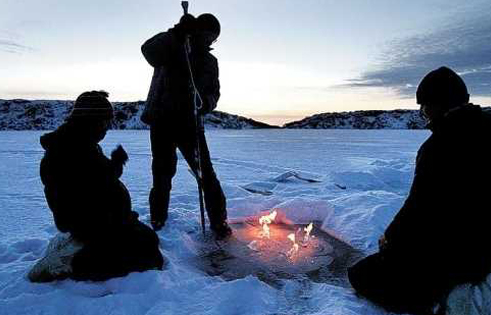
The frozen cap trapping billions of tonnes of methane under the cold waters of the Arctic Ocean is leaking and venting the powerful greenhouse gas into the atmosphere, new research shows.

It is not known if this may be one of the first indicators of a feedback loop accelerating global warming.

Researchers estimate that eight million tonnes in annual methane emissions are being released from the shallow East Siberian Arctic Shelf, which is equivalent to all the methane released from the world’s oceans, covering 71 percent of the planet.

On a global scale of methane emissions from the land-based sources – animals, rice paddies, rotting vegetation – the newly measured emissions from the Siberian seabed are less than two percent.

“That’s still very significant,” Natalia Shakhova, a researcher at the University of Alaska in Fairbanks, told IPS. “Before, it was assumed that this region had zero emissions.”

Do you like this article? It is funded by contributions from readers like you. Please click here to make a donation

Methane concentrations measured over the oceans are currently about 0.6 to 0.7 parts per million (ppm), but they are now 1.85 in the Arctic Ocean generally, and between 2.6 and 8.2 ppm in the East Siberian Arctic Shelf, an area roughly two million square kilometres in size, said Shakhova.

Shakhova, and her University of Alaska colleague Igor Semiletov, led eight international expeditions to one of the world’s most remote and desolate regions and published their results in the Mar. 5 edition of the journal Science. Continue reading

Tsunami of E-Waste Could Swamp Developing Countries

By Stephen Leahy

UXBRIDGE, Canada, Feb 22, 2010

(IPS)

The mighty mountains of hazardous electronic waste are growing by about 40 million tonnes a year globally. In China, India and South Africa, those mountains are expected to grow 200 to 500 percent in the next decade, a new report warns.

And that’s just from domestic sales of TVs, computers and cell phones. The figure doesn’t include millions of tonnes of e-waste that is exported, mostly illegally, into these countries.

Sales of electronic consumer goods are skyrocketing in emerging economies, but that is not matched by capabilities to properly collect and recycle such products, which contain both toxic and valuable materials, says the United Nations report, “Recycling – from E-Waste to Resources“.

It was released in Bali, Indonesia Monday at a meeting of the Basel Convention on the Control of Transboundary Movements of Hazardous Wastes and Their Disposal.

E-waste from discarded mobile phones will be about seven times higher than 2007 levels in China by 2020. In India, the mobile phone e-waste mountain will be 18 times higher. At the same time, e-waste from televisions will be 1.5 to 2.0 times higher in China and India, while in India e-waste from discarded refrigerators will double or triple, the landmark report states. Continue reading

Canada’s Idea of Working on Climate Change Means Muzzling Climate Scientists, Closing Research Stations and Cutting Funding

“This government is doing nothing on climate but they always make sure to sound like they’re doing something to fool Canadians.” — John Bennett, Sierra Club of Canada

By Stephen Leahy

UXBRIDGE, Canada, Mar 16, 2010 (IPS)

Canada’s climate researchers are being muzzled, their funding slashed, research stations closed, findings ignored and advice on the critical issue of the century unsought by Prime Minister Stephen Harper’s government, according to a 40-page report by a coalition of 60 non-governmental organisations.

“This government says they take climate change seriously but they do nothing and try to hide the truth about climate change,” said Graham Saul, representing Climate Action Network Canada (CAN), which produced the report “Troubling Evidence”.

“We want Canadians to understand what’s going on with this government,” Saul told IPS.

Climate change is not an abstract concept. It already results in the deaths of 300,000 people a year, virtually all in the world’s poorest countries. Some 325 million people are being seriously affected, with economic losses averaging 125 billion dollars a year, according to “The Anatomy of a Silent Crisis“, the first detailed look at climate change and the human impacts.

Released last fall by the Geneva-based Global Humanitarian Forum, the report notes that these deaths and losses are not just from the rise in severe weather events but mainly from the gradual environmental degradation due to climate change.

Is this article of interest? It exists thanks to contributions from readers. Please click here to learn more about Community Supported Journalism.

“People everywhere deserve to have leaders who find the courage to achieve a solution to this crisis,” writes Kofi Annan, former U.N. secretary-general and president of the Forum, in the report.

Canadians are unlikely to know any of this. Continue reading

Doubt Is Our Product: Media and Global Warming

Why do media run nonsensical “scandals” about climate science?

Why does the public put up with it?

Those are some of the questions posed on Alex Smith’s fine syndicated weekly Radio Ecoshock Show has three expert viewpoints in his one hour show OUR PRODUCT IS DOUBT

Clive Hamilton on “Requiem for a Species, Why We Resist the Truth About Climate Change.” The madness of masses & media.

Stanford’s Prof. Stephen Schneider on death threats, & threats from Senators (calling climate scientists “criminals”).

Naomi Oreskes on “Merchants of Doubt”.

1 hour CD Quality 56 MB or Lo-Fi 14 MB

See also Alex’s detailed notes and links to far more on his blog: DOUBT IS OUR PRODUCT – the blog

[full disclosure: I supplied my interview with climatologist Stephen Schneider – Violent Backlash Against Climate Scientists

]

Scientists Face Death Threats, Democracy at Risk

[A personal note from Stephen]

There’s something strange in the air when a highly-respected US scientist says he or a colleague will likely be killed for saying climate change is happening.
That’s what Stanford’s Stephen Schneider told me last week. He’s not an alarmist, he’s a pro with 40 years under his belt. These days climate scientists receive all kinds of hate mail and even death threats. I even get hate mail. Bizarre times.

At the same time traditional media are complicit, giving ‘face time’ to those who smear scientists with no evidence, just nonsensical conspiracy allegations. Schneider says simply:

I’m pretty damn angry that media companies are putting profits ahead of truth. The media are deeply broken… That’s a real threat to democracy.”

I couldn’t agree more. We’re in a dangerous trap. Schneider, Victoria Tauli-Corpuz, Chair, UN Permanent Forum on Indigenous Issues, and many other experts have recently told me: ‘we need people like you to write about these issues’.

I could do far more but my time is largely gobbled up trying to figure out how to put bread on the table. Last year writing about these issues put my family $10,000 in the red despite about $4000 in donations which mostly went towards travel costs. (And we have a pretty modest lifestyle, living in my in-law’s basement apt)

Put plainly, writing honestly about important issues is not rewarded in our current economic system, even though it’s in our best interests. Writing junk mail to sell crap that people don’t need is rewarded 100X more. (I know, I used to do it)

Community Supported Journalism

Community Supported Journalism is the only way forward that I can see. That means reciprocity: You help support the investigation, research, writing about what’s important for all of us to know so we can make informed decisions. In an earlier age I would have come to your village, taught your children and told you useful stories about what I’d learned from wise elders in other villages. Today I send out those stories to you and many others in our global village and rely more and more on you to provide the financial equivalent of a place to sleep and a meal to eat.
Reciprocity, co-operation and community are some of the key values we need to escape the trap we are in.

On a practical level supporting or funding individual story ideas isn’t working mainly because it takes too much time to put together and generate support. It’s not nimble enough to respond to breaking news, but it could work for larger, long term projects. Instead what’s needed is ‘bread and butter’ funding — contributions that help cover the everyday costs of living and doing environmental journalism.

A “Bread and Butter Environmental Journalism Support Fund” if you will. That fund will need about $15,000 in 2010 for the work to continue.

It has taken me three days to find the words to ask because it is a lot of money. Please consider $50, $100 or more — less than cost of a newspaper or cable TV subscription — for coverage of important issues that shape our world and our future.

Contributions can be made safely and easily via PayPal or Credit Card. Or  contact me at writersteve [AT] gmail [DOT] com (no spaces) to send a cheque.

Please also pass this along to interested family, friends and organizations. My continued appreciation to those who have contributed in the past.

Thanks and best wishes, Steve

OUR Roof is on Fire: Dangerous Climate Change is Here

It will take lot of us – probably in the streets” to make politicians face the truth, says climate scientist James Hansen.

[Dangerous climate change is already upon us say some of the best scientists we have. But political leaders — and most of the public — don’t get it. This is an attempt to close the chasm between climate reality and climate denial fantasy. I wrote this at the end of the Copenhagen Climate meetings last December thanks in part to financial contributions from readers that allowed me to do the research and interviews. — Stephen]

Our leaders do not get the scale of the problem or the rapidity of the changes.”            — Andrew Weaver, climatologist at Canada’s University of British Columbia

Analysis by Stephen Leahy

COPENHAGEN Dec 22 ,2009 (IPS/TerraViva)

The roof of our house is on fire but our leaders, our economic system and we ourselves are ignoring the alarms and continuing to add more fuel. There are no exit doors in our house; there is nowhere else to go.

Dangerous climate change is already here.

The two-week climate summit in Copenhagen came to an end with disappointing results and details that are still vague.

A ”Copenhagen Accord” was agreed by the US, China, South Africa and India by Friday night. It was unclear which other countries were willing to support it.

But coral reefs are dying, the Arctic is melting and rising sea levels threaten the homes of millions. And we’re on our way to a planet-transforming four-degree C rise in global average temperatures in as soon as 50 years.

Future generations could face an utterly transformed planet, where large areas will be seven to 14 degrees C warmer, making them uninhabitable. In this world-on-fire, the one to two metre sea level rise by 2100 will leave hundreds of millions homeless, according to the latest science presented at the “4 Degrees and Beyond, International Climate Science Conference” at the University of Oxford in September.

That’s the science-based, slap-in-the-face reality as the Copenhagen climate talks fizzle out here with little progress Friday.

Our leaders do not get the scale of the problem or the rapidity of the changes. They don’t get that it must be dealt with now,” said Andrew Weaver, a climatologist at Canada’s University of British Columbia and lead author of the Intergovernmental Panel on Climate Change (IPCC) reports. Continue reading

A Tipping Point on Species Loss?

By Stephen Leahy

UXBRIDGE, Canada, Jan 13, 2010 (IPS)

Humanity is destroying the network of living things that comprise our life support system. While this sawing-through-the-branch-we’re-perched-on is largely unintentional, world leaders can’t say they didn’t know what’s going on: 123 countries promised to take urgent action in 2003 but have done little to stem the rising tide of extinctions in what’s known as the extinction or biodiversity crisis.

Species are going extinct at 1,000 times their natural pace due to human activity, recent science has documented, with 35 to 40 species vanishing each day, never to be seen again.

“The question of preserving biological diversity is on the same scale as climate protection,” German Chancellor Angela Merkel said in a speech in Berlin Monday at the official launch of the United Nations’ International Year of Biodiversity.

This week’s official launch will be followed by the first major event of the International Year, a high-profile meeting at the Paris headquarters of the U.N. Educational, Scientific and Cultural Organisation, Jan. 20-21.

“We need a sea change. Here, now, immediately – not some time in the future,” Merkel said.

While climate has been the focus in 2009, this year will be a global celebration of and action on biodiversity, Ahmed Djoghlaf, executive secretary of the Convention on Biological Diversity (CBD), told IPS from Berlin.

Continue reading

Rage and the Economics of the Environment

Economist Tim Jackson, Copenhagen Dec 2009

[Rage does feel appropriate at times with the continuing mis-information regarding climate change and the IPCC. While some focus on looking for typos in 3000 page report, the real issue is an overwhelming need to bring our economic system in line with the reality that we have but one planet to live on. Economists like Tim Jackson, who I met in Copenhagen, and others are taking on this vitally important task but are getting little media attention. — Stephen]

Stephen Leahy interviews British economist TIM JACKSON*

Tim Jackson: “The climate treaty wasn’t the only thing that failed in Copenhagen.”

TORONTO, Canada, Jan 28, 2010 (Tierramérica)

“Rage is sometimes the appropriate response” to the failure of the world’s leaders to craft a new climate treaty at the Copenhagen summit, says British economist Tim Jackson.

The Copenhagen Accord, the outcome of the 15th Conference of Parties (COP15) to the United Nations Framework Convention on Climate Change in December, not only revealed global environmental governance as a fiction, but also demonstrated a continuing blind adherence to the mantra of economic growth, says Jackson

Professor of sustainable development and director of the Research Group on Lifestyles, Values and Environment at Surrey University in Britain, Jackson also serves as British government advisor and economics commissioner for the Sustainable Development Commission.

In addition, Jackson is a professional playwright with numerous radio-writing credits for the BBC, based in London.

Tierramérica’s Stephen Leahy spoke with Jackson by phone about his new, controversial book “Prosperity without Growth: Economics for a Finite Planet”, the Copenhagen Accord and prospects for a real climate treaty, continuing a conversation they began last month in Copenhagen.

Q: Your book “Prosperity without Growth” argues that economic growth in developed countries is making people less happy and destroying the Earth itself.

A: It’s clear the continued pursuit of growth endangers the ecosystems on which we depend for long-term survival.

There is also ample evidence that increasing material wealth in developed countries is not making people any happier, but just the opposite in some countries. Beyond a certain level of income, there is no correlation of greater income with greater happiness.

Q: If the era of economic growth is over, what will take its place?

A: Wealth and prosperity need to be redefined along the lines of (1998 Nobel laureate in economics) Amartya Sen’s “capability for flourishing.” Flourishing is defined as having enough to eat, being part of a community, worthwhile employment, decent housing, access to education and medical services.

Continue reading

U.N. Climate Chief Quits Post — Says Business Must Lead the Way on Climate

By Stephen Leahy*

UXBRIDGE, Canada, Feb 18, 2010 (Tierramérica)

Countries have largely failed to endorse the Copenhagen Climate accord by the Jan. 31 deadline. On Thursday, the key official in the United Nations climate treaty process announced his resignation.

There is no effective global climate treaty and the well-respected Yvo de Boer, executive secretary of the United Nations Framework Convention on Climate Change, who worked tirelessly for four years to facilitate an agreement, has had enough.

“Copenhagen did not provide us with a clear agreement in legal terms, but the political commitment and sense of direction toward a low-emissions world are overwhelming,” de Boer said in a statement.

“I have always maintained that while governments provide the necessary policy framework, the real solutions must come from business,” he said.

De Boer will be joining the consultancy group KPMG as Global Adviser on Climate and Sustainability, as well as working with a number of universities.

The much-hyped “seal-the-deal” Copenhagen climate talks ended last December with the U.S., India, South Africa, China and Brazil hatching a backroom agreement called the Copenhagen Accord.

The three-page document was not legally binding and had no long-term global targets for emissions cuts. Countries were asked to support the accord by signing on by Jan 31. Less than 60 out of the 190 plus countries signed by the deadline.

via POLITICS: U.N. Climate Chief Quits Post