High Seas Represent $148 Billion Carbon Sink But Overfishing is Destroying It

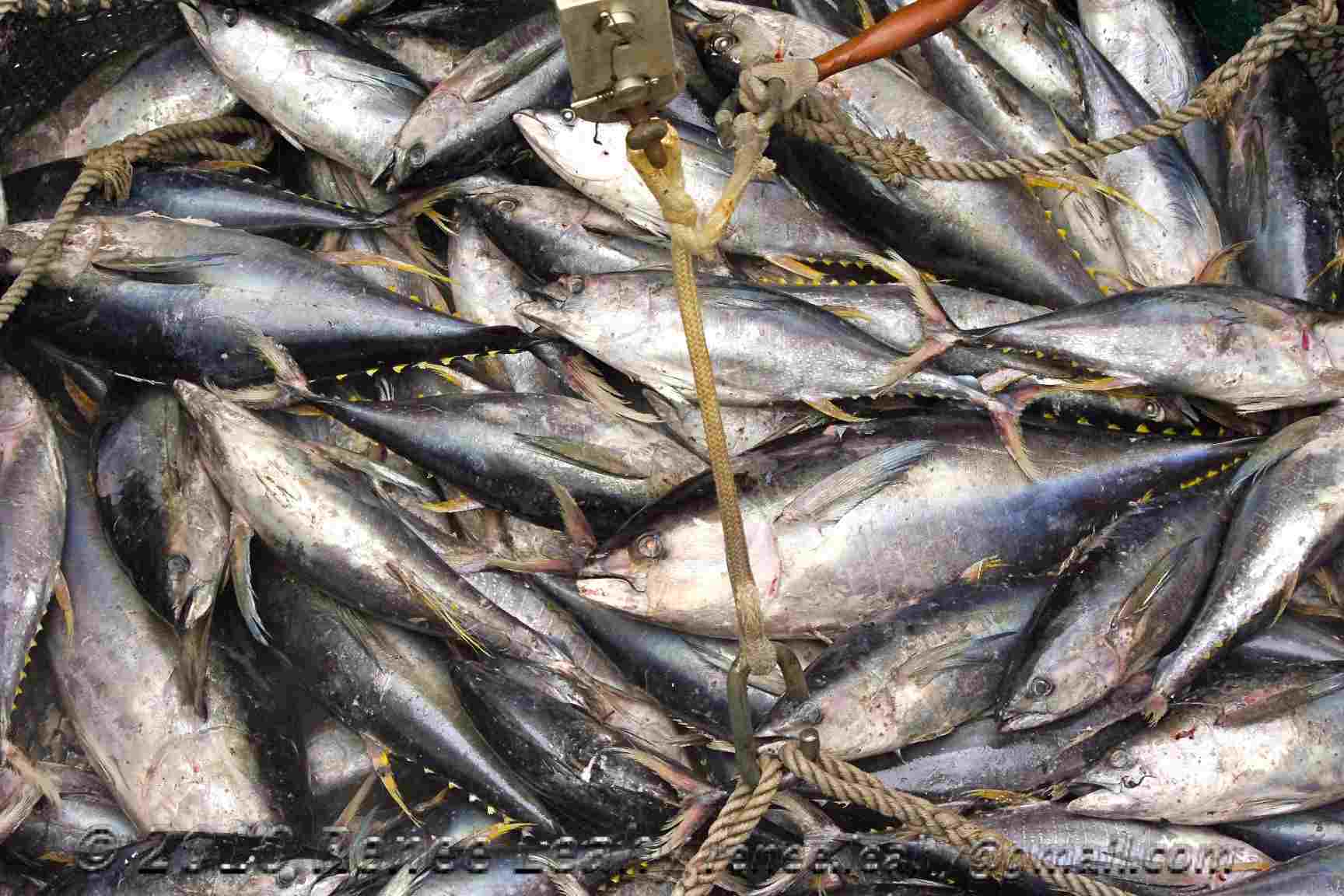
Tuna from the Spanish Purse Seiner

By STEPHEN LEAHY

Stephen Leahy's picture


Scientists estimate that phytoplankton absorb and bury more than 1.6 billion tonnes of CO2 in the seabed every year.

This would be news to readers of Canada’s Globe and Mail newspaper’s detailed two-page spread on the Global Ocean Commission report, which failed to mention this vitally important carbon reduction service (or that it is worth an estimated $148 billion a year).

Additionally, if governments ended fishing in the unclaimed oceans beyond 200-mile economic zones, near-shore fish catches would soar, even more carbon would be safely removed from the atmosphere and the oceans would be healthier said co-author of the study Rashid Sumaila of the University of British Columbia’s Fisheries Centre.

The high seas are like a failed state. Poor governance and the absence of policing and management mean valuable resources are unprotected or being squandered,” said David Miliband, co-chair of the commission and former foreign secretary of the United Kingdom.

The dollar value of all the fish caught in high seas is actually negative

Governments like Japan, Spain, the U.S. and China subsidize fishing fleets to destroy the high seas by overfishing and deep-sea bottom trawling to the tune of $152 million a year.

Here’s the kicker: The dollar value of all the fish caught way out there is actually negative when costs like fuel and subsidies are subtracted. Turns out high seas fishing fleets get 25 per cent of their income from subsidies according to a 2009 analysis by Sumaila.

Most would not be fishing the high seas without subsidies” Sumaila told DeSmog Canada.

Restoring ocean productivity

Fishing should be banned in the high seas, which represent 64 per cent of the world’s oceans just to protect and enhance its role as a carbon sponge, he said. But that is just one of 14 other valuable services the high seas provide humanity according their study, The High Seas And Us: Understanding The Value Of High Seas Ecosystems.

The study was commissioned by the Global Ocean Commission, an 18-month-old organization comprised of business leaders and former senior politicians including former Canadian prime minister Paul Martin.

The commission is calling for the negotiation of a new agreement under the UN Convention on the Law of the Sea to prioritize ocean health and resilience and restore ocean productivity. It also called for an elimination of subsidies on high seas fishing within five years.

The commission’s proposals also call for mandatory tracking of all vessels fishing in the high seas, a ban on the transshipment of fish at sea, measures to end plastics pollution and binding standards for the regulation and control of offshore oil and gas exploration and exploitation.

Carbon really does sink

Phytoplankton are the carbon-eating plants of the seas and pass on this carbon when they’re eaten. When organisms die in the deep seas, their organic matter ends up on the bottom of the ocean, which makes for an effective, natural carbon sequestration process.

Fishing is crippling this free carbon-removal system. This is especially true for bottom-trawlers that bulldoze the sea floor scooping up every living thing. Trawling is by far the most common fishing method and recent studies warn it’s destroying corals and the sea bottom leading to “long-term biological desertification.”

Last May, scientists writing in the journal Science called for an end to “the frontier mentality of exploitation” of the high seas and recommended a ban on trawling to protect the carbon-removal service and halt the decline in the productivity of the oceans. The amount of wild fish caught peaked 20 years ago.

About 70 per cent of fish caught inside the 200-mile limits spend some time in the high seas. If the high seas are protected those fish are likely to grow larger and become more numerous, benefitting near-shore fisheries, Sumaila said.

A number of studies of marine protected zones where fishing is banned or very limited show these areas act as baby-fish incubators increasing the overall population of fish.

If fishing was banned in the high seas, fisheries profits would more than double, the amount of fish would increase 30 per cent and the amount of ocean fish stock conservation would increase 150 per cent according to a study published in PLOS Biology last March.

Given the reality that fishing the high seas is a money loser, even a low carbon price could make a fishing ban valuable, not to mention the other potential benefits of regulating international fisheries. Sumaila said the $148 billion-a-year value of the high seas carbon sponge is a conservative estimate, and it could actually be as high as $222 billion.

Fishing and trawling bans have been proposed before. Last December the European parliament narrowly rejected a bottom-trawling ban on its vessels.

We need wide public understanding of the vital importance of the high seas to all of us,” concluded Sumaila.

Top 10 High Seas Fishing Nations (according to Sumaila’s study) in descending order:
Japan
South Korea
Taiwan
Spain
USA
Chile
China
Indonesia
Philippines
France
First published by DeSmog Canada Wed, 2014-06-25 10:01

Global Experts Call for Moratorium New Tarsands Development Until Climate, Environmental Impacts Assessed

Canada's tar sands projects visible from space
Canada’s tar sands projects visible from space

By STEPHEN LEAHY  Stephen Leahy's picture

A moratorium on any new oilsands expansion is imperative given Canada’s failure to properly assess the total environmental and climate impacts Canadian and U.S. experts say in the prestigious science journal Nature.

Even with a moratorium it will be very difficult for Canada to meet its international promise to reduce CO2 emissions that are overheating the planet according to government documents as previously reported by DeSmog.

Continuing to approve pipelines and new projects guarantees Canada will not meet the Harper government’s Copenhagen emissions reduction target,” said Wendy Palen, an ecologist at Simon Fraser University.

These are the plain facts Canadians need to be aware of,” Palen, a co-author of the Naturecommentary, told DeSmog.

Canadians also have no idea of the overall ‘big picture’ of the impacts of oilsands production and transport because each project is assessed in isolation.

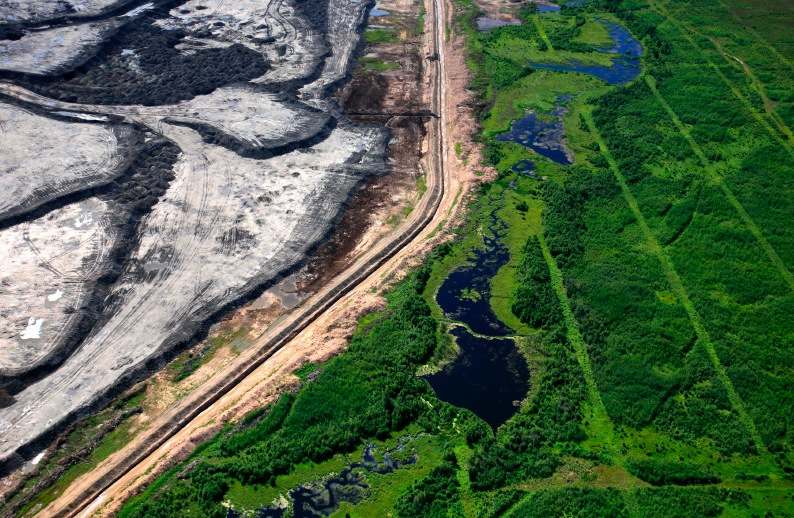
In total more than 280 square kilometres of boreal forest and peatlands have already been eliminated to make way for oilsands development. That amounts to an area more than twice the size of the City of Vancouver.

According to a 2012 study the destruction of this region of the boreal forest – a natural carbon sink –released about 100,000 tonnes of CO2 that had been safely stored underground. And it also meant the end of the region’s ability to absorb some 58,000 tonnes of CO2 every year. Over a 20-year time span that’s 1,161,000 tonnes of CO2 that stays in the atmosphere – close to half the annual emissions of the City of Vancouver.

This does not include CO2 emissions from developing oilsands projects themselves nor the emissions from burning millions of barrels of oil produced there each year.

This piecemeal approach is like determining the risk of cigarette smoking by only looking at the potential harm from smoking one cigarette, environmental economist Mark Jaccard said.

As critics have pointed out during recent pipeline review processes, regulators like the National Energy Board do not consider the climate impacts of pipelines and oilsands projects. It’s considered ‘out of bounds’ Jaccard, another coauthor of the report, said.  Each project is presented as an ultimatum: approve the project or lose an economic opportunity, he said.

This approach artificially restricts discussion to only a fraction of the consequences of oil development,” Jaccard and 7 co-authors argued in the report. The authors represent an interdisciplinary group of experts in environmental science, economics, policy development and decision science.

What Canada and the U.S. need is a “more coherent approach” to evaluate all oilsands projects and pipelines in the “context of broader, integrated energy and climate strategies.”

But first Canada and the U.S. need to impose an immediate halt to new oilsands developments and related pipeline construction, the authors write. (The U.S. is considering developing its own oilsands in Utah and elsewhere). Then the two countries can jointly develop a strategy that allows energy developments to proceed only if they are within environmental limits and respect other national commitments to human health, social justice and biodiversity protection.

However this strategy would need a formal, legislated acknowledgement of the reality that oilsands development impacts the climate. It also should create either a carbon tax or cap-and-trade mechanism to ensure the oil industry absorbs “the full social costs of carbon combustion.”

Finally this strategy should assess the full range of potential impacts compared to alternatives. And it should include the options of saying ‘no’ to a project.

Former Secretary of State Hillary Clinton said Canada and the U.S. need to co-ordinate their climate policies in an interview on the CBC’s The National last week. She acknowledged we need to get beyond project-by-project approvals.

With new regulations on power plants, the U.S. may be on its way to meeting its Copenhagen emission reduction target, which is identical to Canada’s.

While Prime Minister Harper “clearly doesn’t care about climate change,“ Jaccard told DeSmog,  President Obama does and could make approval of the Keystone XL pipeline contingent on Canada meeting its 2020 target.

Economists around the world now agree the costs of carbon pollution far outweigh the benefits,” Jaccard said.

First published by DeSmog Blog Canada Thu, 2014-06-26 12:19


Film Exposes Slick US Industry Behind Climate Denial

Robert Kenner’s forthcoming documentary lifts the lid on the ‘professional deceivers’ manipulating US debate on climate change

OPENS MARCH 6 in US

Shot from Merchants of Doubt film.
 Merchants of Doubt looks at professionals working for the fossil fuel industry to sow doubt in the US climate change debate.    Photograph: Sony Pictures Classics

By  for the Guardian

Who remembers that climate change was a top priority early in George W Bush’s first term as US president? 

Six months later everything changed. The film shows Republican party leader John Boehner calling the idea of global warming “laughable”, said Merchants of Doubt director Robert Kenner.

Framing Climate Science as Attack on Personal Freedoms

With the 9/11 attacks on the World Trade Center occupying attention, Americans For Prosperity, a powerful, fossil-fuel lobby group founded by the billionaire Koch Brothers, launched a decade-long, multi-pronged campaign to sow doubt about the reality of climate change.Screen Shot 2015-03-01 at 5.34.47 PM

By equating the findings of climate scientists as an attack on personal freedoms, they cleverly shifted the focus away from science to political opinion. “Creating a focus point away from what is actually going on is how magicians pull off their tricks,” said Kenner who directed the Oscar-nominated documentary Food Inc.

The deception has worked well. Few Americans know 97% of scientists agree climate change is caused by human activity and is happening now.

Inspired by the 2010 book of the same name, Kenner’s film is about deception and profiles many of the charming and always smiling professional deceivers who work for the tobacco, chemical, pharmaceutical, and fossil fuel industries. The tobacco industry knowingly and successfully deceived the public for 50 years about the connection between smoking and cancer, the 1988 tobacco lawsuit settlement revealed.

In a pattern of manipulation clearly evident today in the manufactured ‘debate’ over climate change, the tobacco industry used media-friendly pseudo-experts, doctored ‘science’ studies and attacked the credibility of scientists or experts who said otherwise, Kenner said.

If you can sell tobacco you can sell anything

Peter Sparber, one the tobacco industry’s most successful deceivers, told Kenner that he could get the public to believe a garbage man knew more about science than prominent climate scientist James Hansen.

“If you can sell tobacco you can sell anything,” Sparber tells Kenner.

Selling confusion and doubt around a complex issue like climate change was far easier than selling tobacco. Nearly all of those well-paid climate misinformers have no science background and often clear ties to industry lobby groups and yet are treated as expert commentators on climate science by media. It’s not just Fox News. Serious news outlets like CNN and the New York Times are complicit by featuring misinformers in news articles and on discussion panels, he said.

The film also focuses on the many self-described “grassroots” organisations that are actually promoting specific corporate and political interests. These organisations are often aided by, and passionately supported by, ordinary citizens who believe they are fighting for personal freedoms and libertarian or conservative values.

Kenner is hoping audiences “will realise they’ve been lied to” and develop better “bullshit detectors”.

First published at the Guardian

Lend Your Car, Make $$ and Save the World

Cars are parked 22 hours a day on average 

The costs of car ownership and travel are far higher than anyone realizes: a 100 km total trip costs between 65 and 80 dollars when parking, fuel, wear and tear, insurance, depreciation, repairs are included. A car is usually parked and unused 22 hours a day but still incurs costs. Why not let someone use the car when you’re not and make some money at the same time Robin Chase told me in this 2011 article. She launched Buzzcar in France as part of a strategy for reducing CO2 emissions and congestion in cities.  UPDATE (Feb 2015) Chase’s concept has come to North America – RelayRides is one such peer-to-peer car sharing service you can now try.  — Stephen

By Stephen Leahy

BERLIN, Jun 2, 2011 (IPS)

The world’s more than 850 million cars and small trucks are parked 20 to 22 hours a day. Why not use these vehicles more efficiently by letting other people drive them when the owners aren’t, asks Robin Chase, CEO of Buzzcar, a car- sharing network to be launched shortly in France.

“Sharing vehicles is much more efficient and represents a huge opportunity,” Chase told some 800 attendees from more than 50 countries at the OECD’s annual International Transport Forum (ITF) in Leipzig last week. The Forum is an intergovernmental organisation for the transport sector involving 52 different nations.

The ITF projects there will be three times as many cars – an eye-popping 2.5 billion – by 2050 according to its Transport Outlook 2011 report released at the meeting. Adding that many more vehicles in a sustainable way is an “extraordinary challenge”, said Jack Short, Secretary General of the ITF.

The vast majority of this growth will come from the developing countries since travel by passenger vehicle in a number of high-income countries has not increased, and even declined in some countries. Short acknowledged making such projections is risky because many factors such as lower economic growth, congestion in cities or new technologies will have an impact on levels of car ownership in future.

And the Transport Outlook report did not factor in the potential for car-sharing to offer personal mobility without car ownership.

Buzzcar is a car sharing service where car-owners in a city or town allow their idle cars to be used by other local citizens in exchange for getting about 70-75 per cent of the rental fee, Chase told IPS in an interview. Even when a car is parked it costs their owners money, she says. The average cost of owning and operating car is 8,000 to 12,000 dollars a year even if it sits parked 22 hours a day. (update: more like $9,000 to 14,000 according to auto clubs)

Buzzcar is an opportunity for car owners to get better value out of their vehicles and to help with ever- rising costs of car ownership. More importantly car sharing reduces the need for car ownership overall, she says.

This independent environmental journalism depends on public support. Click here learn more.

Chase was a co-founder of Zipcar, a U.S.-based car-rental network with more than a half million members where people rent cars by the hour from easy-to-access neighbourhood lots or stations. Zipcar owns some 8,000 rental cars. She then went on to start GoLoco, a ride sharing company in which people pay to ride along with others in the network, and the drivers take a cut of the fees. Continue reading

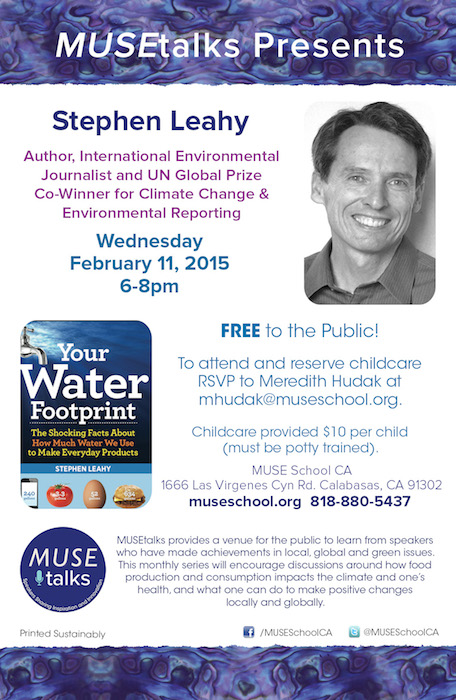
Free Public Talk on How You Consume 2000 Gallons of Water Every Day

Stephen Leahy sml

 [I will be in the L.A. area Feb 9 to 16 and available for interviews and book signings – Contact me

Critically Acclaimed New Book Investigating The Enormous Amounts Of  ‘Hidden’ Water We Consume Every Day

It takes more than 7,600 liters (2,000 gallons) of water to make a single pair of jeans. That morning cup of coffee required 140 liters (37 gallons) of water before it found its way to your table—water that was used to grow, process and ship the coffee beans. When we spend money on food, clothes, cellphones or even electricity, we are buying water  — a shockingly large amount of water.

WATER IS MORE VALUABLE AND USEFUL THAN OIL

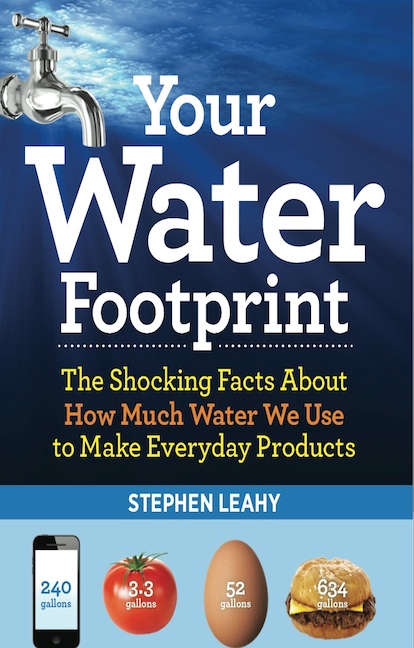
Your Water Footprint: The Shocking Facts About How Much Water We Use To Make Everyday Products reveals how water is essential to our way of life in ways we never imagined. While water usage continues to soar, shortages now affect more than 3 billion people including millions of Americans and Canadians. A decade from now 3 out of 5 people will face water shortages.

Your Water Footprint provides essential information to reduce your water use which will help you save money, be prepared for shortages and ensure our children and grandchildren will have abundant fresh water.  Water-wise choices is all about smart substitutions and changes, rather than sacrifice and self-denial.


“…a brilliant and shocking exposé on precisely how much water we use…” – Publishers Weekly

…exceptionally lucid narration with arresting, full-page info graphics”  — Booklist

Your Water Footprint:  The Shocking Facts About How Much Water We Use To Make Everyday Products

October 2014 Firefly Books, 160 Pages, 125 Unique Infographics only $19.95 Paperback (Also avail in hardcover) Order today

In US:  AmazonPowell’s Books; Barnes&NobleIndiebound

Canada:  Chapters-Indigo Signed copies avail at Blue Heron Books – Stephen’s home town bookstore; In Ottawa visit the legendary Octopus Books

UK:  WH SmithAmazonWaterstones

Australia: Angus & RobertsonBooktopia

New Zealand: Mighty Ape

Water is far more valuable and useful than oil

Average water footprint of bottle of cola

The water footprint of a half-litre bottle of water is 5.5 litres – yet well over a billion people live in areas with chronic scarcity

By Stephen Leahy

I have a confession: I knocked back 320 pints at the pub last night. I actually only had two shots of a decent single malt but it took 320 pints of water to grow and process the grain used to make the whisky. That’s a whole lot of water considering the average bathtub holds 60 to 80 litres.

Even after 20 years of covering environmental issues in two dozen countries I had no idea of the incredible amounts of water needed to grow food or make things. Now, after two years working on my book Your Water Footprint: the shocking facts about how much water we use to make everyday products, I’m still amazed that the t-shirt I’m wearing needed 3,000 litres to grow and process the cotton; or that 140 litres went into my morning cup of coffee. The rest of my breakfast swallowed 1,012 litres: small orange juice (200 litres); two slices of toast (112 litres); two strips of bacon (300 litres); and two eggs (400 litres).

Water more valuable and useful than oil

Researching all this I soon realised that we’re surrounded by a hidden world of water. Litres and litres of it are consumed by everything we eat, and everything we use and buy. Cars, furniture, books, dishes, TVs, highways, buildings, jewellery, toys and even electricity would not exist without water. It’s no exaggeration to say that water is far more valuable and useful than oil.

front cover resized1A water footprint adds up the amount of water consumed to make, grow or produce something. I use the term consumed to make it clear that this is water that can no longer be used for anything else. Often water can be cleaned or reused so those amounts of water are not included in the water footprints in the book. The water footprint of 500ml of bottled water is 5.5 litres: 0.5 for the water in the bottle and another five contaminated in the process of making the plastic bottle from oil. The five litres consumed in making the bottle are as real water as the 500ml you might drink but hardly anyone in business or government accounts for it.

The incredible amounts of water documented in Your Water Footprint are based primarily on research done at the University of Twente in the Netherlands, where Arjen Hoekstra originated the concept of water footprints. The amount consumed to make something varies enormously depending on where the raw materials come from and how they are processed. Wheat grown in dry desert air of Morocco needs a lot more water than wheat grown in soggy Britain. For simplicity, the amounts in the book are global averages.

One of the biggest surprises was learning how small direct use of water for drinking, cooking and showering is by comparison. Each day the average North American uses 300 to 400 litres. (Flushing toilets is the biggest water daily use, not showers.) 400 litres is not a trivial amount; however, the virtual water that’s in the things we eat, wear and use each day averages 7,500 litres in North America, resulting in a daily water footprint of almost 8,000 litres. That’s more than twice the size of the global average. Think of running shoes side by side: the global shoe is a size 8; the North American a size 18. By contrast, the average water footprint of an individual living in China or India is size 6.

Peak water is here

Water scarcity is a reality in much of the world. About 1.2 billion people live in areas with chronic scarcity, while 2 billion are affected by shortages every year. And as the ongoing drought in California proves, water scarcity is an increasing reality for the US and Canada. Water experts estimate that by 2025 three in five people may be living with water shortages.

While low-flow shower heads and toilets are great water savers, the water footprint concept can lead to even bigger reductions in water consumption. For example green fuels may not be so green from a water consumption perspective. Biodiesel made from soybeans has an enormous water footprint, averaging more than 11,000 litres per litre of biodiesel. And this doesn’t include the large amounts of water needed for processing. Why so much water? Green plants aren’t “energy-dense,” so it takes a lot of soy to make the fuel.

Beef also has a big footprint, over 11,000 litres for a kilo. If a family of four served chicken instead of beef they’d reduce their water use by an astonishing 900,000 litres a year. That’s enough to fill an Olympic size pool to a depth of two feet. If this same family of opted for Meatless Mondays, they’d save another 400,000 litres. Now they could fill that pool halfway.

We can do nearly everything using less water. It’s all about smart substitutions and changes, rather than sacrifice and self-denial, but we can’t make the right choices unless we begin to see and understand the invisible ways in which we rely on water.

First published at The Guardian

Treehugger Interview with Your Water Footprint Author Stephen Leahy

Screen Shot 2014-11-23 at 11.06.18 AM

Why care about your water footprint?


"Your water footprint" by Stephen Leahy

© “Your water footprint” by Stephen Leahy. Groundwater comes from aquifers that take thousands of years to fill. Globally, aquifers are being drained faster than then can refill.

Margaret Badore (@mbadore) Science / Clean Water

November 18, 2014

We learn in elementary school that water is in a constant cycle of evaporation and precipitation, making our crops grow and flowing from rivers into oceans. While the amount of water on Earth remains fairly stable, its distribution around the globe is changing, and this change is being accelerated by human activities.

A new book, “Your Water Footprint,” by environmental reporter Stephen Leahy, takes a close look at the “virtual water” that surrounds us in everyday life. This isn’t just the water we use to boil pasta or take a shower, it’s the water that’s used to grow our coffee beans and power the local energy plant. As the demand for this kind of water increases, the more threatened our access to fresh water becomes. At the same time, pollution makes vast amounts of water unusable.

I had the opportunity to catch up with Leahy over Skype.

TreeHugger: What were your goals for writing this book?

Stephen Leahy: To help people understand this other aspect of water that we use, that we don’t see. This virtual water concept: the water it takes to make things, the water it takes to grow our food, to make our products, to make our clothing. This is that unseen water that we don’t think about, and because we don’t see it, we’re not really aware of it.

It’s an enormous amount of water that we end up consuming every day without realizing it.

Continue reading

Your Water Footprint: Book Reviews

front cover resized1REVIEWS: 

…exceptionally lucid narration with arresting, full-page info graphics”  – Booklist,  starred review


“Leahy, an award-winning Ontario environmental journalist… makes it clear that the most innocent-seeming actions and products are far from water-neutral. — Toronto Star


“Leahy drops a tsunami of sobering facts and infographics on the heads of readers who take what comes out of their faucets for granted.” — Kirkus Reviews


Journalist Stephen Leahy’s new book about water footprints is a great introduction to the mysterious world of virtual water. – EcoCentric


“… answers on our water consumption pour forth in this entertaining and extremely well illustrated book..” — Harvest H20


“Leahy’s straightforward, teen-friendly explanations and clever, compelling visuals constitute an ideal introduction to the urgent facts about water.” — Booklist Review


Your Water Footprint:  The Shocking Facts About How Much Water We Use To Make Everyday Products

October 2014 Firefly Books, 160 Pages, 125 Unique Infographics only $19.95 Paperback (Also avail in hardcover) Order today

In US:  AmazonPowell’s Books; Barnes&NobleIndiebound

Canada:  Chapters-Indigo Signed copies avail at Blue Heron Books – Stephen’s home town bookstore

UK:  WH SmithAmazonWaterstones

Australia: Angus & RobertsonBooktopia

New Zealand: Mighty Ape

Canada Leading ‘Deforestation Nation’ In Race to Destroy Planet’s Last Wilderness Areas

Canada's tar sands projects visible from space
Canada’s tar sands projects visible from space

Forest Loss Results in Massive Emissions of CO2

UXBRIDGE, Canada, Sep 5 2014 (IPS) 

The world’s last remaining forest wilderness is rapidly being lost – and much of this is taking place in Canada, not in Brazil or Indonesia where deforestation has so far made the headlines.

A new satellite study reveals that since 2000 more than 104 million hectares of forests – an area three times the size of Germany – have been destroyed or degraded.

Since 2000 more than 104 million hectares of forests – an area three times the size of Germany – have been destroyed or degraded.


“Every four seconds, an area of the size of a football (soccer) field is lost,” said Christoph Thies of Greenpeace International.

The extent of this forest loss, which is clearly visible in satellite images taken in 2000 and 2013, is “absolutely appalling” and has a global impact, Thies told IPS, because forests play a crucial in regulating the climate.


The current level of deforestation is putting more CO2 into the atmosphere than all the world’s cars, trucks, ships and planes together, he said, adding that “governments must take urgent action” to protect intact forests by creating more protected areas, strengthening the rights of forest communities and other measures, including convincing lumber, furniture manufacturers and others to refuse to use products from virgin forests.

Greenpeace is one of several partners in the Intact Forest Landscapes initiative, along with the University of Maryland, World Resources Institute and WWF-Russia among others, that uses satellite imagery technology to determine the location and extent of the world’s last large undisturbed forests.

The new study found that half of forest loss from deforestation and degradation occurred in just three countries: Canada, Russia and Brazil. These countries are also home to about 65 percent of world’s remaining forest wilderness.

However, despite all the media attention on deforestation in the Amazon forest and the forests of Indonesia, it is Canada that has been leading the world in forest loss since 2000, accounting for 21 percent of global forest loss. By contrast, the much-better known deforestation in Indonesia has accounted for only four percent.

Brazil's Amazon forest - 2013. Credit_Courtesy of Global Forest Watch

Massive increases in oil sands and shale gas developments, as well as logging and road building, are the major cause of Canada’s forest loss, said Peter Lee of Global Forest Watch Canada, an independent Canadian NGO.

A big increase in forest fires is another cause of forest loss. Climate change has rapidly warmed northern Canada, drying out the boreal forests and bogs and making them more vulnerable to fires.

In Canada’s northern Alberta’s oil sands region, more than 12.5 million hectares of forest have been crisscrossed by roads, pipelines, power transmission lines and other infrastructure, Lee told IPS.

Canada’s oil sands and shale gas developments are expected to double and possibly triple in the next decade and “there’s little interest at the federal or provincial political level in conserving intact forest landscapes,” Lee added.

The world’s last remaining large undisturbed forests are where most of the planet’s remaining wild animals, birds, plants and other species live, Nigel Sizer, Global Director of the Forest Programme at the World Resources Institute, told a press conference.

Animals like Siberian tigers, orangutans and woodland caribou require large areas of forest wilderness, Sizer noted, and “losing these top species leads to a decline of entire forest ecosystems in subtle ways that are hard to measure.”

While forests can re-grow, this takes many decades, and in northern forests more than 100 years. However, if species go extinct or there are too few individuals left, it will take longer for a full forest ecosystem to recover – if ever.

In just 13 years, South America’s Paraguay converted an incredible 78 percent of its remaining forest wilderness mainly into large-scale soybean farms and rough pasture, the study found. Satellite images and maps on the new Global Forest Watch website offer see-it-with-your-own eyes images of Paraguay’s forests vanishing over time.

The images and data collected for the study are accessible via various tools on the website. They reveal that 25 percent of Europe’s largest remaining forest, located 900 km north of Moscow, has been chopped down to feed industrial logging operations. In the Congo, home of the world’s second largest tropical forest, 17 percent has been lost to logging, mining and road building. The Global Forest Watch website also shows details of huge areas of Congo forest licensed for future logging.

Deforestation starts with road building, often linked to logging and extractive industries, said Thies. In some countries, like Brazil and Paraguay, the prime reason is conversion to large-scale agriculture, usually for crops that will be exported.

The new data could help companies with sustainability commitments in determining which areas to avoid when sourcing commodities like timber, palm oil, beef and soy. Market-led efforts need to gain further support given the lax governance and enforcement in many of these forest regions, Thies said.

He called on the Forest Stewardship Council (FSC) – a voluntary certification programme that sets standards for forest management – to “also play a stronger role” and to improve those standards in order to better protect wilderness forests.

Without urgent action to curb deforestation, it is doubtful that any large-scale wild forest will remain by the end of this century, concluded Sizer.

First published on IPS

Website for my new book: Your Water Footprint

YWF website logoNew Book Investigating The Enormous Amounts Of  ‘Hidden’ Water We Consume Every Day

By Journalist Stephen Leahy, Winner of the 2012 Prince Albert/United Nations Global Prize for Reporting on Climate Change

It takes more than 7,600 liters (2,000 gallons) of water to make a single pair of jeans. That morning cup of coffee required 140 liters (37 gallons) of water before it found its way to your table—water that was used to grow, process and ship the coffee beans. When we spend money on food, clothes, cellphones or even electricity, we are buying water  — a shockingly large amount of water.

New Website featuring:

Articles: How to save 900,000 litres of water at the dinner table

Sample Infographics

About the Author (including video)

Reviews

Your Water Footprint by Stephen Leahy

http://yourwaterfootprint.me

WATER IS MORE VALUABLE AND USEFUL THAN OIL