Public Pays for Fukushima Clean Up While Nuclear Industry Profits

Japan Fukushima Dai-ichi nuclear power plant March 31 2011

By Stephen Leahy

UXBRIDGE, Canada, Mar 12 2013 (IPS)

Two years after Japan’s Fukushima Daiichi nuclear disaster, the country faces 100 to 250 billion dollars in cleanup and compensation costs, tens of thousands of displaced people and widespread impacts of radiation.

The nuclear industry and its suppliers made billions from building and operating Fukushima’s six reactors, but it is the Japanese government and its citizens who are stuck with all the costly “fallout” of the disaster.

“People’s lives were destroyed and we will be paying trillions of yen in tax money because of the Fukushima disaster,” said Hisayo Takada, an energy campaigner with Greenpeace Japan.

“The nuclear industry, other than Tepco (Tokyo Electric Power Co), has paid nothing as they are specially protected by the law,” Takada told IPS.

On Mar. 11, 2011, Japan experienced a 9.0 magnitude earthquake and resulting tsunami that badly damaged Tepco’s Fukushima Daiichi nuclear plant. Three of six reactors suffered a meltdown, and reactor unit four was damaged. The Fukushima accident has been rated at the highest level (7) of the International Atomic Energy Agency scale, the same as the Chernobyl accident.

A year after the disaster, Tepco was taken over by the Japanese government because it couldn’t afford the costs to get the damaged reactors under control. By June of 2012, Tepco had received nearly 50 billion dollars from the government.

The six reactors were designed by the U.S. company General Electric (GE). GE supplied the actual reactors for units one, two and six, while two Japanese companies Toshiba provided units three and five, and Hitachi unit four. These companies as well as other suppliers are exempted from liability or costs under Japanese law.

Full story here

Canada Has Become a Petro-State, Happily Drilling for Profits as the World Warms

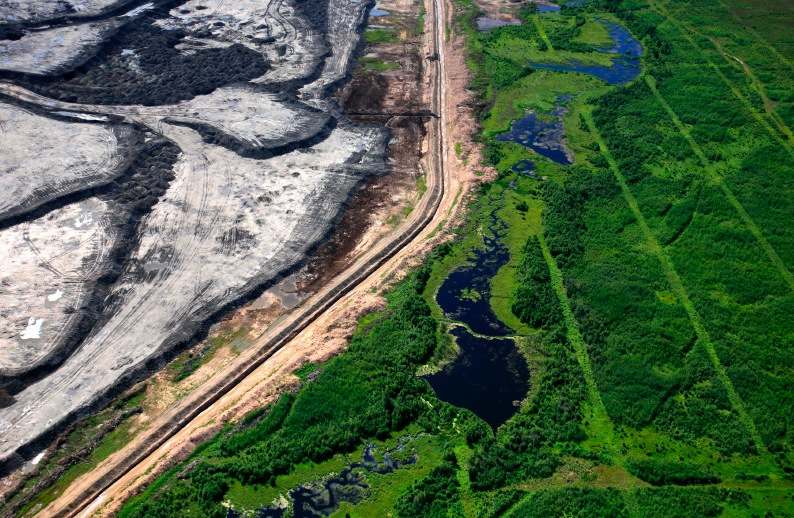
tar sands - visible from space,tarnished earth

Thu, 2013-03-07 08:00 STEPHEN LEAHY

What’s happened to Canada? To the dismay of many a country with an international reputation for relatively progressive environmental policies (at least compared to the United States) is rushing headlong to dig up all the oil, gas, and coal it can. The country’s leaders can scarcely muster the effort to pretend to want to limit climate-heating carbon emissions.

And the Canadian business establishment and media have largely gone along with the program. Put it all together, and you have a country that has become a full-blown “petrostate.”

People are starting to notice. Last December at the UN climate talks in Doha, Qatar, Canada beat out tough contenders like Saudi Arabia to be elected “Colossal Fossil” by environmental organizations from around the planet. Canada had the dishonor of being the most uncooperative country out of 193 nations at the climate summit. It was the sixth year in a row that international environmental groups gave Canada their ‘highest’ award for its persistent efforts to block any agreement on reducing carbon emissions.

What’s happened to Canada is that it has experienced a steady takeover by the fossil fuel industry.

Canada’s is now the world’s fifth largest crude oil producer and the biggest supplier of oil to the US. Canada is also the third largest producer of natural gas and one of the top ten miners of coal. This enormous boom in fossil fuel production has been underway since the late 1990s. Like Saudi Arabia, fossil energy is by far Canada’s biggest export and has become the dominant economic and political focus.

Full story click below:

Blame Canada is a four part series revealing how Canada has become a fossil-fuelled energy superpower that’s going to wreck its future and the global climate.

Killer Heat Waves and Floods Linked to Climate Change

Projected drought and dry regions in 2060-2069

By Stephen Leahy

UXBRIDGE, Canada, Feb 27 2013 (IPS) 

Killer heat waves, floods and storms are increasingly caused by climate change, new research reveals.

Scientists in Germany say they have found how greenhouse gases from burning fossil fuels are helping to trap the jet stream, resulting in extraordinary weather such as the 2010 Pakistan flood and the 2011 heat wave in the United States.

Human-driven climate change repeatedly disturbs the flow of atmospheric waves around the globe’s Northern hemisphere, said lead author Vladimir Petoukhov of the Potsdam Institute for Climate Impact Research (PIK) in Germany.

Giant atmospheric waves called Rossby waves are meanders in the strong, high-altitude winds known as jet streams and have a major influence on weather. These wave movements are caused by the difference in temperatures between the cold air from the Arctic and hot air from the tropics. 

When the waves shift north, they suck warm air from the tropics to Europe, Russia, or the U.S., and when they swing down, they do the same thing with cold air from the Arctic, said Petoukhov.

“During several recent extreme weather events, these planetary waves almost freeze in their tracks for weeks,” he said. “So instead of bringing in cool air after having brought warm air in before, the heat just stays.”

Green Energy Solves Dual Crises of Poverty and Climate

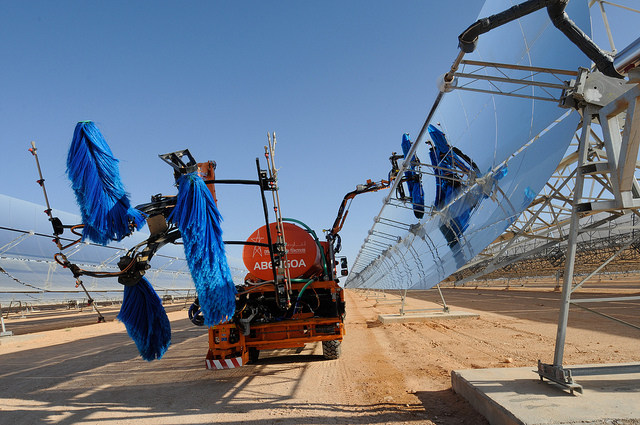
Ain Beni Mathar Integrated Combined Cycle Thermo-Solar Power Plant

By Stephen Leahy

UXBRIDGE, Canada, Feb 25 2013 (IPS) 

Green energy is the only way to bring billions of people out of energy poverty and prevent a climate disaster, a new study reveals.

Conservative institutions like the World Bank, the International Energy Agency and accounting giant Price Waterhouse Coopers (PwC) all warn humanity is on a path to climate catastrophe unless fossil fuel energy is replaced by green energy.

The U.N.’s Sustainable Energy for All initiative intends to bring universal access to modern energy, doubling the share of renewable energy globally, and doubling the rate of improvement in energy efficiency by 2030.

Poverty eradication, sustainable development and the transition away from fossil fuel energy go hand in hand.

If those targets are met and similar efforts undertaken to reduce deforestation, then climate disaster can be avoided, said Joeri Rogelj of the Institute for Atmospheric and Climate Science in Zurich  who headed the analysis published Sunday in the journal Nature Climate Change.


Weird Weather Will Only Get Weirder

New York City flooding

By Stephen Leahy

UXBRIDGE, Canada, Jan 29 2013 (IPS) 
 
Weird is the only way to describe January temperatures whipsawing between record warm and arctic cold over a span of a few days. Experts say that is what climate change looks like: weird, record-shattering weather.

Here’s a fact that goes beyond weird to astonishing. Anyone who is 27 years old or younger has never lived through a month that was colder than the global 20th century average. In other words, we’ve had 334 consecutive months with above average temperatures, according to the U.S. National Oceanic and Atmospheric Administration.

Last summer, the Arctic sea ice shrunk to half of what it used to be during summers only three decades ago. Our planet’s weather is driven largely by the two cold polar regions and the warm tropics. With the Arctic defrosting, it should be no surprise our weather is getting weird. And that it’s not going to get better.

National Legislation Key to Combating Climate Change

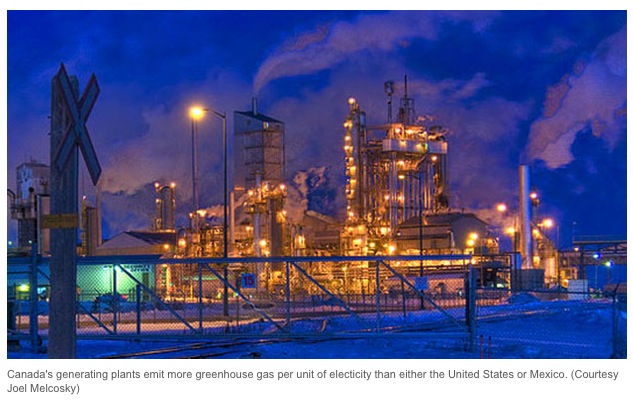
Canada's fossil fuel electricity has highest carbon emissions

By Stephen Leahy

UXBRIDGE, Canada, Jan 15 2013 (IPS)

A majority of major economies have made significant progress in addressing climate change, with countries like South Korea and China taking aggressive action so they can benefit from energy- and resource-efficient economies, a new report released Monday found.

The study by GLOBE International and Grantham Research Institute profiled 33 major economies in an annual examination of climate and energy legislation. 32 of them, including the United States, made significant progress in 2012, while only Canada regressed.

“The study reveals a major trend is underway. More and more countries are acting on climate,” said Adam Matthews, secretary general of GLOBE International, an organisation of legislators.

Pollution as big a health problem as malaria or TB, finds report

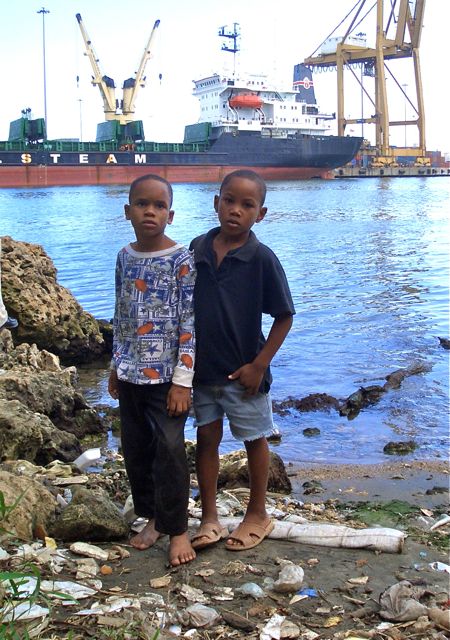
Haina, Dominican Republic - Children are developmentally impaired as a result of lead poisoning
Haina, Dominican Republic – Children are developmentally impaired as a result of lead poisoning

Industrial pollutants harm the health of 125 million people,

many of whom live in the developing world and work in mining

Stephen Leahy

guardian.co.uk, Wednesday 24 October 2012 12.30 BST

Waste from mining, lead smelters, industrial dumps and other toxic sites affects the health of an estimated 125 million people in 49 low- and middle-income countries. This unrecognised health burden is on the scale of malaria or tuberculosis (TB), a new report has found.

This year’s World’s worst pollution problems (pdf) report was published on Tuesday by the Blacksmith Institute in partnership with Green Cross Switzerland. It documents, for the first time, the public health impact of industrial pollutants – lead, mercury, chromium, radionuclides and pesticides – in the air, water and soil of developing countries.

“This is an extremely conservative estimate,” said Bret Ericson of the Blacksmith Institute, a small international NGO based in New York City. “We’ve investigated 2,600 toxic sites in the last four years, [but] we know there are far more.”

The US has an estimated 100,000-300,000 toxic sites, mainly factories or industrial areas, but toxic sites in the low- and middle-income countries assessed in the report are often in residential areas. “We see a lot of disease when we go into these communities,” said Ericson. “But we were surprised the health burden was so high – as much as malaria.”

Click to read full story:  Pollution as big a health problem as malaria or TB, finds report | Global development | guardian.co.uk.

Critics Brand Climate Talks Another Lost Opportunity

findlay ohio flooding AP

By Stephen Leahy

DOHA, Qatar, Dec 11 2012 (IPS)

Rich countries came to the U.N. climate talks in Doha intent on delaying needed action on climate change for another three years and a still to be hammered out new global treaty.

This delay will be extraordinarily expensive and risky.

Every year that fossil fuel emissions fail to decline adds to the cost and reduces the odds that a global temperature rise can be kept below two degrees C.

“Science says emissions need to peak in 2015,” said Kumi Naidoo, executive director of Greenpeace International, as the final plenary of COP 18 concluded last Saturday night, a full day late.

The 195 parties to the U.N. Framework Convention on Climate Change (UNFCCC) approved a set of documents called “The Doha Climate Gateway” that does not increase emission reductions or guarantee much-needed financial help to poor countries suffering present and future impacts of climate change.

“Doha is a betrayal of people living with impacts now. And it is a sellout of our children and grandchildren’s future,” said Naidoo.

“The fossil fuel industry won,” said Alden Meyer, the Union of Concerned Scientists’ director of strategy and policy, who has attended nearly every one of these climate negotiations over the past 18 years.

“The science is clear that four-fifths of known fossil fuel reserves must stay in the ground but we continue to burn them like there is no tomorrow,” Meyer said.

“Doha became more of a trade fair…Negotiators protected the interests of corporations and not the needs of people,” he told IPS.

More than 16,000 delegates participated in the two-week conference of the parties (COP) in Doha, Qatar, a country rich in oil and gas in the heart of the Middle East fossil fuel empire.

Meyer, along with representatives from more than 700 civil society organisations, blamed the U.S. for blocking proposals for greater emissions cuts. The U.S. also refused to commit a singly penny to assisting countries hard hit by climate change. U.S. negotiators did acknowledge poor countries were suffering costly damages and losses.

The world has already warmed 0.8 degrees C, altering weather patterns and increasing extreme events which have led to nearly 400,000 deaths and more than 1.2 trillion dollars being lost every year, according a 2011 study.

A delegate from Bangladesh told IPS that climate-related damages cost his country three to four percent of its annual GDP. Climate change, which is also driven by deforestation and land conversion for agriculture, is undercutting development and will push his country’s and other countries’ economies into a steady decline, he said.

To help governments cope, industrialised nations promised to put 100 billion dollars a year into a Green Climate Fund by 2020. To bridge the gap until then, developing nations asked for 60 billion dollars in total by 2015. Britain, Germany and a few other countries promised to contribute six billion dollars.

But the U.S., Canada, Japan and others agreed only to more talks next year.

“The U.S. spends 60 billion dollars on its military marching bands,” said Naidoo.

The only hope is to build a robust grassroots movement to force countries to act in the interest of the public and future generations, he said.

“We have to build a new social movement like (the one) that overcame slavery,” agreed Oxfam International climate change policy advisor Tim Gore.

“We reject what our leaders are doing here. We are more angry, more impassioned to defeat this process,” said Gore.

The COP process is an obstacle because a few big countries can easily block the will of the majority, said Mohamed Aslam, former environment minister and chief negotiator for the Republic of the Maldives.

“The signs of global warming are obvious and we know that the safe limit is to stay below 1.5 C…and yet we are failing to act,” Aslam said in a press conference.

The U.N. spends millions of dollars on these negotiations and they are going nowhere, he said. “We are running out of time. (We) need to take this to another fora,” he said.

What is lacking is a real commitment to reduce global emissions, said Christina Figueres, executive secretary of the United Nations Framework Convention on Climate Change (UNFCCC).

“What needs to change most is political will,” Figueres told IPS.

In Doha, the U.N. secretary-general announced a world leaders’ summit in 2014 to hammer out emission reduction targets to keep warming below two degrees C. The Doha Climate Gateway confirmed details for a new negotiation track to have a new global climate treaty ready for ratification in 2015 and go into force in 2020.

Under this agreement all countries will likely be obligated to make emission cuts, varying in depth and timing. Without additional cuts before 2020, reductions afterwards will need to be rapid and massive, moving to a zero-fossil fuel emission society in a few decades based on the science.

The Doha agreement includes a second phase of the Kyoto Protocol with the European Union, Australia and a few other countries agreeing to cut fossil fuel emissions between 2013 and 2020. However, they did not set new targets, agreeing instead to a mandatory review of targets in 2014.

The nations involved only represent 12 percent of global emissions, and do not include large developing country emitters like China, India and Brazil. The U.S. has never participated, while Canada and Japan have opted out of the second phase but are supposed to make to make comparable cuts but offered nothing new.

“Rich countries think they can protect themselves from the impacts, leaving the poor with no clear pathway to the future,” said Mohamed Adow of Christian Aid.

“Our leaders have let us down. Civil society will have to lead to get the future we really want,” said Adow.

Original IPS story

Be Part of a New Collaborative Approach to Media Coverage of Climate

Screen Shot 2013-10-17 at 10.09.20 PM

Frustrated by the lack of interest in climate coverage by mainstream media, 15 young journalists on 4 continents want to bring a new collaborative approach to climate change journalism. This is a voluntary effort to both increase and improve reporting called the Climate News Mosaic (CNM).


They need your help for their first collaborative project to connect what’s happening at the UN climate conference (COP) in Warsaw this November with climate impacts/perspectives on the ground from their home countries.

Here’s how it will work:

* 2 or 3 journalists will go to the COP in Warsaw to report and co-ordinate. The rest will be back home doing local coverage on climate. Everyone contributes and shares interviews, links to reports, sources, A/V and so on.

* Members (mainly freelancers) do articles, audio and video for their own outlets. Some 25-30 original stories in at least 4 languages will be made available for use in whole or in part by any media outlet anywhere in the world.

* A live blog placed on a number non-profit news sites like IPSEarth Journalism Network , and others will bring the public a wealth of current info on what is happening at the Warsaw COP but also from other countries. (i.e. a short video from Warsaw, a photo from a rally in San Francisco, a soundbite from a press conference in Nairobi, a quote from an interview with an Italian scholar.)

Learn more about CNM participants on this global map with short bios.

I’m sort of the mentor having used crowd-sourced funding to support my science and climate journalism the past 4 years. That support kept me going and in 2012 I was a co-winner of the Prince Albert/United Nations Global Prize for media coverage of climate change.

For-profit media owners are simply not interested in good science and environment reporting. Coverage of climate change has been in sharp decline since the UN climate summit in Copenhagen in 2009. Even the New York Times closed its environment desk this year. It’s not that there isn’t a lot to report on. Quite the opposite.

Here’s how you can help:

Please spread the word about this project. We need to raise $6000 for travel, accomodation and other costs to do the Warsaw COP reporting.  Please click on Indiegogo to contribute what you can. (There are ‘perks’ for contributors including a Google Hangout.)

This is a fresh new idea: Independent journalists in different countries working together to provide all of us with the news and information on the most important issue of our time.

Please join in and help out.

“We Should be Shaking in Our Boots” – UN Environment Official

Construction of the Trans-Amazonian Highway, Brazil -- sml Photo by Hans Silvester

Earth’s Ability to Support Us At Risk – An Indictment of Governments We Elected

By Stephen Leahy

RIO DE JANEIRO, Jun 19 2012 (IPS)

The science is crystal clear: humans are threatening Earth’s ability to support mankind, and a new world economy is urgently needed to prevent irreversible decline, said scientists and other experts at an event on the sidelines of the Rio+20 Earth Summit.

Yet the Global Environment Outlook report, or GEO 5, which was launched on June 6 and assessed 90 of the most important environmental objectives, found that significant progress had been made only in four in the 20 years since the first landmark summit in Rio in 1992.

Achim Steiner, the executive director of the United Nations Environment Programme (UNEP) said the results of GEO 5 were “depressing, even to me”.

“This ought to have us shaking in our boots,” Steiner told TerraViva at the Fair Ideas conference that concluded Sunday. ”It is an indictment of our behaviour over the past 20 years and of the governments we elected. We need an honest conversation about why we are not turning things around.”rio banner sml

Instead, “what’s happening right now in the RioCentro (Rio+20 official site) is that science is being picked out of the text of the final agreement,” Johan Rockström, executive director of the Stockholm Resilience Centre in Sweden, told the conference.

Rockström said he had received updates from the negotiations that the United States and some of the world’s least developed countries were attacking the science showing humanity is pushing up against “planetary boundaries”.

Climate is only one of those “planetary boundaries”. Another is the ongoing decline of biodiversity, where so many plants and animals are going extinct that the Earth’s living systems, upon which humanity depends, are unravelling. Fresh water is another planetary boundary. Water is a limited resource, yet water use has increased six-fold in the past century.

“The science is absolutely clear: we are up against the edges of the planet’s ability to support us and approaching irreversible tipping points,” Rockström said. Continue reading