U.S. Awash in Oil and Lies, Report Charges | More Oil Development Risks Catastrophe

Canada’s Alberta Tar Sands Mining Pits

By Stephen Leahy

UXBRIDGE, Canada, Sep 2, 2011 (IPS)

With four times as many oil rigs pumping domestic oil today than eight years ago and declining domestic demand, the United States is awash in oil.

The country’s oil industry is primarily interested in who will pay the most on the global marketplace. They call that “energy security” when it suits, but in reality it is “oil company security” through maximising profits, say energy experts like Steve Kretzman of Oil Change International, an NGO that researches the links between oil, gas and coal companies and governments.

The only reason U.S. citizens may be forced to endure a risky, Canadian-owned oil pipeline called Keystone XL is so oil companies with billion-dollar profits can get the dirty oil from Canada’s tar sands down to the Gulf of Mexico to export to Europe, Latin America or Asia, according to a new report by Oil Change International released Wednesday.

“Keystone XL will not lessen U.S. dependence on foreign oil, but rather transport Canadian oil to American refineries for export to overseas markets,” concludes the report, titled “Exporting Energy Security“.

Little of the 700,000 to 800,000 barrels of tar sands oil pumped through the 2,400-kilometre, seven-billion-dollar Keystone XL will end up in U.S. gas tanks because the refineries on the Gulf Coast are all about expanding export markets. One huge refinery operator called Valero has been touting the potential export revenues of tar sands oil to investors, the report found.

Because Keystone XL crosses national borders, President Barack Obama has to issue a permit declaring the pipeline serves the “national interest” in order to be approved.

“The only way Keystone XL could be considered in the national interest is if you equate that with profits for the oil industry,” said Kretzman, who wrote the report. Continue reading

Can Obama Take First Step to Break Addiction to Oil? (And Win First Battle Against Big Oil?)

Sept 3 protest at white house

‘…unless river of money from Big Oil is diverted there is no way to deal with climate change’

Analysis by Stephen Leahy

UXBRIDGE, Canada, Aug 31, 2011 (IPS)

The United States’ biggest environmental groups put aside their differences last week to make an urgent intervention on the country’s addiction to oil. The first step on the long road to recovery, they say, is to stop the proposed construction of the Keystone XL pipeline that will “mainline” the world’s dirtiest oil from northern Canada into the U.S. heartland.

“This (Keystone) is a terrible project,” they wrote in a letter to President Barack Obama, citing dangers to the climate, the risks of disastrous spills and leaks, and the economic damage that will come from continued dependence on fossil fuel.

Oil from the Keystone XL will dump an estimated 150 million tonnes of carbon dioxide (CO2) annually into the atmosphere – more than most countries. Scientists warn that approval of the project will further fuel the extreme weather that has already resulted in over one billion dollars in damages recorded this year in nine separate extreme weather events in the U.S.

And that doesn’t include the estimated 20 to 45 billion dollars in costs from Hurricane Irene last weekend, mainly due to extensive flooding.

Carbon dioxide (CO2) emissions from fossil fuels do not cause hurricanes, tornados or droughts, but they do trap additional heat and water vapour that fuels those events, climate scientists have proven time and time again.

Asked about the impacts of adding another 150 million tonnes of CO2 into the atmosphere, German climate scientist Malte Meinshausen, a researcher at the Potsdam Institute for Climate Impact Research, told IPS that it will warm the planet for hundreds of years and lead to higher sea levels and “more pronounced droughts and floods”.

Continue reading

Keystone XL: A Pipeline to Europe?

By Stephen Leahy *

UXBRIDGE, Canada, Aug 23, 2011 (Tierramérica)

The promoters of Keystone XL, a huge new oil pipeline from northern Canada to the U.S. Gulf Coast, claim that it will reduce U.S. reliance on oil imports from unfriendly countries.

But based on falling U.S. oil demand, the controversial Keystone XL pipeline may simply allow tar sands oil currently landlocked in Alberta, Canada to be exported to Europe, say U.S. and Canadian environmental activists.

The proposed pipeline could also be used to pump water from the Ogallala aquifer in the U.S. Midwest, one of the world’s largest, to the badly parched states in the arid southwest such as Texas, currently suffering its worst drought in history.

Pipeline industry officials often say pipelines like Keystone can be easily used to transport water, said Maude Barlow, chairperson of the Council of Canadians, a large environmental NGO.

Therefore, “Keystone XL poses a double threat to the Ogallala through contamination from a pipeline leak or by pumping water that is already being overdrawn,” Barlow said in an interview with Tierramérica. Continue reading

Welcome to Bizarro World: Canada and US Spending $billions to Create Climate Chaos

President Obama and Prime Minister Stephen Harper (left) say they’re worried about climate change, but neither the U.S. nor Canada has cut emissions.

Analysis by Stephen Leahy

UXBRIDGE, Canada, Aug 10, 2011 (IPS)

Canada and the United States are now the centre of Bizarro World. This is where leaders promise to reduce carbon emissions but ensure a new, supersized oil pipeline called Keystone XL is built, guaranteeing further expansion of the Alberta tar sands that produce the world’s most carbon-laden oil.

“It’s imperative that we move quickly to alternate forms of energy – and that we leave the tar sands in the ground,” the U.S.’s leading climate scientists urged President Barack Obama in an open letter Aug. 3.

“As scientists… we can say categorically that it’s [the Keystone XL pipeline] not only not in the national interest, it’s also not in the planet’s best interest.”

The letter was signed by 20 world-renowned scientists, including NASA’s James Hansen, Ken Caldeira of the Carnegie Institution, Ralph Keeling of the Scripps Institution of Oceanography, and George Woodwell, founder of the Woods Hole Research Center.  Continue reading

Geoengineering for a Desperate Planet — UN Declares Global Moratorium

By Stephen Leahy*

NAGOYA, Japan, Oct 25, 2010 (Tierramérica)

[Update from Nagoya 30 October 2010. Global moratorium passes.]

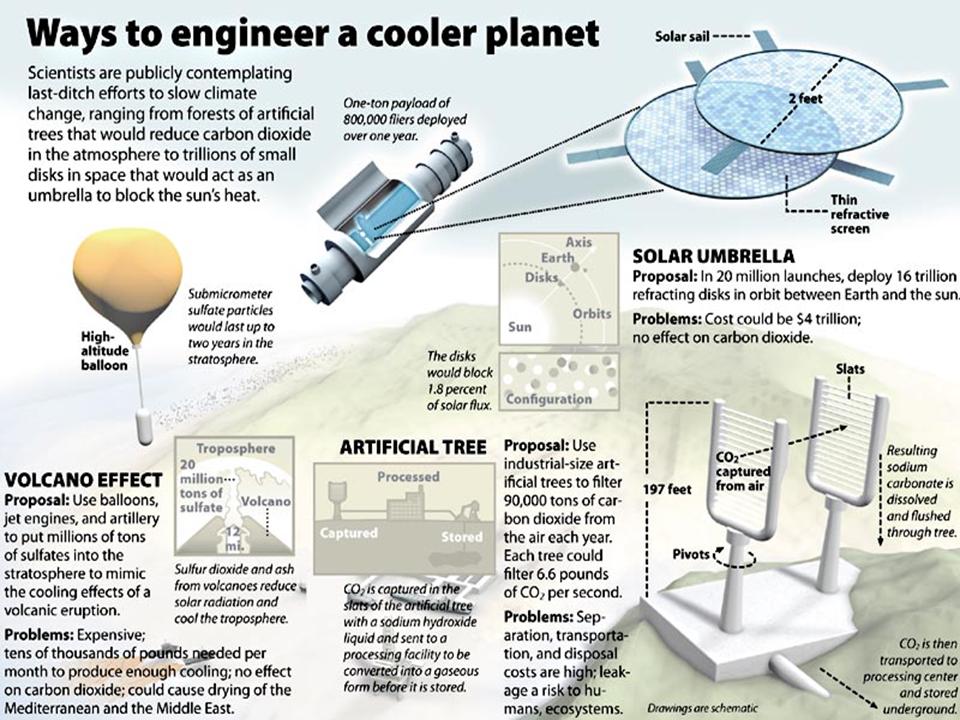
Delegates to the world summit on biodiversity here are calling for a moratorium on climate engineering research, like the idea of putting huge mirrors in outer space to reflect some of the sun’s heating rays away from the planet.

Climate engineering or geoengineering refers to any large-scale, human- made effort to manipulate the planet to adapt to climate change.

Representatives from Africa and Asia expressed concern about the negative impacts of geoengineering during the opening week of the 10th Conference of Parties (COP 10) to the United Nations Convention on Biological Diversity (CBD), Oct. 18-29. They were joined by civil society organisations in calling for a moratorium on geoengineering experiments.

The geoengineering proposals include installing giant vertical pipes in the ocean to bring cold water to the surface, pumping vast amounts of sulphates into the stratosphere to block sunlight, or blowing ocean salt spray into clouds to increase their reflectivity.

[Previously posted – Full Story here] 

Reducing Soot and Smog Would Help Stabilise Climate and Save Millions of Lives

Picture of smog in Cairo.
Image via Wikipedia

By Stephen Leahy

BONN, Jun 14, 2011 (IPS)

Clean the air, cool the planet and prevent millions of deaths with fast action on soot and smog, a new report urges.

Air pollutants like black carbon (soot) and ground-level ozone (smog) arise from incomplete combustion of fossil fuels and biomass like wood and charcoal.

Nations or regional blocks of nations could decide to put measures into place that quickly improve their air quality, reduce crop losses and shorten lives. And, almost as a side benefit, those efforts would do much to slow the rate of global warming, says the scientific assessment report released at the United Nations Framework Convention on Climate Change (UNFCCC) negotiating session here in Bonn.

Continue reading

On the Road to Green Energy for All

27 Jun 2011 09:33

By Stephen Leahy

VIENNA, Jun 27 (IPS)

Like our cave-dwelling ancestors of 200,000 years ago, nearly three billion people still use fire for cooking and heating. Of those, some 1.5 billion people have no access to electricity. For a billion more, their only access is to sporadic and unreliable electricity networks.Now an ambitious global effort is being launched by the United Nations to bring electricity to everyone on the planet by 2030.

“Energy is the issue for the next decade,” said Kandeh Yumkella, director-general of the United Nations Industrial Development Organization (UNIDO).

“Achieving the Millennium Development Goals (MDGs) is impossible without energy,” Yumkella said at the opening of the 2011 Vienna Energy Forum last week.

via On the Road to Green Energy for All – AlertNet.

Fossil Fuel Industry Kings of Corporate Welfare

This graphic from GOOD magazine shows who gets the bulk of the enormous US energy subsidies. Many subsidies are hidden and difficult to estimate and this attempt looks to be low according to the experts I’ve interviewed for various articles (cited below). The graphic also doesn’t include subsidies for nuclear which are equally enormous.  — Stephen

The enormous fossil fuel subsidies are rarely acknowledged when complaints are raised about costs of renewable energy. This report shown below says subsidies for fossil fuel are 12X that for green energy but this is a gross underestimate based on the experts I’ve interviewed in June for this article Free Ride for Oil and Coal Industry May Be Over.

Subsidies experts in Switzerland told me that “two-billion-dollars-a-day public subsidy for carbon-based fuels is a very conservative estimate..”

In reality big oil and coal get more like 20X the money green energy. So let’s do some real pricing: electricity from coal 5 cents kWh X 20 for subsidies (not to mention free use of the atmosphere /environment for its CO2, mercury etc waste products.) Corporate welfare at its best.

A few of the many articles I’ve written on the subject of energy subsidies:

Fossil Fuel Subsidies Are 12X (more like 20X) Support for Renewables, Study Shows

Every Day Governments Give an Estimated $2 billion to Oil, Coal & Gas Industry

Oil Companies and Special Interests Spend Half a Billion Dollars to Defeat US Clean Energy – Study

Nuclear Power Costs Skyrocket, Cost of Renewables Plummet

Is Rio Earth Summit 2.0 Doomed to Fail?

By Stephen Leahy

UXBRIDGE, Mar 7, 2011 (IPS)

Timed to coincide with the 20th anniversary of the 1992 Rio de Janeiro Earth Summit, the Rio 2012 Summit hopes to recapture the optimism of that earlier era.

At the June 2012 Rio Summit it is hoped countries will agree on policies to move toward a green economy from the present “brown” economic system driven by fossil fuel energy and the serial depletion and degradation of natural resources and ecosystems. A green economy promises to bring good jobs, clean energy and water while ensuring a more sustainable and fairer use of resources.

“If we continue on our current path, we will bequeath material and environmental poverty, not prosperity, to our children and grandchildren,” said Rio 2012 Secretary-General Sha Zukang.

“Rio 2012 will be one of the most important events in the coming decades,” Zukang said

Continue reading

April Heat Wave and Drought Breaks European Records

From the coldest December ever recorded to the warmest, driest April  Britain is just one of the countries being whipsawed by extreme weather. Normally wet Scotland is experiencing rare wildfires outbreaks this week. Europe’s wheat crop is at high risk due to very hot and dry temps.

My recent science articles explaining why weather extremes are becoming more common:

Why Our Weather is Weird ‘n Wild and Why It Is Getting Worse

The Yin and Yang of Climate Extremes We Will See More of

Will Year of Climate Extremes End Without Progress on Tackling Climate Change?