Who Owns the Arctic?

arctic-oil-rig-on-ice.pngWith Russia planting its flag 14,000 feet under the North Pole yesterday, oil and gas exploration and conflict over territorial rights in the vast Arctic ocean basin is just beginning.

“The Arctic is one of the last frontiers, representing about 25 percent of the last unexplored potential oil and gas reserves in the world,” says Michael Byers, Canada research chair in Global Politics and International Law at the University of British Columbia

Sovereignty Claims Revived in the Arctic
By Stephen Leahy

(Originally published in 2006)

TORONTO, Apr 22 (Tierramérica) – An expedition is under way to help Canada and Denmark prove their sovereignty over certain areas of this frozen region, and its potential sources of petroleum and natural gas.

Canada and Denmark launched a joint expedition in early April to map the floor of the Arctic Ocean and help the two countries prove their claims of sovereignty over areas potentially rich in petroleum and natural gas.

Continue reading

Drowning Country: Tuvalu Symbol of Catastrophe and Hope

Tiny Tuvalu Fights for Its Literal Survival
By Stephen Leahy


Credit:NASA

Funafuti atoll seen from 125 miles above the Eart

VIENNA, Jul 27 (IPS/IFEJ) – The second smallest nation on Earth hopes to turn itself into an example of sustainable development that others can emulate.

But the South Pacific island nation of Tuvalu and its 10,500 people may only have 50 years or less to set that example before it is swept away by rising sea levels due to climate change.

“Construction of the first ever biogas digestor on a coral island is complete,” said Gilliane Le Gallic, president of Alofa Tuvalu, a Paris-based group that is working with the local Tuvaluan government.

Located on a small islet near Tuvalu’s capital of Funafuti, the biogas digester uses manure from about 60 pigs to produce gas for cooking stoves. More importantly, more than 40 Tuvaluans have been trained at the newly opened Tuvalu National Training Centre on renewable energy.

“We are trying to create simple, workable models of sustainable development that can be reproduced by others elsewhere,” Le Gallic, a documentary filmmaker, told IPS from Paris.

Continue reading

Overweight? Hungry? Blame “Hollow Food”

New Studies Back Benefits of Organic Diet: Conventional agriculture produces “hollow food”, with low levels of nutrients and vitamins

wheat harvest sml

By Stephen Leahy

TORONTO, Canada, Mar 4, 2006 (Tierramérica)

(Originally published in 2006, two authoritative 2007 studies with similar findings are referenced at the end)

Organic foods protect children from the toxins in pesticides, while foods grown using modern, intensive agricultural techniques contain fewer nutrients and minerals than they did 60 years ago, according to two new scientific studies.

A U.S. research team from Emory University in Atlanta analysed urine samples from children ages three to 11 who ate only organic foods and found that they contained virtually no metabolites of two common pesticides, malathion and chlorpyrifos. However, once the children returned to eating conventionally grown foods, concentrations of these pesticide metabolites quickly climbed as high as 263 parts per billion, says the study published Feb. 21 (2006).

Organic crops are grown without the chemical pesticides and fertilisers that are common in intensive agriculture.There was a “dramatic and immediate protective effect” against the pesticides while consuming organically grown foods, said Chensheng Lu, an assistant professor at the Rollins School of Public Health at Emory University.

These findings, in addition to the results of another study published in Britain earlier this month, have fueled the debate about the benefits of organically grown food as compared to conventional, mass-produced foods, involving academics, food and agro-industry executives and activists in the global arena.

Continue reading

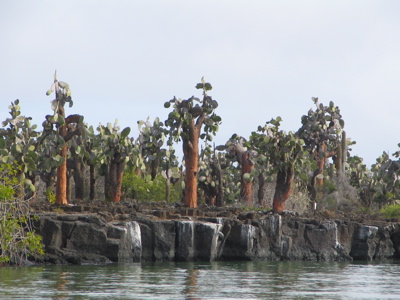
Carbon Project Endangers the Galápagos

img_0235.jpg


By Stephen Leahy

A company is preparing to enrich seawater with iron in order to promote phytoplankton growth and the absorption of carbon from the atmosphere near the environmentally-protected Galápagos Islands.

PUERTO AYORA, Galápagos, Ecuador, Jul 9 ’07 (Tierramérica).- Later this month a U.S. company, Planktos Inc., plans to dump 100 tons of iron dust into the ocean near Ecuador’s Galápagos Islands, despite opposition from environmental groups and marine scientists.This will be the first-ever commercial effort to reduce carbon dioxide in the atmosphere, one of the main gases blamed for climate change, by using iron particles to create a 10,000-square-kilometer “plankton bloom”.

Planktos says the extra volume of these small, floating organisms will absorb large amounts of CO2 from the atmosphere and take it deep into the sea. And this method may be the fastest and most powerful tool to battle climate change.

img_0508.jpg

“The currents will likely bring the bloom into the [Galápagos] Marine Reserve,” covering 133,000 sq. km, the world’s third largest marine reserve, says Washington Tapia, director of the Galápagos National Park, which includes the reserve. Continue reading

Greenest Ethanol Still Unproven

Sugarcane field Queensland Australia Copyright Renate Leahy 2004Cellulosic Ethanol – Clean but Worth Unproven
By Stephen Leahy

Jun 30 (IPS) – With biofuels being blamed for rising food prices and offering limited environmental benefits, diverse luminaries like former U.S. vice-president Al Gore and Microsoft’s Bill Gates are throwing their considerable support behind cellulosic ethanol, a second generation biofuel.

copyright Pembina InstituteThe big benefit cellulosic ethanol has is that virtually any plant material — left-over corn stalks, sawdust, wood chips, native perennials grown on marginal lands — could be turned into ‘green gold’, a low-emission fuel for the transportation sector.

“Cellulosic ethanol would reduce carbon emissions 88 percent over gasoline,” says Bruce Dale, a chemical engineer at the Biomass Conversion Research Laboratory at Michigan State University.
Continue reading

Travel and Writer’s Block

shodou-calligraphy.gifHola from Quito, Ecuador.

It’s difficult to do research and write articles while traveling and holidaying (not to mention the challenge of finding a good internet connection). And it is a challenge to write articles while sitting on a bed or at a cafe where kids are trying sell you scarfs, hats and Ts in rapid Spanish where my comprehension is near zero.

This is why no new stories have been posted recently although I am working on several presently. Difficult to predict when they’ll be done since we are moving around quite a bit — tomorrow we move on to the Galapagos Islands. Tough I know but someone’s got to do it.

Adios.

Synthetic Lifeforms by Microbesoft

picture-6.pngGenome Guru Seeks Patent on Synthetic Life Form
 

By Stephen Leahy

Jun 11 (IPS) – Patent applications for the world’s first-ever human-made species have been made to patent offices around the world.

The Venter Institute, named for its founder and CEO, J. Craig Venter, has applied for a patent on a novel bacterium made entirely from synthetic DNA in the laboratory, according to a civil society organisation concerned that this new technology is outpacing ethics and safety protocols. Applications have reportedly been made to more than 100 patent offices over the past few months for the synthetic bacterium called “Mycoplasma laboratorium”. “In the tradition of ‘Dolly,’ (the first cloned animal) we have nicknamed this synthetic organism ‘Synthia'”, said Jim Thomas of ETC Group, a Canada-based organisation that recently won a 13-year legal battle against Monsanto’s species-wide soybean patent.

“These monopoly claims signal the start of a high-stakes commercial race to synthesise and privatise synthetic life forms,” Thomas told IPS. “Will Venter’s company become the ‘Microbesoft’ of synthetic biology?”

Continue reading

Coke Spraying with Roundup Damages DNA in Ecuador/Colombia

New Studies Reveal DNA Damage from Anti-Coca Herbicide
42_330_x62_538622.jpgBy Stephen Leahy

Scientific studies have collected evidence of the negative effects of the glyphosate-based herbicide Roundup on human and animal health. The chemical is used in aerial spraying to eliminate illicit coca crops in Colombia.

TORONTO, Jun 11 (Tierramérica).- U.S.-funded aerial spraying of suspected coca plantations in Colombia near the Ecuador border has severely damaged the DNA of local residents, a new study has found.

Blood samples from 24 Ecuadorians living within three kilometers of the northern border had 600 to 800 percent more damage to their chromosomes than people living 80 km away, found scientists from the Pontificia Catholic University in Quito, Ecuador.

The border residents who were tested had been exposed to the common herbicide glyphosate — sold by the U.S. agribusiness giant Monsanto under the brand Roundup –during a series of aerial sprayings by the Colombian government begun in 2000, part of the anti-drugs and counterinsurgency Plan Colombia, financed by Washington.

The Ecuadorians suffered a variety of ailments immediately following the spraying, including intestinal pain and vomiting, diarrhea, headaches, dizziness, numbness, burning of eyes or skin, blurred vision, difficulty in breathing and rashes, says the study, which is to be published in the journal Genetics and Molecular Biology.

But the extensive damage to DNA (deoxyribonucleic acid) found in the randomly selected individuals may activate the development of cancer or other developmental effects resulting in miscarriages, according to lead researcher César Paz y Miño, head of human molecular genetics at the Catholic University of Ecuador. Continue reading

The Earth is Going Dark Scientists Say

From Big Melt to Big Swamp
By Stephen Leahy


Credit:Mette M.

Spitsbergen glacier in Norway, Arctic Ocean

Jun 5 (IPS) – The Earth is going dark. From the Arctic Ocean to the Himalayan mountains to the Russian tundra, ice and snow are in rapid and permanent retreat in response to global warming, a new U.N. report said Tuesday.

Glaciers, ice sheets, sea and river ice are all melting. The areas in the northern hemisphere covered by snow and ice have declined 1.3 percent per decade for the past four decades. And that’s expected to accelerate dramatically in the coming years.

“Around the Earth, white is being replaced by dark,” said Gunnar Sander of the Norwegian Polar Institute in Tromso, Norway.

The white — snow and ice — reflect sunlight while the dark — bare ground and open water — absorb the heat from sunlight, increasing the pace of global warming.

“This is affecting the heat balance of the planet,” Sander told IPS.

Continue reading

How to Kick-Start the 21st Century Eco-Economy

restore-cover-wri-sml.jpg Toward a Green Economy
By Stephen Leahy*


May 31 (IPS) – Humanity is facing historic and truly unprecedented challenges from climate change and the rapid decline of ecosystems that sustain life.

This article is final part of a three-part series published by IPS on natural capital and how future global prosperity and equity can be achieved through the preservation of ecosystems. See Part One: Like Enron, Earth Inc. Sliding Into Bankruptcy and Part Two: Global Warming is Real But I didn’t Do It 

The 2005 Millennium Ecosystem Assessment (MA) found that 83 percent of the planet’s natural systems are in serious decline or on the brink. Adding to this already dire situation are the twin pressures of population growth and increasingly consumptive lifestyles.

Global population is expected to soar from today’s 6.6 billion to 9 billion by 2050. Even though we crossed the point of sustainable use of natural resources in the mid-1980s, many of the 2.4 billion people living in China and India are striving mightily right now to approach the materialistic lifestyle of the average North American.

So how can we find our way around the global calamity the human race seems to be hurtling towards?

“Humanity needs a fundamentally new approach to managing the assets upon which we all depend,” said Janet Ranganathan, director of the People and Ecosystems programme at the World Resources Institute, an environmental group based in Washington.

“We need new ways of making decisions at all levels that fully value ecosystems and the services they provide us,” she said.

Continue reading